The Utah Cutthroat Slam: All Four Subspecies and How to Catch Them
 Cameron Spanos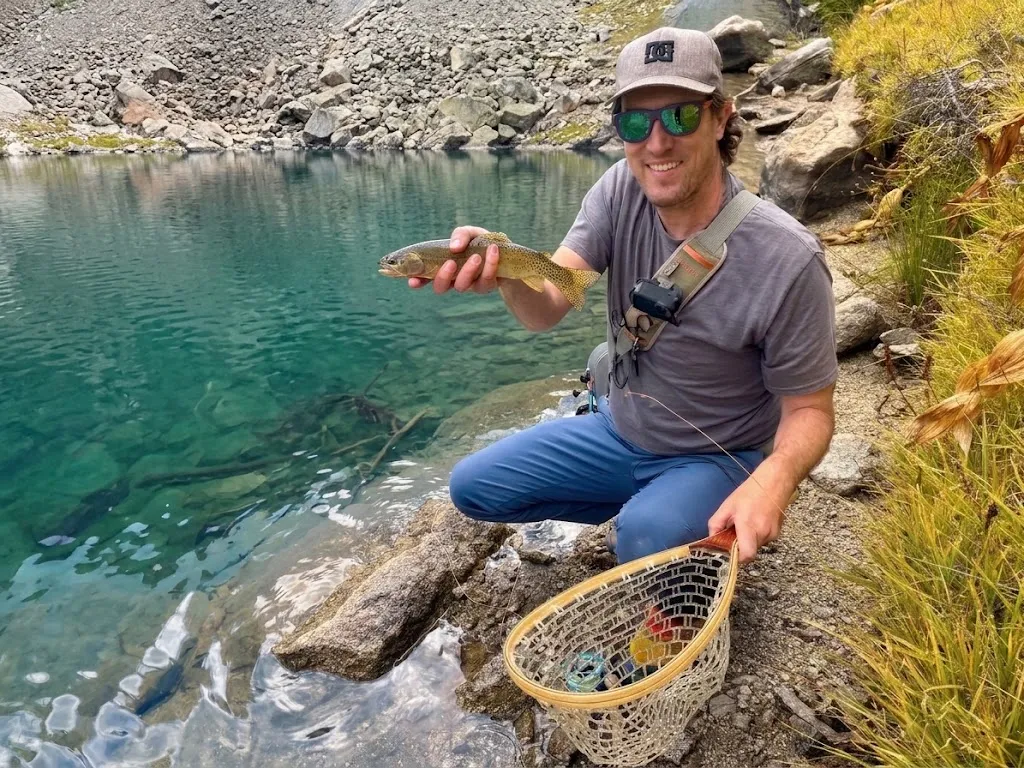
Written by Cameron Spanos
Twenty dollars buys you a lifetime. That's the whole pitch of the Utah Cutthroat Slam: a one-time $20 registration ($10 if you're under 18) that never expires, with $19 of every adult entry going straight into native trout habitat work. Catch one Bonneville, one Bear River, one Colorado River and one Yellowstone cutthroat in its native drainage. Photograph each fish, release it, submit the four photos. Utah DWR sends back a certificate and a medallion.
Most people who register never finish. The program's own running totals put registrations at 5,885 against 2,110 completions, which tells you the hard part isn't the fishing.
It's the geography. Three of the four are fish you'll bump into on any normal Utah summer, sometimes without trying. The fourth lives in a corner of the state almost nobody drives to on purpose, and that's where the slam quietly stalls out for most of the thousands who register.
If you'd rather watch than read, start here.
What the Utah Cutthroat Slam actually is
Utah DWR launched it with Utah Trout Unlimited in 2016. It isn't a tournament and there's no leaderboard. It's a self-reported checklist with a conservation fee bolted onto the front, and the fee is the point: the program's own running totals put more than $130,000 into cutthroat restoration and outreach in its first decade.
The mechanics are short:
- Register online through the DWR's license system or at any Utah license retailer. Registration is separate from your fishing license and doesn't replace one.
- Catch one of each subspecies inside that subspecies' native range. A hatchery Bonneville dumped outside the Bonneville Basin doesn't count.
- Photograph each fish. Lifting it briefly from the water for the shot is allowed.
- Release it, then submit all four photos through the DWR's Cutthroat Slam completion form.
There's no deadline. Registration never expires, so a slam started in June and finished four summers later counts the same as one knocked out in a weekend. Fees and rules do get revised, so check the program site before you pay rather than trusting a number in a blog post, including this one.
The four subspecies, and where each one lives
Native range decides everything. Utah's cutthroat are split by ancient drainage boundaries, not county lines, so the fish you need depends on which way the water runs.
| Subspecies | Native range in Utah | Where anglers target it | Field marks |
|---|---|---|---|
| Bonneville | Bonneville Basin drainages except the Bear: Weber, Ogden, Provo, Spanish Fork, Jordan, Sevier, plus the Deep Creek Mountains | Wasatch canyon streams, Wasatch and central Utah high lakes, southern plateau reservoirs stocked with pure BCT | The plain one. Greenish-yellow to silvery-gray, black spots spread evenly down the flank instead of piling up near the tail |
| Bear River | The Bear River and its tributaries, including Bear Lake, plus parts of the Weber and Ogden systems | Logan Canyon and the Blacksmith Fork in Cache County, the upper Bear near the Wyoming line, Bear Lake | Very close to a Bonneville. Same basin, separate evolutionary path. ID leans on where you caught it |
| Colorado River | Streams flowing to the Green and Colorado: both slopes of the Uintas, the Tavaputs Plateau, southeastern Utah, the southern plateaus | Uinta high lakes and outlet creeks, Boulder Mountain, the Strawberry River drainage | The showy one. Brassy-green back, yellow-gold flanks, orange belly, medium to large spots crowded toward the tail |
| Yellowstone | The Snake River drainage. In Utah, the Raft River drainage in the far northwest corner of Box Elder County, and nowhere else | Small creeks in the Raft River Mountains | Drab yellowish-brown to coppery, paler at the belly, larger black spots bunched near the tail |
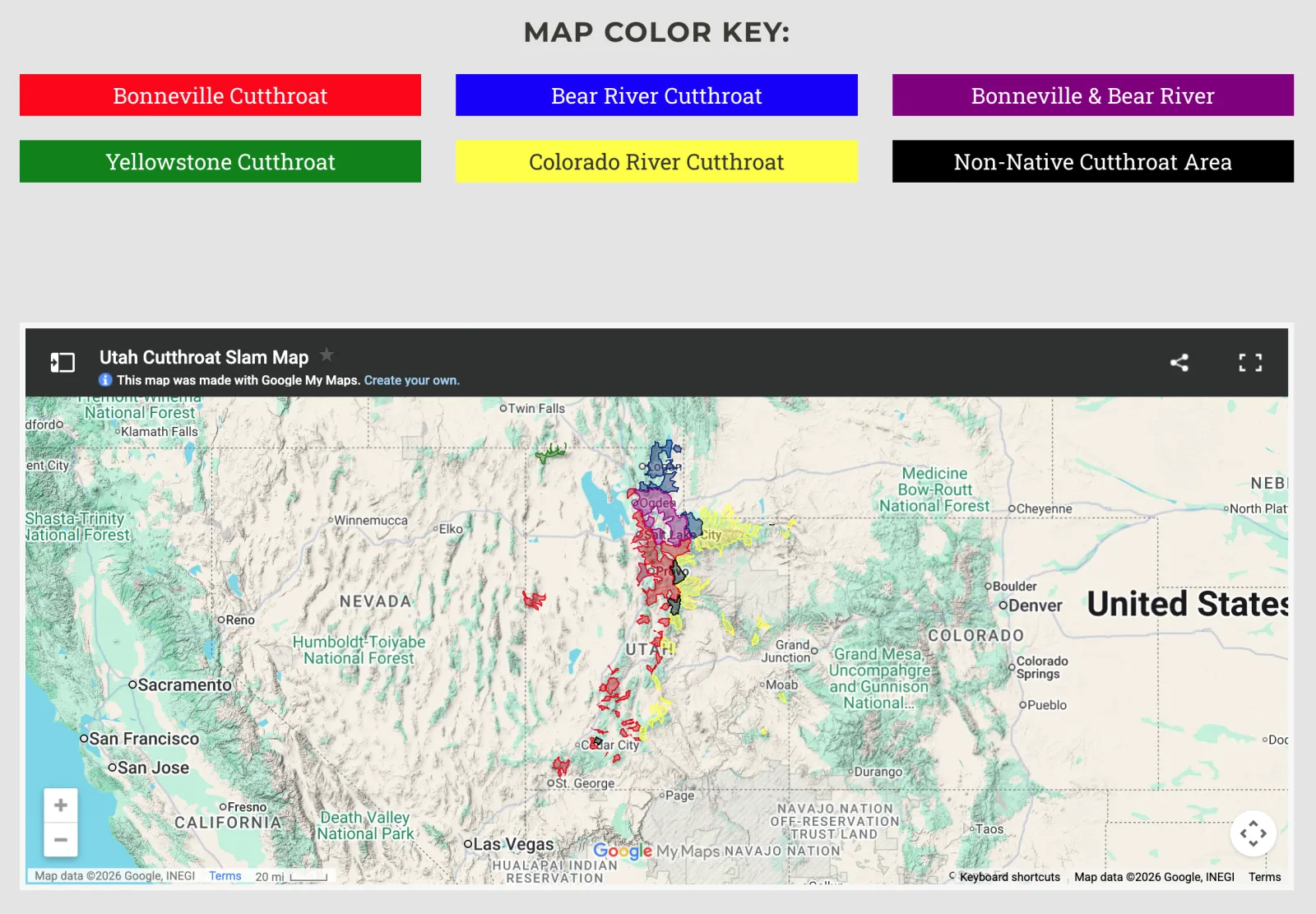
One overlap matters before you go. The Weber and Ogden systems sit in both the Bonneville and Bear River rows, and that's deliberate: the program lets a cutthroat from the Weber or Ogden drainage count toward either subspecies. Either, not both. One fish satisfies one leg, so if you claim your Weber fish as a Bear River, you still owe a Bonneville from somewhere else.
Look at that Yellowstone row again. One drainage, one corner of one county, four hours from Salt Lake with the last stretch on dirt. That's the whole reason completion rates sit where they do.
So knock it out first. Not last. Everybody builds a slam around the convenient fish, then spends three summers hunting for a free weekend to drive nine hours round trip to a creek they can jump across. Do the Raft River leg in your first season and the other three fall into place on trips you were taking anyway.
How do you tell the four cutthroat apart?
Mostly, you don't. Not by eye.
Spotting and coloration give you a decent guess, and the table above is that guess. A Colorado River fish out of a Uinta lake is genuinely unmistakable once you've held one, all orange and brass. But Bonneville and Bear River cutthroat share a basin and a lot of DNA, and even biologists lean on genetics rather than photographs for the hard calls.
Which is why the program is built on location instead of identification. Catch a cutthroat in the Bear River drainage and it's a Bear River cutthroat. Catch one in a stream running toward the Green and it's Colorado River. Knowing which watershed you're standing in is a map question, not a fish question.
One caveat: hybrids. Rainbow-cutthroat crosses are common where both live, and a fish with a faded slash and fine spotting over its whole body probably isn't a pure anything. Fish the headwaters and the higher lakes where rainbows were never stocked and that mostly goes away.
You might also enjoy: Kenai River Bead Fishing: The Rig, the Regs, and the Runs
Picking your water without anybody handing you a pin
You'll find plenty of lists naming specific alpine lakes. Ignore them. Named lakes get hammered, and half the reason a high lake fishes well is that nobody bothered walking to it. Picking your own keeps working after every list on the internet goes stale.
Start with the DWR's own fish stocking database. Searchable by water and species, it tells you what went in and when, and it's the most underused public resource in Utah fishing. Filter for cutthroat, read the high-elevation entries, and you're working from the state's actual management plan instead of somebody's roundup. According to the DWR's High Uintas lakes reports, roughly 446 Uinta lakes sit on a stocking cycle and about 153 are managed primarily for cutthroat, so there's far more water than there are lists. Many get stocked by air, which the DWR documents on its aerial stocking page.
Then judge each candidate on four things before you commit a hike to it:
- Depth. Shallow high lakes winterkill. A lake on a short, repeating stocking cycle often doesn't hold fish over. One stocked every three or four years is usually the deeper, more stable water.
- Inlet and outlet. On satellite imagery, look for a live inlet stream. Lakes with water moving through hold more food, stay cooler, and give cutthroat somewhere to spawn.
- Elevation and aspect. A north-facing basin at 11,000 feet might still have ice in early July. A south-facing shelf at 9,500 is fishable weeks earlier.
- The last half mile. Read the topo, not the mileage. Two miles with 1,400 feet of gain in the final stretch filters out more anglers than six flat miles does.
Do the desk work at home. Overlay stocking records on a topo, drop a few pins, pick the one that looks least convenient. Then write down what you find, because four scattered summers of scouting only turn into a pattern if you kept notes. Our demo dashboard shows what three years of logged trips looks like.
When does a Utah alpine lake actually fish?
Shorter than people expect. Ice-off in Utah's high country generally runs from late June into mid-July depending on elevation, aspect and how the winter went, and it shuts down when snow returns in October. Call it a hundred days, and the good part is narrower.
Ice-off through early July. Fish are shallow, hungry, and stacked near the inlet where the first warm water and food arrive. Least technical fishing of the year. A chironomid under an indicator in four to eight feet, fished dead slow, catches trout that haven't seen a fly since September.
Mid-July through August. Prime. Damsel nymphs migrating toward shore, callibaetis coming off midmorning, and by August the terrestrials take over completely. Alpine lake fly fishing in Utah is at its most forgiving here, and a dry fly is the most effective thing you can tie on rather than just the most fun. The callibaetis and damselfly patterns that work on western reservoirs translate straight up the mountain, just smaller.
September into early October. Fewer bugs, fewer people, cutthroat feeding hard ahead of ice. The bite often doesn't switch on until the sun's been on the water an hour or two.
Plan around the afternoon monsoon instead of fleeing it. Storm runoff pushes food down the feeder streams and cutthroat stack at inlet mouths to intercept it, so fish the hour after a cell passes. Just be off the ridge and out of the water when it's overhead. Above treeline there's nowhere to hide from lightning.
Reading a mountain lake before you string up
Walk the shoreline first. Put the rod down and walk.
Alpine cutthroat cruise. They aren't holding in lies the way a stream trout does, they're patrolling a circuit along the drop-off, and five minutes from a high rock tells you where that circuit runs. Polarized glasses aren't optional. Find the lane and you're casting at fish instead of at water.
Reliable cruiser water: the inlet mouth and the shelf outside it, the outlet, the outer edge of any weed bed, sunken timber, and the shaded band where a talus slope drops into deep water. Skip the featureless flats unless you can see fish on them.
Then lead the fish. Cutthroat moving at a steady clip want the fly three to six feet ahead and roughly on their line of travel, not dropped on their head. A fly landing behind a moving fish is one that fish never sees. That's the biggest split between anglers who catch alpine cutthroat and anglers who watch them swim past all day, and about twenty minutes of practice fixes it. Stay low, because a silhouette on a bare bank shuts down a whole shoreline in water this clear.
Flies that earn their space in a hike-in box
A take that'll annoy the stillwater specialists: for alpine cutthroat, most of a full lake box is dead weight you carried uphill. The growing season is brutally short and the fish can't afford to be picky. Position beats pattern by a wide margin up there. What earns the space:
You might also enjoy: Fly Fishing Gifts Under $50: 11 Amazon Picks Sorted by Job
- A Parachute Adams, 14 to 18. If you carried one fly above 10,000 feet, this is it. It reads as a callibaetis, a midge cluster, or nothing in particular, and cutthroat eat it either way.
- Terrestrials. From late July on, ants and beetles blown off the ridges are a huge part of the diet. A size 16 black foam ant catches fish that ignore everything else (rigging here).
- A bead-head dropper. Hare's Ear or Pheasant Tail, 14 to 18, hung 18 to 24 inches under the dry. The dry-dropper setup doubles your odds without doubling your fly count.
- Chironomids and a small indicator for ice-off and for any day the surface is dead.
- One dark leech or small Woolly Bugger, size 10, olive or black, on a painfully slow retrieve. Your answer when the lake looks empty.
Add a damsel nymph in July and that's the whole box. It fits in a shirt pocket.
Leader matters more than fly choice does. Nine feet and 5X for dries in flat water, 4X with a chop or a dropper. On glass, adding two feet of tippet is the most effective change available and it costs nothing. A 4 or 5 weight around 9 feet handles wind better than the 3 weight you'd want on the creek below, though a tenkara rod is a good call when you're counting ounces.
Bonneville cutthroat fly fishing is the easiest leg
If you live on the Wasatch Front, the Bonneville is the fish you can knock out on a Tuesday evening. Bonneville cutthroat fly fishing puts you on a fish whose range covers an enormous slice of the state, since the Provo, Weber, Ogden, Spanish Fork, Jordan and Sevier systems all drain into the Bonneville Basin, and the DWR has spent decades restoring pure populations across that range.
Canyon streams are the fastest route. Small freestone water in the Wasatch holds Bonnevilles that rise to a dry with the reckless enthusiasm cutthroat are known for, and a fish taken on a size 14 attractor in eight inches of pocket water counts the same as a twenty-incher. The second route is southern Utah, where the DWR stocks pure Bonnevilles into several high reservoirs on the plateaus and those fish grow considerably bigger.
Range that wide is the argument for spending your easy leg close to home and saving the trip-planning for the other three.
Handling native fish so they actually swim off
These are native fish, several populations are conservation-sensitive, and the whole program runs on catch and release. The photo requirement makes handling a bigger deal here than in most fishing, because everybody is lifting a fish out of the water whether they normally would or not.
Wet your hands. Keep the fish in the net and in the water while you get the camera ready, lift for the shot, put it back. Ten seconds is plenty. Pinch your barbs before you start, and cut the tippet on a deeply hooked fish instead of digging.
Water temperature deserves more attention than it gets. Alpine water stays cold, which is part of why this fishing is forgiving, but the lower canyon streams where you'll chase your Bonneville can run genuinely warm by a late-July afternoon. The rules for releasing fish in summer heat apply hard down there: fish early, carry a thermometer, go home when the water hits the mid-60s. A slam photo isn't worth a dead native trout.
How do you log a catch and claim the medallion?
Photograph each fish at the water, then submit all four together through the DWR's completion form once you have the set. You don't report them one at a time as you go, so keep your own records straight: note the water, the date and the drainage with each photo. A phone gallery of four trout pictures with no notes attached is an annoying puzzle to solve two years later.
Completion gets you a certificate and a commemorative medallion. Several designs have been released over the years, each featuring a different subspecies, and finishers have been able to pick which one they receive. Options change as new ones are added, so check the current offering rather than counting on a specific design.
A two-season plan that finishes
The sequence that gets people across the line instead of stuck at three out of four:
- Register in spring and book the Raft River trip first. Pick a weekend in June or early July, drive to Box Elder County, and get the Yellowstone while the creeks still carry decent flow.
- Take the Bonneville on a weeknight. Any Wasatch canyon stream or a southern plateau reservoir. This is the leg you can pull off on two hours' notice, so use it to fill a gap rather than building a trip around it.
- Pair the Bear River fish with a Logan Canyon weekend. The Logan River drainage runs Bear River cutthroat, and to my eye the tight tree cover over the creek is more of a casting problem than a fishing problem. Plan a full day, because the access is the slow part (the walk-and-wade breakdown of Logan Canyon has the parking and pullouts).
- Save the Colorado River fish for an August alpine overnight. Uinta high lakes are the obvious answer, with the Strawberry River drainage as the roadside alternative. Pick a lake off the stocking records using the criteria above, hike in, fish the evening and the next morning. It's the leg worth building a real trip around, and the prettiest of the four.
- Submit the set. Four photos, one form, done.
Two summers is a comfortable pace. One aggressive summer works from the Wasatch Front if you don't mind long drives, and there are anglers who've taken all four in a single day, which is an impressive logistics exercise and a mediocre way to fish.
The real reason to do it is that it drags you out of your rotation. Four subspecies, four drainages, four corners of a state most anglers experience through three or four familiar rivers. You'll end up standing in water you'd never have picked on your own. Track what you find, because a slam takes years and memory doesn't. Bushwhack exists for that kind of long-running project.
Get fishing tips in your inbox
New guides, seasonal tactics, and gear picks — about once a month, no spam.