Kenai River Bead Fishing: The Rig, the Regs, and the Runs
 Cameron Spanos
Written by Cameron Spanos
The Kenai isn't a trout river that happens to have salmon in it. It's a salmon river that happens to grow the biggest rainbows most of us will ever get a hand on, and that ordering matters, because it decides what you tie on. Kenai River bead fishing works for one reason: from midsummer into late fall, an enormous share of the available calories in that water are salmon eggs, and the trout have arranged their entire year around eating them.
So the bead isn't a gimmick. It's the most accurate imitation available of the most important food item in the system.
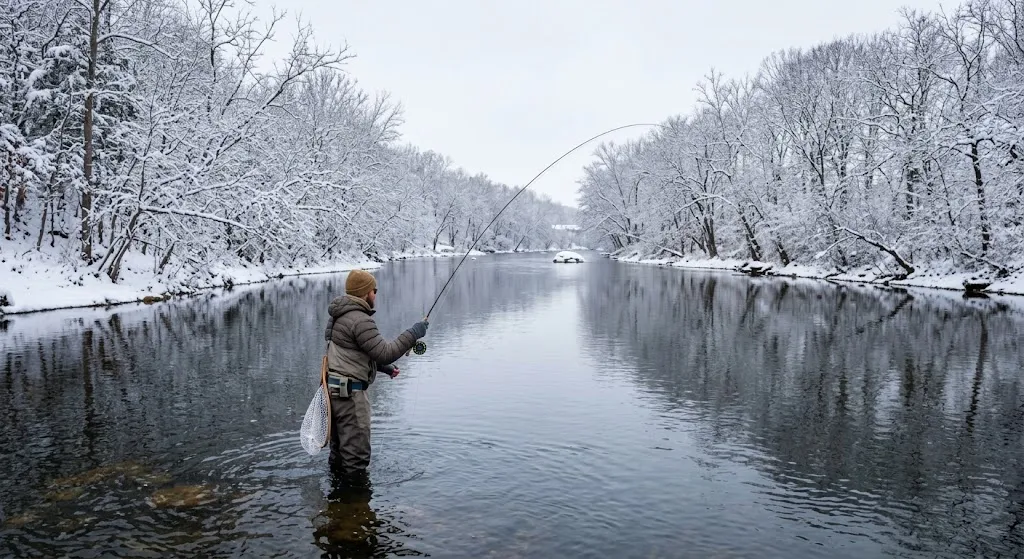
I filmed a few days out there and put it below. It isn't a tutorial. What it does show is the water this post is about: big, cold, glacier-green, with the kind of seams and drop-offs the rest of this post is describing.
The salmon runs are the whole reason the trout are worth chasing
Every good Kenai trout day happens downstream of a salmon. The fish you want are following gravel-bar spawners, picking off what washes out of the redds, then eating the dead ones once the spawn collapses. Learn the run timing and you've learned where the trout will be standing.
Here's the general shape of the season. Treat it as a planning tool, not gospel: run timing shifts year to year, and Alaska manages these fisheries with in-season emergency orders, so check the current ADF&G Southcentral regulations before building a trip around any row below.
| Species | Typical window | What it means for you |
|---|---|---|
| King (Chinook), early run | Mid-May to late June | Heavily restricted in recent years. Check emergency orders first. |
| King (Chinook), late run | July into mid-August | Biggest eggs in the river once they spawn. 10mm territory. |
| Sockeye (red), early run | June, mostly Russian River | First real crowd of the season, and the first eggs. |
| Sockeye (red), late run | Mid-July to early August | The big one. Combat fishing, and the engine of the fall trout bite. |
| Pink (humpy) | Late July to mid-August, even years | 2026 is an even year. Absurd numbers of fish, 8mm eggs. |
| Chum (dog) | Mid-July to mid-August | Fewer here than in other Alaska systems. Big eggs when they show. |
| Coho (silver) | Late July through October, in waves | The second push overlaps peak trout season. Bring an 8-weight. |
| Rainbow trout | Opens June 11, peaks September and October | Upper river and its tributaries close May 2 to June 10 for the trout spawn. |
| Dolly Varden | Moving from May, best late summer and fall | Same drift, same bead, often more willing than the rainbows. |
Kings and chums: the big eggs
Kings are the species you cannot assume anything about. ADF&G has closed or sharply restricted Kenai king fishing in multiple recent seasons, 2026 included, so read the current rules rather than a blog post from three years ago. For the bead angler, kings and chums matter mostly after the fact: their eggs are the largest in the system.
Sockeye: the species that builds the fishery
Sockeye are why the Kenai's rainbows are shaped like footballs. Their eggs are the smallest and reddest of the five. The early June push into the Russian River gets the headlines, but the late July run is the volume event, and the spawning that follows it through August and September is what puts trout on the feed.
Fish behind them, not on them. A trout holding eight feet below a working pair of sockeye is eating. A trout sitting in the redd itself is usually a fish you're about to foul-hook.
Pinks and silvers
Pinks only run in force on even years. They spawn lower and thicker than anything else, and when they die off they turn the lower river into a flesh buffet.
Silvers are the species most likely to interrupt your trout day, and I mean that as a compliment. If they're in, fish the 8-weight and stop pretending you're only trout fishing.
The rainbows themselves
These are wild fish with a serious research record behind them. ADF&G's work on the system has found spawning densities around the middle river reaching roughly 1,000 fish per mile, and angler surveys from 2012 through 2016 produced an average annual catch near 178,000 rainbow trout against a harvest of about 2,000, per ADF&G's own account of the Kenai rainbow fishery. That's a release rate north of 98 percent, and it's the reason a 28-inch trout is a realistic goal rather than a fantasy.
The flip side is that this fishery survives on handling discipline. Barbless hooks, a rubber net, the fish's head in the water, and no grip-and-grin on a 30-incher that took four minutes to land.
Dolly Varden
Char, not trout, and criminally underrated. Dollies start moving in May and hold through fall in the same egg lanes as the rainbows. They'll eat a bead a trout refuses, and in dirty water they're often the only thing willing to play. Nobody books a Kenai trip for Dolly Varden. Plenty of people go home having caught more of them than anything else.
What about steelhead?
The Kenai proper is not a steelhead river. That fishery lives on the lower peninsula's roadside streams, most famously the Anchor River, with Deep Creek and the Ninilchik holding much smaller runs. ADF&G describes the Anchor's fall in-migration starting in early August and peaking mid to late September. Catch and release only, and those fish may not be removed from the water at all. Budget a separate day and a drive south.
You might also enjoy: Egg Patterns for the Brown Trout Spawn: Fish Behind the Redds, Not On Them
Why does a bead beat a tied egg pattern on this river?
Because a real salmon egg is a hard, translucent, almost perfectly spherical thing that sinks at a specific rate, and a plastic bead is the only item in a fly box that does all of that at once. Yarn eggs go soft. Glo-bugs ride too high and look right for about one drift. A bead tumbles the way the real thing does.
The second reason gets undersold: the bead separates the attractor from the hook. A trout inhales it, feels plastic, spits. With the hook pegged an inch and a half below, that spit happens right as the hook reaches the corner of the jaw. Clean hookset in the hinge instead of a barb in the roof of a fish you want to release.
Under Alaska rules, this matters legally as well as ethically. ADF&G treats a bead that isn't attached to the hook as an attractor, not a fly, which is why it's legal in water restricted to artificial lures or flies.
Sizing and coloring the bead to what's actually in the drift
Size first, color second. Size is the part people get wrong.
Match the bead to whichever salmon is spawning above you. Sockeye eggs sit around 6mm. Pink and coho eggs run closer to 8mm. Chum and king eggs are the giants at roughly 10mm. Those numbers show up consistently across Alaska bead guides and ADF&G's own bead primer. A mixed pro pack like BnR Tackle Soft Beads covers the 8mm and 10mm range in one box, which is the cheapest way to stop guessing. In high, fast, or heavily glacial water, bump up a size: visibility beats realism the moment the river goes off-color.
Color tracks egg maturity, and this is where the season tells you what to do:
- Fresh from the fish. Bright orange, sometimes with an oily sheen. This is what's drifting when salmon are actively spawning right above you. Early in a given species' spawn, fish it bright.
- Water-hardened and wandering. After an egg has been loose in the current for a while it goes mottled, softening into light pink, peach, apricot. This is the workhorse category and it's what most eggs in the drift look like on most days.
- Dead. Opaque, solid, dull. Think dirty cream, chalky white, washed-out brown-red. Late in a run, and after the first hard cold snap, the drift is full of these and a bright orange bead starts looking like a lie.
Here's my actual opinion after watching how people pack for this river: most anglers carry forty colors and three sizes when they should carry four colors and three sizes. The color spectrum is a comfort blanket. The thing that genuinely changes your day is how much weight is above the bead, followed by size, and only then the exact shade of peach.
I'd also push back on chartreuse. It's on every Kenai bead list and it imitates no egg that has ever existed. It's an attractor, it works in chocolate water, but on a clear September afternoon a dead-white 8mm is usually the better answer.
How far from the hook can you legally peg a bead in Alaska?
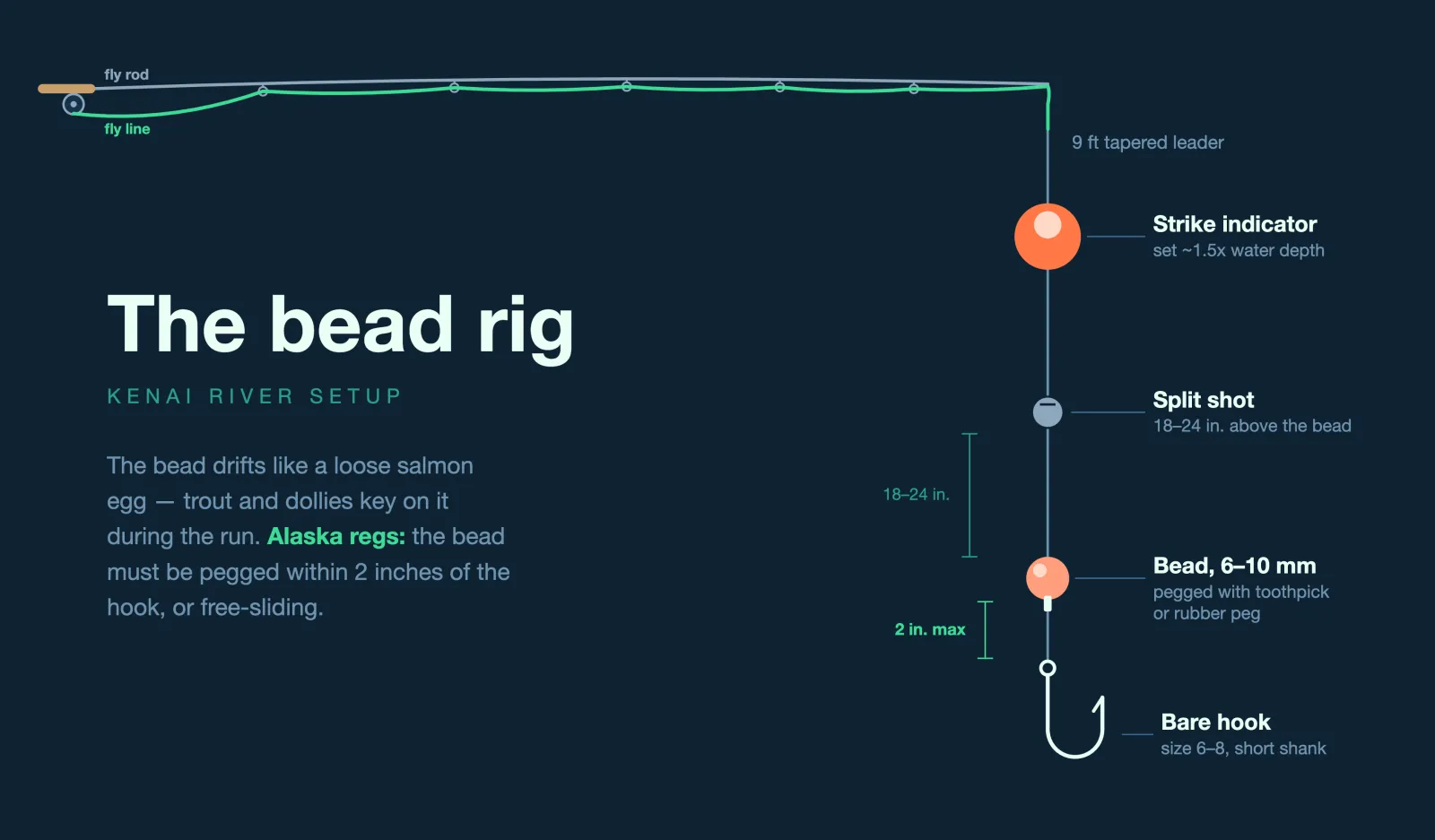
Two inches, or free-sliding. Those are the two legal states. Under Alaska's sport fishing gear regulations (5 AAC 75.020), a bead used as an attractor must either be fixed within two inches of the hook, fly, or lure, or run completely free on the line or leader. There is no middle ground. A bead pegged six inches up is not a legal rig, and that's true regardless of how you feel about it.
The reason is purely mechanical. The farther the bead rides above the hook, the farther the hook sits outside the fish's mouth when it eats. Push that distance out and you stop hooking fish and start lining them, which is snagging with extra steps. Keep it at an inch and a half to two and the geometry does what you want: eat, turn, hook finds the corner.
Two more Kenai-specific rules are worth knowing before you go, and both of them change what you can even tie on:
- Much of the upper river is restricted to one unbaited, single-hook artificial lure or fly, with some sections specifying a gap of 3/8 inch or less between point and shank. That drives your hook choice, not your preference.
- The upper Kenai and its tributaries between Skilak and Kenai lakes close to all fishing from May 2 through June 10 to protect spawning rainbows, reopening June 11. Lower-river tributaries carry their own separate seasons. Fly-fishing-only water, including the Russian River area, carries its own restrictions on beads that aren't attached to the fly.
I'm giving those in general terms on purpose. Section boundaries, hook gaps, and closures get revised. Pull the current ADF&G Kenai River regulations booklet and read the section you'll actually be standing in. Screenshot it, because cell service in the canyon is a rumor.
A Kenai River bead fishing rig, top to bottom
Nothing exotic here, which is part of the appeal.
Rod and line. A 7-weight with a floating line is the honest all-around answer. Drop to a 6 if you're strictly trout fishing and the silvers haven't shown; go 8 if they have. The extra weight isn't about the trout, it's about throwing an indicator, split shot, and a bead into Kenai wind without wearing the rig in your ear.
You might also enjoy: October Caddis Hatch Guide: The Last Big Dry Fly of the Season
Leader. Nine to twelve feet, ending in 10 to 12 lb fluorocarbon — Seaguar Blue Label is the default for a reason. Heavy for trout, right up until a 29-inch rainbow turns downstream in that current. Depth is set by moving the indicator, so leave room to run it long.
Weight. Split shot twelve to eighteen inches above the bead. Carry more sizes than you think you need. This is the single biggest lever on the rig and the one most people leave alone all day.
Hook. Short-shank, size 4 through 8, matched to the bead so the hook doesn't dwarf the egg. Owner Mosquito hooks are the common choice — fine wire, short shank, and a small enough gap to stay inside the regulation. Pinch the barb. Where the regulation calls for a single unbaited hook with a small gap, that's a rule, not a suggestion.
Indicator. Big enough to float split shot and a 10mm bead without drowning. A hard-shell Air-Lock indicator locks in place instead of creeping down the leader every time you mend, which matters when depth is the thing you're constantly adjusting.
The peg. A toothpick jammed into the bead hole and trimmed flush is the classic. Rubber bead pegs like TroutBead Peggz are easier on tippet and worth the extra dollar, because a toothpick edge saws at fluorocarbon exactly where you can't see it. Check that peg after every fish.
Getting the drift right
The whole game is dead drift and bottom contact. Cast up and across, mend immediately, and follow the indicator downstream with the rod tip so the bead outruns the line instead of dragging behind it.
You want to feel the shot ticking bottom. Tick, tick, tick, then a pause. If you're not ticking, you're fishing over their heads and you'll go all day without knowing why. Hanging up every cast? Take a shot off. Adjust depth and weight before you change colors, every time.
Indicator or tight line? On the main Kenai, indicator, and it's not close. The water is too big and too deep to hold contact. On tributary mouths and the skinnier upper braids, a tight-line presentation with the same bead detects the take faster. I'd fish the indicator ninety percent of the trip and switch when the water shrinks.
The take is rarely dramatic. The indicator doesn't plunge, it stalls, or leans upstream half an inch. Set on anything that isn't the current. And set downstream and low, sweeping the rod toward the bank you're standing on rather than lifting straight up, which is what drives the hook into the corner of the jaw instead of pulling it out of the fish's face.
Keep a record and this river pays it back fast. Bead size, color, weight, water clarity, and which salmon was spawning above you: five fields, and after a week you have a repeatable pattern instead of a vague memory. That's more or less why Bushwhack exists, and you can try Bushwhack on a demo account before logging anything yourself.
If you only get three days
Go in September, not July. July is when flights are cheap and sockeye numbers make headlines, but combat fishing shoulder to shoulder on the Russian is a different sport than what I've described here. September gives you post-spawn salmon everywhere, trout that have been eating eggs for two months, thinner crowds, and dead-egg colors that make the fishing feel almost unfair.
Float the upper river if you can. Wading access is real, but the best egg lanes are mid-river shelves you'll never reach from the bank, and a guide who knows which gravel bar the sockeye chose this year is worth more than any bead in your box.
And carry three sizes and four colors, not the forty-compartment monstrosity. You'll fish more and sort less.
Get fishing tips in your inbox
New guides, seasonal tactics, and gear picks — about once a month, no spam.