Flaming Gorge Lake Trout Ice Fishing: Jigging Pups on the Channel Edges (and Why Managers Want You to Keep Them)
 Cameron Spanos
Written by Cameron Spanos
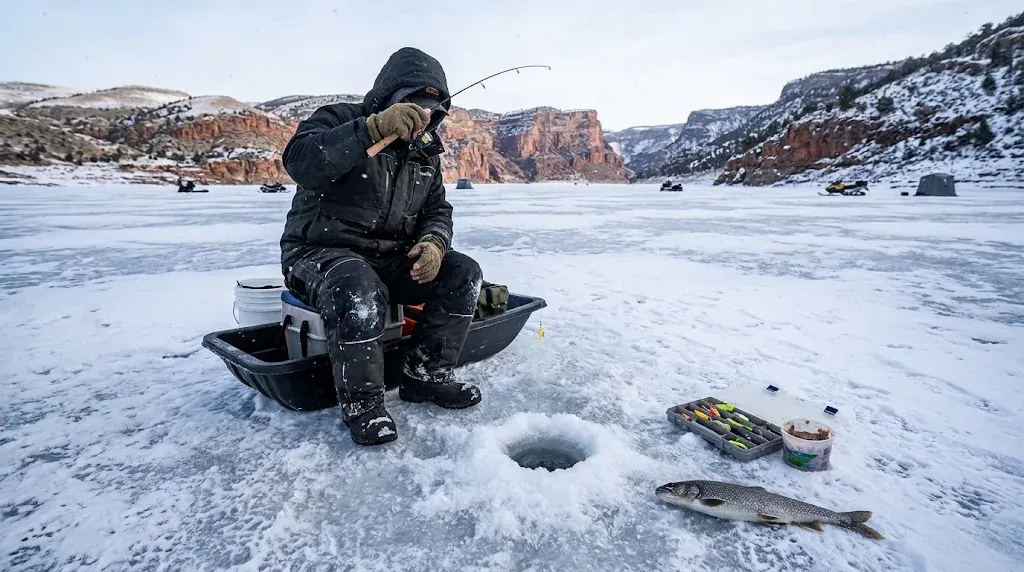
A Wyoming Game and Fish biologist opened up a 22-inch lake trout in spring 2024 and counted more than 50 kokanee in its stomach. Two more fish from the same evening held 25 kokanee fingerlings apiece, according to the agency's announcement of the rule change. That's the whole Flaming Gorge lake trout ice fishing story in one gut check: the "pups" (lake trout under 28 inches) are eating the fishery that made the Gorge famous, and both states have taken the limit off them. This is the one ice bite in the region where filling a bucket is the conservation play, not the guilty one.
What the Flaming Gorge lake trout ice fishing limit actually says
No limit on lake trout 28 inches or less. Only one lake trout over 28 inches. Same rule on both sides of the state line.
Utah's version is in the 2026 Utah Fishing Guidebook under Flaming Gorge Reservoir, Daggett County: "No limit for lake trout 28 inches or less; only 1 lake trout may exceed 28 inches." The same entry caps other trout and kokanee at 4 combined (lake trout excluded), with no more than 3 of those being kokanee, lets you use dead lake trout from your bag as bait, and allows up to six lines through the ice as long as your name is on each line once you run more than two. The same guidebook is blunt about possession: even if you're licensed in both states you only get one daily limit, and at Flaming Gorge you may have only one daily limit in your possession at any time. That matters for the kokanee and the four-fish trout bag, not the pups, since there's no bag on them to stack.
Fillet rules trip up more people than limits do. On the Utah side, the guidebook says you can't possess filleted fish from the current day's catch (or fish with heads or tails off) while you're still in the act of fishing, unless they're being cooked for immediate consumption. Pups go in the sled whole until you're done. Wyoming's filleting rules are different, and the Utah DWR's two-state Flaming Gorge page tabulates those differences side by side with everything else that changes at the state line.
Wyoming went first. Wyoming Game and Fish reclassified lake trout as a nongame fish in its portion of the reservoir effective October 1, 2024, removed the creel limit on fish 28 inches and under, kept the one-over-28 rule, and cut the kokanee limit from four to three. Utah adopted matching language for 2025 and the 2026 guidebook carries it forward.
One December wrinkle: Linwood Bay, west of the line from the mouth of the canyon to Lucerne Point, is closed to night angling from October 15 through 6 a.m. on the second Saturday of December. Daytime jigging is fine the whole time. If you want to run glow jigs after dark in Linwood for burbot or lakers, wait for that Saturday.
Do you need a Wyoming stamp to fish Flaming Gorge through the ice?
Only if you cross the line. A Utah resident license covers the Utah water (Linwood Bay, Lucerne, Sheep Creek, Antelope Flat, everything south). To drill a hole on the Wyoming side (Anvil Draw, Brinegar's Ferry, Buckboard, Firehole, the Confluence) you need either a Wyoming reciprocal fishing permit on top of your Utah license or a full Wyoming nonresident license. Wyoming residents do the mirror image with a Utah reciprocal permit, which the 2026 Utah guidebook lists at $59. Residents of neither state get no stamp at all; you need nonresident licenses from both states to fish the whole reservoir.
The good news for ice anglers is that neither stamp is tied to the calendar year. The 2026 Utah Fishing Guidebook fee table lists the Utah reciprocal permit for Wyoming residents as a 365-day permit at $59, and Wyoming's current license and fee regulations list the Flaming Gorge Reservoir Reciprocal Stamp at $30 for Utah resident license holders, valid for twelve consecutive months from the date of purchase. Buy a Wyoming stamp in late December and it carries you through next December's first ice, so there's no reason to wait for January.
There's no sign on the ice. Anvil Draw sits just north of the line, so Linwood and Lucerne are Utah and nearly everything from Anvil up is Wyoming.
Where lake trout pups stack under new ice
Main channel edges, 40 to 80 feet. Don't overthink it.
Wyoming Game and Fish's own small lake trout handout puts pups on main channel flats and points in 50 to 100 feet of water, and for vertical jigging it narrows that to flats, humps, ridges and underwater draws adjacent to deep water in 40 to 70 feet. Utah DWR ice reports from recent winters have told anglers at Linwood Bay, Anvil Draw and Brinegar's Ferry to start in 50 to 80 feet. Those numbers agree because the fish are using the same thing everywhere: the old river channel. Flaming Gorge is a flooded canyon, and the pups live on the shelves and shoulders where the flats break off into it.
You might also enjoy: Best Dry Fly Floatant (2026): Gel vs Powder, and the Two Bottles to Carry
The time-of-day pattern in the handout is the part most people skip. Early and late, pups sit up on top of the flats and humps, sometimes a long way from the drop. As the sun climbs they slide toward the edge, and by midday they're on or just over the break. The draws that cut from shallow water down into the channel hold fish at any hour. So the first holes of the morning go on the flat in 40 to 50 feet and the noon holes go on the lip in 60 to 80. Punch a line of holes perpendicular to the channel and work outward as the day goes.
Watch the column, not just the bottom. Pups at the Gorge get marked suspended well off the bottom over deeper water, on the same bait the kokanee are chasing, and the WGFD handout tells you to watch your sonar for exactly those fish. This is the lake that settles the flasher question: the fish move vertically through 40 feet of water and you need a real-time read on where a mark is relative to your jig, which a slow-refresh fish finder won't give you.
No mark in ten minutes? Move. The ten minutes is my own rule of thumb; the handout's version is simply "keep moving if you are not catching fish or seeing fish on your sonar gear," which it calls the key point, and it's right.
Tube or spoon, and the cadence that gets bit
The pup lure is a white or glow tube, 3 to 3.5 inches, on a 1/4 to 3/8 ounce head, tipped with a thumbnail-sized chunk of sucker or chub meat. Go to 1/2 ounce over 70 feet. Pink glow is the first color change worth carrying, watermelon the second. WGFD's handout lists pink, yellow, orange and purple glow tubes and says not to shy away from the loud ones; watermelon is my own addition for bright midday light over a clean bottom.
Keep the meat small. The handout's exact words: "a piece the size of your thumb nail, or smaller, will do the trick." A gob of sucker kills the tube's fall and turns a jig into a bait rig. If you want a bait rig, build one on a separate rod.
Which brings up the two-rod approach the Utah DWR repeats in its Flaming Gorge fishing reports (jig one rod, deadstick the other with a bait presentation, because the fish will often show a preference for one), written for the trout bite but tailor-made for pups, and the way I'd fish every day in January. Drill two holes a few feet apart. In one, lower a tube to within a few inches of the bottom and leave it. Dead still. In the other, work a jigging spoon or tube with a lift-drop and let it rest on the bottom between lifts. The jigged rod calls fish in; the deadstick converts them. Over a full day on new ice the deadstick usually outfishes the rod in your hand, which most anglers refuse to believe until they watch it happen.
For the active rod: a Northland Buck-Shot or Buzz Bomb spoon, a Jigging Rap, and a blade bait for neutral fish. The strike WGFD describes, and the one you'll get most, comes when you lift the lure after it's been sitting on the bottom a while. Lift, hold, drop, rest, lift. A mark that rises fast and stalls under the lure wants it dead still.
Tackle is simple: a medium-heavy ice rod, 8 to 10 pound braid to a fluorocarbon leader, because hooksets in 70 feet of water need low-stretch line. Recharge your glow every drop or two.
Why do managers want you to keep small lake trout?
Because the pups, collectively, eat far more kokanee than the trophies do, and there are a lot of pups.
Wyoming Game and Fish's 2023 population estimate put lake trout under 28 inches at roughly 143,000 fish, more than three times the estimates from the 1980s. Research by Chance Roberts at the University of Wyoming, completed in 2022, found lake trout in the 14 to 22 inch range can at times have 25 percent of their diet made up of kokanee. WGFD does the arithmetic plainly in its management overview: an illustrative 130,000 small lake trout eating just ten kokanee each is 1.3 million kokanee a year gone before anglers or the big lakers ever see them. The two states and Jones Hole hatchery stocked an average of 1.77 million three-inch kokanee a year from 2015 through 2022. The pups are eating most of a year's stocking.
You might also enjoy: Best Strike Indicators for Winter Nymphing (2026): Pick by the Run
The old approach was raising the limit: eight fish in 2006, twelve in 2019, plus small-lake-trout derby categories that WGFD credits with removing 7,476 small lakers across seven contests since 2017. It wasn't enough. Kokanee numbers slid around 2020 with reservoir drawdowns piling on, so both states took the limit off entirely, the same move Wyoming made on burbot in 2008.
The 28-inch line isn't arbitrary. WGFD's handout notes lake trout typically switch to a fish diet around 25 inches, so the rule protects the fish that have already survived long enough to become the trophies people drive from three states to catch, while opening harvest on the size classes competing with them for the same kokanee. Releasing a 20-inch laker at Flaming Gorge is well-meaning and wrong. And it's a waste of dinner: a pup from 60 feet of winter water is firm and pale and tastes nothing like the oily summer trophies that gave the species a bad rap.
Access points and the ice reality
Flaming Gorge doesn't freeze all at once, and the main channel where the pups live is the last water to lock up and the first to open.
The north end goes first. Firehole, the Blacks Fork arm and the Confluence lock early and build the thickest ice, often weeks ahead of Anvil Draw and the channel below it. Buckboard sits in the middle, and the Utah bays (Linwood, Lucerne, Sheep Creek) are usually fishable by late January, some years earlier. A Utah DWR report from February 2025 had ice capping most of the reservoir down to the pipeline with fishable ice in Linwood Bay, and warned of thin, patchy ice in the main channel from Buckboard south. Read that twice: the channel, where the pups are, was the sketchy part even with the bays locked.
My honest read on late December: it's a coin flip. Some years the Wyoming bays are solid by Christmas and Linwood goes right as the night closure lifts. Other years you're fishing the Green River below the dam on New Year's Day because the reservoir is open from Buckboard down. Mid-January is the reliable window. The Gorge locks up weeks behind the high Uinta lakes and Strawberry, so don't let a good report from the rest of Utah talk you into the drive before the DWR or the marinas confirm ice on the bays.
For a first trip, Linwood Bay and Lucerne are the easy reach from the Wasatch Front and Vernal, paved to the marina, with the channel edge a short walk off the bay. Anvil Draw and Brinegar's Ferry on the Wyoming side are the old reliables for pups. Firehole and the Confluence are the burbot and kokanee end, with pups mixed in along the channel.
Now the part the glossy reports leave out. Wyoming Game and Fish says plainly that access roads to Flaming Gorge aren't maintained in winter. A two-track that was dry gravel in October can be a drifted, iced mess in January, and Anvil Draw and Brinegar's are the end of a long road with no cell service. Four-wheel drive, a shovel, chains and a full tank are the entry fee.
On the ice, WGFD's rule is four inches of clear ice for a person on foot, and the agency recommends against driving any vehicle onto the ice at all. The Gorge has current, springs, pressure ridges and a channel that stays thin while the bays are a foot thick, and a measurement at Linwood tells you nothing about Anvil. Spud as you walk, carry picks on your chest, fish with a partner, tell someone which bay you're on. And the wind off that open desert water is the real hazard at 6,000 feet; a windbreak shelter is close to mandatory.
One last thing. Pay attention to what the fish tell you: depth, time of day, deadstick or jig, how far off the break. The pattern on a given day at the Gorge is usually narrow, and the anglers who pull it off every winter tracked it rather than remembered it. Log catches with depth and location and it shows up in your own data within a couple of trips; Bushwhack does that bookkeeping.
And if the ice isn't there when you arrive, the Green River tailwater below the dam is under an hour from the Utah bays, the winter midge fishing is some of the best in the West, and the A section is close to empty. That's not a consolation prize. That's the backup plan every Flaming Gorge ice trip should carry in the truck.
Get fishing tips in your inbox
New guides, seasonal tactics, and gear picks — about once a month, no spam.