Starvation Reservoir Ice Fishing: The 2027 Walleye Slot, the Evening Bite, and Perch
 Hudson Reed
Written by Hudson Reed
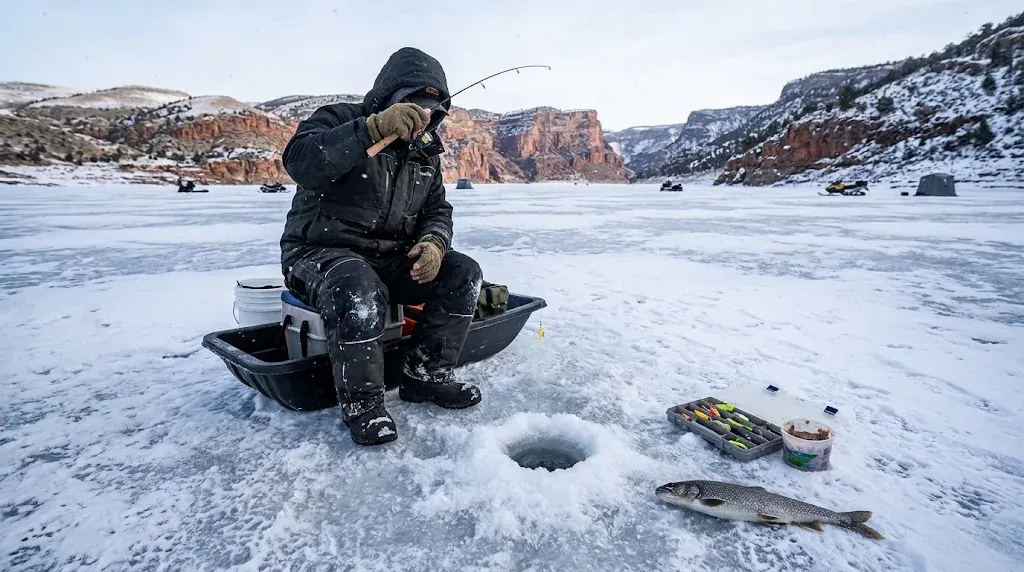
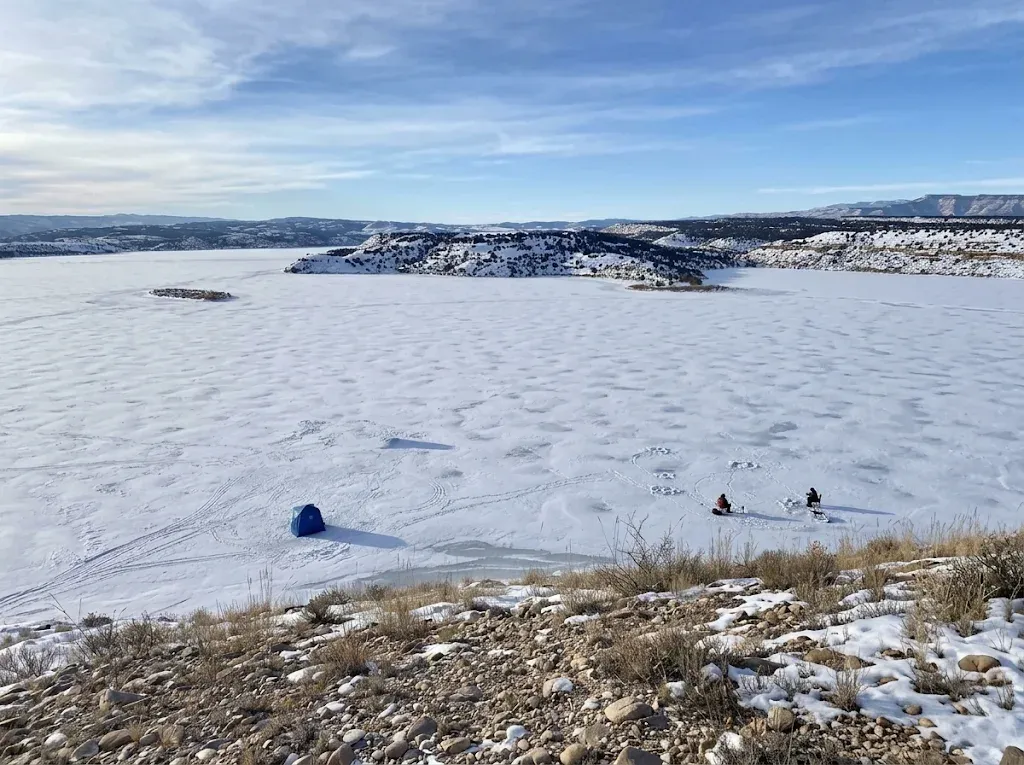
Starvation Reservoir ice fishing has one job most winters: kill small walleye. Not "catch and release a few for the photo." Keep them. Utah's Division of Wildlife Resources has spent years asking anglers to harvest the 10- to 16-inch fish because the reservoir is carrying more young walleye than its forage can feed, and this fall the Wildlife Board went a step further and voted to write it into the 2027 rules. If you've been looking for a trip where filling a bucket is the conservation move, this is it.
Here's how I'd fish it: the evening window, the 25 to 45 foot band, sonar before the auger, perch on the side, and a real plan for the years when the ice never shows up.
Why Starvation wants you to keep the small ones
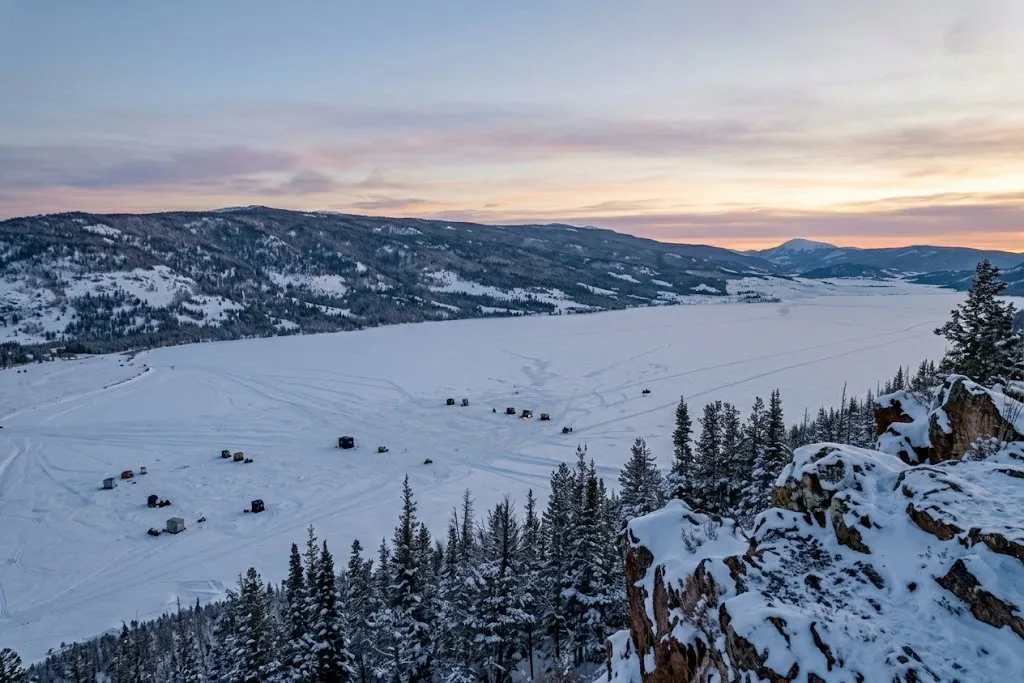
Starvation sits near Duchesne in the Uinta Basin, inside Fred Hayes State Park. It's a walleye lake with a reputation. The park itself notes that its annual walleye tournament turns up trophy fish over 10 pounds nearly every year. That's the headline. The quieter story is underneath it: too many walleye in the 12 to 15 inch class, eating the same perch and forage, growing slowly because there isn't enough to go around.
DWR's fix has been simple and consistent. Thin the young fish so the survivors grow. Earlier DWR releases put it plainly, encouraging anglers "to harvest any 10- to 16-inch walleye they catch," and more recent Starvation reports have repeated the request with a narrower 12 to 14 inch target. Fewer mouths, more food per fish, and over time more of those fish make it into the 20-plus range people actually drive out there for. A Uinta Basin walleye in the 13-inch range is also, and I'll die on this hill, the best-eating size of the fish. Thick enough to fillet clean, small enough that the meat isn't strong. Every one you keep is dinner and fishery management at the same time.
So go in with the right head. A night of releasing 14-inchers isn't sporting here. It's just extra work for the fish you're trying to help.
What's the walleye limit at Starvation this winter?
Under the approved 2027-28 rules, you can keep up to 20 walleye shorter than 15 inches, must release any walleye from 15 to 20 inches immediately, and can keep one walleye over 20 inches. Panfish stay at 10 combined. Confirm the Starvation entry in the 2027 guidebook before you go.
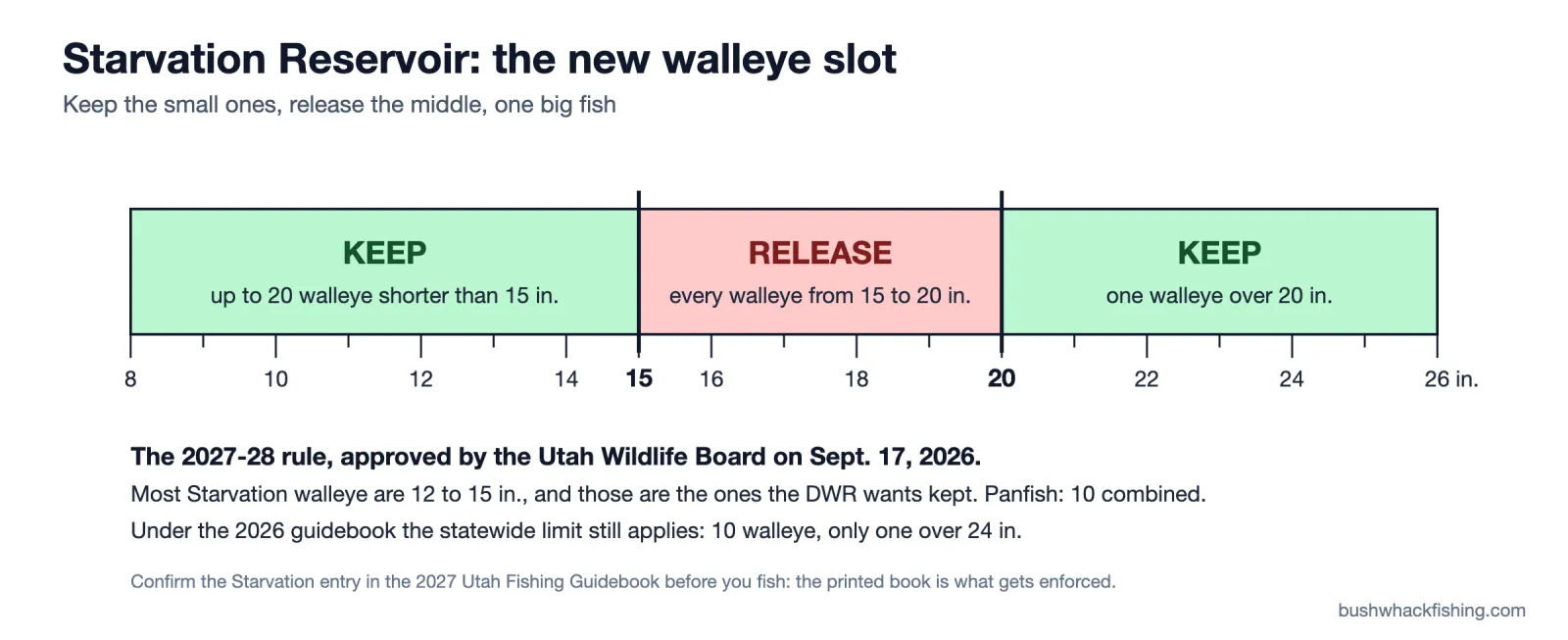
Under the approved 2027-28 rules: the Utah Wildlife Board approved that protective slot for Starvation walleye on Sept. 17, 2026, as part of the fishing regulations for 2027-28. The announcement didn't publish an exact start date, and the 2026 guidebook says only that the next two-year cycle begins in 2027. The board's list of changes didn't touch the Starvation panfish rule, which is why I expect the 10-fish cap to carry over, but that's the other line to check.
Under the 2026 guidebook: the 2026 Utah Fishing Guidebook lists no special walleye rule for Starvation, so the statewide limit applies: 10 walleye, only one over 24 inches. Starvation does have its own panfish rule: 10 bluegill, green sunfish, black crappie and yellow perch combined. That's well under the statewide perch limit of 50, so don't show up planning a 50-perch fish fry.
Read that slot again, because it flips some habits. Under the old rule a 17-inch walleye was a keeper. Under the new one it goes straight back down the hole. Bring a measuring board or a ruler taped to your bucket lid and actually use it on anything close to 15, especially in a dark shelter at 6 p.m. when every fish looks bigger than it is.
One honest caveat. The printed 2027 guidebook is what a conservation officer enforces, and as of mid-November 2026 I'm working from the board's announcement. Before your first January trip, pull up the 2027 guidebook or the Utah Hunting and Fishing app and read the Starvation entry. Five minutes.
A few statewide rules worth remembering on the ice: your hole can't be wider than 12 inches at Starvation (Bear Lake, Flaming Gorge and Fish Lake are the exceptions, not this one), and a licensed angler can fish two poles but still keeps only one daily limit.
You might also enjoy: Eskimo QuickFish 3 vs Clam Hub (2026): The Clam You Remember Is Gone, So Which QuickFish?
The evening window and the 25 to 45 foot band
A January 8, 2023 Utah DWR fishing report (reposted on SportfishingReport) summed up the Starvation ice bite in two lines: walleye and perch were holding 25 to 45 feet deep, and "if you can find the right structure you can get a limit of small walleye in an evening." The same report said the bite window is small, roughly one to two hours in the evening, though a few walleye still feed in the morning and midday. It also noted the walleye were feeding on large zooplankton, which made small tungsten jigs very effective. That was one season, not a law of nature, but it's the best published starting point for where to look.
The daytime hours aren't wasted. That's when you find the fish, drill your holes, catch perch, and get set up so you're fishing, not drilling, when the light goes flat.
Structure-wise, think points that run out into that 25 to 45 foot band, humps, and the edges where a gradual flat drops into deeper water. Walleye relate to those transitions. Perch roam more but often hold tight to the bottom in the same depth range.
Now the catch. Fred Hayes State Park lists winter hours of 8 a.m. to 5 p.m. In January that pushes right up against the best part of the evening bite. Call the park at 435-738-2326 before your trip and ask how late-day anglers are handled this season. Don't assume you can roll out the gate at 7.
Find the school on sonar, then drill
This is the single biggest difference between people who limit at Starvation and people who sit on dead holes. A February 2025 Sportsman's Warehouse fishing report put it bluntly: "It is fairly critical to find fish on sonar before you begin targeting walleye." The fish are schooled up and they move. Twenty holes drilled at random across a flat is a workout, not a plan.
Here's the routine I'd follow:
- Pick two or three spots on a map where a point or hump runs into the 25 to 45 foot range, and plan to check all of them before you commit to one.
- Drill one hole at each spot and drop a transducer, or pour a little water on clear ice and shoot through it with your flasher if the ice is clean enough to read.
- Look for marks hanging a few feet off the bottom or stacked in a band, and stay on the spot that shows the most fish rather than the one closest to the truck.
- Once you've found them, drill a tight cluster of holes over that school so you can hop between them as the fish slide around in the evening.
- Write down the depth, the time the first fish bit, and where the school sat in the water column, because next trip you'll want to start right there.
That last step is the part people skip. A fishing log in Bushwhack makes it painless to record the spot, depth, and time of each fish, and after three or four evenings you'll see the actual pattern instead of guessing at it.
What walleye eat through the ice here
Keep it simple. The Sportsman's Warehouse reports point to a jig tipped with a worm for walleye. A jigging spoon or a small swimming jig like a Rapala Jigging Rap, tipped with a piece of nightcrawler, covers what most of these schools want. Fish it a foot or two off the bottom, lift-and-drop, then hold it dead still. On a slow evening the deadstick catches more than the pounding.
Run your second rod as a deadstick: a plain jighead or a small hook under a light weight, with a crawler or minnow head, set just above where the school is riding on your flasher. Under the 2026 guidebook, dead yellow perch are legal bait at Starvation (it's on DWR's short list of waters where that's allowed), so a strip of perch meat on that deadstick is a legit option. Check that the 2027 book keeps Starvation on that list before you rely on it.
I'd run 6 to 8 pound fluorocarbon on a medium-light rod. These are mostly 12 to 15 inch fish, and if the 10-pounder shows up, that's what the drag is for.
You might also enjoy: Best Tungsten Ice Jigs for Panfish Under $15 (2026): 4 Packs Sorted by Job
Perch: the side bite that fills the gaps
Yellow perch at Starvation have been coming back in recent years, and reports have described them caught throughout the reservoir. They're often in the same 25 to 45 foot range as the walleye, and they'll keep your rod bent through the slow middle of the day.
The recipe from the Sportsman's Warehouse reports is short: small jigs tipped with a nightcrawler or mealworm. A 1/16 to 1/8 ounce tungsten jig gets down to 35 feet without needing a heavy line, and a half-inch of crawler or a single mealworm is plenty. Perch peck. A sensitive rod tip or a spring bobber shows you the bites a stiff walleye rod never will.
Just remember the cap. Ten panfish combined under the 2026 rules. On a good perch day you'll hit that by early afternoon, which is fine. That's your cue to switch rods, slide over the walleye holes, and wait for the light to drop.
What if Starvation doesn't freeze?
Then you fish it from a boat. Starvation's ice is unreliable, and that's not a knock on the place. Some winters it locks up solid and others it never really does. That same January 2023 DWR report described anywhere from 4 to 12 inches of ice across the reservoir, which tells you how patchy it can be. The February 2025 Sportsman's Warehouse report described ice that kept forming and then melting with the warm temps.
The KSL Outdoors crew made a whole episode out of this situation in January 2026, Ice Fishing Without Ice at Starvation Reservoir, taking their ice gear out on open water during a warm start to winter and going after walleye, perch and trout with Cameron Phillips of Strawberry Bay Marina and Ben Kurtz of Toothy Fish Outfitters. That's the right instinct. Your short ice rods, small jigs and flasher work from a boat parked over a school in 30 feet of water almost exactly the way they work through a hole. Anchor or spot-lock over the fish you find on sonar, drop straight down, and fish the same evening window.
Check the boat side before you tow anything three hours. As of mid-November 2026, the park's current conditions page showed open water and the launch ramp open with the wedge dock in, but dock access limited by low water: the boat slip dock was closed, and the boat dock was open but no longer connected to the concrete walkway. The park's main page had the reservoir at 62 percent and rising. Back in August, Utah's Division of Water Resources drought update warned that "low water levels are creating new terrain and boating hazards" at Starvation. Translation: rocks and points that used to sit deep are now shallow, and any ice that forms over them will be different from what you remember. Go slower than you think you need to, on the water or on the ice.
When the ice is marginal
The in-between years are the dangerous ones: shelf ice along the bank, open water out front, and a sheet in the bays that looks fine from the truck. Don't trust anybody's thickness report from last week. Spud your way out, check thickness every few steps, and wear picks around your neck. If the edges are open or rotten, it's a boat year or a no year, not a "let's see how it goes" year.
Starvation Reservoir ice fishing logistics: fees, cabins, and hours
Fred Hayes State Park charges a $10 day-use fee per vehicle (up to eight people) outside the summer peak. Winter camping runs $20 a night at the developed campgrounds, and the park's cabins are $85 a night off-peak from Nov. 1 to May 14. The cabins can be reserved year-round and up to 120 days ahead, which is a genuinely good move for this lake: you're on the water for the evening window and don't have to drive home in the dark. Check the park fees page before you go.
The park posted on Nov. 2, 2026, that campground water and restroom facilities were off for the season, so bring your own water. Duchesne has groceries, fuel and a hardware store, but the park notes most places close earlier than you'd expect. Grab minnows and crawlers on the way in, not on the way back out.
The real trophy here
Honestly, the hardest part of a Starvation trip is the mental shift. Most of us were raised to measure a good day by the one big fish. Here, a good day is a cooler of 13-inch walleye, a bag of perch, and a lake that's a little better off when you leave. Fill the freezer. The fishery will thank you, and so will whoever you're feeding.
Going fishing? Write it down.
Bushwhack is a free fishing log that fills in the weather, moon and pressure for you, then shows which spots, flies and conditions actually produce. Blank days included.
Get fishing tips in your inbox
New guides, seasonal tactics, and gear picks, about once a month, no spam.