Eskimo QuickFish 3 vs Clam Hub (2026): The Clam You Remember Is Gone, So Which QuickFish?
 Hudson Reed
Written by Hudson Reed
If you've been reading old forum threads on QuickFish 3 vs Clam, you've probably landed on the same matchup everybody argued about for years: Eskimo's QuickFish 3 against Clam's C-360, two little three-person hubs a few dollars apart. That fight is over, and not because one of them won. The C-360's product page on Clam's own site now returns a 404, it's missing from Clam's current product catalog, and Clam's hub lineup starts at a much bigger, much pricier shelter. So this is really a different question now. Which QuickFish do you buy, and is the current Clam worth $200 more?
Short version: for one to three anglers buying a first hub, the insulated QuickFish 3i is the pick.
| Product | Best For | Price Range | Amazon Rating |
|---|---|---|---|
| Eskimo QuickFish 3i | First hub for 1-3 anglers, pulled by hand | $349.99 on Amazon | 4.8 / 5 (576 ratings) |
| Eskimo QuickFish 3HD | More floor, gear-heavy days, easier entry | $429.99 on Amazon | 4.6 / 5 (47 ratings) |
Two picks, not five. Every product here was verified in stock on Amazon with 4.0+ stars and 40+ ratings. No current Clam hub cleared that bar, and a short honest list beats a padded one.
Is there still a QuickFish 3 vs Clam hub matchup?
Not the one you're thinking of. The old comparison was apples to apples: the standard QuickFish 3 and the C-360 were both uninsulated 300-denier hubs, with retailers listing 34 and 36 square feet of fishable area. The insulated versions matched up too: retailers list the C-360 Thermal at 600 denier, and the QuickFish 3i is also 600 denier per its Amazon listing. The C-360 Thermal carried a $329.99 list price, about $20 under the 3i's current $349.99 Amazon price, which is where the "Clam is a little cheaper" talk comes from. Fair enough, back then.
Today Clam's hub-shelter collection shows four models: the X-400, X-600, X-800 and X-1200. The smallest is the Clam X-400 Hub, and Clam's own page lists it at $549.99, 50 pounds, 900 denier thermal fabric with 90 g/m² of insulation, 64 square feet of fishable area, and room for "3 anglers comfortably." So today's Clam does have heavier fabric than the 3i. It is not cheaper. It's $200 more than the QuickFish 3i on Amazon, and 16 pounds heavier than the 34 pounds Amazon lists for the 3i.
The X-400's Amazon listings had no ratings and no buy button when I checked, so it can't be a pick here. Leftover C-360 Thermal stock may still turn up at farm-store retailers, and near $330 it's a fair buy. I just wouldn't build a purchase around a shelter its maker has stopped listing.
Eskimo QuickFish 3i: Best First Hub for Most Anglers

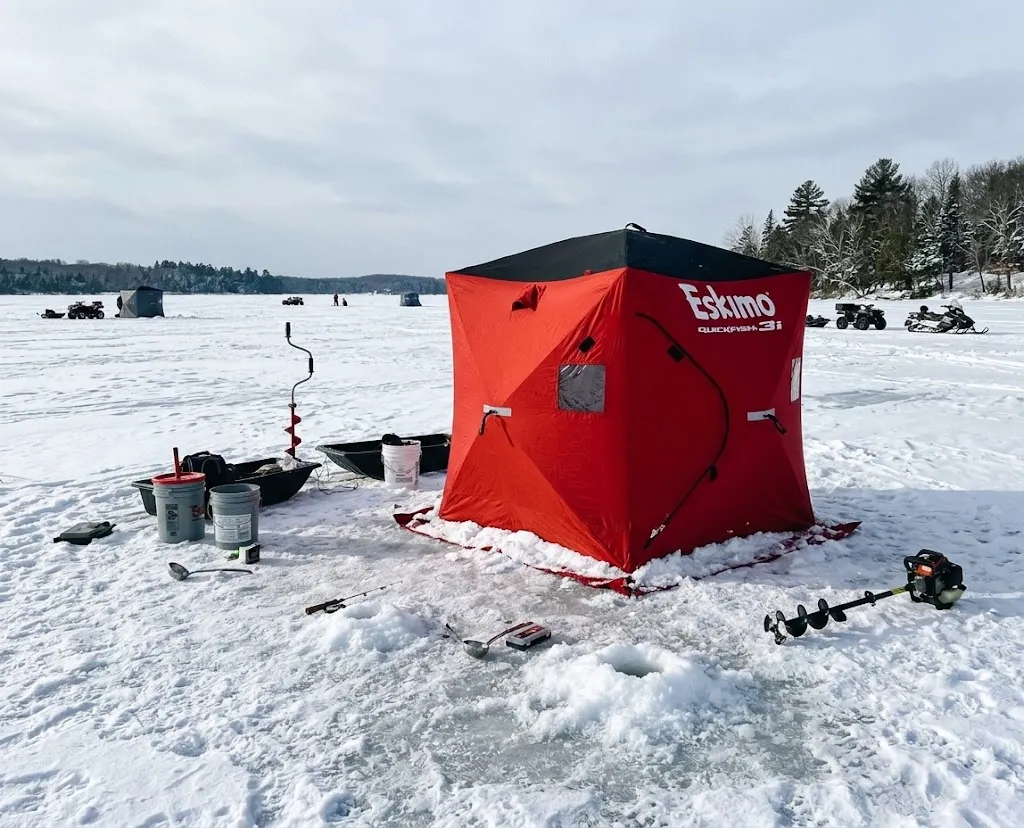
This is the shelter I'd tell a friend to buy if they asked me in the parking lot. Per the Amazon listing, it's a 600 denier IQ insulated quilted shell that Eskimo claims is 35% warmer than a comparable non-insulated shelter, with a set-up size of 5.8 by 5.8 feet and 6.7 feet tall. Thirty-four square feet of fishable ice. Amazon lists the weight at 34 pounds.
Three anglers fit, technically. Two fit happily with a heater and a flasher each.
The anchoring is the detail I like most. Per the listing, self-tapping anchors go through grommets built right into the skirt, so you're not hunting for a separate tab with frozen fingers while the shelter tries to sail off.
Who it's for
Someone fishing alone or with one buddy, walking or pulling a sled by hand, and fishing mid-winter cold where insulation actually pays for itself.
You might also enjoy: Flaming Gorge Burbot Ice Fishing: Glow Jigs After Dark on the Rocky Points (and Why There's No Limit)
Pros & Cons
- Pro: 4.8 stars across 576 Amazon ratings, a deep track record for a shelter
- Pro: Insulated shell cuts condensation and heater fuel compared with a single-wall hub
- Pro: Self-tapping anchors and in-skirt grommets speed up a windy setup
- Con: The cinch duffle can be a tight repack, a complaint that comes up in IceShanty threads
- Con: Standard doors, so you step over the skirt every trip in and out
Price: $349.99 at the time of writing. Check the QuickFish 3i on Amazon.
Eskimo QuickFish 3HD: Best for Gear Haulers and Bad Knees

The 3HD is the newer, roomier cousin. Same IQ insulated fabric and the same self-tapping anchors with in-skirt grommets, but the headline feature is the No-Trip Door: an oversized panel that zips up from ice level, so there's no skirt lip to catch a boot or a sled runner. Retailers list it at 45 square feet of fishable area and a 104 by 104 inch set-up size. Amazon lists the weight at 41.5 pounds.
Is 11 extra square feet worth $80 and 7.5 pounds? For three adults, yes. For one or two, it's a luxury you'll feel on every pull across the lake.
Who it's for
Groups of three, anglers who bring a lot of gear in and out, and anyone who's tired of stepping over a frozen skirt in bibs.
Pros & Cons
- Pro: No-trip door that zips open from ice level
- Pro: Noticeably more floor than the 3i for a third angler
- Pro: Works with Eskimo's E-Hub accessory line (rod holders, table, light kit), per the listing
- Con: 47 Amazon ratings at 4.6 stars, a much thinner record than the 3i
- Con: 41.5 pounds starts to matter on a long walk
Price: $429.99 at the time of writing. Check the QuickFish 3HD on Amazon.
Setting up a hub in the wind
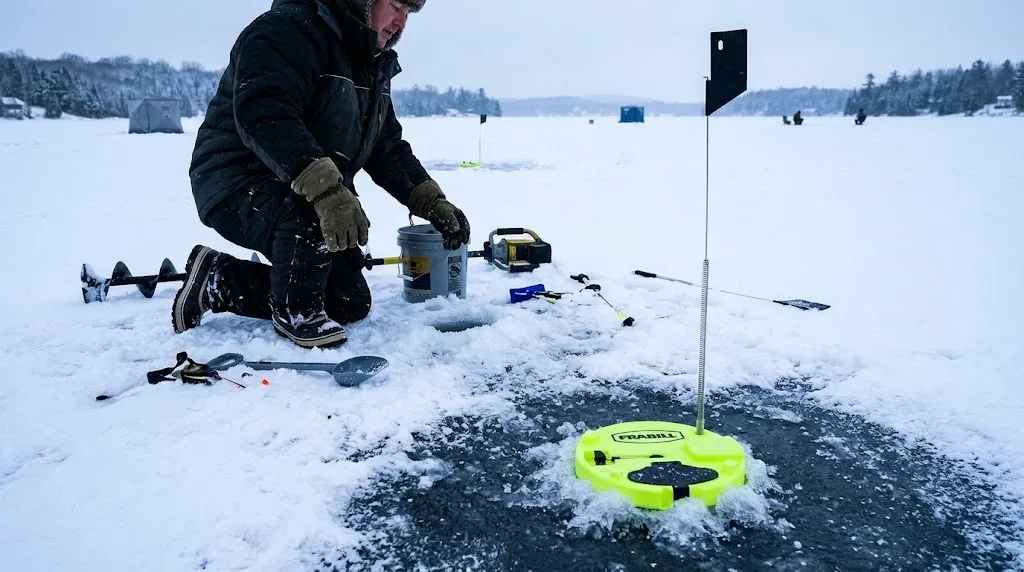
A pop-up hub is a kite until it's anchored. The ones you see cartwheeling across a reservoir almost always got loose in the gap between "popped" and "staked." The order of operations below works for any brand.
- Pull the shelter out of the bag on the downwind side of your holes and lay it flat on its side with the door facing away from the wind, so the wind pushes it onto the ice instead of under it.
- Set the two windward corner anchors through the skirt before you pop a single hub, because a shelter pinned on the upwind edge can't flip.
- Stand it up, pop the roof hub and then the wall hubs, and set the remaining downwind anchors right away.
- Run the tie-down ropes on the windward side and, if there's snow, shovel it onto the skirt to seal the gap and kill the draft.
Clam's X-400 ships with eight anchors plus tie-downs, per its spec page; retailers list six for the Eskimos. On big windy flats, buy a spare pack of anchors either way. Cheap insurance.
What does each one weigh on the sled?
Amazon lists 34 pounds for the QuickFish 3i and 41.5 for the 3HD; Clam lists 50 for the X-400. Those numbers sound close until you add an auger, a flasher, a heater and propane. Then every extra pound of shelter is one you'll feel through slush on the walk back.
Length matters too. Clam lists the X-400 at 65 by 14 by 14 inches packed and says it fits "Mid-Size SUVs, Most Truck Beds." That's a vehicle spec, not a sled spec, and a 65-inch bag is more than five feet of shelter to strap down. Measure your sled before you buy any hub.
My hot take: for a walk-on angler, weight beats warmth. A colder shelter you'll actually drag a half mile to the fish outperforms a warmer one you set up 50 yards from the truck because you didn't want to haul it.
You might also enjoy: First Ice in Utah: When Each Reservoir Gets Safe Ice, Sorted by Elevation
Insulated or non-insulated for your first hub?
Insulated, unless you only fish late-season sunny days. Thermal fabric holds heat from a small propane heater far better and, just as important, it fights condensation. IceShanty owners report thermal hubs condense far less than single-wall ones, though they can still drip in deep cold. Frost raining off the ceiling onto your reels gets old fast.
A non-insulated QuickFish 3 still turns up at other retailers, lighter and cheaper than the 3i. It didn't appear on Amazon when I checked, so it isn't a pick, but if budget is the wall it's worth a look.
Can you run a heater in a pop-up hub safely?
Yes, with ventilation and a CO detector, and not otherwise. The Minnesota DNR's ice shelter carbon monoxide guidance is blunt: every shelter heated with propane needs a vent near the top and the bottom, with an opening within one foot of the ground, and vents have to stay clear of snow and ice. That last point bites hub owners, because the same snow you banked on the skirt for wind can bury a low vent.
The DNR's one-line rule is worth taping inside your bucket lid:
"Every ice shelter should have a carbon monoxide detector." Minnesota DNR
The DNR also says to use only heaters designated for indoor use, never sunflower-style heaters, and to keep propane cylinders outside except the 1 lb bottles that run small portable heaters. Headache, nausea, dizziness or confusion means get to fresh air immediately. The sensors in CO detectors average about a five-year lifespan, so check the date on yours. For a three-person hub, a portable heater sized for a small space is plenty; there's no need to bring a big one.
Insulated fabric holds heat so well you'll be tempted to close everything up. Don't.
Our Pick: QuickFish 3i for most, 3HD for three, Clam only if you haul by machine
For a first hub serving one to three anglers, buy the Eskimo QuickFish 3i. It's insulated, it's 34 pounds, and 576 Amazon ratings at 4.8 stars say it holds up. Step up to the Eskimo QuickFish 3HD if three adults will regularly fish inside it or if the no-trip door appeals to your knees.
And the Clam? The X-400 has more floor, more anchors and thicker fabric, and if you pull by snowmobile or ATV, its extra 16 pounds won't matter. Pulling by hand, it's $200 of shelter you don't need yet.
Once you've got a shelter, the spots you set it on are the real asset. Try Bushwhack to log which holes, depths and days produced, so next winter you're popping the hub on fish instead of guessing. See what else Bushwhack's features track before you head out.
Get fishing tips in your inbox
New guides, seasonal tactics, and gear picks — about once a month, no spam.