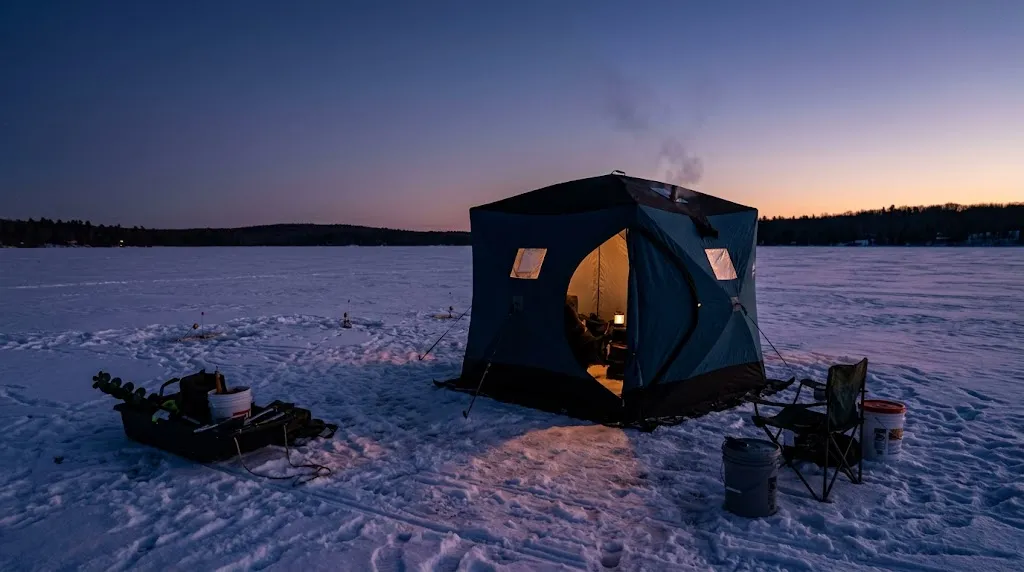
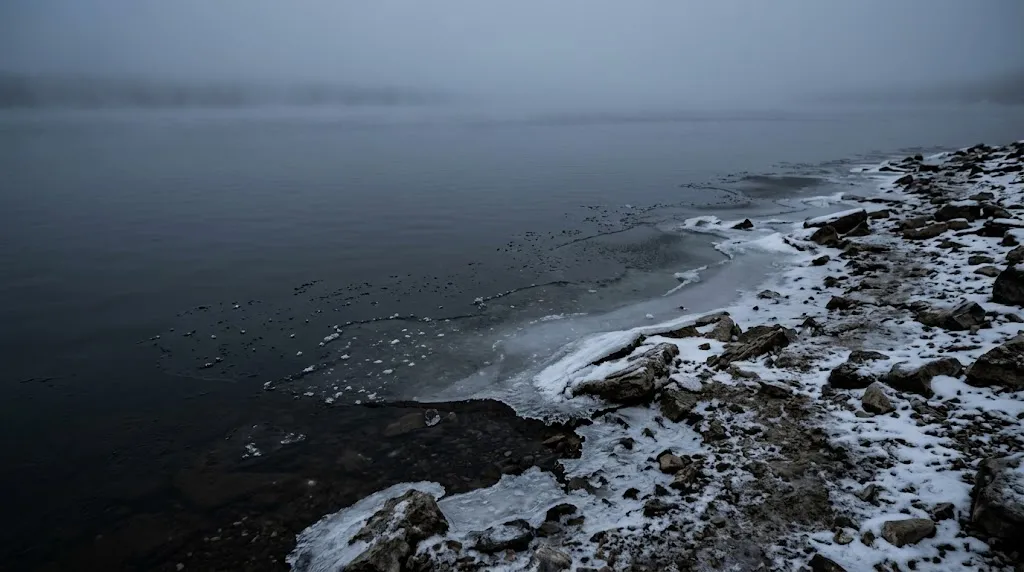
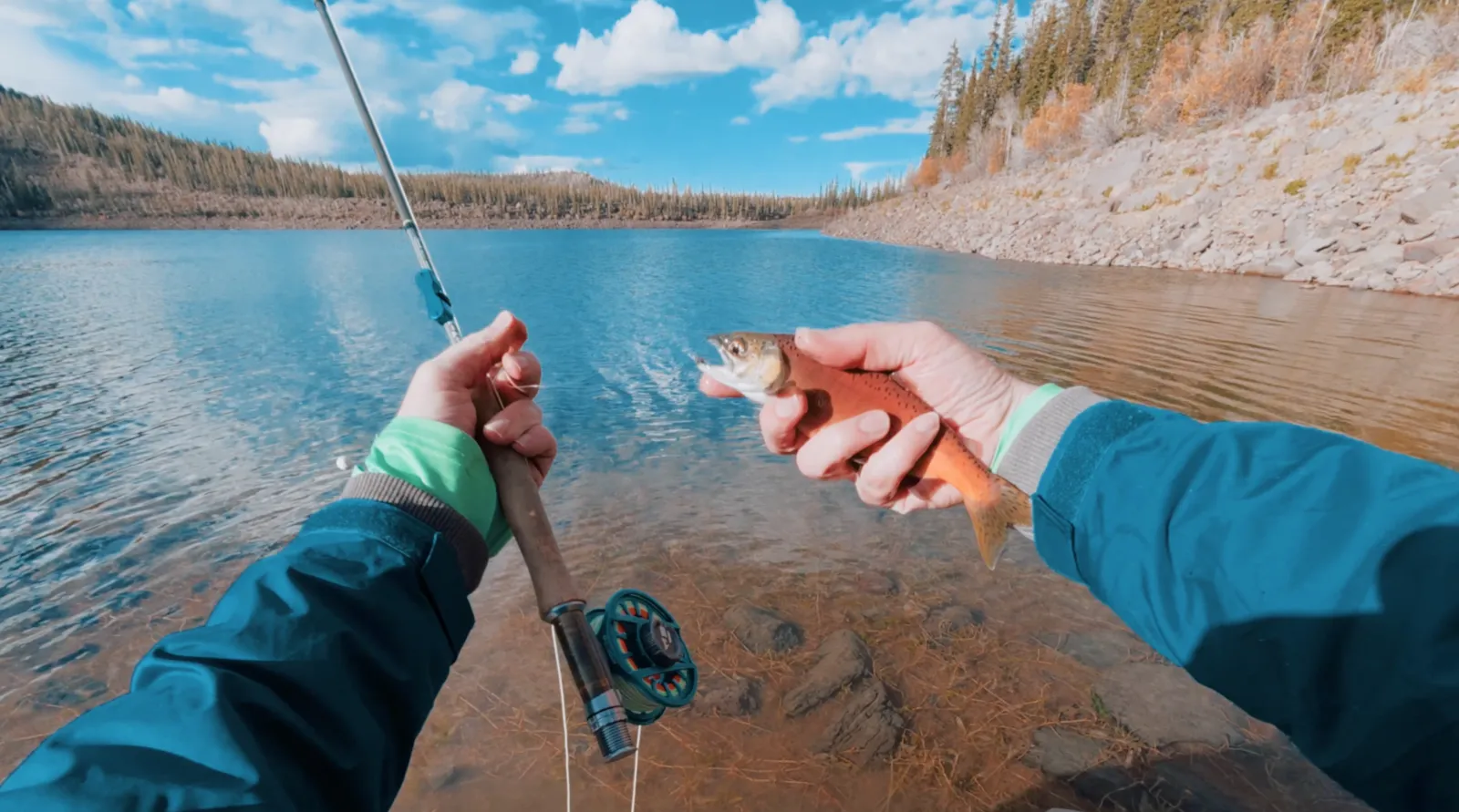
Fish Lake Ice Fishing: Weedline Perch, Mid-Depth Splake, and Deep Mackinaw
 Cameron Spanos
Written by Cameron Spanos
During a single day of Fish Lake ice fishing in February 2015, more than 1,700 contest anglers pulled somewhere between 30,000 and 40,000 yellow perch out of the lake, and the Utah Division of Wildlife Resources' message in its report was basically: keep going.
That's the first thing to understand about Fish Lake ice fishing. Perch aren't a sideshow here. They're a problem the state wants you to help solve, and they'll keep a kid's rod bent all morning while you wait on the fish that actually get people to drive to Sevier County in January: splake and rainbows cruising mid-depth, and lake trout (everyone up here still calls them mackinaw) sitting near bottom in 70 to 100 feet of water.
Shallow weedline, middle water, deep basin. Each band has its own fish and its own kind of patience.
Fish Lake ice fishing at a glance
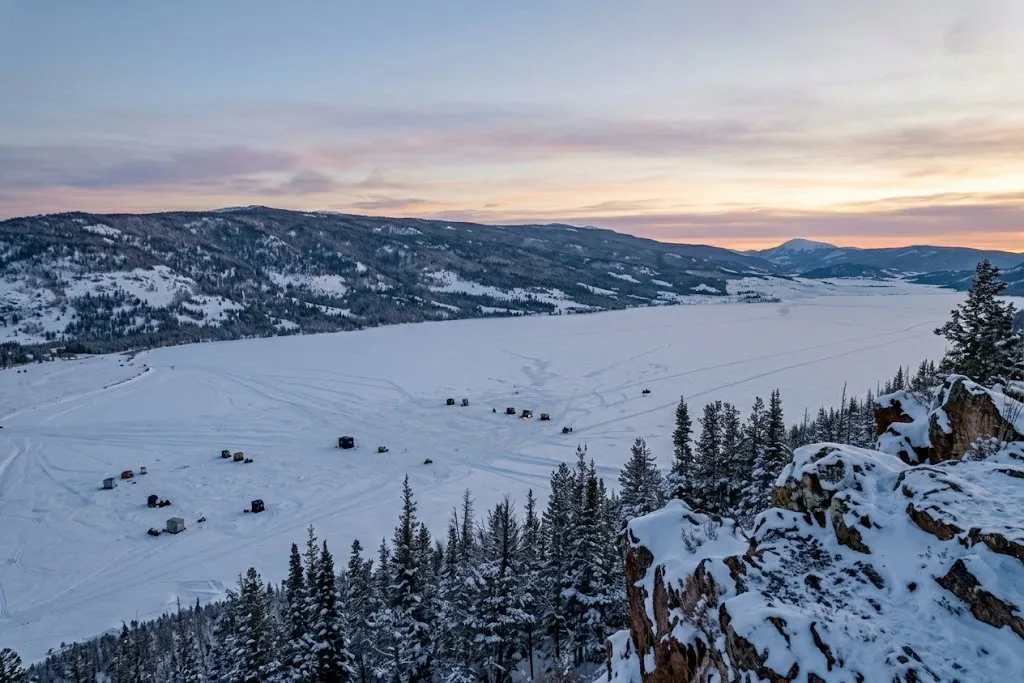
Fish Lake sits at roughly 8,850 feet on the Fishlake National Forest, northwest of Loa, reached off Highway 24 by SR-25. It's about 2,500 acres, long and narrow, with plenty of deep, cold water for lake trout. At that elevation it's one of the later big waters in the state to lock up, so if you're tracking first ice in Utah by elevation, expect it to lag the lower reservoirs. It also holds ice late: the DWR's March 20, 2015 report put thickness at 14 to 18 inches across the lake.
The species list through the ice: yellow perch, rainbow trout, splake (a brook trout and lake trout cross), and lake trout. Kokanee live here too, but they're mostly an open-water troll fish and rarely the reason anyone drills a hole.
Where each species holds: the depth map
The DWR's winter reports for Fish Lake have repeated the same three-band pattern for years, nearly word for word, and it holds up. Here's the version from its January and February 2015 updates:
| Species | Depth | Where in the column | Go-to presentation |
|---|---|---|---|
| Yellow perch (and small trout) | 15-25 ft | Near the weedline, close to bottom | Small jig or ice fly tipped with a waxworm, mealworm, or perch meat |
| Larger rainbows and splake | 25-35 ft | On bottom, or suspended at that depth over deeper water | Jigging spoon or 1/8-1/4 oz jig with bait |
| Lake trout (mackinaw) | 70-100 ft | On or just off bottom | 3-5 inch white tube or heavy spoon tipped with sucker or perch meat |
One wrinkle. A separate DWR ice fishing roundup suggests going after lake trout and splake in 20 to 40 feet with bigger jigs and bait. That's not a contradiction. The deep lakers sit on bottom and make you earn them, while cruising fish push up onto the same flats the splake use. If you can only fish one band for trout, fish that middle band.
Perch on the weedline: why is there no limit?
Because the DWR wants them gone. The 2026 Utah Fishing Guidebook lists "No limit on yellow perch" for Fish Lake, Sevier County, against a statewide yellow perch limit of 50. And it goes a step further than most no-limit waters: Fish Lake is on the guidebook's short list of places where you can legally dispose of a specific species without breaking Utah's wasting law. For Fish Lake, that species is yellow perch. The DWR's March 2026 report spelled it out plainly: if you don't want to take them all home, kill the fish and drop them back in the lake.
So don't release perch here. Every one you toss back alive is one more mouth competing with the trout.
Expect small fish. The DWR describes Fish Lake perch as "typically small" but plentiful, and tournament numbers back that up: KJZZ reported that the winning three-angler team at the 2020 Fish Lake Perch Tournament weighed 1,182 perch for 201.1 pounds. Do the math and that's under three ounces a fish. You're here for volume and a fish fry, not jumbos.
How to fish them
Find the edge of the weeds in 15 to 25 feet and stay mobile. Perch schools wander, and the DWR's late-season advice was to move around, especially away from crowded spots, until you find active fish. A small tungsten jig or a glow ice fly tipped with a waxworm will catch them. Once you've killed a few, a sliver of perch eye or perch meat works as well as anything you brought, and dead yellow perch are legal bait at Fish Lake under the guidebook's bait rules. Fish it a few inches off bottom on 2- or 4-pound line and watch for the soft lift-bite perch are famous for.
You might also enjoy: Fly Fishing Gifts Under $100: 5 Step-Up Picks for Anglers Past the Basics (2026)
Splake and rainbows in the middle water
This is the band most people should spend their trout time in. The DWR's reports put larger rainbows and splake at 25 to 35 feet, either on the bottom or suspended at the same depth over deeper water. That second part matters. Fish marking at 30 feet over 60 feet of water are a real target, and plenty of anglers drop straight to bottom right under them.
Splake are aggressive and they respond to movement. A 1/4-ounce jigging spoon with a hook dressed in a piece of nightcrawler or sucker meat, ripped a foot and allowed to flutter, is the standard play. Rainbows tend to want it slower. Run a second rod with a small jig and a mealworm hanging motionless a couple feet above where the splake are marking, and you'll often find the rainbows took that one while you were busy working the spoon.
If you've chased tiger trout in Utah through the ice, you'll recognize the program. The difference here is how often a lake trout crashes the party.
The mackinaw game in deep water
Here's where opinions diverge, so let me give you mine: most anglers who come to Fish Lake for lake trout spend the day staring at a hole in 90 feet of water and go home with nothing. That's not a knock on the fishery. The DWR itself describes deep lake trout fishing here as something that "requires a lot of patience," and a 2014 report rated splake and lake trout fishing slow to fair while perch were good to excellent. If you aren't running sonar, I'd skip the deep water entirely and fish the middle band.
If you are running sonar, it's a different game. The deep fish move through, show up as a mark that rises off bottom, and you have a few seconds to make the bait look like something worth chasing. Some things that matter:
- Bring sonar you trust in 100 feet. Without it you can't tell a dead hole from a fish that looked and left.
- Go heavy enough to stay vertical. A 1/2- to 1-ounce jig head with a 3- to 5-inch white tube, tipped with sucker or perch meat, is the classic laker setup. Sucker meat is legal bait statewide, wherever bait is allowed.
- Pound bottom, then lift. Bang the jig on the mud to throw a puff, then raise it a foot or two and hold. When a mark rises toward it, reel away from the fish. Lakers chase.
The fish are worth the effort. A DWR ice fishing roundup noted that recent gillnet surveys showed both the size and number of lake trout in Fish Lake had increased. And there's a reason the lake has a special rule about big fish.
What the 2026 regulations actually say
Read this section twice, because the Fish Lake rules are short and people still get them wrong. From the 2026 Utah Fishing Guidebook entry for Fish Lake, Sevier County:
- No limit on yellow perch. You may also dispose of perch at the lake without violating wasting laws.
- Trout: the statewide limit of 4 trout, kokanee, and grayling combined applies, and only 1 trout or salmon over 24 inches regardless of species. That one fish counts toward your 4.
- Ice holes may be up to 18 inches across. Statewide the max is 12 inches. Fish Lake is one of only three exceptions, along with Bear Lake and Flaming Gorge.
- Twin Creek, the main tributary, is closed to fishing.
Notice what's not there. Fish Lake has no special lake trout limit and no slot. Lake trout, splake, and rainbows all go into the same 4-fish bag, and the "one over 24 inches" rule covers all of them together. A 26-inch splake and a 30-inch mackinaw can't both go home with you. This trips people up who are used to Flaming Gorge, where lake trout 28 inches or less have no limit. That rule doesn't apply here, and if you've been reading up on Strawberry Reservoir ice fishing, leave that slot math at home too.
Two statewide rules also bite on the ice: two poles still means one daily limit, and a trout that's been on a stringer or in a bucket can't be released.
The 2026 guidebook covers Jan. 1 through Dec. 31, 2026, so it governs December's first ice. For a January trip, check the 2027 guidebook before you go.
Which part of Fish Lake ices up safely first?
The south end, most years. In its January 16, 2015 report, the DWR called the south end the safest ice at 4 to 6 inches, while the stretch from just north of Lakeside to the Mackinaw campground area had only about 3 inches. By February the pattern held: up to 12 inches on the south end, about 6 inches of clear ice on the north end. Clear ice is strong ice, so 6 inches of it isn't scary by itself, but it tells you the north end lags.
You might also enjoy: Middle Provo Winter Fly Fishing: Midges, the Midday Window, and Snow-Day Access
Treat every thickness reading in this section as an example from a past winter, not a forecast for this one.
The marinas usually freeze first. A DWR report from late 2023 said ice would most likely form in the marinas by early December. There's a catch at Lakeside, though. In 2021 the DWR added an aerator to the Lakeside Marina to keep it ice-free for December boat launching, and the DWR said power to it would be off for the 2023 season for repairs. Whether it's running in a given winter is exactly the kind of thing you ask about before walking out from that marina. An aerator makes thin ice and open water in a spot that looks frozen from the parking lot.
Other spots that have stayed open or gone bad in DWR reports: open water between Bowery Haven and Joe Bush, large cracks on the north end, and the area right next to Twin Creek, which was the last open water when the lake finally capped in February 2014. Inlets stay soft. Give them room.
How does snow cover hide bad ice?
Snow insulates new ice and slows the freeze underneath, and its weight pushes water up through cracks to make slush. In February 2014 the DWR reported about a foot of snow on top of 10 to 12 inches of ice, "and it can get a little slushy." In March 2015 it warned of slush areas even with 14 to 18 inches of ice.
The DWR put the real risk best in its January 2015 report: "It's easy to be overconfident with snow on the ice." A smooth white surface looks the same over 10 inches of ice and over 3. You can't see cracks or the gray patches that mark weak spots. So drill. Check with a spud bar or auger every time you move a meaningful distance, and treat any spot where water wells up through your boot prints as a red flag. The DWR's minimum for walking is 4 inches of good ice. Snowmachines and ATVs need a lot more.
Winter access, parking, and getting there
You'll come in on SR-25 from Highway 24. That's a high mountain road in winter, so check UDOT Traffic for conditions and carry chains or drive four-wheel drive. DWR Sportfish Coordinator Randy Oplinger has singled out Fish Lake for its good winter access, which is a big part of why it's popular compared with lakes that are snowmobile-only.
Most ice traffic launches from the resort and marina areas. The DWR consistently points anglers to Fish Lake Resorts (Fish Lake Lodge and Lakeside Marina) for current ice and access, and its past reports listed the Fish Lake Lodge at 435-638-1000 (confirm it with the resort). Call before you drive. Ask three things: Is the parking area plowed? Is the marina aerator running? Where are people walking out this week? Plowing changes with every storm, so don't trust a blog post on it, including this one. For the forest-side picture (roads, closures, the snowmobile complex), the Fishlake National Forest office is the source.
Gear list for a Fish Lake day
Three rods cover it: a light perch stick with 2-4 lb line, a medium-light rod with 4-6 lb for splake and rainbows, and a medium-heavy rod with 8-12 lb for lakers. A standard 8- or 10-inch auger is plenty for most fish. The 18-inch hole allowance is legal headroom: if a big laker won't fit, you can widen the hole rather than lose it. Add ice picks, a spud bar, cleats, and a shelter, because the wind on the open lake gets nasty.
With three bands in play, keep track of what bit where. Log each fish in Bushwhack and by your second or third trip you'll see whether your splake actually come at 28 feet or 34, and what time the deep marks start showing up.
If Fish Lake is your first high-mountain ice trip, start on the weedline, fill a bucket with perch the state wants gone, and spend the last two hours on the middle flats with a spoon. Save the 90-foot mackinaw hole for the trip when you bring sonar and a thermos.
Get fishing tips in your inbox
New guides, seasonal tactics, and gear picks — about once a month, no spam.