When to Stop Fishing for Trout: A Water-Temperature Decision Tree for Summer
 Cameron Spanos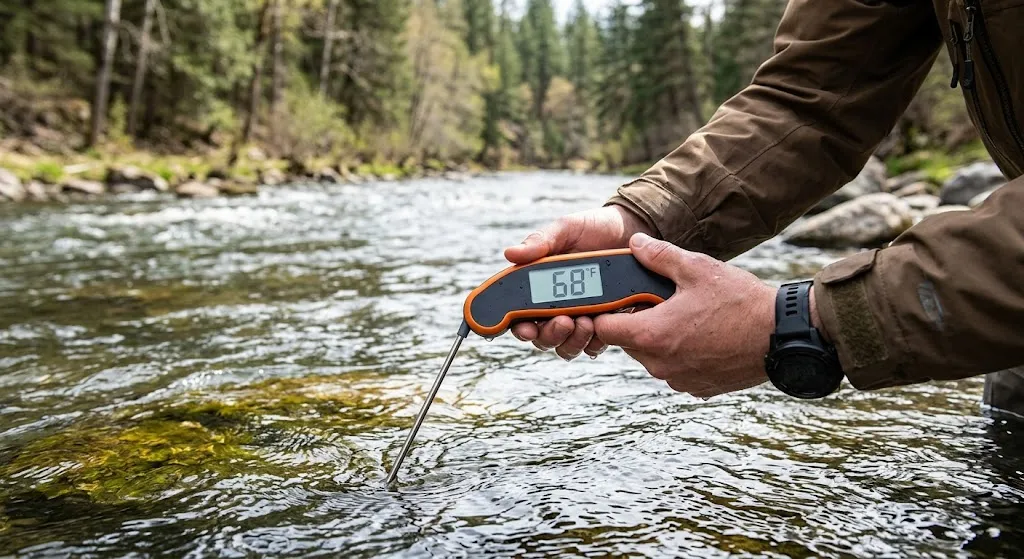
Written by Cameron Spanos
The day I learned when to stop fishing for trout in summer, I'd just released a 16-inch brown on the lower Provo that took four full minutes to swim out of my hand. Four minutes. The water was 71F on my pin-on thermometer. That fish probably lived, probably didn't. I'll never know. What I do know is that I was the asshole holding it there.
That moment is what this post is about. Knowing when to quit is not a vibe call or a guilt thing. It's a number. The number is the water temperature, and the decision tree below tells you exactly what to do at each rung. If your home river has already hit 65F this May (Utah's Weber crossed it on the 11th, the Provo on the 13th), the next eight weeks are going to test your discipline.
When to stop fishing for trout: the decision tree in one paragraph
Under 65F, fish like normal. From 65 to 68F, fish at dawn only and bump your tippet up a size so fights stay short. From 68 to 70F, leave the freestone behind and drive to a tailwater or an alpine creek. At 70F and up, the rod stays in the truck. That's it. Memorize those four rungs and you'll never have to argue with yourself in a parking lot at 2pm in July.
Why 68F is the line in the sand
The 68F threshold is the one cited by Colorado Trout Unlimited, Montana FWP, and most state agencies, and it exists because two things happen at once when water crosses it. First, dissolved oxygen drops. Cold water can hold roughly twice as much oxygen as warm water. Second, the trout's metabolism speeds up, so they need more oxygen at the exact moment there's less available. Hook one in that double-bind and play it for three minutes, and the math is ugly.
Idaho Fish and Game put a number on it in a study cited by their own fisheries staff: trout landed in 73F water died 69% more often than fish landed below 66F. That's not a rounding error. That's a tripling of mortality in seven degrees.
It gets more interesting. A 2021 literature review by Jamie Madden of Carleton University, published through Keep Fish Wet, looked at every available study on angling-induced trout mortality and concluded the 68F line is too generous. Her recommended awareness thresholds: 61F for rainbows, cutthroat, and brook trout, and 66F for browns. If you want to fish ethically, those are tighter numbers. If you want to fish at all, 68F is still the public consensus.
I'm going to use 68F as the hard cutoff in this guide because that's what the regulators use and that's what your fishing buddies will recognize. But if you want a personal standard that's actually defensible, stop at 65F.
The four rungs, in detail
Rung 1: Under 65F, fish normal
This is the green zone. Trout feed, fight, and recover well. Take photos, take your time, do whatever. The only nuance: water can warm 5F across a single afternoon in shallow freestone runs. The 7am reading is not the 2pm reading. Bring the thermometer back out after lunch.
Rung 2: 65 to 68F, dawn patrol with heavier tippet
This is the rung you'll spend most of June and early July on if you fish the Mountain West. Three rules:
- Be off the water by 11am. Water temps spike fastest between noon and 4pm.
- Bump tippet up one size (5X to 4X, 4X to 3X). The point is to end fights in under 60 seconds.
- Skip the photo. Keep the fish in the net, in the water, pop the hook, watch it swim. If you must shoot, shoot it in the net underwater.
If you're still wondering how to actually find feeding fish in this window (slower current seams, oxygenated riffles, deeper bend pools), our summer trout tactics piece covers the where and how. This post is about the when.
Rung 3: 68 to 70F, change rivers
At 68F you stop fishing the freestone. You don't fish it at 5am, you don't fish the riffles, you don't fish it. The cumulative stress from the heat itself is already pushing fish to refuge water. Adding a hook to that math is exactly the kind of small selfish choice that compounds into a population problem when 200 of us all make it the same week.
You might also enjoy: Middle Provo River Wade Fishing: Access, Parking, and Hatches Mile by Mile
The move is to a tailwater (a river below a bottom-release dam, which spits out 40-55F water year-round) or to a high-elevation creek above 8,500 feet. The Mountain West has a full inventory of both. The next section is the list.
Rung 4: 70F and up, the rod stays in the truck
Above 70F, even on a tailwater that's running 48F, do not drive to your home freestone hoping for an evening cool-down. The fish you'd catch are already stacked in spring seeps and tributary mouths trying not to die. They have a job: survive August. Your job is to not interfere with that job. Montana FWP's hoot-owl rule kicks in at 73F for three consecutive days, with restrictions running 2pm to midnight; the 70F personal cutoff is the conservative version of the same logic, applied earlier.
Drive home. Tie flies. Go fish bass. Fishing isn't going anywhere.
Where do you fish instead when your river hits 68F?
This is the part most ethics posts skip and it's the part that actually matters. Telling someone to stop fishing without telling them where to go is how you get ignored.
Mountain West tailwaters that stay cold all summer:
- Green River below Flaming Gorge (Utah). 22,000 trout per mile in the upper seven miles. Dam releases hold the A and B sections in the high 40s to low 50s through August. Cicada hatch tapers in early June; tricos and PMDs carry the dry-fly game into September.
- San Juan below Navajo Dam (New Mexico). Sight-fishing tailwater that stays in the mid-40s year-round. Midges and tiny BWOs are the food. Bring 6X and patience.
- Bighorn below Yellowtail Dam (Montana). 40-55F all season. June into late July is the prime window before air temps grind everything down. Big browns on hoppers in August evenings if the river stays cold enough.
- Missouri below Holter Dam (Montana). 4,000 to 8,000 trout per mile in the Craig stretch, averaging 16-18 inches. Caddis blizzards in late June. The most reliable dry-fly tailwater in the lower 48.
- Madison upper, between Hebgen and Quake Lakes (Montana). This short tailwater piece runs colder than the famous lower Madison and is the play when the rest of the system goes hoot-owl.
- Henry's Fork below Island Park Dam (Idaho). The Box Canyon and Last Chance sections fish cold and bug-heavy through July. Above the dam the river warms; below it doesn't.
- Frying Pan below Ruedi Reservoir (Colorado). 14 miles of consistently cold water, technical fishing, mysis shrimp making fat rainbows.
Spring creeks and alpine alternatives:
- DePuy's, Armstrong's, and Nelson's spring creeks (Paradise Valley, Montana). Rod fees, but the water comes out of the ground at 50F and the fish don't care that it's 95F outside.
- Silver Creek (Idaho). Spring-fed, technical, holds up through summer.
- Anything above 9,000 feet in the Wind Rivers, Uintas, or San Juans. Cutthroat and brookies in alpine basins almost never hit 65F. If you've got the legs, this is the August play.
One thing about tailwaters in a heat wave: check the dam release flow before you drive. Some reservoirs cut flows during drought summers, and a thin tailwater warms downstream faster than usual. The Green's upper A section stays cold for miles; the lower C section can creep into the mid-60s by August. Know which mile you're fishing.
Buy a stream thermometer. Today.
The whole decision tree falls apart if you're guessing. A pin-on stream thermometer costs $15 to $25 at any fly shop and clips to your pack strap. Stick it in a riffle (not slack water near the bank, which reads warmer), give it 60 seconds, read it. That's it. Anything you're trying to do with weather apps, USGS gauges, or vibes is a downgrade from a $15 piece of equipment that fits in a vest pocket.
The USGS real-time water temperature gauges are useful for trip planning the night before (most major Western rivers have one), but the gauge is a single point on a long river, and the section you're fishing might run 4F warmer or colder. Use the gauge to decide whether to leave the house. Use the thermometer to decide whether to wet the line.
Log the reading. Try Bushwhack if you want a place to keep those temps tied to the trip. Pulling up last July's reading on a specific stretch when you're standing there again is the kind of pattern recognition that turns into actual skill over years.
You might also enjoy: Weber River Brown Trout: Where to Find Trophy Browns Below Rockport
What about evening fishing after a hot day?
Tempting and usually wrong. Water cools way slower than air. A freestone that hit 72F at 4pm is still 70F at 9pm, even if the air is suddenly 65F and feels like fall. Mornings are when freestone water is at its daily minimum. That's the window.
The exception: spring-fed sections and the first half-mile below a cold tributary mouth. Those stay cooler in the evening because the cold input doesn't care about the air. If you know your river well enough to know exactly where those zones are, an evening session there is defensible. If you're guessing, you're rationalizing.
Are catch-and-release ethics actually changing trout populations?
This is where the conversation gets uncomfortable. Idaho Fish and Game has argued, with data, that catch rates drop so much in hot water that the total angling mortality on a river isn't dramatically higher in July than in May, because most people stop catching fish. Their public position has been that voluntary fishing restrictions have limited population-level impact.
I think that argument misses the point. The decision to stop fishing at 68F isn't an actuarial calculation about herd-level outcomes. It's about not being the angler who killed the specific fish in your hand because you wanted one more grip-and-grin. Population-scale and individual-fish ethics are two different conversations, and the second one is the one you're having with yourself in the parking lot.
The other thing the population argument misses: hoot-owl restrictions exist because state agencies have decided that crowding effects compound. One angler at 73F is noise. Two hundred anglers on the Big Hole at 73F, all picking the same shaded pools where stressed fish have stacked up, is a population-scale event. Voluntary self-restriction is the only thing that prevents mandatory closure. Every angler who keeps fishing the lower Madison at 71F in July is a vote for more hoot-owl seasons and more full-river closures, not fewer.
The hot take
Most fly anglers in the Mountain West treat the 68F number as a suggestion they apply to other people. I've watched guys with $1,200 in gear cinch a fish for a photo at 73F because the trip cost too much to leave empty-handed. That's the actual problem here. Not ignorance. Sunk-cost. If you drove four hours to get there and the water is 70F, the ethical move is the gas-money loss, not the fish. Drive home. Eat the cost. The river will be there in October.
The cheapest fix for this whole problem is a $20 thermometer and a hard rule with yourself. Tougher than it sounds in August, easier than the version of you who has to explain to a buddy why you kept fishing when the gauge read 72F.
When can you actually fish? Here's how
If your water is in the green or yellow zones, the question shifts from should I to where are the fish stacked. Riffles, oxygenated current seams, spring seep mouths, and the first 200 yards below a cold tributary are where summer trout hold when their home water is marginal. The mechanics (leader, fly choice, approach angles) are the subject of a different post on summer trout location.
For everything else: clip the thermometer to your pack, take the reading before the first cast, and trust the number more than your mood. The fish will pay you back over a 30-year fishing life. Drive home this Thursday and you'll be the angler in your group who still has trout to chase when everyone else is fishing carp.
Get fishing tips in your inbox
New guides, seasonal tactics, and gear picks — about once a month, no spam.