Ledge Fishing for Summer Bass: How to Find and Fish Offshore Ledges Like a Tennessee River Pro
 Hudson Reed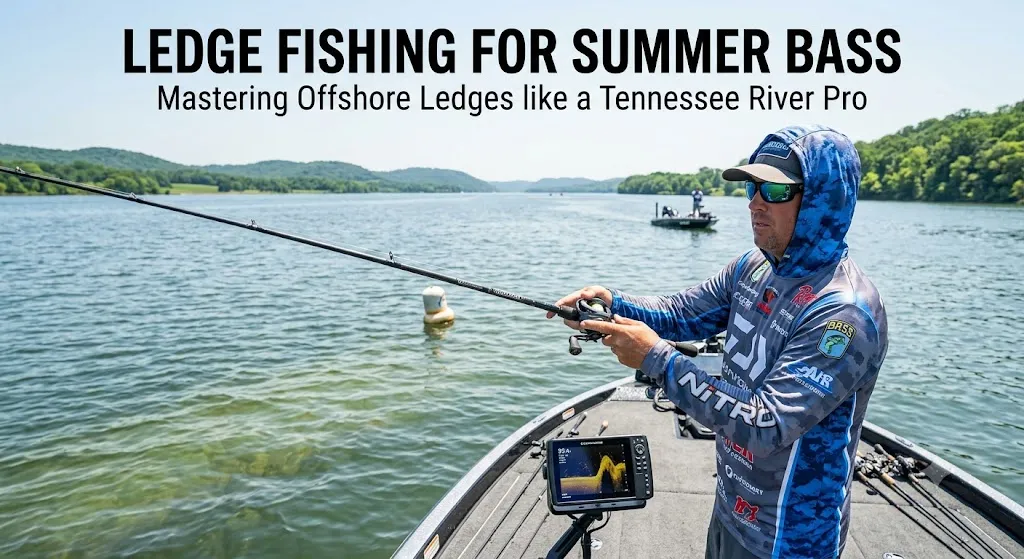
Written by Hudson Reed
Most anglers who lose summer bass on a ledge lose them by sitting on top of the school with a trolling motor instead of backing off 70 feet and bombing casts from a stake-out. That single positioning mistake costs more fish than wrong-lure choice, wrong-line choice, and bad knots combined. Ledge fishing for summer bass isn't about owning forward-facing sonar. It's about knowing what a ledge actually is, why bass stack on it, and what to throw once you find one.
This is a tactical sequel for anglers who already know summer bass go deep but don't know how to fish them once they get there.
Ledge fishing is the practice of locating offshore depth transitions where the bottom drops from a shallow flat into the deeper river or creek channel, then concentrating casts on the high-percentage current breaks (shell beds, brush, mussel bars, channel bends) where summer bass ambush shad. It works on the Tennessee River, on northern reservoirs, and at a smaller scale on any pond with a defined deeper hole.
What is a ledge, really?
The word came out of the TVA lakes. On Kentucky Lake, Pickwick, Chickamauga, and Guntersville, the old Tennessee River channel cuts through the lake bed and leaves behind a hard edge where a flat (say, 12 to 15 feet) breaks off into the river channel (20 to 35 feet). That edge is the ledge. Bass park on the lip.
But the structural concept generalizes. A ledge is any defined break between shallower flat and deeper channel where bass can post up out of the heat and ambush bait moving along the drop. If your lake has a defined channel, you have ledges. Even a farm pond with a 6-foot flat tipping into a 14-foot hole is, functionally, a ledge.
Three pieces of ledge anatomy matter more than the rest:
- The flat-to-channel transition. This is the lip. The exact spot where contour lines pinch tight. On a graph, this is the wall.
- The shell bed or hard spot. Freshwater mussels colonize spots with current and hard bottom. Run your crankbait across the top of a ledge and feel for the difference between mud (mushy, no telegraph) and shell (gritty, ticks the bill). When the lure starts knocking, you found it.
- The current break. A submerged stump, a small high spot, a subtle bend in the channel. Anything that lets a bass sit out of the flow and watch shad get swept past.
If a ledge has all three (lip + shell + break), it's a community hole. If it has one, it might hold a couple of fish. If it has none, keep moving.
Why do bass stack on ledges in summer?
Three reasons, in order of importance: bait, comfort, ambush.
Shad school up offshore in summer. According to Brandon Lester's Bassmaster ledge fishing primer, threadfin and gizzard shad on the Tennessee River system spend the post-spawn slid out over the main lake basin, and the ledges are the cafeteria line. The bait runs the channel edges, the bass eat the bait, and current pins both groups to specific spots.
Comfort matters too. Largemouth on TVA lakes rarely live deeper than 20 feet because dissolved oxygen drops fast below that during the summer thermocline. The 15-to-20-foot ledge is the sweet spot. Cool enough, oxygenated, and full of food.
Then there's the ambush. The TVA generation schedule is the key. When the dam pulls water, current flips on across the lake, and bass that were lazy at noon get aggressive at 1:30 because shad start tumbling. If your lake has dam-controlled flow, get a TVA generation app on your phone. On reservoirs without generation, you're hunting wind-driven current instead, but the principle holds.
"They have something unique that concentrates the bass in a very small area."
(Brandon Lester, Bassmaster Elite Series pro, in his Bassmaster "Ledge Fishing 101" feature)
That sentence is the whole game. Don't look for ledges. Look for the thing on the ledge that pins fish to one cast.
You might also enjoy: Pike Fishing for Beginners: The Freshwater Predator Most Anglers Overlook
How do you find ledges without forward-facing sonar?
Skip the LiveScope debate. You don't need it. Anglers were winning Kentucky Lake derbies with paper graphs and a lead-core line forty years ago. Here's the modern workflow with traditional 2D and side imaging, which is what most of us actually own.
Step 1: Pre-fish on a contour map at home
Open Navionics, Lakemaster, or whatever app your unit uses. Find the main river or creek channel. Trace it on the map and mark every spot where the contour lines pinch tight against a flat. Bends, channel-swing points, junction holes where a creek channel hits the main channel. Those are your candidate ledges. Drop 15 to 25 waypoints before you ever launch the boat.
Step 2: Idle the candidates with 2D and side imaging
Run 2.5 to 3 mph. Watch your 2D screen for the wall of the ledge, and watch side imaging for the surface texture on top. Mud reads smooth and dark. Shell beds read like grainy sandpaper. Stumps and brush throw shadows. Bait shows as clouds, usually suspended a few feet over the structure. Bass show as arches or commas on 2D, and as bright dots with shadows on side imaging.
Step 3: Mark the sweet spot, then back off 70 feet and cast in
Once you mark fish or hard bottom, drop a waypoint right on it. Pull the boat 70 feet down-current and stake out with a Power-Pole or trolling motor anchor. Use a landmark on shore to line up your casts. Long bombs from a stationary boat catch more fish than 25-foot pitches from a boat constantly repositioning. The bass on a ledge are spooky, especially in clear water; the trolling motor over their head puts them off the feed.
If you've never done this, the try Bushwhack demo dashboard has a logging shape designed for exactly this kind of waypoint-driven offshore work. Log the depth, the structure type (shell, brush, bend), the lure, and the generation status. Three trips in, you'll start to see which combinations actually produce.
When to throw what: the four ledge baits
This is where most guides hand-wave. The honest answer is that the bait choice is dictated by the mood of the school, not your favorite rod. Here's the decision tree.
Flutter spoon: aggressive school, you saw them boil or your graph is lit up
A 4- to 5-inch flutter spoon (Nichols Lake Fork, Ben Parker Magnum) is the big-bait, big-bite tool. Cast past the school, let it fall on slack line, rip it up 3 to 5 feet, kill it. The flash and the slow flutter mimic a dying gizzard shad. It catches the biggest fish on the school. It also gets ignored when the bass are sluggish. If three casts produce zero strikes from a school you can see, switch.
Deep crankbait: covering water on a ledge you haven't fished before
A 6XD, 10XD, or Rapala DT-20 grinds the bottom across the top of the ledge and tells you two things: where the hard spots are (feel the bill tick), and whether there are players home (a fish will smoke it). It's a search bait first, a catching bait second. Don't lock onto cranking once you've located the school. Switch tools.
Football jig: post-frontal, slow bite, big-bass kicker
A 3/4-ounce football jig with a craw trailer crawled across the shell bed gets bites when nothing else will. It's a slower presentation, but on a school of finicky 4-pound-plus fish, it's often the only thing that draws a strike. Drag, pause, hop, pause. Feel for shells. When the bottom changes texture, slow down and milk that 4-foot patch.
Drop-shot: high-pressure or finesse situation
A 6-inch worm on a No. 1 or No. 2 hook with a 3/8-ounce weight, fished vertically over a marked fish or pitched out and pumped slowly, will out-fish everything else when the school has been pounded by tournament traffic. According to a Realtree feature on offshore ledge tactics, Elite Series pro Stetson Blaylock leans on a drop-shot with a Yum Sharp Shooter worm precisely for these high-pressure scenarios. It's the bait that puts fish in the boat after the spoon and crank have failed.
A contrarian opinion that will save you money: you don't need a 10XD if you can't crank it for 8 hours. A 6XD reaches 12 feet on 10-pound line, covers most lake ledges, and won't wreck your wrist. The 10XD and bigger are for guys who fish 25-foot ledges six days a week. Most weekend anglers do better with a 6XD and a flutter spoon than a 10XD they hate throwing.
How do you apply ledge logic to a northern reservoir or pond?
This is where most ledge content lets you down. Everyone teaches Kentucky Lake. Almost nobody teaches you how to translate it to a glacial lake in Minnesota or a 4-acre pond in Pennsylvania.
The translation isn't about scale, it's about finding the same three things on whatever water you have.
You might also enjoy: 2026 Fishing Regulation Changes Every Angler Should Know
On a northern highland reservoir (Smith Mountain, Raystown, Quabbin): the standing timber along the old river channel is your ledge. Find the channel on a map, run it, and look for trees still standing in 18 to 28 feet. The trees ARE the current break. Throw a deep crank parallel to the timber line, or drop-shot a worm vertically next to a marked fish.
On a glacial natural lake without a true river channel: hunt humps, mid-lake bars, and saddles between basins. A 12-foot hump topping out from a 22-foot basin is functionally identical to a Tennessee River ledge. Smallmouth especially stack on these, and a drop-shot with a goby imitator eats them up.
On a pond: find the deepest hole and the steepest break leading into it. It might be 8 feet to 14 feet, not 15 to 25. Shape is the same. A 1/4-ounce football jig or a small Acme Kastmaster worked along that break in July afternoons outproduces another lap throwing a frog along the bank.
The principle that travels: summer bass want depth, current or oxygen, hard bottom, and bait. If you can identify the spot on your water that has three of those four, you've found a ledge.
How long should you fish a ledge before moving?
Two casts with the right bait, or fifteen minutes with the wrong one. If you've graphed bait and arches and your first two casts with a spoon or crank don't draw a strike, change baits before you change spots. A school that ignores a deep crank will often crush a flutter spoon two casts later, and vice versa.
If you've cycled through three bait styles (search, reaction, finesse) and nothing happens, the school has moved or shut down. Hit your next waypoint. On a productive lake in the 2026 season, you should have 8 to 12 ledges in rotation, not 2 to 3. Ledge fishing is a milk run, not a stand-and-deliver.
What about generation timing and weather?
On TVA lakes, generation is the single biggest variable. The Tennessee Valley Authority publishes hourly generation forecasts for every dam at tva.com, and a free app like "TVA Lake Info" pushes the same data to your phone. Watch for the moment generation kicks on. The first 30 to 60 minutes of pulled water is often the most violent feeding window of the day.
Off TVA, you're playing wind. Wind blowing across a ledge creates the same horizontal current that pins bait and turns fish on. A bluebird, glass-calm afternoon on a lake without dam-controlled flow is the worst time to ledge-fish. A 10-to-15-mph southwest wind on a north-facing ledge is gold.
One thing the magazines won't tell you: forward-facing sonar has not killed ledge fishing on the Tennessee River the way it killed shallow tournament wins. The schools are too big and the lake is too vast. Anglers without LiveScope are still cashing checks on Pickwick and Kentucky Lake in 2026 because school-fish patterns reward boat positioning and bait selection more than picking off individuals. If you don't own forward-facing, ledges are the best place to fish.
Putting it together
A weekend ledge plan: Friday night, drop 15 waypoints on channel bends and contour pinches in your mapping app. Saturday morning, idle the top 5 with side imaging and confirm which have bait, hard bottom, and arches. Pick one, back off 70 feet, fire a flutter spoon and a deep crank. If they're feeding, milk the spot. If two casts come back empty, switch to football jig. If that fails, drop-shot vertically over the best mark.
You won't catch a fish on every ledge. You'll catch a fish on the right ledge. Logging which structures on which lake produce on which generation schedule is the difference between guys who guess and guys who run a milk run. Bushwhack exists because that pattern work is worth more than any new lure.
The bass are out there in 17 feet of water sitting on a shell bed the size of a parking space. Go find them.
Get fishing tips in your inbox
New guides, seasonal tactics, and gear picks — about once a month, no spam.