Winter Whitefish Fly Fishing in Utah: Where Pods Stack on the Provo, Weber, and Logan
 Cameron Spanos
Written by Cameron Spanos
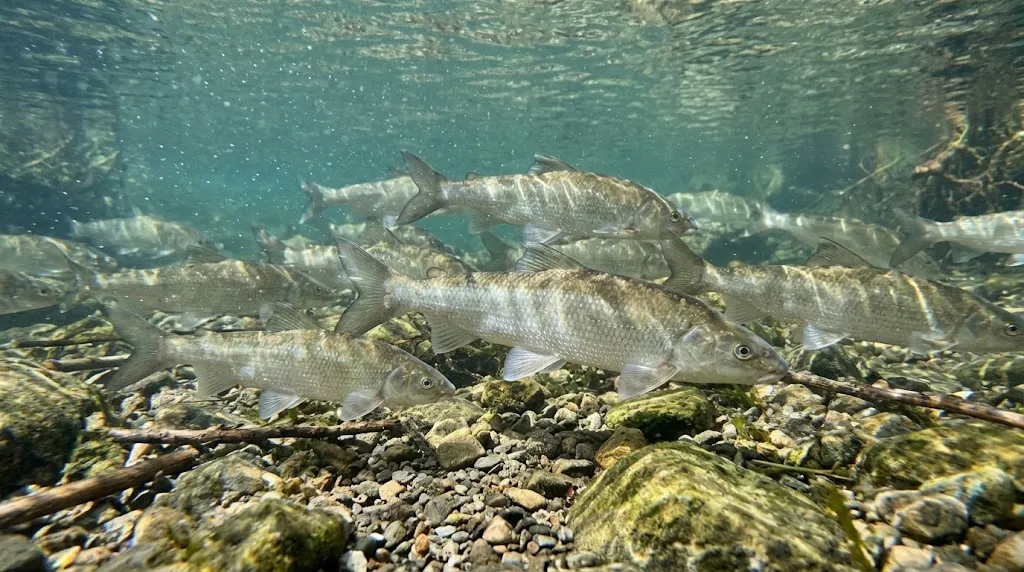
The best fish in a Utah river in January isn't a brown trout. It's the mountain whitefish everybody makes fun of, and if you're serious about winter whitefish fly fishing you already know why: on a 28-degree morning when the trout have gone to sleep in the soft water, whitefish are the ones still eating. They sit in pods, they take tiny nymphs, and they'll bend a 4-weight in water that otherwise feels dead.
This is how I'd go about it on the big northern Utah rivers: where whitefish stack up in winter on the Provo, the Weber, and the Logan, the small-nymph rig that finds them, and why most missed fish are a hookset problem, not a fly problem.
Why do whitefish keep eating when the trout shut down?
Because they're built for it. Mountain whitefish (Prosopium williamsoni) are native to northern Utah's rivers, and they've been living in cold, snowmelt rivers a lot longer than the browns and rainbows they share water with now. They're bottom feeders by design. The mouth is small and set back under a blunt snout, which is exactly the tool you want for picking midge larvae, sowbugs, and caddis off rocks all winter.
Trout don't quit eating in winter either, but they get picky about where and when. Every fish's metabolism drops in cold water, so trout tuck into slow water, feed in short windows, and let a lot of drifts go by. Whitefish slow down too. The difference is that they school up in the same slow water and keep grazing as a group, so once you find a pod you're rarely fishing to one reluctant fish. You're fishing to twenty of them, and one usually eats.
Timing helps too. Whitefish spawn in the fall, so by December they're done and back to feeding.
One more thing in their favor: they're a native fish with a long history in Utah research. Utah State's William Sigler studied them in the Logan River, and his 1951 life history and management study of mountain whitefish in the Logan River is still sitting in the USU archives.
Reading water for winter whitefish fly fishing
Think slow, deep, and boring. The riffles that hold trout in July are mostly empty in January.
What you're looking for is the slowest water in a run that still has some push to it. Walking-speed current. Depth you can't see the bottom of, or barely can. The tail end of a long, deep pool. The inside seam where a fast tongue of water slows down and spreads out over cobble. Big, uniform runs with a smooth surface tend to hold more whitefish than broken pocket water, because a pod needs room to spread out side by side.
Pods are the whole game. Whitefish school tightly, so a stretch of river can look empty for a hundred yards and then give up a dozen fish from one bus-sized slot. When you catch one, don't move. Make the same drift again, with the same depth and the same lane, before you change anything. If you've gone 20 minutes in a run that looks perfect without a touch, walk to the next one.
Timing matters more than location once you're in the right kind of water. The best window on most Utah rivers is late morning through mid-afternoon, roughly 11 to 3, when the water has warmed a degree or two and the midges start moving. Showing up at first light in January mostly gets you frozen guides.
Where they stack on the Provo, Weber, and Logan
Provo River
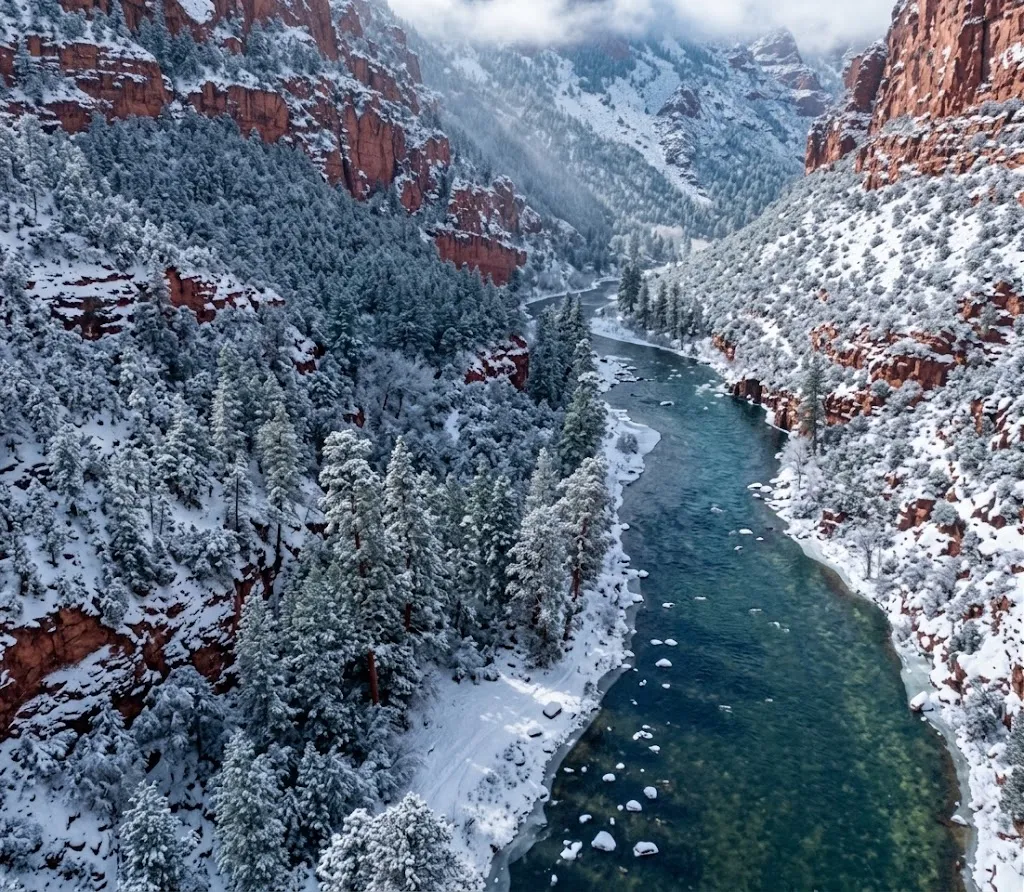
The Middle Provo, from Jordanelle down to Deer Creek, is the most consistent winter whitefish water in the state in my opinion. It's a tailwater, so the flows and temperatures stay steadier than a freestone river, and the bug life is dominated by exactly the small stuff whitefish eat: midges, sowbugs, and small mayfly nymphs. Look for the long, deep glides and the slow middle of the bigger bends. The Lower Provo below Deer Creek, through the canyon, holds plenty of whitefish too and gets far less winter pressure than summer pressure.
Weber River
The Weber below Rockport and on down toward Echo is a winter nymphing river with a reputation for big browns, and the whitefish are in the same water. The Weber is less predictable than the Provo because irrigation and reservoir operations swing its flows around, so pay attention to releases before you drive up. When it's low and clear in midwinter, the deeper slots below riffles and the slow runs along the I-80 stretch are where pods tend to sit.
You might also enjoy: Panguitch Lake Ice Fishing: Shallow Tigers, Cutthroat, and the Slot That Runs Backwards
Logan River
The Logan is a freestone canyon river, colder and moodier than the Provo, but it's whitefish country with a long scientific record behind it. In winter you're fishing the lower canyon and the water closer to town, not the high country (part of the upper river is closed in winter; see the regulations section below). Focus on the deeper plunge-pool tailouts and the slower runs between the pocket water.
What flies catch mountain whitefish in winter?
Small ones. That's most of the answer.
A whitefish's mouth is tiny, and its winter diet is mostly midge larvae and pupae, sowbugs, scuds, and small mayfly nymphs. Size 18 to 22 covers the bulk of what you need, with sowbugs and scuds going up to 16. You can catch them on a size 10 stonefly, but you'll hook more on a fly that fits their mouth.
Here's the short list I'd carry:
- Zebra midge, size 18-22, black and red. The default point fly on almost any Utah tailwater.
- Sowbug or scud, size 16-18, in gray, tan, or pink-orange. On the Middle Provo especially, a sowbug is often the best whitefish fly in the box.
- Pheasant tail or small Perdigon, size 16-20. Your heavier anchor fly when you need to get down fast.
- Small egg pattern, size 16-18. Egg patterns keep working into early winter after the fall spawns, and whitefish don't pass them up.
A little flash helps. A tungsten bead, a small hot spot, or a strand of flash in the thorax all seem to get noticed in cold, clear water. I wouldn't overthink color beyond that. Depth beats pattern every time with these fish.
The small-nymph rig that finds them
Indicator or euro rig, both work. If you already euro nymph, use it, because tight-line contact makes a subtle whitefish take easier to see. If you don't, a small indicator rig is simpler with cold hands.
Here's how I'd build the indicator version for a winter whitefish run:
- Start with a 9-foot 4X or 5X leader on a 9-foot 4- or 5-weight, and set a small indicator at roughly one and a half times the depth of the run, so the flies can reach the bottom of slow water.
- Tie on 18 to 24 inches of 5X fluorocarbon to a heavier anchor fly, like a tungsten pheasant tail or sowbug in size 16, which does most of the work of getting the rig down.
- Add a second fly on 12 to 18 inches of 6X off the bend of the first hook, usually a zebra midge in 20 or 22, because that's the fly most whitefish actually eat.
- Pinch on a small split shot above the first fly only if the anchor isn't ticking bottom every few drifts; if you're not snagging the river occasionally, you're too shallow.
- Make short, upstream casts and get a clean dead drift through the slow lane, mending so the indicator moves at the same speed as the surface current instead of dragging.
Two flies is plenty. Utah's general rules cap you at three artificial flies on a line anyway, and a third fly mostly adds tangles when your fingers are numb.
For euro nymphing, run the same two flies on a long mono leader with a sighter, keep the rod tip just ahead of the flies, and lead them through the slow seam at the speed of the bottom current. Whitefish takes on a tight line look like the sighter hesitating for half a second. That's it. No big dive.
Set the hook light (this is where most whitefish get lost)
The takes are soft and the mouths are small and soft, and those two facts together cost more winter whitefish than any fly choice. A whitefish often just stops your drift. The indicator twitches, slows, or tips sideways. The angler who's been waiting for a trout-style plunge never even sets.
So set on anything. Every pause, every twitch. It costs you nothing but a recast.
You might also enjoy: Fish Lake Ice Fishing: Weedline Perch, Mid-Depth Splake, and Deep Mackinaw
But set it light. A big, overhead trout hookset with 5X and a size 20 hook rips straight out of a whitefish's lip or pulls the fly away before it seats. What works better is a short, smooth lift or a low sideways sweep downstream, just enough to come tight, and then a soft rod and steady pressure for the fight. Whitefish roll and headshake, so don't horse them. If you're losing a bunch of fish right after the hookset, the fix is almost always to set softer and play them slower, not to switch flies.
Write down which runs held pods and what time they turned on. Patterns show up fast across a winter, and you can try Bushwhack to log catches, spots, and conditions instead of trusting memory.
Can you keep whitefish in Utah?
Yes, and the statewide limit is generous. According to the 2026 Utah Fishing Guidebook, the statewide daily limit for whitefish is 10, which sits separate from the four-fish combined trout limit. Special rules on certain waters change the math, and a couple of them matter on the rivers in this post:
- Logan River: from Card Canyon Bridge up to the Red Banks Campground highway bridge, the limit is 2 trout and whitefish combined, flies and lures only. Above the Red Banks bridge to the Idaho line it's also 2 combined, and that section is closed from Jan. 1 until 6 a.m. on the second Saturday of July.
- Provo River: the Middle Provo (Legacy Bridge up to Jordanelle Dam) and the Lower Provo (Deer Creek Dam down to Olmstead Diversion) both carry a limit of 2 trout under 15 inches, artificial flies and lures only. The stretch from Deer Creek Dam to Legacy Bridge runs under statewide regulations.
- Weber River: from the I-80 bridge near Wanship down to the first I-80 bridge above Echo Reservoir it's flies and lures only with a 2-trout limit, and below Echo Dam every cutthroat must be released.
Read the exact section you're fishing before you keep anything. The current guidebook covers the 2025-2026 regulation cycle, and the DWR says a new two-year cycle begins in 2027, so if you're on the water in January or February 2027, check the new guidebook rather than trusting this list.
Release most of them in winter, but a couple smoked or pickled are genuinely good eating. They have a reputation as bony and slimy that's half earned and half just people repeating it.
Whatever you decide to keep, handle the rest well. Whitefish are slick and they flop. Wet your hands, keep them in the net in the water, and don't squeeze. They're a native fish and a decent sign of a healthy river, which is reason enough to treat them like one.
Mountain whitefish vs. Bonneville whitefish (Bear Lake)
This trips people up because Utah has more than one whitefish, and the one most anglers catch in rivers isn't the one Bear Lake is famous for.
Mountain whitefish are the river fish. Light brown on the back, silver to white on the sides and belly, with a short, blunt snout and a little flap of skin on each nostril. They live in moving water across northern and central Utah, including all three rivers above.
Bonneville whitefish are a different species found only in Bear Lake, along with the smaller Bear Lake whitefish and the Bonneville cisco. Per the Utah guidebook's fish ID pages, Bonneville whitefish can reach 20 inches and four pounds, while Bear Lake whitefish never get bigger than about 10 inches, and the two are indistinguishable under 10 inches. They're lake fish, and the people who chase them in winter mostly fish small jigs or bait in the lake, not nymphs in a river. If you want to go deep on how these Bear Lake fish evolved, USU has a long-standing body of work on it, including a thesis on the systematics of Bear Lake's endemic whitefishes that compares them directly against Logan River mountain whitefish.
The Bonneville cisco is the fish people dipnet at Bear Lake in January, which is its own thing entirely.
Winter on the big Utah rivers can feel slow if you only fish for trout. Fish for whitefish and it turns into some of the most consistent nymphing of the year. If you want to see how other anglers keep track of that kind of seasonal pattern, take a look at Bushwhack's features.
Get fishing tips in your inbox
New guides, seasonal tactics, and gear picks — about once a month, no spam.