Green River Winter Fly Fishing Below Flaming Gorge: Midges, Flow Bumps, and an Empty A Section
 Cameron Spanos
Written by Cameron Spanos
The Green River below Flaming Gorge Dam doesn't sit at 47 degrees all winter, whatever the shop chatter says. Last January the USGS gauge at Greendale, a short way below the dam, averaged about 41.5°F, and February slid to roughly 40°F. That five or six degrees matters more than any fly in your box, and it shapes nearly everything Green River winter fly fishing asks of you between December and the end of February: smaller bugs, slower drifts, a shorter feeding window, and a lot more patience in the soft water.
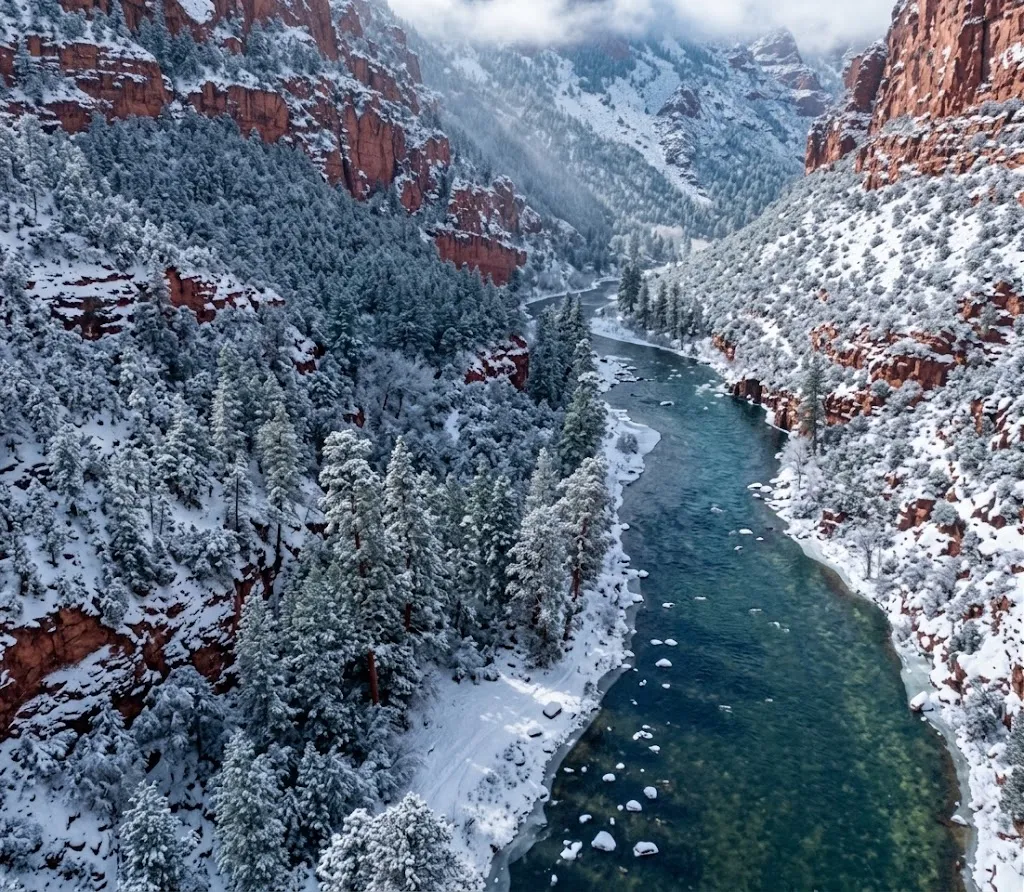
The good news is the part everyone already knows. The A section, packed shoulder to shoulder from June through September, goes quiet. On a weekday you can walk the trail from the spillway and have whole eddies to yourself.
Green River Winter Fly Fishing Starts at the Greendale Gauge
Before you pick flies, pull up the USGS Green River near Greendale gauge (09234500). It reports both flow and water temperature, and for a tailwater this close to the dam those two numbers tell you most of the story. Here's what the last four winters looked like on that gauge, December through February:
- Winter 2025-26: daily mean water temperature ran 40-45°F (about 43°F in December, 41.5°F in January, 40°F in February), with flows pinned between 840 and 871 cfs nearly the whole time.
- Winter 2024-25: water ran 38-45°F, flows mostly 900-1,260 cfs.
- Winter 2023-24 and 2022-23: water as cold as 37°F on the coldest days, and much bigger releases, roughly 1,750-2,260 cfs.
So the honest range is high 30s to mid 40s. Not 47. The dam keeps the river ice-free and fishable right below the outlet, but the water isn't warm, and trout in 40-degree water eat small, eat close to the bottom, and don't chase much.
Flow is the number that changes year to year, and it's the one to watch this winter. Reclamation's August 2026 Flaming Gorge Working Group minutes say it plans to continue drought-response (DROA) releases into the fall and winter, and the Greendale gauge averaged roughly 2,230-2,240 cfs a day through the last week of October. If anything close to that holds into December, this winter will fish more like 2023-24 than last year's low, steady 850. Treat last winter as the floor, not the forecast, and let the gauge tell you which winter you're actually getting.
Midges Carry the Whole Winter
From December into February you're fishing midges. Scuds and the odd egg or worm pattern still produce, and by late winter you can see the first blue-winged olives on gray days, but the food a Green River trout sees most often in January is a size 20-26 midge in some stage between larva and adult. Get comfortable with tiny hooks or stay home.
The subsurface tandem (most of your day)
The workhorse rig is two flies, both small, fished on or near the bottom. I like a size 18 tungsten zebra midge or an orange scud on the point, mostly as weight and as something a fish might eat anyway, with a size 22-24 pupa on a tag 18 inches above it. Flashy pupa with a bead or a bit of tinsel get the nod more often than plain ones in that slow, cold water. Run 6X fluorocarbon; drop to 7X for the top fly if the water's gin clear and the fish are refusing.
How you fish it depends on the water. In walking-speed runs and the inside seams below riffles, tight-line it. A sighter, a short leash to the flies, and a slow lead through the slot will out-detect an indicator on the subtle winter takes, which often look like nothing more than the sighter pausing for a half second. In the big, slow back eddies (and the Green has plenty of them in the A section) an indicator wins, because you need the flies to sit in one place and slowly spin through the foam line where the midges collect. A small yarn indicator set at roughly one and a half times the depth works fine there.
Weight is where most people get it wrong. In 41-degree water, fish hold in the slowest, deepest part of a run, and they won't move six inches up the water column for a size 24 pupa. If you're not occasionally ticking bottom, you're fishing over their heads.
You might also enjoy: Best Ultralight Spinning Rod for Trout and Panfish Under $100 (2026): 4 Picks by Job
The cluster dry on gray afternoons
Then there's the good part. On overcast, windless afternoons (and the colder and grayer, the better, oddly) midges hatch thick enough to ball up on the surface and fish start rising in the slow flats and eddy lines. This is when a size 18-20 Griffith's Gnat earns its spot. It isn't imitating one midge; it's imitating a clump of them, which is a much bigger meal and a much easier fly to see in flat light.
When fish ignore the cluster and sip singles, go to a size 22-26 adult midge or emerger and accept that you'll lose track of it. Trail it 18 inches behind the Griffith's Gnat so you have something visible to track, and set on any rise near the bigger fly. Bright, bluebird afternoons rarely produce the same surface activity. On those days, stay subsurface and save your eyes.
What Happens When the Dam Bumps Flows?
Flaming Gorge releases follow power demand as well as reservoir management, and they don't always run flat. You can see it on the gauge right now. From October 20 to 27, 2026, the daily average at Greendale barely moved (about 2,230-2,240 cfs), but inside each day the river swung from roughly 1,870 cfs in the early hours up to about 2,880 cfs, peaking in the evening, usually around 8:30 p.m. at the gauge. That's a thousand-cfs bump every single day hiding behind a flat daily number. Last winter's steady 850 was the exception, not the promise, so look at the gauge's hourly graph, not just the daily average.
When flows bump, fish move and they feed. Rising water pushes food off the bottom and shoves trout toward the banks and seams, and that's the short window when a streamer outfishes everything in your midge box. Expect the change to show up at your spot some time after it shows on the gauge, and the farther downstream you are, the later it arrives.
Here's my contrarian take: leave the big articulated streamer in the truck on a flat, steady, sunny winter day. A lot of anglers show up on a big-name tailwater in January and strip meat for six hours because it feels like the thing to do. At 850 cfs and 41 degrees with nothing changing, that's mostly cardio. Save the streamer for three situations: a flow change you can see on the gauge, a snow squall that drops the light, and the low-light last hour. In those windows, go small and slow. A weighted olive or black Woolly Bugger, a small leech, or a lightly articulated pattern swung and crept along the bottom of deep eddies and boulder banks will move fish. Fast strips in 40-degree water mostly move nothing.
Why the A Section Empties Out
The A section runs from the dam to Little Hole, about seven miles of canyon, and in summer it's one of the busiest stretches of trout water in the West. In winter you lose the hatches that bring the crowds (the cicadas, the hoppers, the big summer dry-fly days), you lose daylight, and you lose most of the out-of-state traffic. What you keep is a lot of trout in a river that never freezes near the dam.
That makes it the best wade-fishing season of the year on the upper river. You don't need a boat. The Little Hole National Recreation Trail follows the north bank from the spillway area at the dam down to Little Hole, and it's rocky and narrow in spots with boardwalks over the cliffier sections. Park at either end and work the eddies and riffles a mile or two in. At low winter flows like last year's 850 cfs, a lot of water that's unwadeable in June becomes reachable from the bank.
If you'd rather float, several Dutch John outfitters guide through the winter, and a short midday drift beats rowing yourself in 20-degree air.
You might also enjoy: Panguitch Lake Ice Fishing: Shallow Tigers, Cutthroat, and the Slot That Runs Backwards
Can You Still Get to Little Hole When It Snows?
Usually, but check before you commit. River access in the A section comes off two roads near Dutch John: the spillway road just below the dam, and Little Hole Road, which runs east off US-191 to the Little Hole day-use area. Conditions change storm to storm, so check before you go. This is remote country with little to no cell service, US-191 over the Uintas and through Dutch John sees real winter weather, and a day after a big storm is not the day to assume every lot is plowed.
Three things to do before the drive:
- Check road conditions on US-191 through UDOT Traffic the morning you leave, since that's the road between you and Dutch John from either the Vernal or the Wyoming side.
- Call one of the Dutch John fly shops and ask specifically whether the Little Hole road and the spillway access are plowed; they'll know that week's conditions better than any website.
- Check the Ashley National Forest recreation pages for current alerts, and carry a Flaming Gorge Use Pass (America the Beautiful annual and senior passes are honored in its place), which is required at both the Spillway and Little Hole day-use areas.
Below Little Hole: Colder Water and More Ice
The farther you get from the dam, the more the air gets a vote on water temperature. The B section, from Little Hole down to Indian Crossing in Browns Park, and the C section below it run colder through a hard winter than the water near the outlet, and shelf ice along the banks gets more common the farther you go. The dam's release water loses heat to the air with every mile of canyon, so a cold snap that barely touches the A section can put serious ice on the river by Browns Park.
That's why I'd keep a December-to-February trip focused on the upper A section, where the dam does the warming for you, and treat the B section as a bonus on mild spells. Shelf ice is a real hazard, not a nuisance. Never stand on it to reach a seam. It undercuts from below in moving water and you can't see how thin the lip is.
Small Details That Decide Cold Days
Start late. There's no reason to be on the water at first light in January; the best midge activity usually runs late morning into mid-afternoon, and an 11 a.m. start with a hot lunch on the bank beats two frozen hours at dawn. Expect your guides to ice up on any day below freezing. Dip the rod tip in the river every few minutes to clear them, and use a little guide paste or chapstick if you've got it. Rubber-soled boots shed snow; felt soles ball up into slick ice platforms on the walk in, which is a bad combination on the rocky sections of the Little Hole trail. And because bait isn't allowed on this stretch and special regulations apply below the dam, read the current Utah DWR fishing guidebook before you keep anything.
One more habit worth building: write down the flow, the water temp, and the fly every time you hook fish this winter. After a few trips you'll know whether your best Green River days come on bumps, on gray afternoons, or on the dead-flat days you'd normally skip. That's exactly the kind of pattern Bushwhack's catch log is built to surface, with weather and moon data attached to each entry automatically, so you're not trying to remember in March what the river was doing in January.
The Short Version for a January Trip
Watch the Greendale gauge for a week before you go. Pack 6X and 7X, size 20-26 midge pupa and larva, Griffith's Gnats, orange scuds, and a couple of small dark streamers. Fish the soft, deep water in the A section on foot, tight-line the walking-speed slots, hang an indicator in the eddies, and look up every time the clouds roll in. And when the flow changes, cut everything off and throw the streamer for an hour.
Winter is the one season you get a famous tailwater mostly to yourself. Worth the cold hands.
Get fishing tips in your inbox
New guides, seasonal tactics, and gear picks — about once a month, no spam.