Best Water Temperature for Fish to Bite: A Multi-Species Chart
 Hudson Reed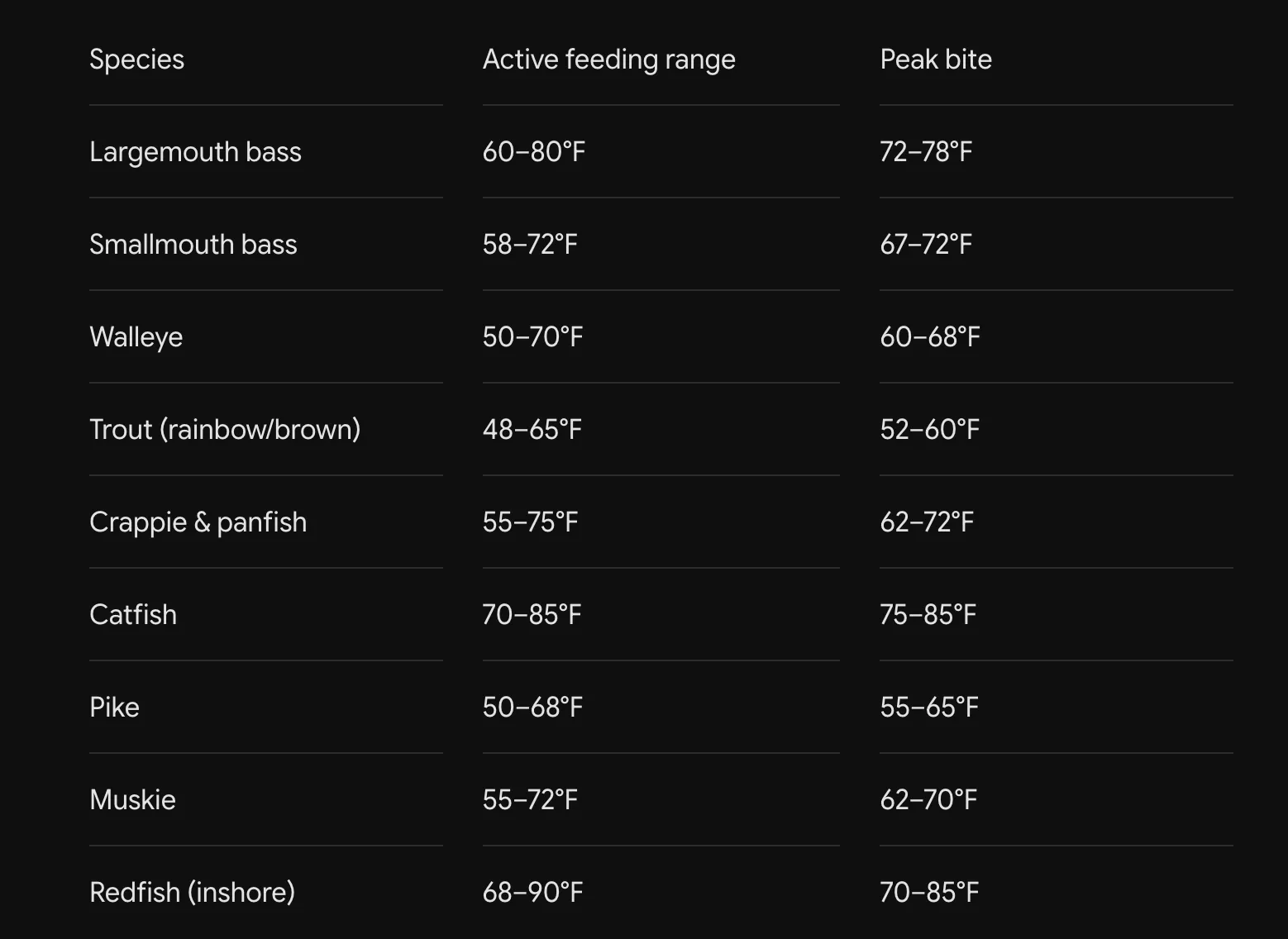
Written by Hudson Reed
Stick a thermometer in the water before you stick a hook in a fish. That one habit will out-fish half the guys on your lake who never bother. The textbook best water temperature for fish to bite isn't one number, it's a different window for every species, and once you know roughly where each fish wants to be, you stop wasting cold mornings throwing topwater at bass that are still half-asleep at 48 degrees.
Below is the chart most articles bury under 2,000 words of preamble, updated for the question everybody skips: which of these numbers come from actual fisheries agencies, and which are angler folklore that happens to work. Scan it, screenshot it, then keep reading, because the fall cooldown that starts in a few weeks rewrites every row.
Most freshwater gamefish bite best between roughly 55 and 75 degrees Fahrenheit. Largemouth bass peak around 72-78F, walleye around 60-68F, trout around 53-60F, and catfish keep eating into the mid 80s. Cold-water species get stressed above 68F, and most warm-water species go sluggish below about 50F.
The best water temperature for fish to bite, by species
These are surface-temperature feeding windows. The "peak" column is where the bite tends to be most aggressive, not the only place you'll get bit. And the last column says where each number actually comes from, because almost no agency publishes feeding temperatures. They publish spawn temperatures, since spawning is what they manage, and the feeding windows around them are guide and angler consensus. Pretending folklore is science is how bad charts get copied around the internet for a decade.
| Species | Feeding window | Peak bite | Where the number comes from |
|---|---|---|---|
| Largemouth bass | 60-80°F | 72-78°F | Angler rule of thumb. The sourced anchor point: Texas Parks and Wildlife puts the start of spawning near 60°F |
| Smallmouth bass | 58-72°F | 67-72°F | Angler rule of thumb. Likes it a touch cooler than largemouth; aggression fades once water pushes past the mid-70s |
| Walleye | 50-70°F | 60-68°F | Guide consensus. Minnesota DNR's sourced number is a 42-50°F spawn peak; they'll still eat near 40°F, just slower |
| Trout (rainbow/brown) | 48-66°F | 53-60°F | Vermont Fish and Wildlife lists 53-66°F as optimum for brown trout; USGS puts their common range at 41-77°F. Above 68°F, stop fishing for them |
| Crappie & panfish | 55-75°F | 62-72°F | Rule of thumb bracketed by sourced points: Minnesota DNR puts the spawn in mid-60s water, and the fall pull-off from summer brush starts below 70°F |
| Catfish | 70-85°F | 75-85°F | Summer-catfish consensus. Missouri Department of Conservation: channel cats don't even spawn until the water hits 75°F |
| Pike | 50-68°F | 55-65°F | Angler rule of thumb, except the 75°F stop-targeting line, which is research-backed (see below) |
| Muskie | 55-72°F | 62-70°F | Angler rule of thumb; tolerates a touch more warmth than pike, but the same research-backed 75°F line applies |
| Redfish (inshore) | 68-90°F | 70-85°F | Inshore guide rule of thumb. Hard cold snaps into the low 50s shut the bite off and push fish into deep holes |
A few of those numbers shift a degree or two depending on who you ask, and that's the honest state of the science. Walleye are the classic case. The 60-68°F peak is what most guides quote, yet plenty of those same guides will tell you their best walleye fishing of the year happens in the fall as the water drops through the upper 50s. Both are right. Which brings us to the part of the chart that actually matters.
Is the surface temperature the temperature that matters?
Not exactly. The chart says "surface temperature," but your fish are usually not at the surface.
In summer, a lake stratifies. The top layer might read 84 degrees while bass are sitting at 18 feet where it's a comfortable 72. The surface number still matters because it tells you what layer the fish are avoiding, but don't assume the thermometer reading equals the temperature where the fish are holding. On a hot August afternoon the surface temp is a "stay away from the shallows" signal, not a "the bass are miserable" signal.
The bigger trap: the same temperature reads completely differently in spring versus fall.
Sixty-two degrees on a warming spring lake means fish are sliding shallow, metabolism waking up, moving toward the spawn. They're optimistic. Sixty-two degrees on a cooling fall lake means the opposite migration is underway, and fish are often gorging before winter. A spring 62 and a fall 62 can produce two totally different bites in the same spot. Direction of change matters as much as the number itself, which is something a static chart can never show you.
What's the single most important reading?
The change since your last trip. A two-degree warm-up after a cold front is worth more information than the absolute number. Fish respond to trend. If your lake jumped from 55 to 59 over a warm weekend in April, the crappie just got a lot more catchable, full stop.
The warm-water crowd vs. the cold-water crowd
Group the species and the whole thing gets easier to remember.
You might also enjoy: Best Suspending Jerkbaits for Fall Bass (2026): Picks by Water Temp & Clarity
Trout, walleye, pike, and muskie are the cool/cold-water crew. They thrive where the water holds more dissolved oxygen, and they get stressed when it warms up. This is straight physics: cold water holds more oxygen than warm water, so a trout in 70-degree water is fighting low oxygen and high metabolic demand at the same time. The agencies actually publish numbers here. Vermont Fish and Wildlife lists 53 to 66 degrees as the optimum range for brown trout, and the USGS species factsheet has browns commonly living in 41-77°F water, though the top of that range is survival, not comfort. That's why summer trout fishing means chasing cold inflows and tailwaters, and why you target walleye at first light before the surface heats.
Largemouth, catfish, and redfish are the warm-water crowd. Their best feeding lines up with water that would have a trout gasping. In Texas, largemouth don't even start spawning until the water reaches about 60°F, per Texas Parks and Wildlife, and the Missouri Department of Conservation notes channel catfish hold off spawning until the water hits 75°F. Catfish are the extreme case: angler consensus says they eat harder as the thermometer climbs into the mid-80s, which is exactly why catfishing is a summer-night game.
Crappie, panfish, and smallmouth live in the middle, which is why they're so popular. There's a wide band of comfortable water where they'll cooperate.
Here's a take that'll annoy some people: I think the published "optimal" range gets quoted way too rigidly. I've caught plenty of largemouth in 58-degree water that the chart says should have them sluggish, and I've watched textbook 74-degree water produce nothing because a front had just blown through. The range is a starting hypothesis. It is not a guarantee, and treating it like gospel is how you talk yourself out of fishing a perfectly good day.
What happens to these numbers in the fall?
The chart runs in reverse, faster than most anglers adjust.
Late August is the annual peak on most lakes. From here through November the surface sheds a few degrees a week, and every species drops back through its window on the way down instead of up. The catfish bite fades first. Bass feed harder as the water falls through the 70s and 60s, chasing bait ahead of winter. And the cold-water crew wakes up: fall walleye turn on as the surface slides through the upper 50s, and brown trout feed aggressively ahead of their spawn, which Vermont Fish and Wildlife pegs at an optimum of 44 to 48 degrees, typically late October through December.
Crappie run the cleanest fall script of any species, and it lines up with the chart: they hold on summer brush until the surface drops below 70°F, slide to deep timber and channel bends through the 60-to-50 stretch, then settle into basin holes below 45°F. That below-45 basin school is the same one you'll drill on at first ice, which is why the best first ice panfish anglers find their spots in November, not January. We've mapped where crappie go in the fall stage by stage if you want the full depth-by-temperature version.
One fall wrinkle the chart can't show you: turnover. When the surface cools enough to match the depths, the whole lake mixes, and for a week or two fish scatter and every band in the table gets scrambled. The fastest way to tell if your lake has turned over is the same tool this whole article is built on: a surface reading and a deep reading that suddenly match.
Don't fish for pike and muskie when it's too warm
This one isn't about catching more, it's about not killing fish. The widely cited rule among esox anglers is to stop targeting pike and muskie once water temperatures climb past 75°F.
The problem is delayed mortality: a big fish fought in warm, low-oxygen water can swim away looking fine and die hours later. West Virginia University researchers radio-tagged muskies specifically to study warm-water release mortality, and they point out that the only earlier study on the question, by Carleton University's Sean Landsman, observed no mortality below 75 degrees, which is where the line got drawn. Outdoor Life's review of the research lands in the same place: most studies concur that you shouldn't target pike and muskie above 75.
It's the same discipline as knowing when to stop fishing for trout in summer. Trout anglers walk away at 68°F, esox anglers at 75°F, and in both cases a fish swimming off is not proof it survived. So when your surface thermometer reads 78 in August, the chart isn't telling you the muskie bite is slow. It's telling you to go catch catfish instead and leave the muskie alone until the cooldown pulls the water back under the line.
You might also enjoy: Best Polarized Fishing Sunglasses Under $100 (2026): Top Picks Compared
Why does temperature drive the bite at all?
Fish are cold-blooded, so their body temperature, and therefore their metabolism, tracks the water around them. Warmer water (up to a point) means a faster metabolism, faster digestion, and a fish that needs to eat more often. That's the aggressive bite.
But temperature and oxygen pull against each other. Warm water holds less dissolved oxygen, and a fish's oxygen demand goes up as it warms. Push past a species' comfort zone and the fish hits a wall: high metabolic demand, not enough oxygen to support it. At that point survival beats feeding, and the bite dies. Fondriest's dissolved oxygen reference puts numbers on it: warm-water gamefish like largemouth and bluegill depend on dissolved oxygen above 5 mg/L and start avoiding water below 3, while most trout and salmon eggs die when it falls under 6.
That tug-of-war is the whole story. Every "optimal range" in the chart is just the sweet spot where metabolism is high enough to drive feeding but oxygen is still plentiful enough to support it.
The part every chart skips: find your lake's real number
Here's what twenty fishing articles won't tell you. The chart is a national average. Your water has its own pattern.
The largemouth in a shallow, fertile Florida pond behave differently than the largemouth in a deep, clear northern reservoir, even at the identical temperature. Forage timing, water clarity, oxygen, fishing pressure, the spawn calendar at your latitude: all of it nudges the real bite window off the textbook number. Your lake's smallmouth might absolutely fire at 64 degrees every single spring while the chart insists the peak is 70.
You only learn that by keeping records. And not vague ones. The catch that taught you something is the one where you wrote down the water temp, the date, and what was happening with the weather.
Do that for a season and a pattern emerges that's worth more than any chart: your personal sweet-spot for each species on your water.
How many trips before a pattern shows up?
About a dozen, in my experience, if you're logging the water temperature on every fish. After ten or twelve outings across a range of conditions you'll start seeing the same temperatures show up next to your best days. Two seasons and it's locked in. The anglers who seem to "just know" when the bite turns on aren't psychic. They've simply been paying attention to the thermometer for years and remember what worked.
The honest catch is that manual logging is a pain, and most of us quit after three entries in a damp notebook. That's the gap Bushwhack closes. Log a catch and it auto-captures the water temperature alongside air temp, barometric pressure, time of day, season, and moon phase, then surfaces the patterns on a dashboard so you're not doing arithmetic on graph paper. The textbook hands you the broad range. After about a dozen logged trips, Bushwhack's features show you the narrower window your fish actually live in, no charting required.
Buy the cheap floating thermometer. Take the reading before your first cast. Write it down next to every fish, or let something log it for you. Start now, while the fall slide is about to put the numbers in motion, and by ice-up you'll have a temperature chart with exactly one species and one lake on it: yours. That's the only chart that ever really mattered.
Get fishing tips in your inbox
New guides, seasonal tactics, and gear picks — about once a month, no spam.