Where Do Crappie Go After the Spawn? A Summer Brush Pile Depth Guide
 Hudson Reed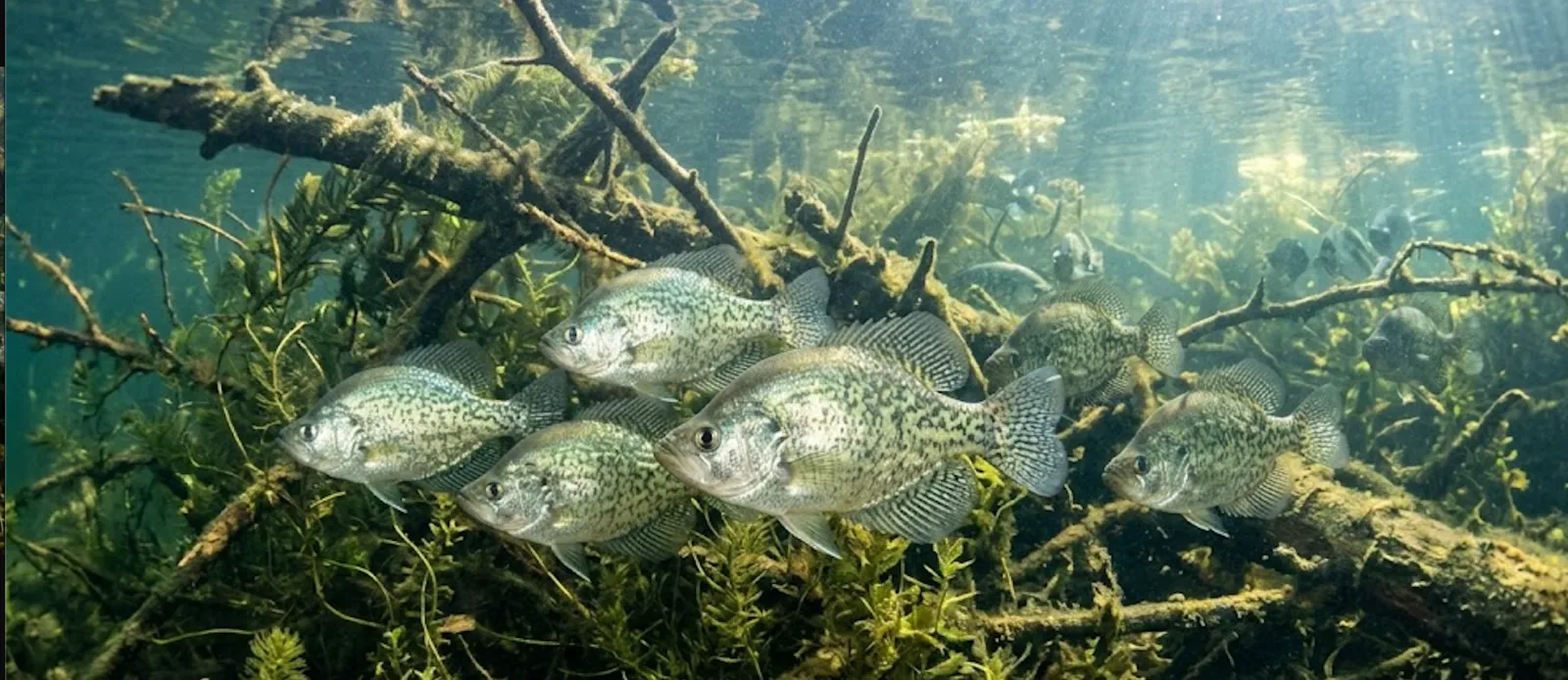
Written by Hudson Reed
The crappie spawn ended two weeks ago and your favorite shallow stump row is dead. No swirls. No bites. The fish you slabbed in late April have vanished, and the guys posting hero shots on Facebook are not fishing the bank anymore. So where do crappie go after the spawn? They do not go far. They drop down the breakline a little at a time, follow the bait and the oxygen, and settle onto the deeper wood you should have been mapping in March.
This is a depth chart, not a timeline. Lakes south of I-40 hit these phases six weeks ahead of lakes in Minnesota or upstate New York, so use your surface temp gauge, not the calendar.
Where Crappie Go in the First Two Weeks After the Spawn
Females finish first. The bigger eggs are dropped, they pull off the beds, and within a couple of days they are feeding again on the first piece of structure between the bank and the channel. Males stay on the beds longer to guard fry, look beat up, and are usually the last to leave the shallows.
According to the Missouri Department of Conservation, post-spawn crappie through September "tend to stay in brush located in 15 to 20 feet of water, about 10 or 15 feet down." That's the destination. But for the first two or three weeks after the spawn ends, expect to find fish on the staging structure they used on the way in: dock ends in the back third of spawning coves, the lip where a flat drops into the creek channel, blowdowns sitting in 10 to 15 feet of water.
Larger males need recovery time. If the chewed-up post-spawn males are gone from the bank but the deeper brush is not loaded yet, give them another ten days. Black crappie tend to linger shallow longer than white crappie, which usually scoot offshore faster after their spawning chore is done.
What to throw here: a 1/16 oz jig with a 2-inch soft plastic, fan-cast over the structure, slow countdown to depth, swimming retrieve. Live minnows under a slip float pegged a foot off the brush works on the lazy afternoons when nothing wants a jig.
Midsummer: 15 to 20 Feet on Channel-Edge Brush
When the surface hits the mid-70s, the lake stratifies. A thermocline forms (a narrow band where warm oxygenated water above meets cold, oxygen-starved water below). In most reservoirs that band sits somewhere between 12 and 25 feet down. Crappie set up just above it.
This is the classic Missouri-DNR pattern: brush piles in 15 to 20 feet of water, fish hanging 10 to 15 feet down. The brush sits a little above the thermocline. The bait stacks against the brush for the cover. The crappie hover at the depth where temperature, oxygen, and shad all line up. Find that band on your graph and you have found 80 percent of the summer fish in the lake.
How do you find the thermocline on a fish finder?
Crank your sensitivity up. The thermocline shows on 2D sonar as a fuzzy horizontal band, lighter than the bottom return but clearly there. Like a layer of smoke hanging in the water column. On most Humminbird and Lowrance units you'll see it once the gain hits around 80 percent. Note that depth. Every brush pile near that depth is in play. Brush piles 10 feet below it are dead water.
Reading brush piles vs reading fish on the graph
A brush pile on down-imaging looks like a tangle of branches splayed up off the bottom: bright, sharp, with shadows underneath. On 2D it shows as a thick clump of returns rising off the floor, usually with the densest mark a foot or two off bottom and twiggy returns above. Crappie on the brush show up as small distinct marks just above or tucked into the cover. If you see vertical stacks of marks above brush, that is a school in feeding mode and you should already be dropping.
You might also enjoy: Pike Fishing for Beginners: The Freshwater Predator Most Anglers Overlook
On forward-facing sonar, individual fish flash as bright dots that move when you twitch the rod tip. The first thing you'll learn from FFS is how often crappie ignore your jig. They will sit two feet off the bait and just look. The second thing you'll learn is that the fish on the brush were not the fish you needed to catch. The ones cruising five feet above it are.
Vertical Jigging vs Spider Rigging the Brush
Two ways to fish a summer brush pile, and the choice is not about which one is better. It is about whether the fish are locked into the cover or roaming over it.
Vertical jigging is for committed fish. When the school is sitting tight in the limbs of a single brush pile, you anchor or spot-lock over the top, drop a single jig or minnow straight down on a long pole (10 or 12 footers are the standard B'n'M setup), and pick the cover apart depth by depth. You're not casting. You're hovering the bait a foot above each section of the brush, then six inches, then in the limbs. When you get bit, that's your depth for the next hour.
Spider rigging is for spread-out fish. Eight rods off the front of the boat, fan-arranged in rod holders, double-jig rigs, troll at 0.2 to 0.4 mph through a corridor between brush piles. You are covering 200 yards of water at six different depths simultaneously. It shines when crappie are between structure rather than buried in it, which happens a lot in midsummer when the school spreads out to chase shad along a channel edge.
My take: most weekend anglers over-spider-rig. If you have a graph and you can see fish locked on a brush pile, sit on top of them and pick the pile apart. Spider rigging is a discovery tool for finding the productive depth across a stretch of water. Once you find the fish, vertical fishing puts more in the box per hour.
Single hook or double hook in brush?
Single. The double-jig rig is fine over open water but in thick limbs you will hang up twice as often and lose twice as many fish when a hooked crappie wraps the dropper around a branch. Save the doubles for spider rigging away from cover.
When the Heat Pushes Fish Deeper: Suspended Over 20+ Feet
Late July and August in the South, or any week the lake surface tops 85 degrees, the fish stop relating to brush in 15-20 feet of water. They suspend.
You'll find them holding 15 to 18 feet down over 25 to 35 feet of open basin water, often hovering over the deepest brush piles in the lake but well off the cover. They are following oxygen and shad, and the brush is more of a reference point than a hiding place. This is the hardest period of the year for shore anglers and the easiest for anyone with a graph.
Drop a small jig (a 1/16 or 1/8 oz head with a 2-inch shad-pattern body) to the exact depth the school is holding and pendulum it gently. Big white shad-imitator plastics, the same color as whatever the lake's threadfins look like, work most days. If the fish are deeper than 20 feet, use a heavier head so you can actually feel the bait.
You might also enjoy: Best Kids Fishing Rod and Reel Combo for 2026: Dock Demon vs Ugly Stik GX2 vs PLUSINNO
Can crappie just go below the thermocline?
No. In a stratified lake, the water below the thermocline can drop to 2 ppm dissolved oxygen or lower. Crappie tolerate low oxygen better than bass but they do not stack up in dead water. Anything you see on the graph below the thermocline in midsummer is debris, a stray catfish, or sonar noise. Save your time and fish above the line.
The Night Bite: An Underrated Summer Pattern
If your day bite collapses by 10 a.m., flip your schedule. Crappie feed actively at night in summer and they come shallower to do it. Often as shallow as 6 to 10 feet, right under lit bridges, dock lights, and submerged green lights you set yourself off the back of the boat.
The process is mechanical. Light hits the water. Phytoplankton drifts toward it. Zooplankton follows the phytoplankton. Shad and small minnows show up for the zooplankton. Crappie show up for the shad. The whole food web stacks under a single 1,000-lumen submersible green light within an hour of sunset, and it works on any reservoir, every summer, almost without fail.
Best spots: lit bridges with riprap on both ends and the creek channel running through the middle, marina dock lights, fishing piers with overhead lights, your own light hung off the back of the boat anchored over a brush pile in 15-20 feet of water.
Tackle: 1/32 or 1/16 oz jig, glow chartreuse or pink, vertically dropped right into the lit zone. Live minnows on a slip bobber set to the depth you see fish on the graph. That is it. The fish do most of the work.
The Two Numbers That Matter More Than Calendar Date
Surface temperature and thermocline depth. Everything else (your jig color, your boat position, your rod length) adjusts off those two readings. A late-May day with 72 degree surface temps and no thermocline yet means fish are still on the post-spawn flats in 10-15 feet. The same lake in late June with 84 degrees on top and a thermocline at 16 feet means everything has dropped to brush in the 15-20 zone and the night bite is firing.
If you log your catches with depth and surface temp every trip, you start to see your lake's pattern stack up over years. Two summers of data on a single reservoir is more useful than ten generic articles. Track it in a notebook, a spreadsheet, or use Bushwhack to log catches with depth and conditions so the pattern comes out of your own water rather than someone else's.
Quick Depth Reference
- Late spring (1-3 weeks post-spawn): 10 to 15 feet, dock ends and channel-edge brush, females first then males.
- Early to midsummer: 15 to 20 feet of water, fish 10 to 15 feet down, brush above the thermocline.
- Hottest weeks of summer: Suspended 15-18 feet down over 25-35 ft basin water near the deepest brush.
- Night bite (any summer night): 6 to 10 feet under lit bridges, dock lights, and submersible greens.
The crappie did not leave the lake when the spawn ended. They just stopped being where everyone else was fishing.
Get fishing tips in your inbox
New guides, seasonal tactics, and gear picks — about once a month, no spam.