Does Moon Phase Fishing Work on YOUR Lake? Run the Experiment
 Hudson Reed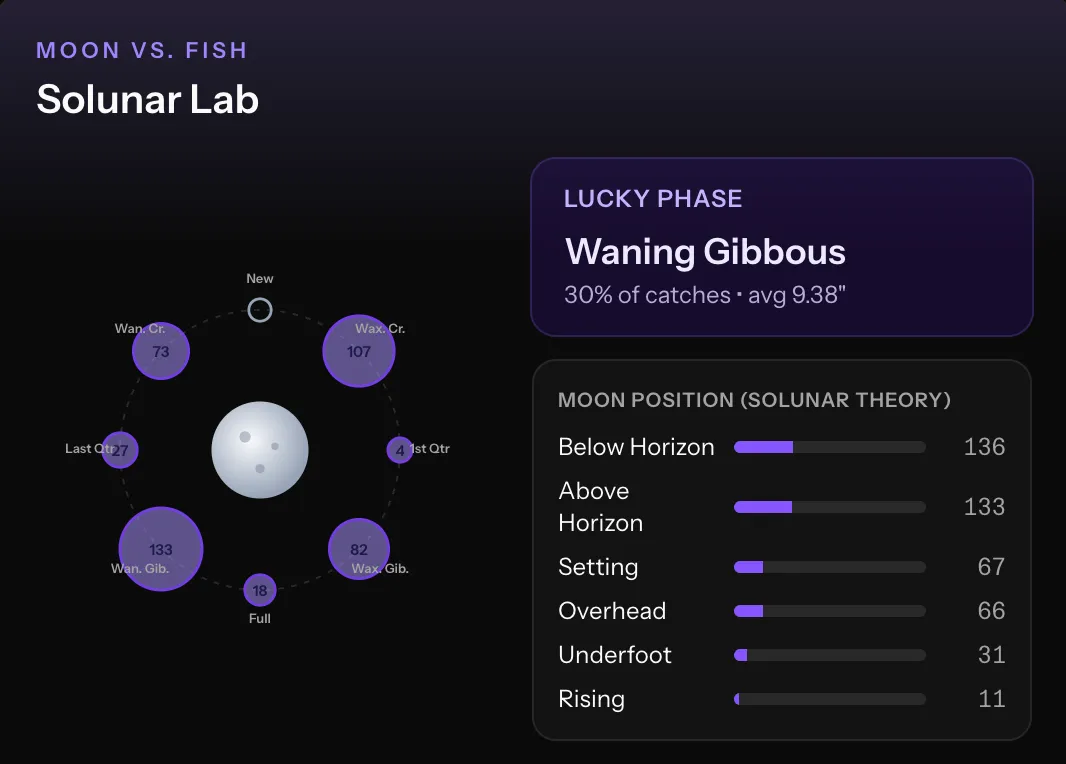
Written by Hudson Reed
Pull up any solunar app and it will hand you a verdict: today is a "good" fishing day, tomorrow is "poor," and there are two green-shaded bars telling you exactly when the bite should fire. Confident. Specific. Built from a generic almanac calculation that has never once seen your lake. So here is a better idea than arguing about whether the moon phase fishing table is right: run your own experiment and let your water tell you. This post is not about whether solunar theory works in general. It is about how to test it on the only body of water that matters to you, with your species, and settle the question with data you collected yourself.
I'll keep the theory short, because the science has already been chewed over (including elsewhere on this blog). The interesting work is the experiment.
The 90-second version of solunar theory
Outdoor writer John Alden Knight cooked up solunar theory back in 1926 and published it in 1936, after logging observations from over 200 hunting and fishing outings. He looked at 33 variables and decided the position of the sun and moon mattered most. The framework he left us has four daily windows: two major periods (roughly an hour each, when the moon is directly overhead or underfoot) and two minor periods (about 30 minutes, around moonrise and moonset). Layer on the phase claim that new and full moons trigger the strongest feeding, and you have the modern solunar table.
The evidence? Genuinely mixed. A North Carolina Sea Grant review of 190 studies on pelagic species found 51% of fish swam deeper as moonlight increased and only 5% moved shallower, with responses that were wildly species-specific rather than universal. A long-running study at Escanaba Lake in Wisconsin tracked walleye and muskie catches across 13 years and more than 4,700 angler trips; lunar phase and the moon's overhead/underfoot position did nudge the odds of a successful walleye trip, but the effect was tiny (Cohen's d under 0.2) and got dwarfed by light intensity, air temperature, wind direction, and whether the angler used live bait or a guide.
So the moon is real and probably does something. It's just not the master switch the green bars imply. Which is exactly why a generic table is the wrong tool and a personal experiment is the right one.
Why a generic solunar table can't answer your question
The table on your phone is computed from astronomy. It does not know that your lake is 40 feet deep with a thermocline that parks the walleye at 22 feet in August. It does not know your smallmouth go nocturnal in July, or that the reservoir three miles away gets drawn down every fall for the dam. Knight's framework was built on his outings, in his era, on his water.
Fish respond to the moon (when they respond at all) through local mechanisms: light penetration in clear versus stained water, how moonlight shifts overnight feeding so dawn comes slow, tidal range if you're coastal. None of that is in the almanac. The only way to know how the moon plays on your water is to measure it there.
Here's my contrarian take: most anglers who swear by solunar tables have never actually tested them. They remember the great trip that landed on a major period and forget the three skunks that also did. That's not evidence. That's memory doing what memory does. The fix isn't more faith or more skepticism. It's a logbook.
How do you design a moon-phase fishing experiment?
You're running an observational study on your home water. The goal is to isolate the moon's signal from everything else that drives a bite. Four things make or break it.
Pick one water and one or two species. Don't pool your bass lake with your trout stream and your saltwater flats. Different systems, different moon mechanics, and mixing them turns your data to mush. One lake, one or two target species. That's your study.
You might also enjoy: Same Spot, Different Day: Why You Got Skunked Where You Slayed Them
Define "success" before you start. Decide your metric up front so you can't move the goalposts later. Fish per hour is the cleanest (it accounts for trips of different lengths). Or biggest fish of the trip if you're chasing size. Pick one and write it down.
Log everything, every trip. This is where almost every personal experiment dies. People log the good days and skip the skunks, which deletes exactly the data that tells you when not to fish. You need the grinds and the blowouts in there too.
Capture the confounds. The moon never acts alone. A cold front, a pressure crash, a season change, the wrong time of day. Any of these can swamp a lunar effect. If you don't record them, you can't separate them later, and you'll credit the moon for a bite that the falling barometer actually caused.
That last point is the one that quietly ruins most homemade experiments, so it's worth being concrete about what to record.
What to log on every trip
- Moon phase and solunar period: the phase (new through full) and whether your fishing window overlapped a major or minor period.
- Catch count and times: what you caught, how big, and when each fish hit.
- Hours fished: so you can compute fish per hour instead of raw counts.
- Weather and barometric pressure: including whether a front was moving through. The pressure trend matters more than the absolute number.
- Water and air temperature: seasonal water-temp swings drive feeding harder than the moon does.
- Time of day: dawn and dusk light was the single strongest predictor in the Escanaba walleye data, ahead of every lunar variable.
- The skunks: log the zero-fish trips with the same detail. They're not failures. They're data points.
Reading that list, you can probably feel the problem. Recording seven variables, accurately, on every single trip, for a whole season, by hand? Almost nobody does it. The notebook gets left in the truck. This is the exact reason most personal moon experiments never produce an answer.
It's also why a logging app earns its keep here. Bushwhack auto-records the moon phase, weather, barometric pressure, water and air temperature, time of day, and season on every catch you log, the moment you log it. The experimental dataset builds itself. You tap to record a fish, and the seven variables you'd otherwise have to chase down attach automatically. The single biggest reason these experiments fail (nobody logs consistently for a whole season) basically disappears.
How long do you need to run it?
Longer than you want to. This is the unglamorous truth.
The moon cycles every 29.5 days, so a single month gives you exactly one new moon and one full moon. One. You cannot draw a conclusion about full-moon fishing from a single full moon, any more than you'd call a coin biased after one flip. You need repeats of each phase.
Aim for a full season of regular trips, ideally 30-plus, spread so you hit each moon phase several times. The Escanaba researchers needed 13 years and thousands of trips to tease out an effect that turned out to be small; you're not going to settle it in three weekends. Thirty to fifty logged trips across a season won't give you a peer-reviewed result, but it'll give you something far more useful: a read on your water that no almanac can sell you.
And keep going across years if you can. A logbook compounds. Year two of data on the same lake is worth more than year one, because now you can compare the same phase across different seasons and start separating "full moon" from "October."
You might also enjoy: How Barometric Pressure Affects Fishing (And How to Know If It Matters on Your Water)
Reading your results without fooling yourself
Say you've got a season logged. Now comes the part where smart anglers trick themselves. A few traps to step around.
Confirmation bias. You will remember the fish that fit the theory and forget the ones that didn't. The whole point of writing it all down is to overrule your memory with the actual tally. Trust the spreadsheet, not the story you tell at the ramp.
The confound trap. This is the big one. Suppose your three best trips all landed on a major period. Feels like proof. But what if all three also happened to fall on a falling barometer the evening before a front? Then you can't tell whether the moon or the weather did the work. Confounding variables (factors that move with both the moon and your catch) create fake correlations and hide real ones. The only defense is to have logged the weather too, so you can hold it constant.
That's the second place a tool with rich data pays off. Because Bushwhack captures the barometric trend, temperature, time of day, and season alongside the moon phase, you can filter your own catches to compare like with like: look only at your dawn trips, or only at stable-pressure days, and see whether the moon still shows a pattern once the front that rolled through is held still. That's the difference between "I caught fish on a full moon" and "I caught fish on a full moon after controlling for the weather." One is a coincidence. The other is a finding.
Small samples lie. Two good full-moon trips out of three is a 67% "hit rate" that means nothing at three trips. Be suspicious of any pattern built on a handful of outings. Real patterns survive more data. Flukes evaporate.
A simple way to actually score it
- Group every logged trip by moon phase, or by whether it overlapped a major solunar period.
- For each group, average your chosen metric. Fish per hour is the honest one.
- Compare the groups. Is the gap big and consistent, or could a couple of lucky trips explain it?
- Re-run the comparison inside a controlled slice: same time of day, similar pressure. Does the moon difference hold up, or did it vanish once you removed the confound?
- Write down what you find, and update it as more trips come in. A conclusion from 40 trips can flip at 80.
If the moon effect survives that scrubbing on your water, congratulations. You've found something real and specific, worth more than any green bar. If it evaporates, that's just as valuable. Now you know to stop scheduling your life around the almanac and go fish the conditions that actually move your fish.
What you'll probably find (and why it's still worth doing)
My honest bet, based on the science and a lot of logbooks: for most freshwater anglers on most lakes, the moon will turn out to be a minor factor sitting well behind weather, water temperature, season, and time of day. That's roughly what the controlled studies keep finding. The walleye crowd and the saltwater tidal-water folks may see a stronger signal, because their fish have clearer moon-linked mechanisms.
But the real prize isn't the moon verdict. It's that by running this experiment you'll have built a season of clean data on your own water, and that data answers a hundred questions the almanac never could. When do your fish actually bite? What pressure trend turns them on? Does your lake fish better at dawn or dusk in August? The moon question is the excuse. The personal dataset is the reward.
Start logging this season. Record every trip, skunks included, with the moon phase and the weather attached, and let Bushwhack handle the recording so you can keep your hands on the rod. Give it a season, then look at what your own water has been trying to tell you the whole time.
Get fishing tips in your inbox
New guides, seasonal tactics, and gear picks — about once a month, no spam.