Best Braided Fishing Line for Bass and Inshore 2026: Power Pro vs Sufix 832 vs Daiwa J-Braid
 Hudson Reed
Written by Hudson Reed
The best braided fishing line for bass and inshore in 2026 is not one product. It is three, and you should own all three.
Braid is a re-spool every season, not a once-a-decade purchase. The first 30 feet take all the abrasion, the color fades from the UV, and a spring and summer of skipping under docks has already shaved your knot strength down to maybe 70 percent of what the box promised. Late August is the right time to deal with it. The fall feed is coming for bass, the inshore bite only gets better from here, and whatever you spooled back in March is tired.
Three of the most common braids on bass and inshore spools are Power Pro Spectra, Sufix 832, and Daiwa J-Braid Grand x8. They aren't interchangeable, and they don't belong on the same rods. This is the picking guide for which one earns space on which reel, what pound test to run for what you are chasing, and where each one is honestly overrated.
For most anglers heading into fall 2026, Sufix 832 is the best all-purpose braid for bass and inshore. Eight-fiber construction with a GORE strand, a published diameter chart Daiwa doesn't match, and color that holds up for a season. Daiwa's J-Braid Grand x8 is the supple 8-carrier for spinning reels, and at current spool prices it costs less per yard than the Sufix. Power Pro Spectra stays the heavy-cover workhorse you buy in bulk.
The best braided fishing line for each job, at a glance
Prices and ratings below come straight from the linked Amazon listings, checked August 2026.
| Line | Price (Aug 2026) | Per yard | Carriers | Amazon rating | Best for |
|---|---|---|---|---|---|
| Power Pro Spectra | $44.97 (500 yd) | ~9 cents | 4 | 4.7 (5,838) | Frog rods, heavy cover, bulk respooling |
| Sufix 832 | $17.99 (150 yd) | ~12 cents | 8 (7 HMPE + 1 GORE) | 4.7 (1,933) | Rocky bottoms, oyster bars, dock skipping |
| Daiwa J-Braid Grand x8 | $26.35 (300 yd) | ~9 cents | 8 (IZANAS) | 4.7 (198) | Spinning reels, long casts, clear water |
Three lines. Three jobs. The mistake most anglers make is buying one bulk spool of whichever was on sale and filling every reel they own from it. Wrong line on the wrong reel will cost you fish.
Power Pro Spectra: the workhorse you probably learned on
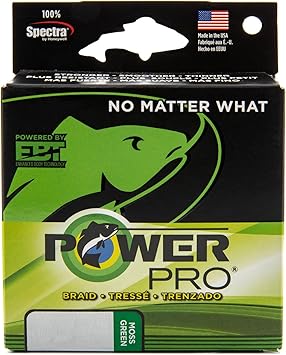
Power Pro is the braid most of us cut our teeth on. It's sold in spools big enough to fill every baitcaster you own (including anything from our best baitcasting reels under $200 roundup), it's the most forgiving of bad knots, and it's stocked everywhere. The 500-yard spool of 20-pound moss green runs $44.97 on Amazon right now, which works out to about 9 cents a yard, and the same listing carries everything up to the heavy frog-rod tests.
Here is the honest part. Power Pro Spectra is a 4-carrier braid using Power Pro's Enhanced Body Technology coating, not an 8-carrier like the other two on this list. That matters. A 4-carrier line has a coarser feel against the guides, makes more noise on the cast, and is noticeably stiffer in the hand. On a baitcaster throwing a half-ounce Texas rig into mats, none of that hurts you. On a 2500-size spinning reel throwing a drop shot at finicky smallmouth, you will feel it. The line wants to spring off the spool in coils.
Note the carrier count when you shop. Power Pro Super 8 Slick V2 is the company's 8-carrier sibling product and a different animal entirely. If a review online raves about how smooth Power Pro casts, double-check which one they actually ran. The standard Spectra in vermilion red, moss green, or hi-vis yellow is still the 4-carrier weave.
Where Power Pro wins:
- Frog rods and flipping sticks. The stiffness helps the line stand off matted vegetation instead of digging in. 50 or 65-pound on a frog rod is doing exactly what Power Pro is designed for.
- Heavy cover, period. Brush piles, laydowns, hydrilla edges. It saws through and you do not feel bad burning 20 feet of line to retie.
- Beginners. If you are still working on your FG knot, the slightly coarser surface grips the knot better than a slick 8-carrier line. Fewer slipped connections.
Where Power Pro is overrated: spinning reels with light braid. The 10 and 15-pound Power Pro on a finesse setup will give you wind knots and line memory that an 8-carrier line just does not produce. Skip it for that job.
Sufix 832: the one to put on if you could only own one

Sufix 832 is over-engineered in the best sense of the word. The construction is unusual. Seven strands of HMPE (Dyneema-class polyethylene) plus one strand of GORE Performance Fiber, woven at 32 pics per inch. That single GORE fiber is the difference. Rapala credits it with improving abrasion resistance, tightening casting accuracy, and cutting line vibration, and it's the reason 832 keeps its spot on boats that live around shell and rock.
The diameter-to-strength ratio is also strong. Per Rapala's published chart, 20-pound 832 measures 0.009 inches (about 0.23 mm) and 30-pound measures 0.011 inches. You get more line on the spool and a quieter cast through the guides. A 150-yard spool of 30-pound is $17.99 on Amazon as of August 2026, up about a dollar from spring.
It's the line to run on anything that lives near rock, oyster, or barnacled wood. Smallmouth on a river ledge, redfish around dock pilings, a glide bait worked into laydowns. The line takes scrape after scrape and keeps testing close to label, which is why it stays on so many guides' inshore reels season after season while cheaper braid gets shredded by the oyster bars.
It is not slick. That is the trade. Compared to the J-Braid Grand, 832 has a slightly firmer, drier hand and is louder through the guides. On a long-cast spinning rod fishing pressured clear water, the noise matters. So does seeing the fish before they see you, which is what a pair from our best polarized fishing sunglasses under $50 roundup is for. On a 7-foot-6 medium-heavy throwing frogs into pads, no one cares.
You might also enjoy: Best Fishing Rain Jacket Under $100: 3 Picks and 1 to Skip
The smartest pound test for an inshore reel is 20-pound 832 with a 25 to 30-pound fluorocarbon leader. That covers redfish, speckled trout, and 90 percent of the snook you will hook in non-structure water. For bass, 30 or 40-pound on baitcasters and 15 on spinning gear.
Daiwa J-Braid Grand x8: the smooth caster that costs less per yard

Earlier this year this slot belonged to Daiwa's Expedition X8E, the flagship above the Grand. We've swapped the pick, and not reluctantly. The Expedition is still in Daiwa's lineup, but on Amazon it has thinned to a single dark-green 150m listing with about two dozen ratings and limited stock when we checked in August 2026. The Grand is the J-Braid anglers are actually buying, and the one that makes sense to recommend.
It's a good problem to inherit. Daiwa spins the Grand from eight carriers of IZANAS, a Japanese fiber the company claims is four times as abrasion resistant as a typical 4-carrier braid. Set the marketing math aside and the honest pitch is the body: Daiwa built the Grand to be supple and well-rounded so it lays flat on a spinning spool instead of digging in, and the hand backs that up. Run it between your fingers next to Power Pro Spectra and the difference is immediate.
Then there's the price. The 300-yard spool is $26.35 on Amazon right now, which is about 9 cents a yard. The Sufix works out to roughly 12. If you're filling three or four spinning reels before fall, that gap stops being a rounding error.
Where the Grand earns the spot:
- Spinning reels, full stop. The supple body is exactly what a spinning spool wants. Fewer wind knots, quieter casts, less coiling.
- Clear-water finesse. 10 and 15-pound Grand on a drop-shot rod casts a country mile and takes a knot cleanly.
- Filling multiple reels. The 300-yard spool at 9 cents a yard is the value play for spinning gear.
The rating story holds up too: 4.7 stars across 198 ratings on the 300-yard spool we linked, with reviews still coming in through August 2026.
Sufix 832 vs Daiwa J-Braid: Head to Head
This is the matchup people actually argue about, so here is the direct answer. If your water is shell, riprap, or dock hardware, spool Sufix 832. If you're loading spinning reels for open water and long casts, spool the J-Braid Grand and pocket the difference. Neither is a wrong answer, which is why the argument never dies.
| Spec | Sufix 832 | Daiwa J-Braid Grand x8 |
|---|---|---|
| Construction | 8 carriers: 7 HMPE + 1 GORE Performance Fiber | 8 carriers of IZANAS |
| Weave density | 32 pics per inch (published) | Not published on Daiwa's US page |
| Published diameter | 0.009 in at 20 lb, 0.011 in at 30 lb | Not published on Daiwa's US page |
| Price per yard (Aug 2026) | ~12 cents ($17.99 per 150 yd) | ~9 cents ($26.35 per 300 yd) |
| Amazon rating | 4.7 stars, 1,933 ratings | 4.7 stars, 198 ratings |
| Home water | Oyster bars, rock, dock skipping | Spinning reels, open flats, long casts |
On paper, Sufix simply publishes more. Rapala lists the weave density, the fiber mix, and a full diameter chart. Daiwa's US product page gives you the fiber name and an abrasion claim measured against 4-carrier braid, not against other 8-carriers. When one company shows its homework and the other doesn't, I lean toward the homework for anything abrasion-critical. That's an opinion, but it's the reason my money goes to 832 anywhere the bottom bites back.
On the spool, the Grand's case is simpler. It's supple, it behaves on a spinning reel, and at current listings you're paying about three quarters of Sufix's per-yard price. Respool four reels and the savings buys your leader material.
One naming trap. "J-Braid" and "J-Braid Grand" are different lines, and half the comparisons you'll read online don't say which one they ran. The original J-Braid x8 is Daiwa's earlier standard 8-carrier weave. The Grand is the IZANAS version that Daiwa positions as the top braid in the J-Braid family, with a fuller body that lays smoother on the spool. If you're cross-shopping against Sufix 832, the Grand is the fair fight. And above both sits the Expedition X8E with its slicker coating, if you can find it in the size you need.
What pound test should I run?
The single most common mistake is overlining a finesse rod and underlining a frog rod. Match the line to the technique, not to whatever was on the reel last year.
| Application | Braid | Leader |
|---|---|---|
| Finesse bass / drop shot / Ned rig | 15-20 lb | 6-10 lb fluorocarbon |
| General bass / Texas rig / spinnerbait | 30-40 lb | None, or 15 lb fluoro for clear water |
| Topwater frog / pads / heavy mats | 50-65 lb | None, tie direct |
| Inshore redfish / speckled trout | 20-30 lb | 20-30 lb fluoro |
| Snook / heavy mangrove cover | 50-65 lb | 40-50 lb fluoro |
| Snakeheads / pike / muskie | 65-80 lb | Steel or 80 lb fluoro |
One note on the inshore numbers. The Florida guides who run 10-pound braid for redfish in open water are correct that you can land a 20-pound red on light line. They are also fishing from polished skiffs with perfect drag systems and no obstructions for a quarter mile. If you are wade-fishing or kayak-fishing where docks and oyster bars are 30 feet away, the 20-pound is doing real work for you. Do not chase the IGFA line-class flex unless you actually need it.
What color should I buy?
Color matters less than the internet wants you to believe, with two real exceptions.
High-vis yellow is for line-watching. If you fish anything where the bite is detected by the line jumping or going slack (drop shot, light Texas rig, swimming a fluke), buy yellow. Tie on a leader and the fish never sees the bright braid.
You might also enjoy: Best Sand Spikes for Surf Fishing Under $50: What Holds a Loaded Rod in a Nor'easter
Moss green or low-vis green is the call when you are tying braid direct (frog, swim jig, flipping). Fish are looking up at a frog from below, and the cleaner the silhouette, the better.
Vermilion or red is fine for offshore depth-indication but does not matter for inshore or bass. Multi-color (with marker color changes every 10m) is genuinely useful for deep jigging and offshore. For everything else, skip the gimmick.
FG knot or double uni for the leader?
Both work. They are not equivalent.
The FG knot tests consistently at or near 100 percent of rated line strength when tied correctly, and has a tiny enough profile that it passes through your top guide cleanly. That second part matters more than people think. If you fish leaders longer than your rod (almost everyone inshore), your knot rides through the guides on every cast. A bulky knot kills cast distance and shreds your top guide insert over time.
The double uni is weaker than the FG, especially on heavier braid, but fast to tie streamside and acceptable for most freshwater bass. It is bulkier through the guides. It is also tieable in 30 seconds with cold hands at 5:30 a.m. when an FG knot would take you four minutes and produce a botched wrap pattern.
Tie an FG when you are at the truck or sitting on a kayak in calm water. Switch to a double uni when wind, chop, or a fading bite forces a fast retie. Both have a place. Spend the 20 minutes on YouTube to actually learn the FG. It is not nearly as hard as the videos make it look once you settle on a single tutorial.
How long does braid actually last?
Color fades first. The top 30 to 40 feet of braid takes a beating from UV, abrasion against the rod's first guide, and the constant friction of being the part of the line that gets retied. After about 50 to 80 trips, the high-vis yellow turns chalk white and the moss green turns gray. That is not a strength problem yet. It is a warning.
Real failure starts where the line attaches to your leader. After enough retie cycles, the first 6 to 10 feet of braid is microfractured from cinched knots. You can extend the life of a spool by trimming back 20 feet and re-tying every two months on a heavily fished rod. When you have trimmed back 50 yards and a fresh knot still feels wrong, the spool is done.
A spool of braid typically gets one full season on a freshwater bass reel and about nine months on an inshore spinning reel. Saltwater is harder on it than freshwater no matter what the spec sheet claims. If you spooled in March, a late-August refresh puts fresh line under the best two months of fishing on the calendar.
Is braid worth it over fluorocarbon or mono for bass?
For most of what bass and inshore anglers do in 2026, yes. Sensitivity, hookset power, and casting distance with braid is in a different league. The short version: braid is the main line for nearly every modern technique, and fluorocarbon goes on as a leader where stealth matters. Pure fluoro main line still has a place for crankbaits and jerkbaits where shock absorption and a sinking line help. Pure mono is for topwater anglers who hate braid-to-mono knot bulk and do not mind sacrificing some hook-set power.
Can I use the same braid on baitcasting and spinning reels?
Technically yes. Practically no. Stiff braid (Power Pro Spectra) is happy on a baitcaster because the spool speed is controlled by your thumb. The same line on a spinning reel becomes a tangle factory because spinning reels rely on the line being limp and pliable enough to lay against the spool without coiling. Always put your slickest, softest braid on your spinning gear. That is where the J-Braid Grand or Sufix 832 belongs. Power Pro can stay on the baitcasters.
Our pick for 2026
If you are buying one spool to cover most bass fishing, get Sufix 832 in 30 or 40-pound moss green. At $17.99 for 150 yards it's the lowest cost of entry here, the construction detail Rapala publishes is the kind of homework that earns trust, and that single spool will handle Texas rigs, jigs, swimbaits, spinnerbaits, and inshore redfish duty without complaint.
If you have a finesse spinning setup, you fish pressured clear water, or you're respooling several reels at once, put Daiwa J-Braid Grand x8 in 15 or 20-pound on the spinning gear. The supple body behaves on a spinning spool, and at about 9 cents a yard it undercuts the Sufix by a meaningful margin.
And if you are setting up frog rods, flipping sticks, or anything that lives in 50 to 65-pound territory, Power Pro Spectra is fine, the 500-yard spool fills multiple heavy rods, and the heavy-cover stiffness is actually a feature on those rods. Save the premium braid for the reels that need it.
Once you have your line sorted, the next thing worth thinking about is what you are tying to it. If your reels are tired too, check out Bushwhack for help tracking what you are catching on which setup. Logging spool history alone can save you from re-spooling fresh braid you put on six weeks earlier.
Get fishing tips in your inbox
New guides, seasonal tactics, and gear picks — about once a month, no spam.