Night Fishing for Bass in July: The Black-and-Blue Playbook for Pressured Summer Lakes
 Hudson Reed
Written by Hudson Reed
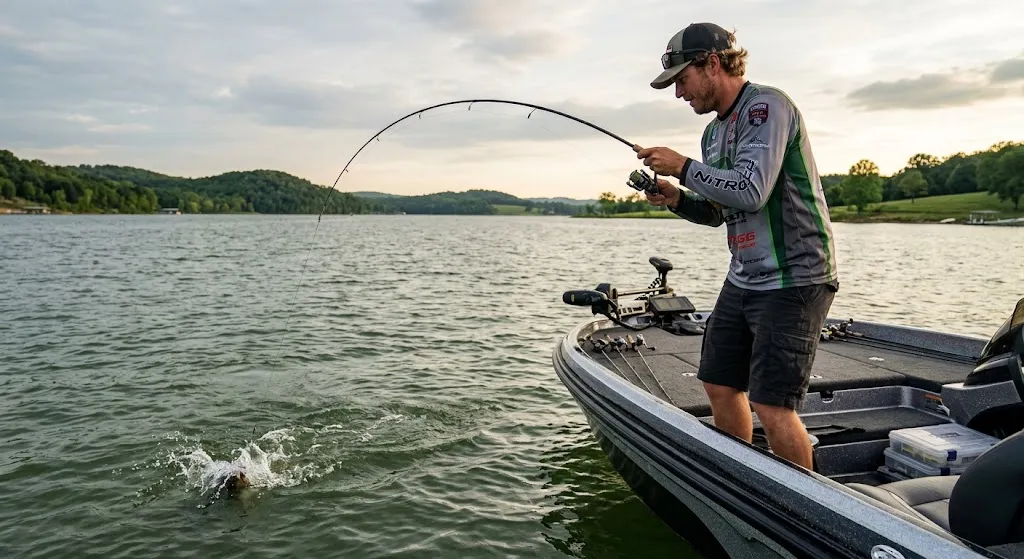
The boat ramp at 10 p.m. on a July Wednesday is empty, and that is the whole reason night fishing for bass in July works. Surface temps are pushing 87. Somewhere under the third dock light on the east bank, a five-pound largemouth is sitting an inch outside the green halo, watching threadfin shad pile up like they're being served on a plate.
That fish is why we're out here.
This is not the beginner's version. If you've never thrown a black spinnerbait at midnight before, start with the May/June post and come back. This one assumes you've already done a few summer night trips and you're ready to talk about what actually changes when the water hits 85 and the fish stop playing along with the easy patterns.
Why night fishing for bass in July is a completely different game than May or June
In May and June the lake is still mixing. Surface temps run 68 to 78. Bass cruise shallow at night because they cruised shallow during the day. You're fishing the spawn hangover under the moon.
July is when the thermocline locks in. According to multiple state fish and wildlife write-ups, once surface temperatures cross roughly 85F, largemouth metabolism backs off. They feed in tighter, more efficient windows instead of grazing all day. The mid-day deep bite gets pressured to death by boat traffic that's been hammering ledges since June.
The night fish are different fish. A lot of the biggest ones never come up during the day at all in July. They just wait.
The playbook in one sentence: fish the wait. The hours bracketing midnight, the dock lights stacked with forage, the dawn handoff when night and morning populations overlap.
The black-and-blue principle (and why it actually works)
Bass don't see the bait the way you see it from the boat. They see a silhouette against whatever sky-glow filters down through the surface film. A bright chartreuse spinnerbait disappears against a moonlit sky. A black-skirted bait with a black trailer cuts a hard, fish-shaped shadow.
Black-and-blue is the workhorse skirt combo because the blue gives you a faint contrast edge inside the silhouette without softening the outline. Solid black works too. Junebug works on overcast nights. What does not work in July: white, chartreuse, anything translucent, anything with chrome flash. Save those for daylight.
The lure short list for July nights:
- Single Colorado blade spinnerbait, 1/2 to 3/4 oz, black skirt, black trailer. Wired2Fish's nighttime spinnerbait breakdown specifically recommends single Colorado short-arm builds for the maximum thump per crank, and that matches what I've seen on the water. The big Colorado blade lets you crawl the bait at a pace bass can actually track with their lateral line in pitch dark.
- Black buzzbait, 3/8 oz, clacker. For the first hour after sunset and the last forty-five minutes before dawn, when fish will still come up.
- Black 10-inch worm, Texas-rigged on 5/0, 1/4 oz pegged weight. The cleanup bait. When the spinnerbait gets eaten and you know there's a wolfpack on a piece of cover, you drop the worm in and pick the rest apart.
- Black 1/2 oz jig with blue trailer. For dock pilings and laydowns specifically.
Four baits. Not eight, not twelve. The hardest part of night fishing is keeping your hands and your boat organized in the dark, and every extra rod on the deck is a rod you're going to step on at 2 a.m.
Why are Colorado blades better than willow blades at night?
Bass hunt with their lateral line in low light, and a Colorado blade displaces dramatically more water per revolution than a willow. The willow is a flash blade designed to mimic a fleeing baitfish in clear daylight. The Colorado is a thump blade. At 1 a.m. under a half moon, the bass isn't going to see the flash anyway. He's going to feel the bait coming through the column from twelve feet away, line up the silhouette in the last two feet, and crush it.
One Wired2Fish piece on summer night spinnerbaits puts it bluntly: a slow, loud bait is much easier for a bass to track in low visibility than a fast-moving one with a quieter sound signature. A 3/4 oz Colorado outfishes a 3/8 oz willow at night by a margin that's not even close.
If you only own willow-blade spinnerbaits, swap the blade. A $4 Colorado fixes the problem.
The dock light pattern: where July bass actually live after dark
Dock lights are the closest thing to a cheat code on a pressured July lake. The food chain in 90 seconds:
You might also enjoy: Best Kids Fishing Rod and Reel Combo for 2026: Dock Demon vs Ugly Stik GX2 vs PLUSINNO
A green or white dock light pulls plankton. Plankton pulls bait shad. The shad form a feeding ball just inside the lit zone. Bluegill drift in to pick at the shad. The bass, per a Wired2Fish dock-light primer, sit on the outside edge of the halo, in the dark water, using the lit zone as a backlit screen against which every prey silhouette becomes obvious.
That last part is the part most anglers miss. They throw into the light. The fish are outside the light. Land the bait in the dark water on the shadow side, then bring it across the boundary toward the lit zone so it crosses the bass's window from his blind side.
A few rules I've stopped breaking:
- Park 30 to 40 feet off the dock. Trolling-motor noise inside the halo will spook the apex fish.
- Cast parallel to the dock face, not perpendicular. You want the bait to spend three or four feet in the strike zone.
- The first three docks lit on a bank are usually fished. Pick the fourth.
- If a dock has been dark for a week and just got turned back on tonight, that's the dock. The forage hasn't been picked over.
Full moon vs. new moon: planning the trip, not just the night
Most night-fishing content treats moon phase like a footnote. On a 85F+ July lake, it's the planning unit. Plan the trip around the moon, then plan the night around the solunar windows inside it.
Full moon in July does two things. It pulls a lot of solunar-believer pressure, but it also gives the bass a real visual hunting window all night, not just the dock-light pockets. On a full-moon July night, a bass on a windblown grass edge in three feet of water can see a topwater silhouette as well as he can at 7 a.m. Bassmaster's solunar coverage notes that shallow flats next to deep water become viable from full dark to dawn during the full phase.
New moon flips it. The lake goes blacker than the inside of a coffee can. Lateral line becomes everything. The Colorado-blade pattern peaks because the bass can't see the bait at all until it's two feet away. Dock lights become the only show in town because they're the only light on the lake.
My July rule of thumb: full moon, fish open structure (humps, points, grass edges). New moon, glue yourself to the dock-light pattern. Quarter and half moons, run a hybrid.
What about the heat? Is 85F+ water actually a problem for the bass too?
Yes, but not in the way most people think. The bass aren't dying. They're shifting their feeding to the coolest, most oxygenated water available, which at night is the top three feet of the water column once the surface starts to radiate heat back into the sky. By 1 a.m. in mid-July, the top of the column has often dropped two or three degrees from its 4 p.m. peak. That's enough to pull active fish up.
Outdoor Life's night-fishing piece quotes Nashville guide Jack Christian on the summer hump pattern, and he puts it simply.
"Picture a hump as an underwater oasis. The best summer humps top out at around ten feet."
(Jack Christian, Nashville bass guide, via Outdoor Life)
Ten feet is the magic number on a lot of lakes. Deep enough that the bass were sitting near it during the day for the cooler water, shallow enough that they can push to the top of the hump after dark to ambush bait that's also been pulled toward the slightly cooler surface layer.
Step 1: Get your boat on the spot before the sun is fully down
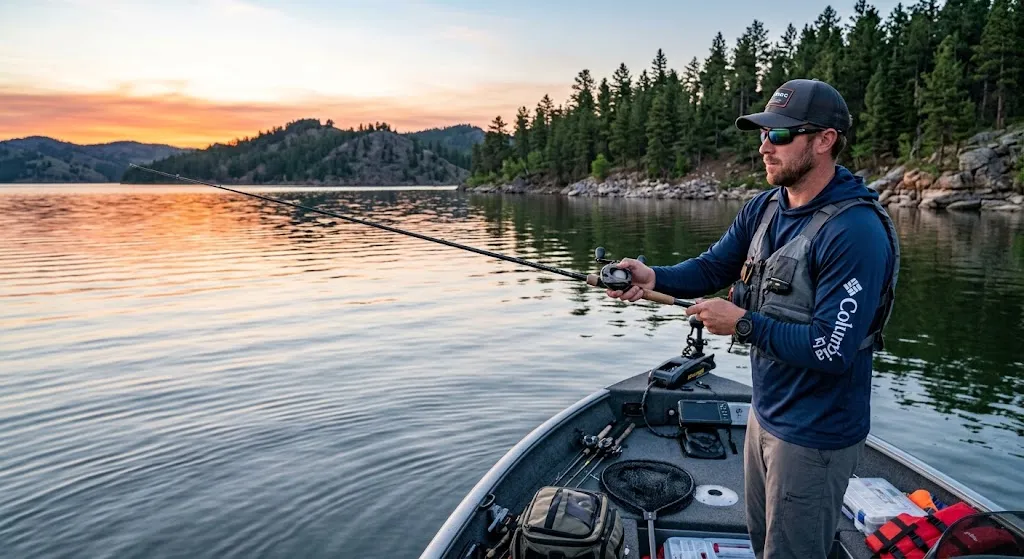
Sounds obvious. Half of all unsuccessful July night trips are just guys arriving at midnight, idling around with the trolling motor for twenty minutes, blowing up the spot they meant to fish. Be on the dock-light or the hump by sunset. Eat your sandwich. Let the lake forget you exist.
Step 2: Work the spinnerbait at half the speed you think
Cast it. Let it sink to bottom contact (count down: five seconds for ten feet of water, ten seconds for twenty). Then reel just fast enough to feel the Colorado blade thump every rotation. If you can't feel the thump, you're going too fast. If the bait feels dead, you're going too slow. Tick cover when you can.
Step 3: When you get bit, do nothing for half a beat
The fish has the bait sideways. Cross his eyes a beat too early and you'll yank it out of his mouth. This is hard to do at 1 a.m. when you've been waiting three hours for the bite, but it pays.
You might also enjoy: Best Braided Fishing Line for Bass and Inshore 2026: Power Pro vs Sufix 832 vs Daiwa J-Braid
Step 4: Mark the spot on the GPS the second the fish hits the deck
You will not find that exact piece of cover again at 2 a.m. without a waypoint. I promise. The advantage of tracking your spots in Bushwhack is that the next July, when surface temps cross 85 again, the same hump or the same dock light gets a notification on your phone. The fish do the same thing every year. Treat your log like an annuity.
The dawn handoff: the window every night fisherman undervalues
This is the part nobody talks about, and it's where the biggest fish of most July night trips gets caught.
From roughly 30 minutes before sunrise to about 30 minutes after, two populations of bass overlap on the same structure. The night population is finishing its feeding cycle and pushing toward deeper rest water. The morning population, the ones that fed at dusk and rested overnight, is waking up and starting to slide shallow for the first early topwater bite.
For about an hour, you have double the active fish on the same flats you've been working all night. The light is just enough to make a buzzbait visible against the sky. The water is at its coolest 24-hour low. Boat traffic hasn't started.
If you're leaving the lake at midnight in July, you're leaving before the best hour of the trip. Bring coffee. Stay through dawn. Switch from the black Colorado-blade spinnerbait to a black buzzbait at the first hint of grey in the sky.
Dawn-handoff fish in July are almost always bigger than the average night fish. Apex predators feed in shorter, more efficient windows than smaller bass. The 1 a.m. window pays out a lot of fish. The dawn handoff pays out the biggest one.
The contrarian take: skip the full moon
Every magazine cover says fish the full moon. After a decade of July night trips on a few different lakes, my honest take is that the second-best night to be on the water is the night before the full moon, not the night of it. The bass are dialed in and feeding hard, but the lake has not yet filled up with every other guy who read the same magazine. Quieter water, same bite window, less competition for the good dock lights.
The actual best night, in my experience, is a calm new-moon night with stable barometric pressure and a slight south wind on the grass flats. No moon at all. No other boats out. Pure lateral-line fishing.
Fish the night nobody else is fishing.
Safety stuff that actually matters in July
The lake at 2 a.m. is a different place than it is at 2 p.m. A few things I won't get on the water in July without:
- A red headlamp. White light blows your night vision and your fishing partner's. Red preserves both.
- A 360-degree all-around white anchor light visible from any direction. Required by Coast Guard rules when stopped.
- Bug spray with picaridin, not DEET. DEET will eat the finish on your rod handles and dissolve braided line.
- A float plan with a real human. Tell someone the lake, the ramp, the expected return time.
Heat exhaustion is the under-discussed July night-fishing risk. Hydrate before, during, and after.
The five-trip rule for July night fishing
Pick one lake. Fish it five July nights this season. Run the same general lap each trip with small variations. Log every fish: the dock light it came off, the depth, the time, the moon phase, the surface temp. By trip five you will have a private map of that lake's night patterns that no one else has, and the next July all you have to do is repeat it.
That's the whole game. Skip the daytime pressure. Skip the heat. Fish the moments when nobody else is on the water.
Get fishing tips in your inbox
New guides, seasonal tactics, and gear picks — about once a month, no spam.