Chatterbait vs Swim Jig for Summer Grass: Which One to Tie On and When
 Hudson Reed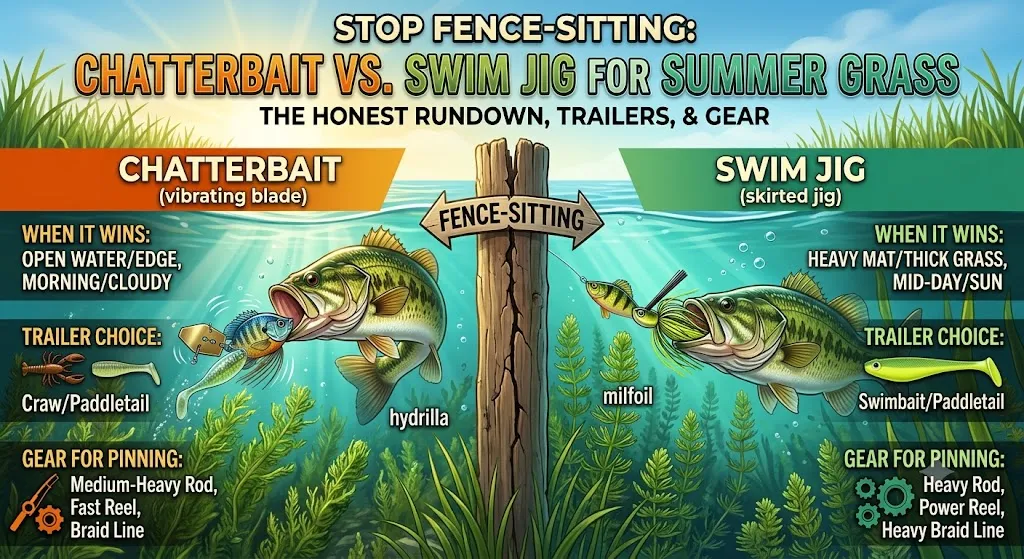
Written by Hudson Reed
The first time I really understood the chatterbait vs swim jig argument was on a wind-blown hydrilla flat in late July. I had a half-ounce bladed jig tied on, snapping it free of grass tips, getting bit on the rip. My buddy was throwing a 3/8-oz swim jig 20 feet off my bow, slow-rolling it through the same stuff, and he was getting nothing. An hour later the wind quit, the water flattened, the sun broke through. He switched nothing. I kept throwing the chatterbait. He out-fished me four to one the rest of the day.
That is the whole post in one paragraph. But you came for detail, so here it is.
Chatterbait vs swim jig: why summer grass changes the math
By July and August, the grass is built. Hydrilla is topping out, milfoil mats are forming on the surface, pencil reeds and pads are at their thickest. Bass live in this stuff because it holds oxygen, shade, and bait. They will not move far to eat. You are not searching for fish so much as you are searching for the right delivery vehicle into the kitchen window.
That is where the two best summer grass baits diverge. A chatterbait is a calling card. It throws vibration, flash, and a wider strike radius than any other moving bait short of a spinnerbait. A swim jig is a fake. It looks like a bluegill or a shad swimming through cover, and it does it quietly.
One is a megaphone. The other is a whisper. Knowing which mood the fish are in is most of the game.
When the chatterbait wins
Tie on a bladed jig when at least two of these are true:
- Wind is putting a chop on the water, especially blowing into the grass edge you want to fish
- Water is stained, dingy, or post-rain muddy (less than about 18 inches of visibility)
- Grass is sparse to moderate, topping out a foot or two below the surface, with lanes you can rip the bait through
- You are fishing the outside weed edge, points, or scattered isolated clumps
- The fish are aggressive and you want to cover water fast
The reason is sensory. In muddy water and chop, bass hunt with their lateral line first and their eyes second. A chatterbait's blade slap is the loudest moving-bait signal you can put down without going to a spinnerbait. According to guidance from Greg Hackney via Bassmaster, most bladed jig work happens in five feet of water or less, which lines up with where summer grass tops out on most fisheries.
The other reason is the deflection bite. A chatterbait that loads up on a hydrilla stalk and then rips free is one of the best reaction triggers in all of bass fishing. The hesitation, the snap, the sudden return to vibration. That is when the rod loads. I throw a chatterbait specifically to hunt for that pause-and-rip moment.
The downside, said honestly
Chatterbaits foul. Once the grass crosses about 50% canopy coverage or starts matting on the surface, you will spend more time picking salad off the blade than fishing. They also push fish in glass-clear water more than people admit. If you can see your bait at ten feet, the bass can see every fake thing about it. Put on a pair from our best polarized fishing sunglasses under $50 roundup and check for yourself before you commit to a blade.
When the swim jig wins
Tie on a swim jig when at least two of these are true:
- Water is clear to lightly stained (over two feet of visibility)
- Surface is calm or barely rippled
- Grass is thick, matted, or topped out at the surface (the bait needs to skip across or burrow through)
- You are fishing pencil reeds, lily pad stems, water willow, or any vertical stalky cover that grabs a chatterbait blade
- The fish have been pressured all weekend or are sulking on a cold front
A swim jig is the bait you tie on when you want to fish through grass instead of over it. The skirt and trailer are the entire silhouette, so there is nothing to grab vegetation except the line tie and the hook point, both of which a good weed guard handles.
The other quiet advantage: a swim jig falls. When you drag it across a mat and into a hole, it pendulums down through the canopy at maybe a foot per second. Bass living under matted milfoil eat it on that fall. A chatterbait cannot do that. Kill the retrieve on a bladed jig and you get a dead piece of lead.
You might also enjoy: Best Kids Fishing Rod and Reel Combo for 2026: Dock Demon vs Ugly Stik GX2 vs PLUSINNO
Where swim jigs disappoint
They do not draw fish from a distance. If you are trying to find scattered fish on a 200-yard grass flat, a swim jig is a slow, methodical answer to a fast question. Use the chatterbait to locate, then come back with the swim jig if you find a juice spot.
The scenario-by-scenario pick
Enough hedging. Here is the honest call by situation.
| Scenario | Winner | Why |
|---|---|---|
| Dirty water, sparse hydrilla, 15 mph wind | Chatterbait | Vibration carries; bass hunt by feel |
| Thick matted milfoil, slick surface, bluebird sky | Swim Jig | Slides over and falls into holes |
| Outside weed edge in 4-6 feet, slight breeze | Chatterbait | Covers water, triggers reaction strikes |
| Stalky pencil reeds, lily pad stems | Swim Jig | Blade fouls on every vertical stalk |
| Pressured tournament water, third day in a row | Swim Jig | Quieter presentation fish have not seen |
| Post-frontal calm, clear water, fish glued to grass | Swim Jig | Subtle profile gets bit when chatterbait pushes |
| Pre-frontal, falling pressure, wind building | Chatterbait | Aggressive fish, hunt mode |
| Shad spawn on grass edges at first light | Swim Jig | Matches the baitfish profile exactly |
If you only fish one, fish the chatterbait. It is more forgiving and covers more water. But if you are serious about summer grass, you need both rods rigged.
Trailer choice: this matters more than the bait
I will go further. The trailer on a swim jig matters more than the swim jig itself.
There are two camps and they catch fish differently.
Paddle tail trailers
A 3.5 or 4.5-inch paddle tail (Keitech Fat Swing Impact, YUM Pulse, Strike King Rage Swimmer) cuts water cleanly, lets you reel faster, and gives the bait a tight roll. This is the choice for swimming over deep grass, for the shad spawn, and any time you want to imitate a baitfish moving in a straight line. It is also my default trailer for a chatterbait because it does not slow the blade thump.
Craw or creature trailers
A craw-style trailer (Rage Craw, NetBait Paca Chunk, Missile Baits D Bomb) adds resistance and lift. The bait rides higher in the column. The trailer kicks like a panicked bluegill. This is the call for shallow water under three feet, for skipping pads, and for any time you want the bait to glide and pause through cover instead of plow through it.
Rule of thumb: paddle tail when you want to swim, craw when you want to glide. If the fish are short-striking either bait, downsize the trailer profile before you change the jig.
Blade or skirt: what should you actually focus on?
People obsess over chatterbait blade color. I think it is a top-five factor at best. The blade does three jobs: thump, flash, and deflection. Black blade for muddy water and overcast. Hammered or nickel for clear water and sun. Gold for stained water with green tint. Pick one of those three and stop thinking about it.
Skirt color is where I spend more attention. Match the dominant forage. White or shad pattern when shad are the meal. Bluegill pattern (green pumpkin with orange and chartreuse accents) in pad fields and pencil reed flats. Black and blue when the water is genuinely muddy or for night fishing.
On the swim jig, skirt is everything. There is no blade flash to make up for a wrong color. Bluegill imitator in pads. Shad pattern on offshore grass edges. Bream pattern (green pumpkin / chartreuse) anywhere there is mixed cover. The bait is supposed to look real, so go for accuracy over attention-grabbing.
What gear setup do you actually need?
The biggest mistake I see is people throwing both baits on the same rod. They are different jobs.
You might also enjoy: Pike Fishing for Beginners: The Freshwater Predator Most Anglers Overlook
Chatterbait rod
You want some give. A medium-heavy rod with a moderate or moderate-fast action, 7'2" to 7'4". The softer tip lets fish load up on the bait before you take it away from them. A pure fast-action stick rips the bait clear of mouths half the time.
- Reel: 7.1:1 to 7.5:1 baitcaster (see our best baitcasting reels under $200 roundup)
- Line: 15-17 lb fluorocarbon in clear water; 20 lb fluoro or 30-40 lb braid in stained water and around heavy grass
- Weight: 3/8 oz is my default; 1/2 oz when wind or deep grass forces it
Swim jig rod
You want backbone for hooksets through grass. A 7'2" to 7'6" heavy power, fast action rod. Less forgiveness, more leverage.
- Reel: 7.5:1 to 8.1:1 baitcaster. Faster gets the fish out of cover quicker
- Line: straight 50-65 lb braid in mats and pads; 17-20 lb fluorocarbon in cleaner water with sparse grass
- Weight: 3/8 oz default, 1/2 oz for thicker matted grass that you want to punch into
Two rods, two reels, two spools. That is the minimum kit if you are taking summer grass seriously. Try Bushwhack if you want to start logging which combo works on which day. Patterns show up faster than you would expect once you have a season of data.
Retrieve cadence: the part nobody talks about
This is where most anglers leak fish. The chatterbait retrieve is not a steady reel. It is reel, snap, reel, pause, snap. You are hunting for that grass-tip rip every cast. If your bait is not making contact with grass periodically, you are too far above the canopy.
The swim jig retrieve is more deliberate. Steady reel with occasional twitches of the rod tip. Pause when you cross holes in the grass. That pendulum fall is where 30% of my bites come on swim jigs in pads. Do not muscle it. The bait works on the slow side better than the fast side.
Pre-spawn anglers tend to burn both baits. Summer is different. Bass are not chasing. They are ambushing from a 12-foot strike zone. Slow down by maybe 25% from what you would do in April.
What about a bladed swim jig, the hybrid?
You will see baits marketed as bladed swim jigs that try to be both. I have thrown a few. They are fine. They are not great at either job. If you fish enough days a year to care about edges, run the two specialized baits. If you fish 15 days a year and want one rig, the bladed swim jig is a reasonable compromise. Just know you are giving up the deep mat penetration of a real swim jig and some of the vibration of a true chatterbait.
How do I know which one to start with on a new lake?
Three questions. Look at the water clarity first. Under 18 inches of visibility, start with the chatterbait. Over 30 inches, start with the swim jig. In between, look at the wind. Steady chop, chatterbait. Glass calm, swim jig. If both are ambiguous, look at the grass. Sparse and submerged, chatterbait. Matted or stalky and vertical, swim jig.
Forty-five seconds of observation answers the question 80% of the time.
What is the biggest mistake people make with these two baits?
Throwing them in the same water at the same speed. They are different tools. The chatterbait is a covering bait that calls fish; the swim jig is a finishing bait that gets bit by fish you already know are there. Treat them like the same lure and you will under-fish both.
Pick the right one for the conditions in front of you, match the trailer to the depth and forage, run the right rod and line, and slow down your cadence to summer speed. Do those four things and you will outfish the guy with one rod and a tackle box full of crankbaits every August day for the rest of your life.
Get fishing tips in your inbox
New guides, seasonal tactics, and gear picks — about once a month, no spam.