Where Do Trout Hold in Winter? Reading a River by Type and Water Temperature
 Cameron Spanos
Written by Cameron Spanos
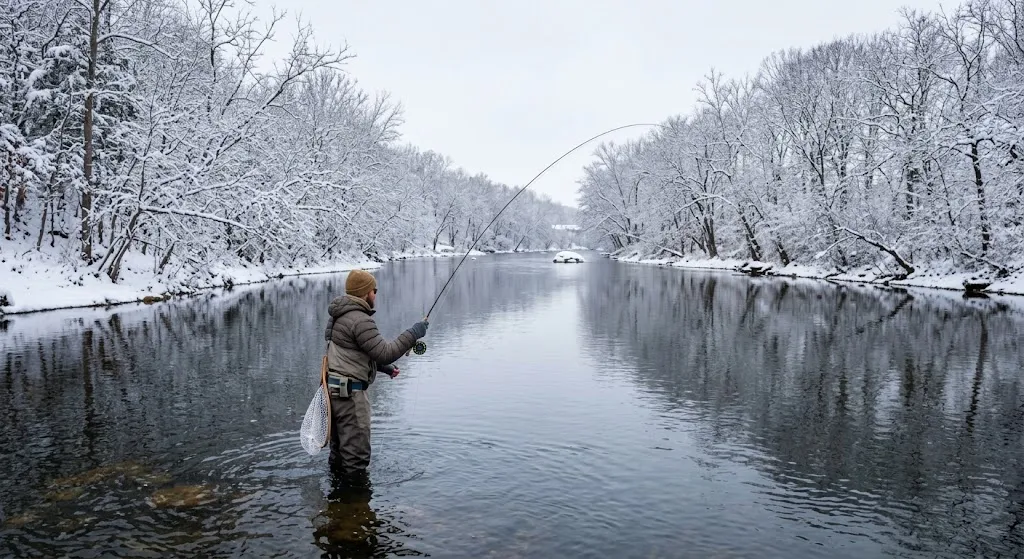
Ask where do trout hold in winter and you get one stock answer: fish the deepest, slowest pool. It's right often enough that nobody checks it. On a freestone with ice along both banks, it's most of the truth. A mile below a dam it's maybe half. On a spring creek with green weed still waving in January, it can walk you straight past most of the fish in the river.
River type decides more than the calendar does. So does a thermometer.
Why do trout slow down in cold water?
Trout are cold-blooded, so their metabolism falls with the water temperature. A fish sitting in water a few degrees above freezing needs far less food than it did in September, and it can't afford to spend much energy getting it. Nearly every winter lie follows from that. The fish wants slow current, food drifting past within a few inches of its nose, and either depth or something overhead so it feels safe from birds and mink.
My test is walking pace. If the surface is moving faster than you'd stroll down a sidewalk, most winter fish aren't under it, with one exception: current drags on the streambed, so the bottom foot of a deep run moves slower than the top. A run that looks a little quick can still hold fish if it's deep and the bed is rough with cobble. A shallow one moving at the same speed won't.
Depth is the means. Slow is the goal.
That distinction matters because plenty of deep water isn't slow (a chute through a canyon slot) and plenty of slow water isn't deep (the inside of a bend, a tailout, a side channel). Winter trout use the second kind more than the stock advice admits, mostly in the afternoon. More on that below.
Tailwaters: the dam flattens winter, but only for a while
A bottom-release dam below a deep reservoir pulls from far under the surface, where winter water stays well above freezing and barely changes from week to week. The river just below it never gets the hard cold a freestone does. So the fish there never get the hard shove into wintering water either.
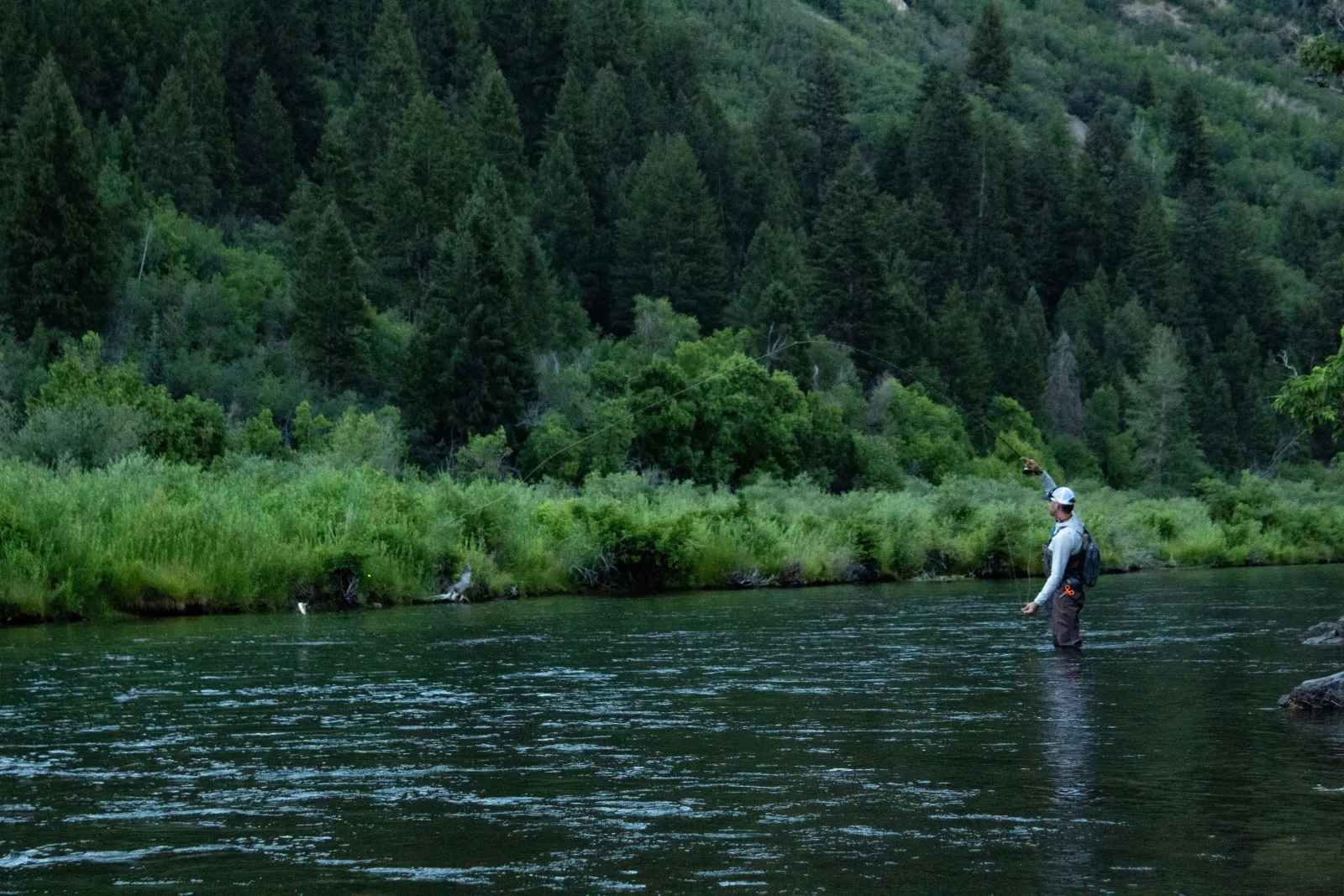
Close to the dam, expect trout in the slow half of the same water they used in fall. The drop-off where a riffle dumps into a run. Waist-deep runs with a steady, strolling current. The soft inside seam of a bend. They tend to pod up more than they do in summer, so you'll find long stretches of nothing and then several fish in a space the size of a pickup bed.
I think the deepest hole is overrated on a tailwater. The fish in the bottom of a ten-foot pool are hard to reach and often aren't the ones eating. I'd rather spend the day on a three-to-five-foot run at walking pace, where a drift is easy to control and the fish that are there are usually there to feed on midges.
Two things change the picture. Distance is the first: release water gives up its heat to the air mile by mile, and far enough downstream in a bitter week a tailwater grows shelf ice and starts fishing like a freestone. The second is flow. When the dam bumps the release, fish slide off the main current into the nearest soft edge, and they slide back when it drops.
You might also enjoy: Utah Winter Fly Fishing: Which Rivers Actually Fish in December, January, and February
So where do trout hold in winter on a freestone?
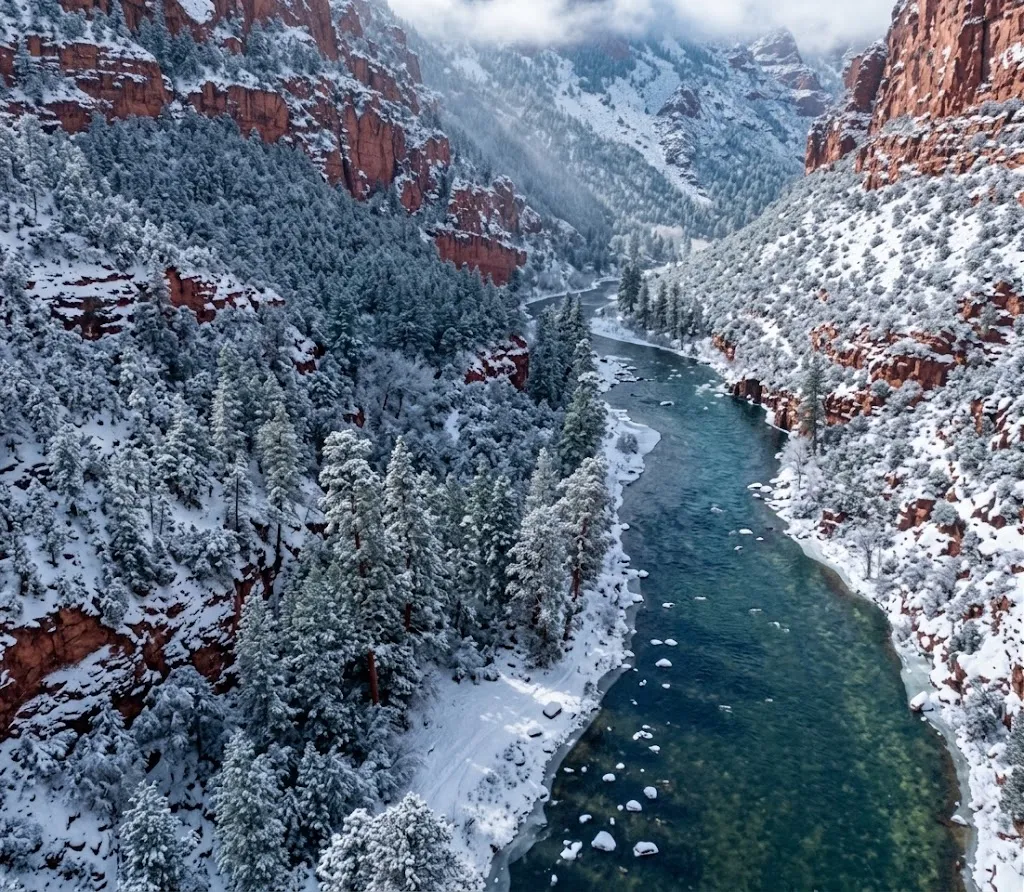
In the slowest deep water that also stays stable, and far less of the river qualifies than you'd guess. Long pools. The scour pool on the outside of a bend, especially with a logjam or an undercut along it. A deep slot beside a boulder the size of a car. On a freestone in real cold, the fish leave the riffles and pocket water almost entirely and concentrate, so empty water is normal and one fish usually means several.
The word that matters there is stable, and the reason is ice. Two studies of Wyoming streams are worth knowing about. In the first, Lindstrom and Hubert (2004) radio-tagged 25 cutthroat trout and 25 brook trout in a 7-kilometer reach of a Rocky Mountain foothills stream and followed them from fall through the winter of 2002-2003. Both species selected beaver ponds as winter went on. The tagged fish that weren't in beaver ponds selected lateral scour pools that were deeper than average and stayed stable through the winter.
So depth and stability held up. But the second study shows what "unstable" does. Barrineau and colleagues (2005) assessed the pools beside constructed instream structures on a low-gradient mountain stream in western Wyoming and found that hanging dams and anchor ice dams were the main ice features affecting them. Trout were seen in those pools in fall and tended to abandon the ones where ice formations kept changing as winter progressed.
Frazil is the slush of loose ice crystals that forms in open, turbulent water on a very cold night. Anchor ice is what you get when it sticks to the streambed. Either one can choke a pool, and the bottom of a pool is exactly where the fish are trying to sit. If you walk up to your favorite hole and it's running gray slush or has a ridge of ice damming the tailout, it probably isn't holding fish that day, however good it was in November.
Spring creeks and groundwater seeps: warm water with a catch
Groundwater comes out of the earth at roughly the same temperature all year, close to the local yearly average air temperature, which across much of trout country means the 40s to low 50s. A true spring creek is all groundwater near its source, and its trout barely have a winter pattern near the source. They hold in weed channels, under cut banks, and at riffle drop-offs much as they did in October, and they'll rise to midges on days when the freestone across the valley is locked up.
On a freestone or the lower end of a tailwater, a seep or a spring-fed side channel is a small pocket of those conditions. You find them by looking for what doesn't match: a hole in the shelf ice with no obvious cause, a strip of bank where the snow melted first, watercress or bright green weed in midwinter, a wisp of steam on a bitter morning. Fish stack in the plume and in the first slow, deep water below it.
Now the catch, and it comes from that same Lindstrom and Hubert study. Groundwater entered their stream at three places, lifted mean daily winter water temperature to between 0.2 and 0.6°C (still under 34°F), and kept at least 250 meters of the channel downstream free of ice. Good news, you'd think. But farther downstream, the lack of surface ice let frazil and anchor ice form in the pools, and the authors describe those conditions as unstable habitat for trout. The pools in segments the groundwater didn't reach, like the beaver ponds, collected snow on their surface ice and tended to stay stable.
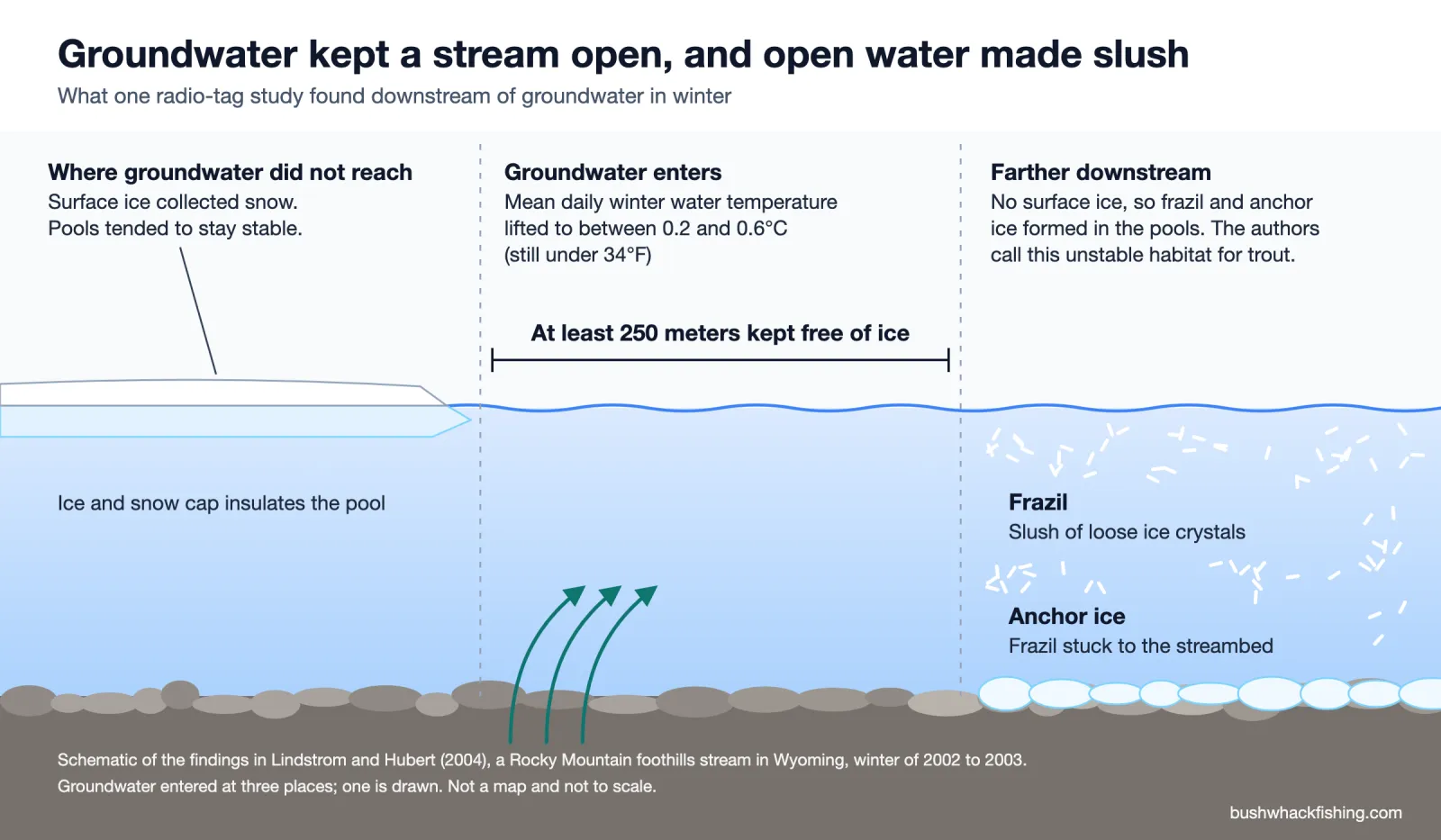
Open water and good water aren't the same thing. A cap of ice and snow insulates a pool. A long ice-free stretch on a subzero night is where slush gets made. My read: fish the seep and the water right below it, and be suspicious of open pools a long way downstream after a hard cold snap. A big spring that holds a creek in the 40s is a different animal from a trickle that keeps a foothills stream half a degree above freezing.
You might also enjoy: White River Shad Kill: A December-to-February Fly Fishing Playbook
Do all the trout really move to the deep pool?
No, and the best evidence I know of comes from the other end of the country. Burrell and four co-authors (2000) radio-tracked 27 adult brown trout, roughly 10 to 18 inches long, in the Chattooga River watershed in the southern Appalachians from November 1995 to December 1996. During the day those fish stayed in small, well-established home ranges of less than 270 meters of stream. Each one's daytime locations were restricted to a single pool or one riffle-pool combination, and the same fish kept turning up in the same spot from one tracking period to the next.
They could travel when they wanted to. Eight of a possible 18 fish made spawning runs during two weeks in November 1996, one of them 7.65 kilometers upstream, and the spawners were back at their old addresses within a few days. Apart from those runs, the authors didn't see a single fish displaced from its established home range. Not in summer, when the water got warmer than brown trout are supposed to like, and not in winter.
It isn't a clean "trout never move" result, though, and it shouldn't be quoted as one. The same paper reports that the browns kept larger home ranges in winter than in any other season and were more active in fall and winter than in spring and summer. The abstract doesn't give a reason. My guess is that on a southern river winter is the comfortable season. Whatever the cause, the fish used more water, not less.
Put that next to Wyoming, where trout shifted into beaver ponds and stable scour pools and moved less often as winter deepened (some individuals of both species still moved in winter). Different species, different rivers, a few dozen tagged fish apiece, so none of it is law. Here's how I square them: ice moves trout, not the date. Where a river stays open and a degree or two above miserable, expect fish near where they lived in fall, tucked into the slowest part of that neighborhood. Where it freezes hard, the big relocation is real.
When do winter trout move shallow?
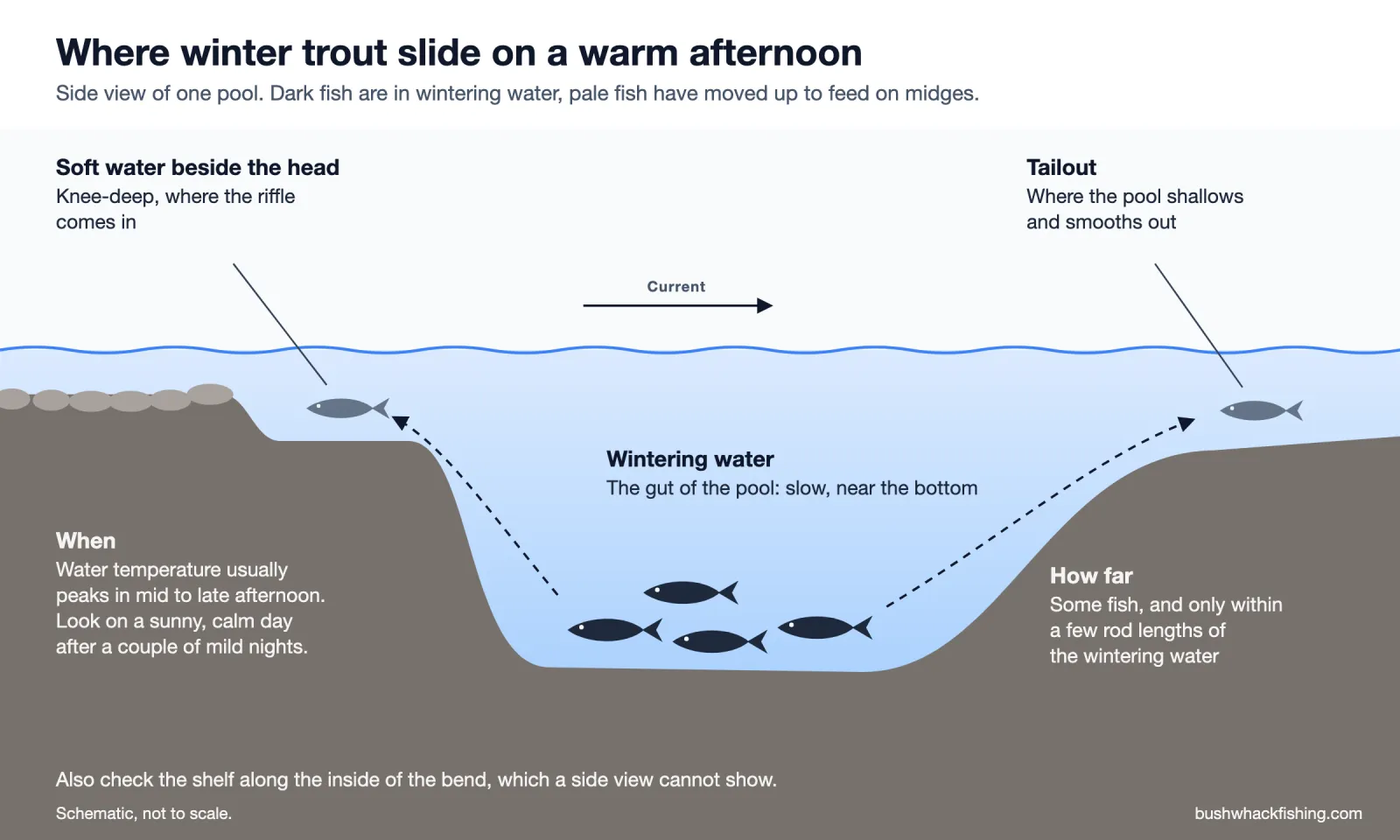
Water temperature peaks later than air temperature, usually in mid to late afternoon. On a sunny, calm day after a couple of mild nights, that small rise is enough to pull some fish out of the gut of the pool and onto water that looked dead at 10 a.m. I care more about the direction the thermometer is heading than the number on it.
They don't go far. Look within a few rod lengths of the wintering water: the tailout where the pool shallows and smooths out, the shelf along the inside of the bend, the knee-deep soft water beside the head where the riffle comes in. Midges hatch in the same window, and fish that slide up are there to eat them.
Two cautions. On a freestone with snow on the banks, a genuinely warm afternoon can send cold meltwater into the river and knock the temperature back down late in the day, so the window may close earlier than you expect. And on a tailwater near the dam the sun has less to do with water temperature, though the midday midge hatch still sets the clock.
How I'd work a winter river, in order
- Take the water temperature when you arrive and again after lunch. A reading that's climbing tells you to check the edges; one that's flat or falling tells you to stay on the deep, slow stuff.
- Start at the slowest deep water with cover, and fish its edges before its middle: the seam where the current gives out, the inside, the lip of the drop-off.
- Walk the bank looking for groundwater. Open holes in shelf ice, bare strips of bank, and green weed are worth ten minutes each.
- After about 1 p.m. on a bright day, go back to the tailouts and shelves you skipped in the morning.
- Skip any pool running slush or dammed with ice, and don't feel bad about it.
Then write down what you found. Water temperature, river type, and the kind of lie each fish came from take thirty seconds, and you can try Bushwhack to see how a log sorts catches by conditions. A few winters of notes will tell you which version of all this your own river runs on, and that beats any general rule, these included.
Going fishing? Write it down.
Bushwhack is a free fishing log that fills in the weather, moon and pressure for you, then shows which spots, flies and conditions actually produce. Blank days included.
Get fishing tips in your inbox
New guides, seasonal tactics, and gear picks, about once a month, no spam.