Where Do Crappie Go in the Fall? A Depth and Temperature Guide From Turnover to First Ice
 Hudson Reed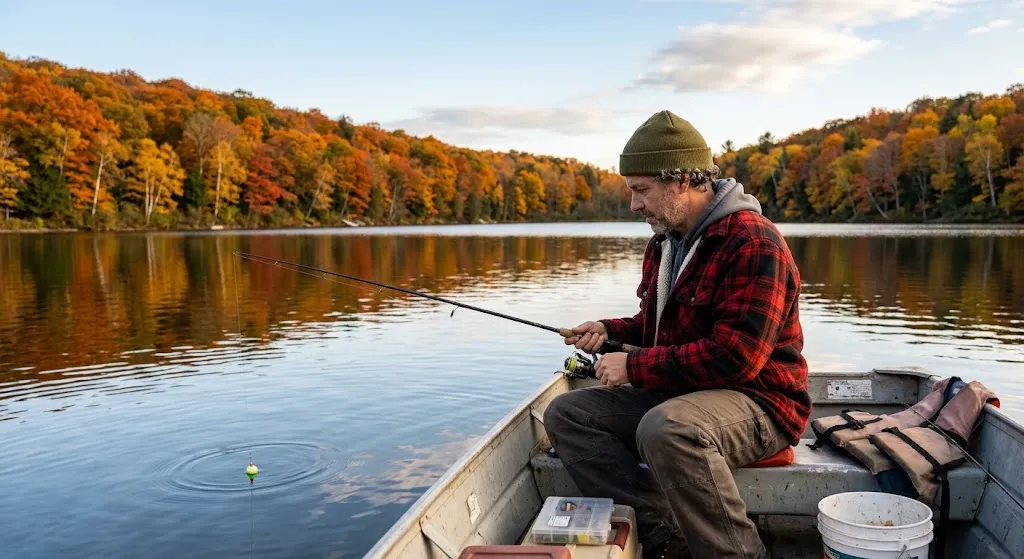
Written by Hudson Reed
The biggest fall crappie mistake is treating September, October, and December as one pattern with one depth. The question “where do crappie go in the fall” almost always gets answered in a single word: deeper. Which is true the way “north” is a direction. It doesn't tell you whether to hang a jig at 8 feet or 28, and on most reservoirs those two answers are sixty days apart.
So quit thinking in months. Think in degrees.
In fall, crappie follow cooling water down and out. Near 65F they still suspend over summer brush in roughly 12 to 20 feet. Turnover scatters them while the column mixes. From 60F down to 50F they stack on deep timber and creek channel bends. Below 45F they settle into basin holes, and those holes are your first ice spots.
That's the season in five sentences. The useful part is the reason behind each step, because the reason is what tells you how the numbers shift on your lake instead of somebody else's.
At 65F They Haven't Left the Brush
Mid September across most of the country, the surface is falling through the 70s and anglers start fishing like it's November. Too early. The lake is still stratified.
That matters more than the surface reading does. As long as a thermocline is intact, the cold water underneath it has been sealed off from the atmosphere since early summer while decomposition draws its oxygen down, and Nebraska Extension puts it plainly: the hypolimnion "is the zone of decomposition" where "dissolved oxygen levels are often very low". It's the same constraint behind why bass won't live below the thermocline. The deep water is right there on your screen, and it's uninhabitable.
So crappie stay in the layer that works. Suspended over brush piles and standing timber, usually somewhere in the 12 to 20 foot band on a reservoir, holding at the same depths they used through August. If you already know where do crappie go after the spawn on your water, you know where they are the third week of September, because it's the same brush.
Species mix moves the numbers a little. The Minnesota DNR's crappie biology page notes that black crappie favor clear, quiet lake water while white crappie do fine in warmer, murkier, more riverine conditions, so a white crappie reservoir tends to run its whole fall progression shallower and dirtier than a clear black crappie lake sitting at the same temperature.
My take: if your lake still has a hard thermocline in mid September, ignore every fall article pointing you at 30 feet. The fish physically cannot be down there yet.
What Actually Happens When a Lake Turns Over?
Turnover is the most misexplained event in fishing, and the mechanism isn't complicated. Surface water loses heat to the air. Cooling makes it denser. It sinks, gets replaced, cools again, and the warm upper layer keeps thinning and getting heavier until it is about as dense as the water beneath it. At that point the density difference propping the layers apart is gone and, as University of Nebraska Extension puts it in its physical look at fall turnover, the lake can mix with the help of the wind. Fresh water reaches its maximum density right around 39F, which is why the whole process bottoms out where it does.
What follows is the part you see from the boat. Oxygen from the surface gets carried down. Nutrients and decomposing organic matter from the bottom get carried up. The water goes off color, dead vegetation floats, and the lake can smell like a wet basement.
Two things turnover does not mean. It doesn't arrive on a date, and it doesn't run for a fixed number of days. A shallow lake with a long wind fetch can mix in a night or two. A deep reservoir can grind through it in pieces, arm by arm, over weeks. Anyone who tells you when your lake turns over without looking at your lake is guessing.
You might also enjoy: Best Ultralight Spinning Reels (2026): 5 Picks for Trout and Panfish Under $100
“The turnover is just a hurdle but every hurdle can be overcome.”
Jeff Faulkenberry, Truman Lake guide, quoted by CrappieFIRST
Fishing the Scatter
During the mix the fish are not gone. They're just no longer where the structure says they should be, because for a stretch there is no oxygen gradient telling them what depth to use.
Two places hold catchable fish through it. The backs of creek arms, where shallower water tends to carry the better oxygen through the mix, and standing timber, where CrappieFIRST's reporting on Missouri reservoir guides describes active crappie suspending high in the trees rather than down in them. Three to six feet down over fifteen or twenty feet of water is a real turnover pattern, and it's the last depth most people try.
Speed is the tactic. Hit a tree, count to three, move to the next one. You aren't coaxing fish during turnover, you're canvassing for the ones that never got the memo.
Turnover also gets blamed for more bad fall trips than it causes. A good share of the days written off as "the lake's turning" were days somebody fished a July depth in October.
60F Down to 50F: The Channel Bend Window
This is the best crappie fishing of the year, and it's the stage most anglers miss because they're still sulking about turnover.
Once the column has mixed, dissolved oxygen is roughly uniform from top to bottom. The ceiling is gone. Crappie can now use any depth the lake offers, which sounds like bad news for finding them and is actually the opposite. With the water column open, they quit organizing around oxygen and start organizing around bait, and around the highways that move bait. In a reservoir those highways are creek and river channels. Fish push up the channels into shallower feeding water in early fall, then slide back down the same channels as the water keeps dropping, until by late fall they're suspending over the deepest part of the channel itself.
Guides writing for B'n'M Pole Company put numbers on the slide: crappie begin pulling out as the surface drops below 70F, and once it dips under 60F they're holding in 15 feet and beyond, which through the middle of the country usually lands in late October or early November.
Where to put the boat, in rough order of how often it produces:
- Outside bends where a creek channel swings in tight against a timber flat
- The drop edge of a feeding flat, especially on secondary points near the channel mouth
- Standing timber in 15 to 25 feet, worked through the middle third of the water column
- Main lake points at the mouth of whichever creek arm the fish are draining out of
Suspension height beats bottom depth at this stage. Fish sitting 10 feet down over 22 feet of water will eat a jig held at 10 feet and completely ignore one dragged along the bottom. Find the band, then work the cover inside it.
Where Do Crappie Go in the Fall on Your Lake, Specifically?
Every depth in every fall crappie article, the ones above included, came off somebody's home water. Numbers born on a 90-foot Ozarks impoundment do not transfer to a 28-foot prairie flood control lake, and pretending they do is how anglers end up fishing a hole with no fish in it under perfect conditions.
You might also enjoy: Best Sand Spikes for Surf Fishing Under $50: What Holds a Loaded Rod in a Nor'easter
Calibrate with four things:
- Usable maximum depth. Not the dam hole. The deepest broad basin with a reasonable bottom. If that's 26 feet, then the deep winter pattern on your lake is 18 to 24, not 30.
- Summer thermocline depth. Where the layer sat in July tells you how much of the column the lake can actually put to work.
- Clarity. Clear water pushes the same fish deeper at the same temperature. Stained water holds them higher. Judge clarity with a pair from our best polarized fishing sunglasses under $50 roundup on, because surface glare makes every lake look stained.
- Species mix. Black crappie water fishes deeper than white crappie water, trip for trip.
Then track it. Surface temperature paired with the depth you actually caught them is the only fall crappie chart that will ever be exactly right for your lake, and it takes one season to build. Published best water temperature for fish to bite ranges get you into the neighborhood. Your own log gets you the street address.
Below 45F: Basin Mud and Zooplankton
Somewhere in the 40s the whole thing settles down. Crappie abandon the 10 to 15 foot band for good and set up over the deepest water they intend to use until spring, which on a large reservoir is commonly described as 25 to 35 feet.
The driver isn't thermal comfort. It's groceries. Cold-water crappie feed heavily on zooplankton, and zooplankton drift off the shallows and concentrate over open basin. Winter crappie coverage in outlets like MidWest Outdoors and Angling Edge converges on open mud basins on natural lakes, with the fish suspended well off bottom, riding the plankton's daily vertical migration instead of hugging structure.
Not every basin is worth your time, though. The good ones are contained: a defined bowl ringed by shallower water, with inside turns along its edge and a transition from hard bottom to soft mud somewhere on the rim. Those features gather fish and slow down the aimless roaming that makes open-basin crappie so maddening to chase. A featureless 30-foot flat holds crappie that are somewhere in a hundred acres. An inside turn on a basin edge holds crappie you can find twice.
Your November Marks Are Your December Holes
Now the part that makes fall worth fishing even when the fall bite is lousy.
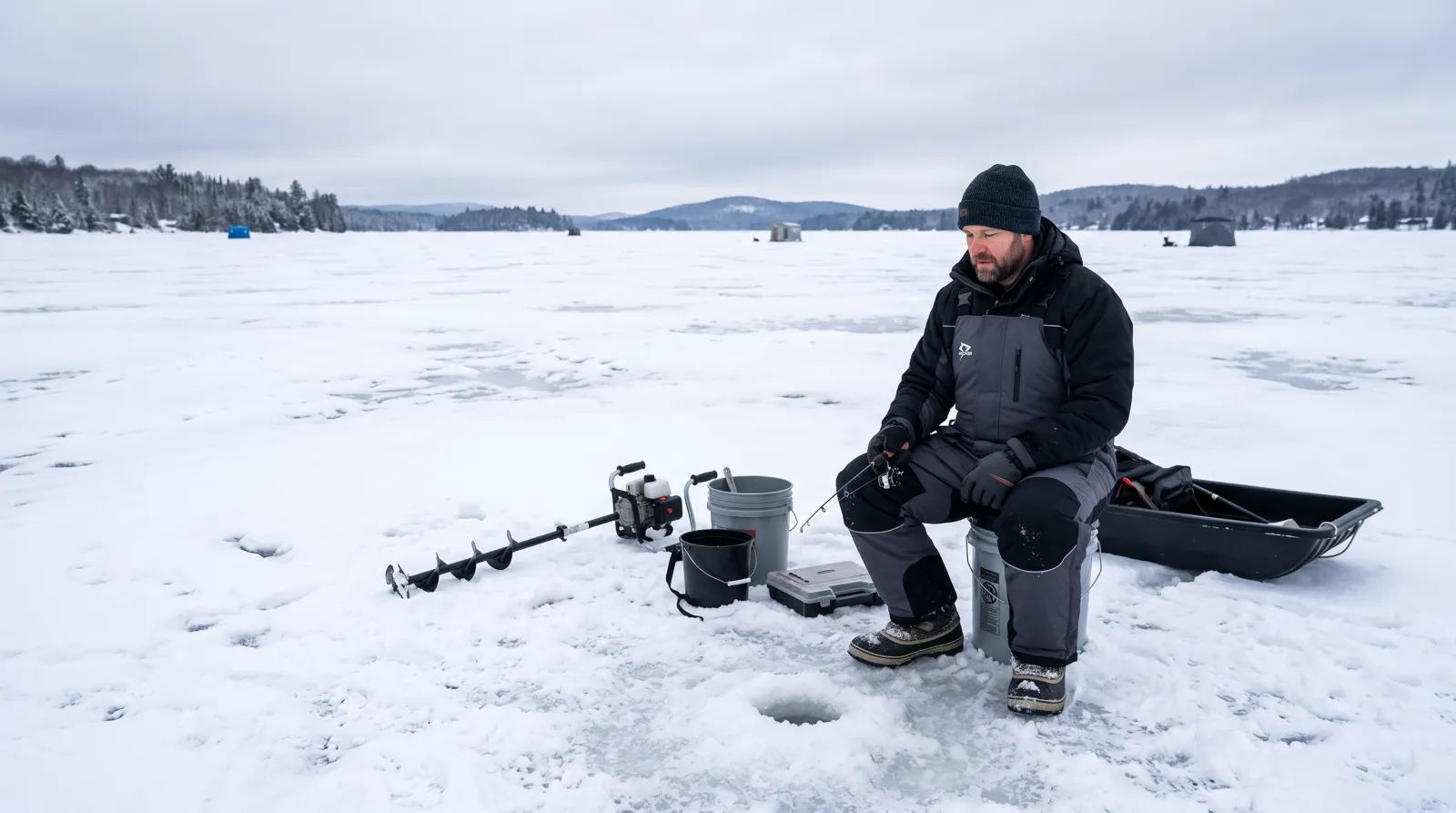
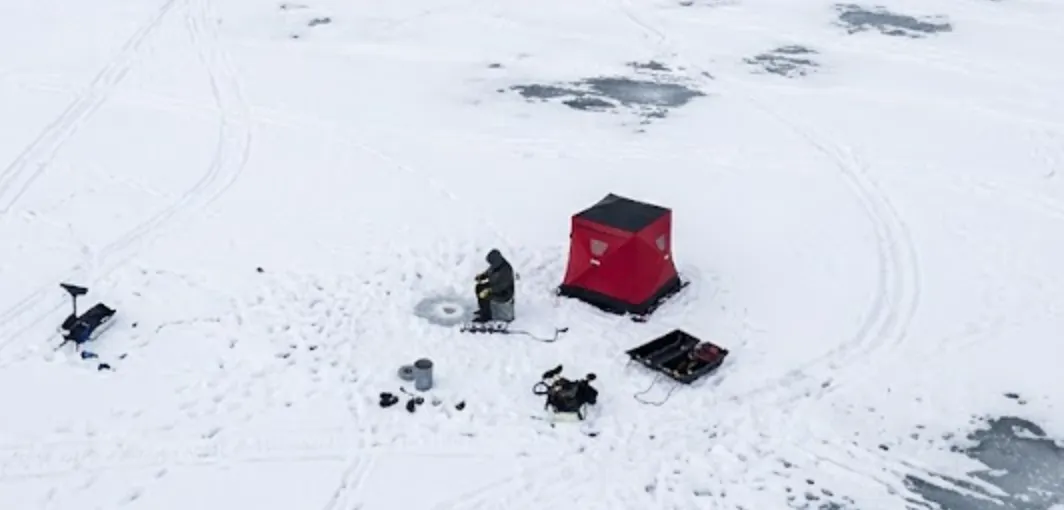
The wintering hole crappie occupy at 42F in open water is the same hole you drill at first ice. They usually don't relocate when the lid goes on. That, I'd argue, is what makes first ice the best crappie window of the winter: the school is already stacked, and nothing has been dropped on their heads since freeze-up. Which means the most valuable trip you take in November might be the one where you catch three fish and mark eleven spots.
Idle the progression while you still can:
- Pull up a contour map and pick the deepest usable basin with a creek channel feeding into it, then note exactly where that channel enters the bowl.
- Through late October and November, idle from the timber flat down the channel and into the basin, watching for suspended fish and marking every bend, inside turn, and bottom-content change you cross.
- Log the surface temperature every trip alongside the depth the fish were holding and the bottom depth underneath them, so the season reads as a ladder rather than a pile of disconnected good days.
- When the surface reaches the low 40s, the marks that keep producing are your wintering holes, and those coordinates are where you walk out and drill in December.
Holding all of that in your head doesn't work. A notebook barely works, because the comparison that pays is across years, not across weeks. That's the whole job of a log entry with a temperature and a depth in it, and it's why I'd rather record a blank trip than skip the entry because nothing bit. Two seasons of that and you can quit reading fall crappie articles, because you'll have written a better one for your own water. Bushwhack's features exist mostly so that comparison is one screen instead of an afternoon with a shoebox.
If you fish south of the ice line, nothing about this changes except the roof. Those same basin holes keep producing from a boat straight through January. And when the water starts climbing again in February, the fish reverse the exact route they came down, which is why spring crappie fishing tips from ice-out to spawn are really just the fall progression run backwards up the same creek channels.
Degrees, not dates.
Get fishing tips in your inbox
New guides, seasonal tactics, and gear picks — about once a month, no spam.