Best Sand Spikes for Surf Fishing Under $50: What Holds a Loaded Rod in a Nor'easter
 Hudson Reed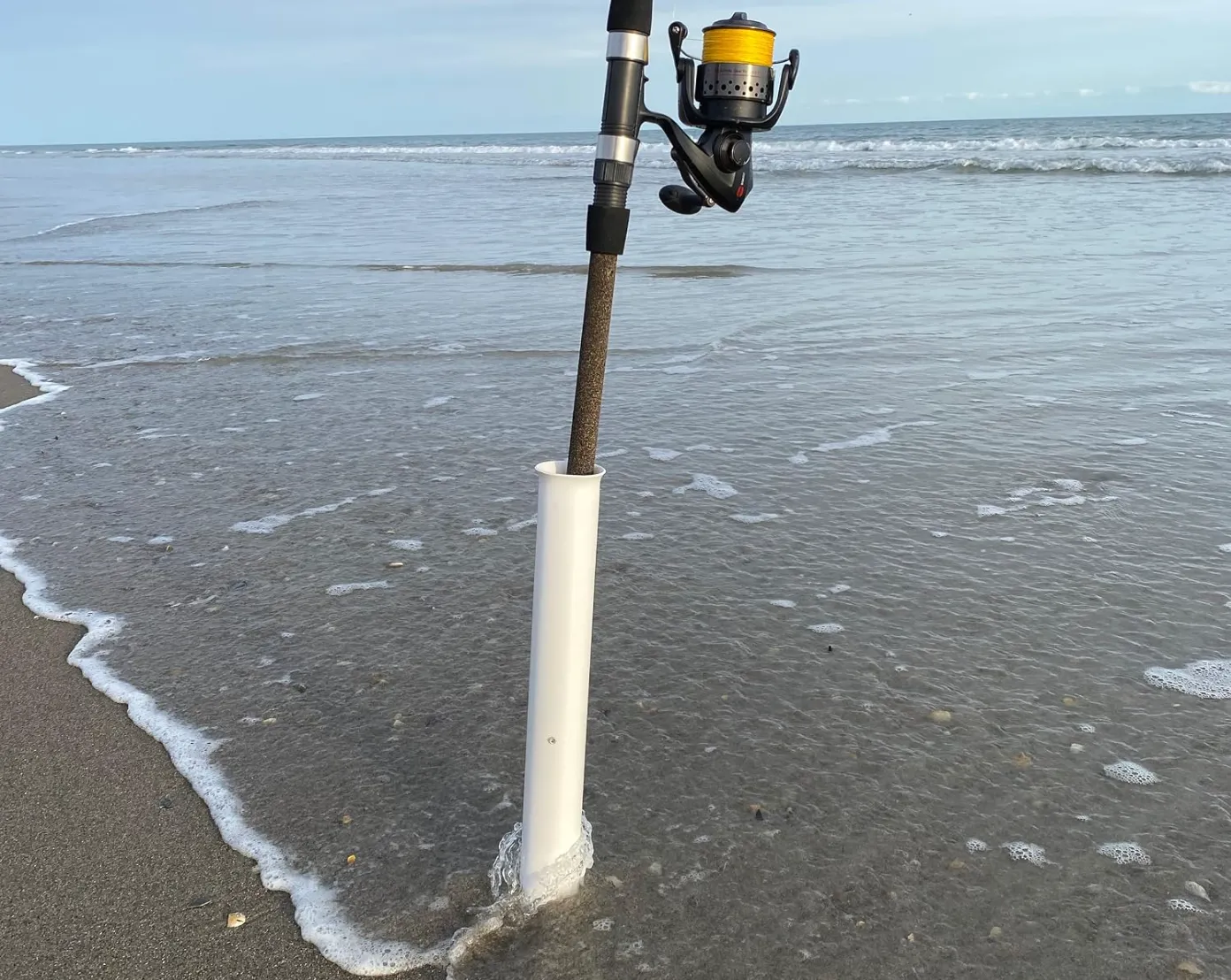
Written by Hudson Reed
A sand spike doesn't fail gradually. It fails in about one second: a swell washes out the base, a bluefish loads the rod tip, and your 10-footer goes over sideways into the foam with the reel packed full of wet sand. If you're still shopping for that 10-footer, start with our best surf fishing rod and reel combos roundup. That one failure mode is the whole test, which is why the best sand spikes for surf fishing get judged on buried depth and stake material long before anybody looks at the bait tray.
Everything under fifty dollars here is a plastic tube with an angled cut on one end. What separates them is how far that end goes down, whether there's metal ahead of the plastic to part packed sand, and how high the reel sits above the wash. Cup holders and cutting boards are pleasant on a flat July evening. They contribute nothing at 4 a.m. in late October with a northeast wind shoving wash halfway up the beach.
Quick picks: three spikes under $50
| Spike | Best for | Price | Our rating |
|---|---|---|---|
| Sea Striker 36 in PVC Sand Spike | Most beaches, most anglers, the default buy | $15.99 | 4.5 / 5 |
| Sea Striker sand spike with aluminum stake, 42 in | Coarse, wave-washed sand and loaded 10-footers | $15.99 | 4.5 / 5 |
| Adjustable telescoping sand spike, 24 to 44 in | Flying to the beach, or a full trunk | $12.95 | 3.5 / 5 |
What makes the best sand spikes for surf fishing hold in wave-washed sand?
Buried depth first, tip material second, everything else a distant third. A spike is a lever with its fulcrum at the sand line: rod, line, and sinker pull sideways at the top, and the only thing resisting is the column of sand gripping whatever you drove down. Get a third of the spike under the surface and a 4-ounce sinker in a moving sweep won't move it. Leave 8 inches buried because the sand felt firm, and the same rig walks that spike out of its hole one wave at a time.
Sand type decides more than brand does.
Soft dry sand above the wrack line accepts a plain PVC tube easily and grips it poorly. Wet fine sand near the wash is where PVC is happiest. Coarse, shelly, wave-packed sand is where plastic quits, because the angled cut skates and flexes instead of parting the grains. The mechanism is simple: a hardened metal edge parts packed grains, while a beveled PVC wall flexes and skates across them, which is why a mallet becomes part of the kit on those beaches. Height helps for a separate reason, keeping the reel out of blowing sand and the line above incoming foam on a big fall tide.
Sea Striker 36-Inch PVC Sand Spike: Best Overall

This is the spike you see stuck in the sand from Sandy Hook to Cape Hatteras, and it earns that. One piece of corrosion-resistant high-impact plastic, an angled end that pushes in without tools, and an aluminum stop pin so your rod butt rests on metal instead of notching the tube. Per the manufacturer's spec page it's made in the USA in 22, 27, and 36 inch lengths. Buy the 36. It runs 4.6 stars across 1,017 Amazon ratings, the deepest evidence base in the category.
What it isn't: premium. It's the standard beach spike, priced like one, and it'll crack if you drive it into cobble with a hammer.
Who it's for
Anybody on fine to medium sand who wants one spike that works and costs less than a pack of bunker.
Pros and cons
- Pro: aluminum stop pin, so the rod butt doesn't chew the tube
- Pro: one piece, nothing to seize or corrode
- Pro: 4.6 stars from 1,017 ratings, the largest review base here
- Con: 36 inches is short for a steep beach
- Con: plain PVC skates on hard-packed or shelly sand
Price: $15.99 as verified. Buy it on Amazon.
Sea Striker Sand Spike With Aluminum Stake: Best for Wave-Washed Sand

You might also enjoy: Best Lipless and Squarebill Crankbaits for Fall Bass 2026
Same company, different idea. The tube is still PVC, but the part that goes into the ground is an angled aluminum stake: metal at the digging end, plastic at the holding end. Be clear on that, because listings and roundups blur it constantly. This is not a solid anodized-aluminum spike and you shouldn't pay for it expecting one. Amazon's title is even garbled, brand run into product name, which makes it easy to mistake for something better. It sits at 4.6 stars from 454 Amazon ratings at the same $15.99 as the plain tube, so the metal stake is essentially free.
It comes in 28 inch and 42 inch. Get the 42.
That length is the one that answers the question this post opened with. A loaded 10-footer with 5 ounces and a chunk of bunker, planted in coarse sand a nor'easter has been packing for two days, is where a 36-inch PVC tube tends to get levered out and a 42-inch spike with a metal digging end holds.
Who it's for
Steep or coarse beaches, 10-foot rods and up, and anyone who has already watched a rod go into the wash once.
Pros and cons
- Pro: aluminum stake parts packed sand that PVC skates across
- Pro: the 42 inch option clears the wash
- Pro: no premium over the standard PVC spike
- Con: PVC body, not the one-piece aluminum spike some anglers want
- Con: sloppy listing, and the length is easy to get wrong at checkout
Price: $15.99 as verified. Buy it on Amazon, and double-check you selected 42 inch.
Adjustable Telescoping Sand Spike: Best Packable Pick

It collapses from 44 inches to 24, which no fixed spike does, and that trick is the whole reason to consider it. Fly to the Outer Banks, or load a trunk that already holds a cooler and a cart, and a spike that shrinks 20 inches solves a real problem. At $12.95 it's also the cheapest here.
Now the honest part. It carries 4.2 stars from 106 Amazon ratings, the thinnest evidence base here by a wide margin, and a telescoping joint is one more thing for salt and grit to seize. Buy it as the travel spike or the second-rod spike. Don't make it the thing holding your good rod during a blow, because a joint you cranked shut with sandy hands is a weak link the other two don't have.
Who it's for
Traveling anglers, small cars, and anyone who wants a cheap spare in the beach cart.
Pros and cons
- Pro: one spike covers 24 to 44 inches
- Pro: cheapest of the three at $12.95
- Pro: packs into a suitcase or a full trunk
- Con: 4.2 stars from only 106 ratings, weakest record of the group
- Con: the telescoping joint is a salt-and-sand failure point
Price: $12.95 as verified. Buy it on Amazon.
How long should a sand spike be for your beach?
Match the length to the slope and the sand, not to your rod.
You might also enjoy: Best Polarized Fishing Sunglasses Under $100 (2026): Top Picks Compared
- Steep, coarse, cobble-and-shell beaches where wash reaches your gear: 42 inches or longer, with a metal stake. Rhode Island's south shore in a blow, the Montauk beaches, the steeper cuts along Hatteras.
- Flat, gently sloping fine sand where gear sits 30 feet back: 36 inches of plain PVC is plenty, and easier to drive and pull.
- Bay beaches, inlet flats, and soft sand above the wash: 27 to 36 inches. You're fighting for grip, not waves, and extra height buys nothing.
The 22-inch spikes are a beach-chair accessory. They exist for kids with 6-foot rods and flat bay shorelines in July, and if you buy one for the fall run you'll spend the trip picking your rod out of the sand.
Why you want two spikes, not one
Two plain spikes is the upgrade almost everyone should make before spending $50 on one deluxe spike with a bait tray bolted to it.
The first spike holds the rod that's fishing. The second is where that rod goes while you re-bait, so a sandy reel never touches the ground. Two also let you fish two distances at once, one in the trough and one past the bar, which is how you find fish instead of guessing at them. At $15.99 each, a pair lands under $32.
One thing to know before you plant a wall of rods: the coastwide ocean recreational limit for striped bass is one fish per day in a 28 to 31 inch slot, per ASMFC, and Addendum III (approved October 2025) left those recreational measures unchanged for 2026. Two rods is about covering water, not filling a cooler. Check your state's rules too, since seasons and bonus programs vary.
Is a DIY PVC spike worth it?
Yes, but not for the reason people assume. You don't build PVC spikes to save money anymore. You build them for length nobody sells cheaply.
An 8-foot stick of 1.5-inch or 2-inch nominal Schedule 40 PVC, cut in half on a 45-degree angle or sharper, yields two spikes just under 48 inches. Drill a stainless bolt through each about 8 to 11 inches down as a stop pin, sand the cut edges so they don't chew your rod butt, and you're done inside an hour. Total the pipe, the hardware, and the saw time and you haven't beaten $15.99 by much. What you have is a spike pushing 48 inches, and at that length the shelf goes mostly empty under fifty dollars. Use Schedule 40, not thin-wall DWV, which snaps when you lean on it in packed sand, and go 2-inch so it swallows a fat rod butt with a gimbal instead of pinching it.
Our pick for the fall run
Buy two Sea Striker spikes with the aluminum stake in 42 inch, about $32 total. That pair solves the problem this post opened with for less than one aluminum spike from a specialty shop. If your beach is flat and you fish well back from the water, swap one for the 36-inch plain PVC.
The timing isn't academic. Atlantic striped bass move north in summer and south in fall, with mixed-stock wintering grounds offshore from New Jersey to North Carolina according to ASMFC's species profile, which is why the run rolls from Massachusetts to the Outer Banks between late September and November. That same profile lists the stock as overfished: female spawning stock biomass in 2023 was estimated at 191 million pounds against a 197 million pound threshold. Bluefish ride the same conveyor south. NOAA Fisheries is where to watch for stock and management updates.
A population under that pressure rewards anglers who track patterns instead of hours. If you're going to stand on a cold beach for six weeks, log every trip: tide stage, wind direction, water temp, which distance produced. Two seasons of that will teach you more about your beach than any article, which is the whole reason Bushwhack exists.
Buy the spikes now. By October the shelves near the beach thin out, and the shop closest to the sand is not where you want to find that out.
You might also enjoy: Best Polarized Fishing Sunglasses Under $50: 5 Picks (2026)
Get fishing tips in your inbox
New guides, seasonal tactics, and gear picks — about once a month, no spam.