Weber River Winter Fly Fishing: Where It Stays Open, Where It Ices, and the Midges That Work
 Cameron Spanos
Written by Cameron Spanos
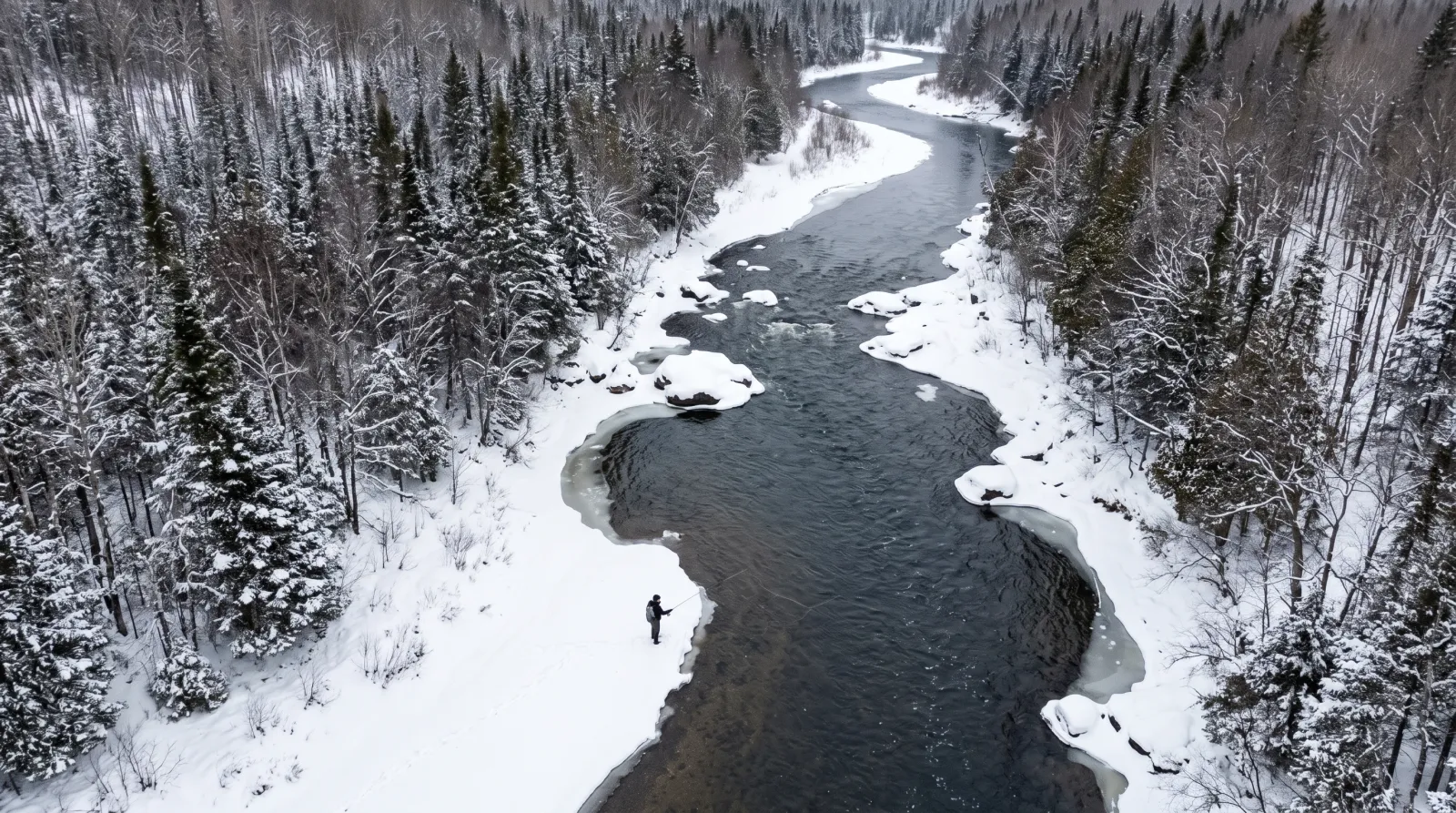
When people rave about the Weber in January, they mean one stretch: the tailwater under Rockport. Weber River winter fly fishing below Echo is a different deal, and anglers who drive to that dam expecting a mirror image of the Rockport side tend to find a trickle instead of a river. So before you pick flies, pick the right Weber. Most of what follows is about doing that.
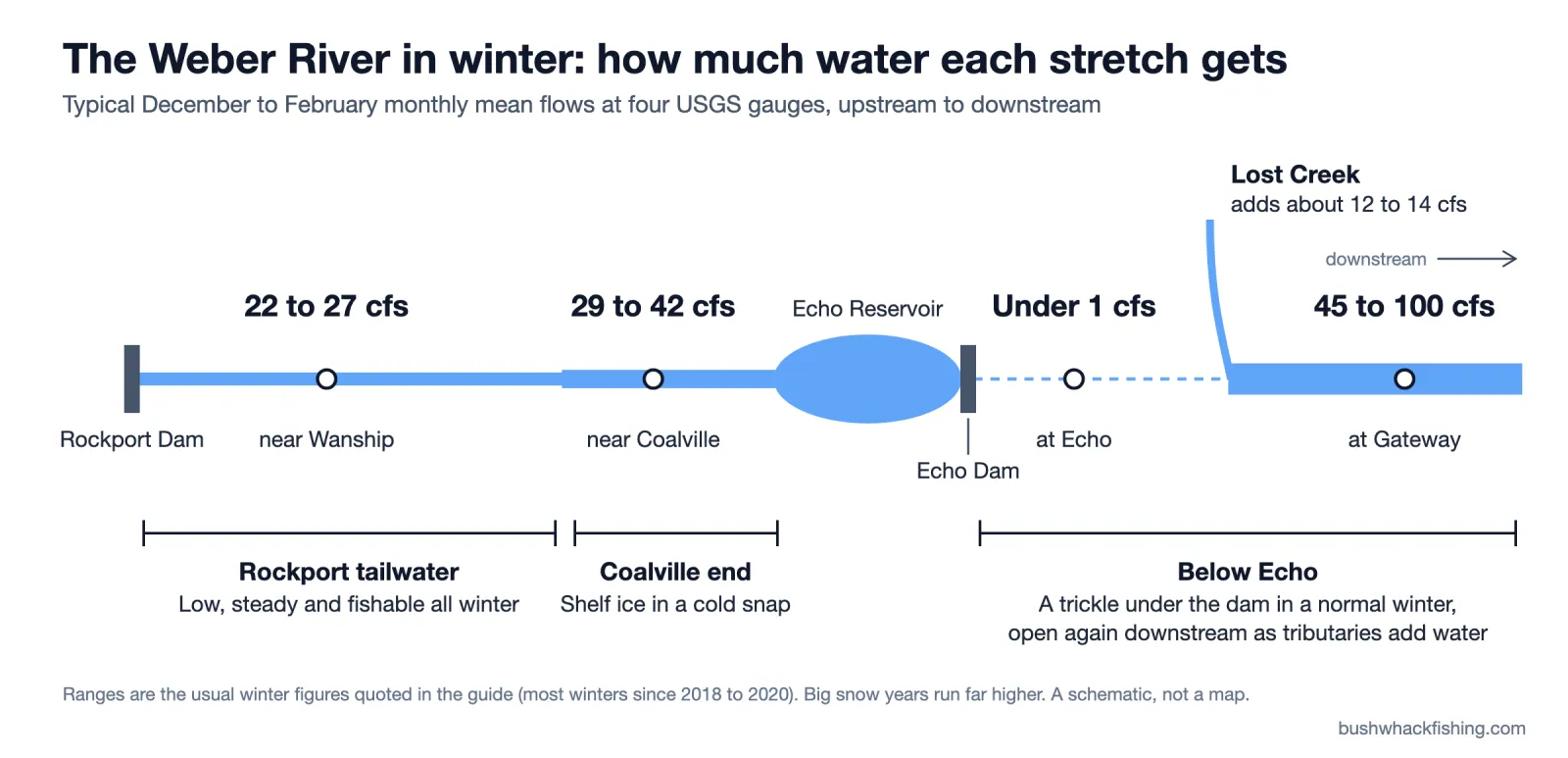
The short version: below Rockport the river stays low, steady and fishable all winter. Below Echo it recovers miles downstream as tributaries add water. Toward Coalville, cold snaps bring shelf ice. Wherever it's open, nymph size 16 to 24 midges and sowbugs on 6X and 7X, tight to the bottom.
Is the Weber River open to fishing in winter?
Yes. Utah runs a year-round season on most waters, and the Weber has no winter closure in the 2026 Utah Fishing Guidebook. What changes by section is the tackle and the limit, so it's worth knowing the two Weber entries in the guidebook before you string up:
- From the I-80 bridge near Wanship (near Exit 156) down to the first I-80 bridge upstream from Echo Reservoir (near Exit 164): limit 2 trout, artificial flies and lures only. This is the special-regulation water below Rockport.
- From the Great Salt Lake up to Echo Reservoir dam: all cutthroat trout, or trout with cutthroat markings, must be released immediately, and common carp are the only nongame fish you can keep.
That's straight from the guidebook. Elsewhere on the main stem the statewide daily limits apply: 4 trout and 10 whitefish. Rules get updated, so read the current Weber entry yourself each season instead of trusting a blog post (this one included).
Below Rockport: the Weber that fishes all winter
Rockport Reservoir's dam sits just above Wanship, and the river under it behaves like a proper winter tailwater. USGS gauge 10129500 (Weber River near Wanship) sits a short way below the dam, and its monthly mean flow for December, January and February has landed between roughly 22 and 27 cfs in nearly every winter since 2018. The exceptions were big-water years: February 2020 averaged about 52 cfs and February 2023 about 153 cfs, per the USGS monthly statistics.
Twenty-five cfs isn't a lot of water. It's clear, it's skinny, and it makes the fish easy to spook and hard to fool. But it's consistent, and consistent is what you want in January. A tailwater release comes out of the bottom of the reservoir, so the water near the dam doesn't swing with every cold night the way a freestone does, and that's why the bugs (and the fish eating them) keep working through the winter.
The special-regulation water starts at the I-80 bridge near Wanship and runs toward Coalville. From the confluence of the Middle and Main Forks downstream about 40 miles to Echo Reservoir, Utah's courts have found the Weber navigable, and the DWR's upper Weber access page spells out what that means: you can fish and walk the riverbed up to the ordinary high-water mark (the permanent vegetation line), you enter or leave the river only at public access points or on posted private land with landowner permission, and you don't trespass on posted private land above that line. Park where it's legal, get in at a public access point, and stay in the river corridor.
Fish here are mostly brown trout and mountain whitefish, with some cutthroat and rainbows mixed in. This post isn't about hunting a trophy. It's about catching fish when it's 20 degrees at the truck.
Where the Weber ices up
The tailwater effect fades with distance. By the time the river has run past Wanship and down toward Coalville, it's been exposed to a lot of cold air, and in a hard snap the slow edges skim over first. That's where you'll see ice first: shelf ice along the banks near Coalville, and sometimes a lid on the slow water where the river slides into Echo Reservoir. Flow doesn't drop much (USGS gauge 10130500, near Coalville, has mostly averaged 29 to 42 cfs in winter months since 2020), but ice changes what you can actually fish.
Three things to watch for down there:
- Shelf ice that looks solid and isn't. Wading out to reach a seam from a shelf is how people end up swimming.
- Slush in the current after a frigid night. When the drift is full of it, fishing a nymph is basically hopeless until the sun burns it off.
- Ice in your guides. Not a safety problem, just a misery. A little paste on the guides or dunking the rod helps.
My take: in a real cold snap, don't drive past the upper end of the special-regulation water. Fish closer to the dam, where the water's freshest out of Rockport, and save the Coalville end for the thaw.
You might also enjoy: Pflueger President vs Shimano Sedona: Which Ultralight Reel to Buy for Trout and Panfish (2026)
Can you fish below Echo Reservoir in January?
You can, but the reach right under Echo dam is often barely a river in winter. USGS gauge 10132000 (Weber River at Echo) has posted monthly mean winter flows under 1 cfs in most winters since 2018. The outlier came after the record 2023 snowpack, when the winter monthly means ran between about 58 and 159 cfs across the 2023 and 2024 winters. In a normal winter, Echo is storing water, not sending it downstream.
The lower Weber gets its flow back from tributaries. Lost Creek alone added about 12 to 14 cfs through last winter's monthly means at USGS gauge 10133000 (Lost Creek at Devil's Slide), and at USGS gauge 10136500 (Weber River at Gateway), near the mouth of Weber Canyon, winter monthly means have mostly run from about 45 to 100 cfs since 2020, per USGS monthly statistics. That's why the lower river tends to stay open well downstream even when it's thin up top. Back in December 2013, a DWR fishing report said the only open, fishable water on the river was between Mountain Green and Morgan. One report from one winter, but it lines up with the gauges.
Access is the other catch. The navigability ruling that opened the upper river covers the confluence of the Middle and Main Forks down to Echo Reservoir, and the lower river along I-84 runs past a lot of private ground. The Henefer to Taggart stretch is the best-known reach down there (it's the summer tubing float), and even there access has been argued over in recent years. Check the DWR's stream access page and the Fish Utah map before you go, and treat posted land as posted. Don't hop a fence because the water looks good from the freeway.
Below Echo is a warm-day bonus, not a winter destination. If you only have one January day, spend it below Rockport.
Weber River winter fly fishing is a midge game
On most winter days the fish are eating midge larvae and pupae, plus sowbugs and scuds that live in the weeds year-round. Visit Utah's Weber page calls out sowbugs, scuds and midge larvae as year-round trout food on this river.
These are the patterns that keep showing up in Weber winter reports:
- Zebra Midge in sizes 20 to 24, black with copper or silver wire. If you carry one midge, carry this one.
- Black Beauty and Desert Storm in 20 to 24, both named for winter in Game & Fish's 2010 Weber feature.
- Sowbugs in 16 to 22. A tailwater sow in gray or tan is an easy upper fly.
- Top Secret Midges and Jujubee Midges, which Fly Fish Food's March 2026 Weber report listed alongside black Zebras.
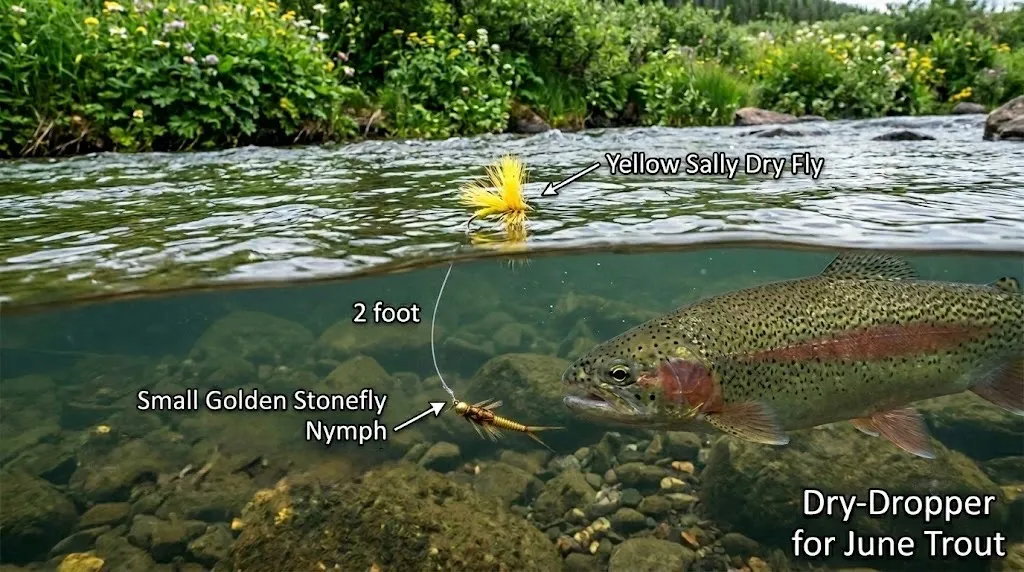
Run the sowbug on top and a midge 12 to 16 inches below it. If they ignore it, try a pupa with a bit of flash before you go smaller.
Tippet: 6X for the sowbug, 7X to the point fly when the water's gin clear and the fish are refusing. Norrik's 2025 Weber report recommended going finer than 6X with long leaders in winter. On 25 cfs below Rockport you'll feel the difference. Fluorocarbon earns its price on these midge rigs.
Why tight and deep matters
Cold trout don't move far for food. They sit low in the water column, in the softer seams and the slow middle of the runs, and they'll let a midge tick past six inches over their heads without moving. So you fish it to them.
That means enough weight to get down fast (a tungsten bead plus a small split shot if the run needs it), an indicator set about one and a half times the depth, and short, controlled drifts where you can keep slack off the line. Mend early. If you're not ticking bottom now and then, you're probably too shallow. Euro nymphing works great here too, and it's probably better than an indicator in the faster pocket water, but a small yarn indicator and a long leader is easier to fish on the flat, slow glides where most winter fish stack.
You might also enjoy: Flaming Gorge Lake Trout Ice Fishing: Jigging Pups on the Channel Edges (and Why Managers Want You to Keep Them)
Strikes are tiny. A pause, a twitch, the indicator tipping sideways. Set on all of it.
When do the dries come out?
Rarely, and on the right days. Plan on nymphing. Game & Fish's 2010 Weber feature reported surface activity as generally rare from January through March, and that's still a fair rule. The exception is a warm, overcast afternoon with little wind, when midges hatch heavily enough to cluster and fish start sipping in the slow tailouts.
When that happens, bring a size 18 to 22 Griffith's Gnat or a small cluster pattern, cut back to 7X, and pick one rising fish instead of flock-shooting the pod. As February wears on, small Baetis (blue-winged olives) start showing up on mild gray days too, so a few size 20 BWO emergers in the box are cheap insurance.
Sunny and cold? Don't wait for rises. Go back to the midge rig.
Whitefish are half the winter catch
Mountain whitefish are native to the Weber, and in winter they're often the fish you'll catch most. They pod up in the deeper, slower runs and eat the same sowbugs and midges the browns do. A DWR report from winter 2014 said fly anglers were doing well on whitefish with sowbugs and midge patterns, and DWR's December 2025 forecast noted that both the brown trout and whitefish spawns were done for the year.
Don't sneer at them. A big whitefish on 7X in a 25 cfs run is a real fight, and when you hit a pod you'll know you're fishing the right depth. They're game fish with a 10-fish statewide daily limit, separate from the trout limit.
A simple winter day plan
Here's how I'd set up a December, January or February trip to the Weber:
- Check the gauges the night before. USGS 10129500 (near Wanship) tells you the Rockport release, 10130500 (near Coalville) shows the middle river, and 10132000 (at Echo) shows what's leaving Echo dam. DWR's own winter forecast says flows may fluctuate, so a sudden jump means turbid water or a release change.
- Start late. Midday to mid-afternoon is the window when the water and air warm a few degrees, the midges get moving, and you're not fighting frozen guides. Arriving at 11 a.m. isn't lazy in January, it's sensible.
- Pick the slow, deep runs first. Skip fast riffles and look for soft, waist-to-chest-deep water where fish can hold without fighting current.
- Rig a sowbug over a Zebra Midge on 6X and 7X, with enough weight to tick the bottom, and change depth before you change flies.
- Watch the slow tailouts after 1 p.m. on warm gray days. If fish start rising, switch to the dry rig and slow down.
Record what worked. The winter Weber is a pattern river: the same flow, the same depth and the same midge stage repeat every week, so noting the release and the fly that got eaten saves you the next trip's first two hours. You can try Bushwhack to log the flow, the fly and the run on every trip, then see which conditions actually put fish in the net.
If you've got one cold day and one Weber to pick, pick the Rockport tailwater. Bring small flies, fine tippet and patience, and don't push the ice.
Going fishing? Write it down.
Bushwhack is a free fishing log that fills in the weather, moon and pressure for you, then shows which spots, flies and conditions actually produce. Blank days included.
Get fishing tips in your inbox
New guides, seasonal tactics, and gear picks, about once a month, no spam.