Middle Provo Winter Fly Fishing: Midges, the Midday Window, and Snow-Day Access
 Cameron Spanos
Written by Cameron Spanos
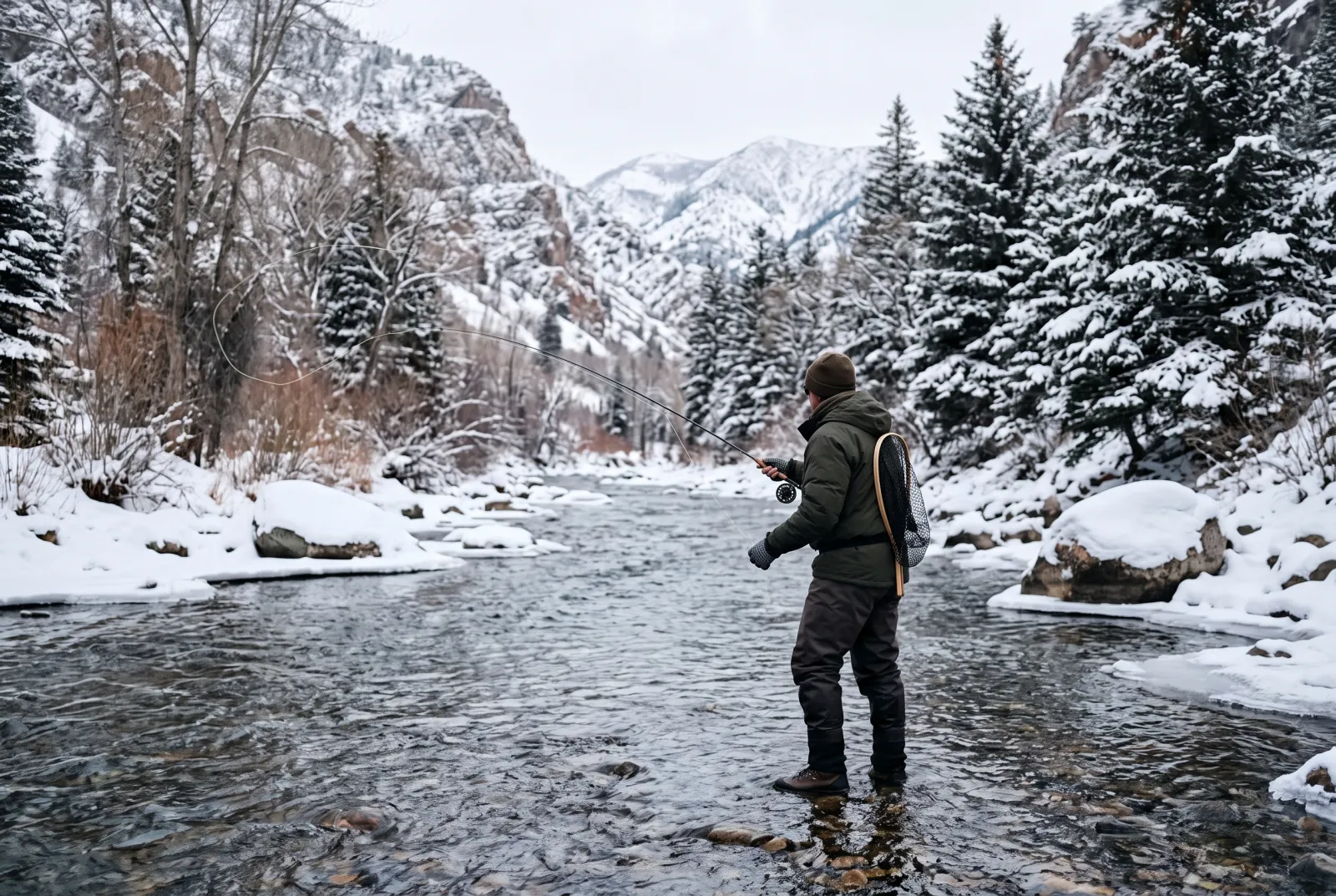
The Middle Provo isn't allowed to drop below 125 cfs. That floor was written into the deal that built Jordanelle Dam, and it's the main reason Middle Provo winter fly fishing works at all while the freestones around Heber Valley sit under shelf ice. Last winter the river barely tested it: the USGS gauge at the River Road bridge logged daily mean flows between 127 and 166 cfs from December 2025 through February 2026. Steady water. Small bugs. Fish that will eat if you show up at the right hour with the right size 22.
So yes, it fishes. It just fishes on a schedule, it fishes tiny, and after a storm the parking lot can be harder than the trout.
Is the Middle Provo good in winter?
Yes. It's one of the most dependable winter rivers in northern Utah, and the reason is plumbing, not luck. The Utah Reclamation Mitigation and Conservation Commission lists a 125 cfs year-round minimum release from Jordanelle as one of the conditions of the dam's construction, so the Middle Provo never gets the low, slushy, anchor-iced flows that shut down unregulated rivers in January. The fish stay put and they keep feeding. Fly Fisherman's 2015 feature on the river put the Middle Provo at better than 3,000 trout per mile, mostly browns with rainbows mixed in, and those fish still need calories in mid-winter.
What you won't get is a June day. The trout slide out of the fast riffles and stack into soft water: tailouts, slow inside seams, the deeper buckets at the heads of runs, the slack behind boulders. Most of your fish will come within a foot of the bottom, on something smaller than a grain of rice, during a window that might last three hours.
If you want to swing streamers through riffles, wait for April.
What the gauges actually show
Flows are the easy part. The USGS gauge near Charleston, at the bottom of the reach, ran daily means of 152 to 226 cfs last winter (provisional data), a bit higher than River Road because of tributary and return-flow inputs on the way down the valley. Each gauge held steady from month to month: Charleston's monthly means were 166, 164, and 163 cfs for December, January, and February. On this river, winter flow is close to a non-factor.
Water temperature is the number that matters, and it moves more than most people expect. The Charleston gauge recorded daily mean water temps of roughly 39 to 44°F in December, 34 to 43°F in January, and 36 to 43°F in February. January averaged about 37°F. That's cold enough to put fish down hard.
Here's why the upper river behaves differently. Water drawn from deep in a reservoir in winter sits near 39°F, the temperature where fresh water is densest, and Jordanelle releases from depth. That water then runs roughly a dozen miles through an open valley under frigid winter nights and loses heat the whole way. USGS doesn't publish a temperature record at the River Road gauge, so I can't show you the upper-river numbers side by side. But the physics points one direction: in a cold snap, the water near the dam stays warmer and steadier than the water at Charleston. That's the stretch I'd fish in January.
Sleep in. The window is 10 to 2
The single most useful thing to know about this river in winter is when to be on it. Fly Fisherman's Provo coverage named 10 a.m. to 2 p.m. as the productive window, and that matches how midges behave everywhere: emergence follows the warmest, brightest part of the day. Rigging up at first light in January buys you three hours of frozen guides and nothing else.
My take is stronger than "fish midday." Skip the morning entirely. Drive up after the sun has been on the valley floor for a couple of hours, fish hard from late morning until the light goes flat, and be back at the truck before the shadows reach the water. Once the sun drops behind the mountains to the west, the bugs quit, the air temp falls off a cliff, and your tippet starts freezing in the guides every third cast.
You might also enjoy: Which Flies Catch the Most Trout? 514 Fish From 193 Logged Fly Fishing Trips
Midges run the show
From December into March, midges are most of what's on the menu. Expect sizes 20 to 26, low and clear water, and trout that have seen every zebra midge sold in Salt Lake County. Fly Fisherman's advice for this river was 5X as a baseline, dropping to 6X or 7X when fish get picky. On dries you'll end up at 7X more often than not.
Under the surface
This is where most winter fish get caught, and it's where I'd spend most of December and January. Run a two-fly midge rig with a small split shot, either under a tiny yarn indicator or tight-lined through the slower slots. Short drifts, lots of them, dead slow.
- Zebra midge in black or red, sizes 20 to 22, as the point fly
- A smaller pupa or emerger (WD-40, RS2, or a thread midge) in 22 to 24 above or below it
- A size 16 sowbug or scud as an attractor when nothing's moving. Fly Fisherman listed scuds and sowbugs in sizes 14 to 18 as winter staples on the Provo
- Egg patterns and Provo River worms, which older BackcountryChronicles January reports credited for a lot of their fish
Weight matters more than pattern. If you aren't ticking bottom every few drifts, add a shot. In January's coldest water, fish won't move eight inches to meet a nymph.
On top
When fish start dimpling in a tailout, they're usually eating midge clusters or emergers stuck in the film. A Griffith's Gnat or another cluster pattern in 18 to 20 is easier to see and often outfishes a true-to-size single adult. When they get selective, go down to a single adult midge in 22 to 24 on 7X and cast to one fish at a time. BackcountryChronicles has reported strong buffalo midge hatches on the upper Middle Provo through February and March, producing early-afternoon dry fly fishing. That's the bug that makes February worth the drive.
BWOs: the gray-day bonus
Blue-winged olives are the other winter bug, and they want bad weather. Overcast, flurries, a low ceiling, no wind if you're lucky. The Fly Fishing Place's Provo hatch chart lists midges and BWOs as February's main hatches on the Middle Provo, sizes 18 to 22.
Don't plan a December trip around them. Olives on this river are mostly a late February and March thing, and they come off in the afternoon, later than the midges. When a gray afternoon does deliver, a Pheasant Tail or RS2 in 18 to 20 below a parachute or CDC olive will cover it. Sunny bluebird days in February belong to the midges. Gray, snowy days are when you bring the olive box.
Middle Provo winter fly fishing, month by month
December is the transition. The water's still near 40°F early in the month and fish feed more freely than they will in January. Brown trout spawned in the fall and their eggs are still incubating in the gravel, so stay off the clean, light-colored ovals in the tailouts. Walking through a redd kills it.
January is the grind. It's the coldest water of the year at the lower gauge, midge hatches are hit and miss, and the fish are at their most lethargic. Nymph it. Fish the upper river nearer the dam, fish the softest water you can find, and treat any rise as a bonus. A handful of fish is a good day.
February is the payoff. Days get longer, the sun gets higher, and the midday window widens. Hatches get more consistent toward month's end and during stretches of warmer weather. Pods of risers in the tailouts become a regular thing, BWOs start showing on gray afternoons, and crowds stay thin until spring. If you can only pick one winter month, pick late February.
Which access points work after a snowstorm?
Honest answer: I couldn't find a published winter plowing schedule for any of the Middle Provo angler lots, from the Mitigation Commission, the DWR, or Wasatch County. I'm not going to guess which ones get cleared. What I can tell you is how access is set up and how to plan around the uncertainty.
You might also enjoy: The Utah Cutthroat Slam: All Four Subspecies and How to Catch Them
Public access to the corridor runs through seven designated parking areas with restrooms and information kiosks, and the commission asks anglers to enter and leave the corridor only through those sites. That matters in winter, because the temptation after a storm is to pull onto a snowy shoulder somewhere near the river and hike in. Don't. The corridor isn't all public land, and the commission has specifically called out illegal parking along old Highway 40 near the Wasatch Diversion as a problem.
The practical plan:
- Pick a primary lot and a backup before you leave home, ideally on different roads. A lot sitting right off a state highway, like the one at Legacy Bridge on Midway Lane (SR-113), is easier to reach after a storm, but a plowed highway tells you nothing about whether the lot itself got cleared.
- Carry a shovel and assume you'll need it. A lot that was cleared yesterday can be drifted shut by the time you come back to the truck at 2:30.
- Expect the walk to the water to be the slow part. Trails that take five minutes in July can take twenty through boot-deep snow, and the longer walk-ins (the Bunny Farm trail runs about a quarter mile) eat into a fishing window that's already short.
- Give it a day. The morning after a big dump is a bad time to find out which lots get cleared. The day after that, with sun on fresh snow, often fishes better anyway.
For lot-by-lot details on every access point, parking capacity, and where the regulation line falls, see our mile-by-mile Middle Provo access guide.
Winter wading without the swim
The Middle Provo is slick in July. In January it's slick, cold, and unforgiving if you go in. A dunking at 36°F water and 20°F air is a get-back-to-the-truck-now emergency, not an inconvenience.
A few things change in winter. Felt soles pack with snow on the walk in and turn into skates on the first frozen rock, so studded rubber soles are the better choice when there's snow on the ground. Shelf ice along the banks looks solid and often isn't, especially where current undercuts it, so get in and out where the bank is bare. Use a wading staff, cinch the wading belt, and wade less than you would in summer. The fish are in slow water anyway; you rarely need to cross anything. Keep a full dry change of clothes in the truck, tell someone which lot you're parked at, and keep your phone in an inside pocket where the battery stays warm.
Regulations to know before you go
Per the 2026 Utah Fishing Guidebook, the Middle Provo has two sets of rules, split at Legacy Bridge on Midway Lane (SR-113):
- From Legacy Bridge upstream to Jordanelle Dam: limit 2 trout under 15 inches, artificial flies and lures only.
- Below Legacy Bridge down to Deer Creek: statewide regulations apply, which means bait is legal and the statewide limit of 4 trout applies.
Don't confuse these with the river above Jordanelle Reservoir, where the guidebook limits harvest to brown trout and requires all cutthroat and rainbow trout to be released. Regulations change, so pull up the current guidebook before every season. And in winter, even on the harvest stretch, I'd release everything. Handling fish fast and keeping them wet matters more when the air is colder than the water; a trout held up out of the water for a photo can have its gills and fins start to freeze fast.
Make the winter days count
Winter trips on this river are short, so every one teaches you something if you keep track. Note the water temp, the time each fish ate, what it ate, and which lot you parked at. A few trips in, you'll know your own window better than any general rule. That's what we built Bushwhack's fishing log for: you can see your catches by time of day and conditions instead of trying to remember which February afternoon the buffalo midges came off.
Leave the dry box in the truck until February. Bring the zebra midges, the 7X, and a shovel.
Get fishing tips in your inbox
New guides, seasonal tactics, and gear picks — about once a month, no spam.