Tarpon Fishing for Beginners: How to Catch Your First Silver King in June
 Hudson Reed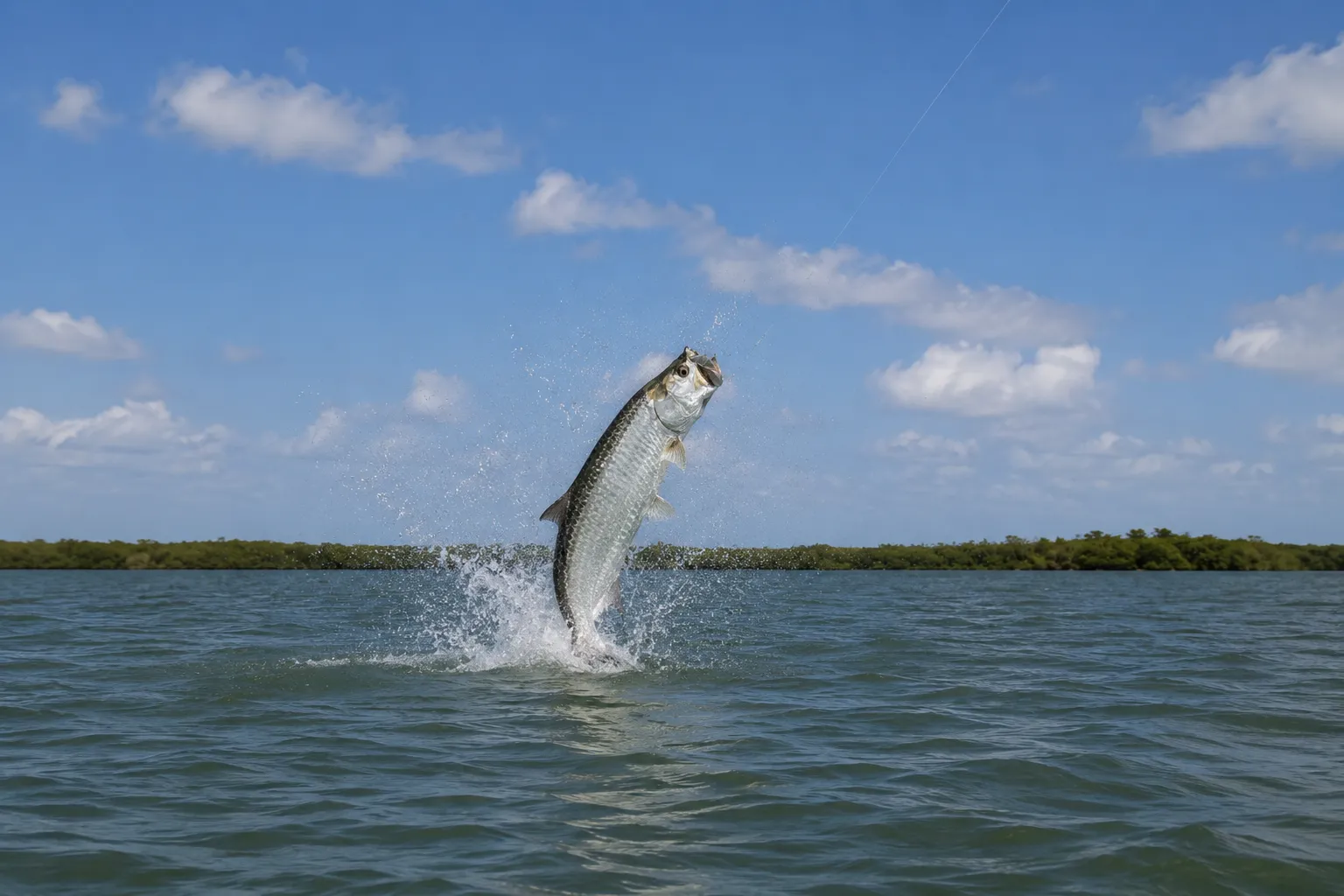
Written by Hudson Reed
The first jump ruins you. A hundred-plus pounds of silver airborne, head shaking so hard you can hear the gill plates rattle from forty yards off, and you have about a quarter second to remember everything anyone ever told you about tarpon fishing for beginners before you blow it. Most first-timers do blow it. The Florida Fish and Wildlife Conservation Commission has cited landing rates around 37% on hooked tarpon, and that number includes guides who do this every day.
So June. You picked a good month.
Tarpon fishing for beginners works best in May and June when the migration concentrates fish at Boca Grande Pass, the Tampa Bay beaches, and the Keys flats. Bring a heavy 8-foot spinning rod, 50-lb braid, an 8-foot leader of 60-80 lb fluorocarbon, and a 5/0-7/0 circle hook. Bow the rod tip toward every jump. Keep any fish over 40 inches in the water. That's a Florida rule, not a suggestion.
Why June Is the Window
Tarpon migrate north along both Florida coasts when surface temperatures hold above 75°F. Sanibel Island Fishing Charters tracks the move starting in late March, but the fish don't really stack until May, and by June you have schools of a hundred-plus stretched along the beaches from Naples up to Anna Maria.
Boca Grande Pass is the famous one. Thousands of tarpon stage there in May and June before spawning offshore, and the average fish is 100-150 lbs with 200-pounders not unusual. But Boca Grande is also a circus on weekends (pro tournaments, boat traffic, captains who've been working that water for thirty years). As a first-timer you're not going to outfish them. You're going to either hire one, or go elsewhere.
The Tampa Bay beaches are where I'd send a beginner. Fish travel within fifty yards of the sand from Egmont Key north to Bean Point, and from a flats skiff or even a kayak you can sight-cast to laid-up pods in clean water. The Keys flats (Bahia Honda, Islamorada, the Marquesas) are the other classic option: smaller average fish, but the water is so clear you'll see refusals you didn't even know were happening.
One thing nobody tells beginners: moon phase matters more than time of day. New moon and full moon tides in June trigger the most consistent feeding windows, especially the outgoing tide three hours after slack. If you only have a long weekend, time the trip to those phases instead of the calendar.
Spinning Setup vs. Fly: Which Should a First-Timer Pick?
Pick spinning. I'll die on this hill.
Tarpon on the fly is one of the most absorbing things you can do with a rod, but the first time you do it, you're going to spend the whole charter not casting well enough to get an eat. A 12-weight rod with a heavy fly line in 15 knots of Gulf breeze is a learned skill, and you don't have it yet. Spinning gets you fish.
Spinning rig that actually works
- Rod: an 8-foot heavy-power, fast-action spinning rod rated for 30-60 lb line. Star Stellar Lite, St. Croix Mojo Inshore Heavy, or Penn Battalion II all work and live in the $150-$250 range.
- Reel: a 7000 or 8000-class spinning reel with at least 25 lbs of max drag. Penn Spinfisher VII 7500, Shimano Saragosa SW 8000, or Daiwa Saltist MQ 8000 are all solid.
- Main line: 250+ yards of 50-lb braided line. A big fish will burn 150 yards on the first run alone; if your spool isn't full you're done.
- Leader: 8 feet of 60-80 lb fluorocarbon. Go 60 in clean Keys water with crabs, go 80 around the passes with mullet or threadfin.
- Hook: 5/0 to 7/0 inline circle hook (Owner Mutu Light or VMC 7385). Sharpen it before every trip. Tarpon mouths are bone.
- Connection knots: Bimini twist in the braid, doubled and tied to the leader with a double-uni or improved FG. Snell or non-slip loop knot to the hook.
That whole rig will cost you somewhere between $400 and $700 depending on the reel. It's not a cheap fish.
You might also enjoy: Pike Fishing for Beginners: The Freshwater Predator Most Anglers Overlook
If you really want to fly fish anyway
9-foot 11- or 12-weight rod, large-arbor reel with sealed drag and 250 yards of 30-lb backing, weight-forward floating tarpon taper line, a 9-foot tapered leader ending in 16-lb class tippet and a 60-lb fluoro bite tippet (the IGFA rules let you fish a 12-inch bite tippet for records). Flies: tarpon toads, EP baitfish, and black-and-purple worms in 2/0-4/0 in June. The Yellow Dog guides will tell you 80% of your shots happen in the first hour of a trip. Be ready before the bow goes up.
What Are the Best Baits for Tarpon in June?
Live bait is where most beginners get their first one. Three things actually work:
- Live crabs. Pass crabs around full and new moons at Boca Grande and Sebastian Inlet. Hook through the corner of the shell, free-line on the outgoing tide. This is probably the single highest-percentage bait in Florida.
- Threadfin herring and live mullet. 6-10 inches, hooked through the upper lip or in front of the dorsal. Slow-troll along the beaches or anchor up-current of cruising pods and drift them back.
- Dead mullet on the bottom. Half a mullet on a 7/0 circle, 4-oz sinker, 70-lb leader. Park near a pass mouth at night and wait. Less glamorous, very effective, and how a lot of Tampa Bay regulars get their fish.
Artificials that catch June tarpon: DOA Bait Buster (gold/black or chartreuse), Hogy 10-inch Pro Tail Eel, and a Mirrolure 65M slow-rolled. Work them slow. Tarpon will run down a slow lure all day and ignore a fast one.
The Bow-to-the-King Rule (And Why Most First-Timers Get It Wrong)
Every angler who's never caught a tarpon has heard about bowing. Most of them still blow it the first time.
Here's what's actually happening. A tarpon's mouth is a hinged plate of cartilage and bone with almost no soft tissue for a hook to bury into. When the fish jumps and shakes its head, the hook is held in place by line tension. Keep tension and the hook either tears free or your leader snaps under 100-plus pounds of thrashing fish. The fix is counterintuitive: as soon as the fish breaks the surface, you drop your rod tip toward the water and shove it forward at the fish, full arm extension. You're deliberately introducing slack.
"The reason anglers bow to tarpon is because these powerful fish jump like crazy, and bowing helps decrease the odds of the hook pulling out or the line breaking as a result of their powerful jumps and violent head shakes."
(Salt Strong, Tarpon Fighting Tip: Why Should You Bow to the King)
The instinct when a giant fish goes airborne is to lift the rod. Don't. Lift and you're done. Practice the motion on the dock with the rod and a friend yanking on your leader. It should be automatic before you ever hook one.
The rest of the fight: pump and reel on the downstrokes, never reel while the fish is running (the line twist will end you in an hour), and use your hips and core, not your arms. A 130-lb tarpon will drag a healthy adult around for forty-five minutes if you're fighting with biceps. Use the rod butt against your hip bone, lean back, lift, drop, wind on the way down. Repeat for as long as it takes.
You might also enjoy: How to Take Your Kids Fishing This Summer: A Parent's Practical Guide
What Does FWC Actually Require for Tarpon Handling in 2026?
This is where a lot of first-timers and even some social-media-influencer types get into trouble. Florida's tarpon rules are strict and the FWC is not subtle about enforcement.
The rules, straight from myfwc.com:
- Tarpon are catch-and-release only. No harvest, period, unless you hold a tarpon tag.
- Tarpon over 40 inches must remain in the water. You cannot lift it into the boat, you cannot hold it up for a photo on the gunwale, you cannot drag it onto the beach. Boatside, in the water, hook out, photo from above, release. That's it.
- Tarpon tags exist but only for state or world record pursuit. One per angler per year, around $50, purchased before fishing. Most anglers never need one.
- Fish under 40 inches can be briefly out of water for a photo, but must be supported horizontally with two wet hands under the belly. Never by the gill plate. Never by the lip alone.
- Aim for a no-touch release. A long-handled dehooking tool is the gold standard. If you can't reach the hook, cut the leader as close as you can.
The Boca Grande Pass has additional gear rules in April through June: maximum three fishing lines per vessel, no breakaway weights, and no "weighted hooks/lures where the weight hangs lower than the hook when the line or leader is suspended vertically." Translation: the old jig-and-rattle setups that defined the pass for decades are illegal there now. Bring conventional rigs.
Why these rules matter (it isn't bureaucracy)
A tarpon caught from a school of spawning fish is already burning calories you don't see. Drag her out for a 90-second photo on the deck and her recovery window goes from minutes to hours, with bull sharks following the school. The 40-inch-in-the-water rule cuts post-release mortality dramatically. It's the single best conservation tool the fishery has, and it works only if anglers actually follow it.
What to Bring on a First Tarpon Trip
Pack light, pack right:
- A pair of polarized sunglasses you actually trust. Amber or copper lenses for sight-fishing the flats.
- Long-sleeve sun shirt, neck gaiter, wide-brim hat. June in Florida is brutal and you'll be on the water 8+ hours.
- Reef-safe sunscreen and zinc on the nose. Sunburn ruins more tarpon trips than bad weather.
- A fish-grip-free release plan. Lip grippers are widely used and widely criticized. A long dehooker is better for fish over 40 inches.
- The Bushwhack app open in your back pocket. Log the catch (or the miss, with the bait you tried and the tide stage) and you'll have a real pattern after three trips instead of a vague memory. Try Bushwhack if you want to see how a season of saltwater logs builds up.
How Long Does It Take to Catch Your First Tarpon?
Honest answer? Two trips if you're lucky, four to six if you're not, and somewhere closer to ten if you're DIY on foot. Booking a half-day with a Boca Grande or Tampa Bay guide in peak season runs $700-$1,100. That's a lot. But you're paying for the boat positioning, the bait already in the livewell, and the captain who'll tell you to bow before you know to bow.
If you DIY, the highest-percentage approach for a beginner is a kayak or skiff on the Tampa beaches a couple of hours before sunset, threadfin or mullet under a popping cork, and a willingness to throw your bait at every pod of rolling fish you see. You'll get refusals. You'll get cut off by guide boats. You'll eventually hook one, and then if you remember to bow, you'll lose it on the third jump anyway. The fourth time, you'll land it.
That fish is worth every hour. And the second one is easier. Bushwhack exists because most anglers don't actually remember what they learned on the water. Log the fight, the bait, the tide, the moon, and a year from now you'll be the one telling a beginner to drop the rod tip.
Get fishing tips in your inbox
New guides, seasonal tactics, and gear picks — about once a month, no spam.