Best Fishing Rod Racks for Garage & Wall Storage (2026)
 Hudson Reed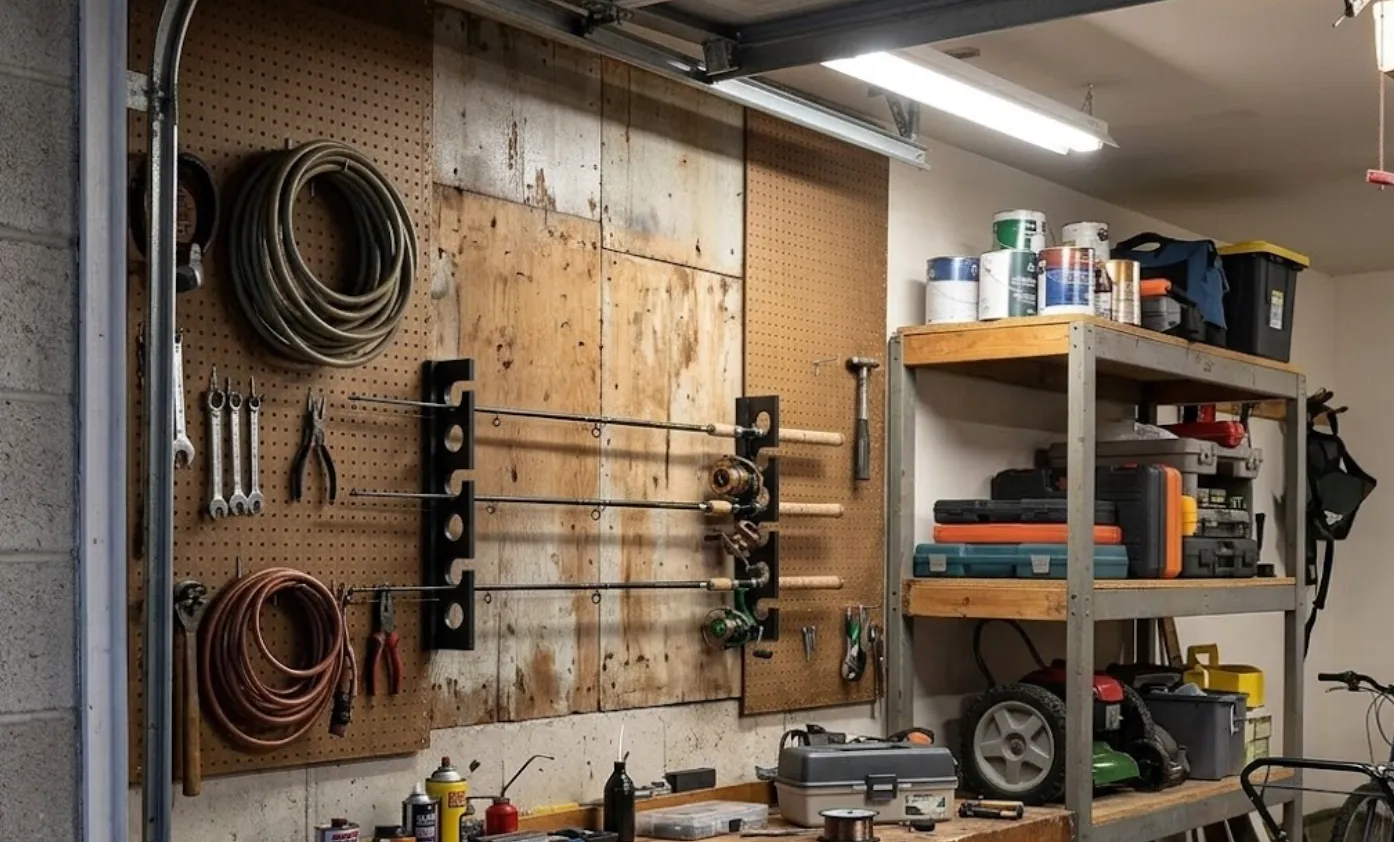
Written by Hudson Reed
Leaning rods in a garage corner is how you turn a $200 blank into a $200 banana. Constant pressure on the tip, a little garage heat, a few months of neglect, and you've got a rod with a set in it that throws every cast a few inches off. A good rack fixes that for less than the cost of a decent reel.
The best fishing rod racks for garage and wall storage come down to three mounting styles and one thing everybody ignores until it's too late: the grip. Foam pads, wood cradles, silicone V-grooves, aluminum arcs. Some hold rods gently for years. Some leave a dent in a graphite blank after a hot summer of pressure. I sorted the picks below by how you want to mount them, because that decision matters more than brand.
All four racks here are current, in-stock, and rated 4.5 stars or higher on Amazon as of 2026. No discontinued zombie listings.
Quick picks at a glance
| Rack | Best For | Price Range | Rating |
|---|---|---|---|
| Ghosthorn Wall/Ceiling Hardwood Rack | Budget pick, wall or ceiling | $13-15 per set | 4.5 / 5 |
| PLUSINNO H5 Aluminum Horizontal | Horizontal wall or ceiling | $18-20 per set | 4.6 / 5 |
| PLUSINNO H5W Solid Wood | Looks, scales to 20 rods | $28-30 per set | 4.8 / 5 |
| SOYEEZE 3-Tier Rolling Cart | Renters, mobile storage, tackle | $65-70 | 4.8 / 5 |
Vertical vs horizontal vs ceiling: which should you actually use?
Store rods vertically if you can. It's the safest orientation for a blank because gravity keeps the rod straight and there's no length of it resting under its own weight. Anglers who store vertically report the least trouble with rod set, the permanent bend that ruins casting accuracy. Vertical racks are also the most compact on wall space and let you grab the exact rod you want without pulling three others.
Horizontal mounts are the move for two situations: rods too long to stand up in a garage (surf rods, some steelhead sticks), and ceilings. A horizontal rack up on the ceiling turns dead space above your car into rod storage, which is the single best trick for a crowded garage. The catch is you need the rack to support the rod at two points so there's no sag, and you'll need a step to reach it.
Ceiling storage is the safest for keeping rods out of harm's way (no kids, no car doors, no rake handles knocking a tip) but the worst for grab-and-go. I run a hybrid at home: everyday rods on a vertical wall rack by the garage door, offseason and backup rods horizontal on the ceiling. Set it up that way and you stop fighting your own gear.
One thing to skip no matter the orientation: the garage attic. Storage guides consistently warn against attics and uninsulated sheds because sustained heat weakens the epoxy resins in a blank and loosens guide wraps. Aim for a spot that stays roughly 50 to 80 degrees. Most attached garages are fine. A metal shed baking in July sun is not.
What grip style won't dent your blanks?
This is the part nobody talks about. The rack holds the rod, sure, but how it holds it decides whether your blank survives long-term storage. Here's the honest ranking.
Wood cradles and wide-diameter slots are the gentlest. The rod rests in a shaped opening with no pinch point, so there's no concentrated pressure anywhere on the blank. Injected soft pads and silicone grips are next, and they're great as long as the pad is soft and the contact area is wide. The danger zone is a hard, narrow clip that grabs the blank at a single point. Over a hot summer that point can leave a faint indentation on a thin graphite blank. It's rare, but it happens, and it's always on your nicest rod.
So the rule: the thinner and more expensive your blanks, the more you want a wide, soft, or cradled grip. Ultralight and premium graphite sticks belong in wood or a wide silicone V. Broomstick catfish and saltwater rods will shrug off just about anything.
Ghosthorn Wall or Ceiling Hardwood Rack

If you want the most rack for the least money, start here. One set runs around $13 to $15 and cradles 6 rods or combos in solid hardwood. Buy two sets and you've got a clean 12-rod wall for under $30. The pieces are meant to be combined however you want, so you can go wide, stack them, or split them across two walls.
You might also enjoy: Best Floating Waterproof Phone Pouches for Fishing (2026)
The reason it leads the budget tier isn't the price, it's the grip. A shaped wood cradle with a widened diameter is about the friendliest surface you can rest a blank against, and it fits everything from an ultralight noodle to a broomstick saltwater rod. Mount it vertically on the wall or flip it horizontal on the ceiling. The hardwood carries a waterproof, moisture-resistant coating, which matters in a humid garage where a cheap rack can swell or warp.
Who it's for
Anyone furnishing a garage on a budget, or an angler who wants the gentlest possible grip on nice graphite without paying for it.
Pros & cons
- Pro: Cheapest per-rod cost here, and it looks better than plastic
- Pro: Wood cradle is easy on delicate blanks
- Pro: Mounts vertical or on the ceiling, expandable in 6-rod sets
- Con: Sold in 6-rod sets, so a big collection means buying several
- Con: Fixed spacing gets tight with fat baitcaster reels side by side
Price is usually $13 to $15 per set. Check current price on Amazon.
PLUSINNO H5 Aluminum Horizontal Rack

For horizontal wall or ceiling mounting, this is the one I'd buy. The H5 is aircraft-grade aluminum with an anodized finish, so it never rusts and the finish won't peel, which is more than you can say for powder-coated steel racks that chip and start bleeding rust in a damp garage. One pack holds 5 rods in under 18 inches, and the ends string together, so you scale it as far as your wall or joists allow.
The detail that sells it is the 15-degree inclined opening. Combined with the arc-shaped cradle, it lets you pull or drop a rod with one hand in about a second, which sounds like a gimmick until you're loading the truck at 5 a.m. with a coffee in your other hand. There's an injected protective pad on the contact surface and PLUSINNO widened the force-bearing area specifically so the rack won't leave an indentation after long-term storage. Mounting holes are spaced 16 inches on center to hit standard studs or ceiling joists.
Who it's for
Anyone mounting on a ceiling or storing long rods flat, and anyone who wants a rack that survives coastal humidity.
Pros & cons
- Pro: Aluminum won't rust, ideal for saltwater and damp garages
- Pro: One-handed 15-degree inclined grab is genuinely useful
- Pro: 16-inch stud spacing makes for a rock-solid mount
- Con: 5 rods per pack, so a wall of rods adds up in cost
- Con: The 1.77-inch openings are generous, which means very skinny rods can shift a little
Runs about $18 to $20 per pack. Check current price on Amazon.
PLUSINNO H5W Solid Wood Rack
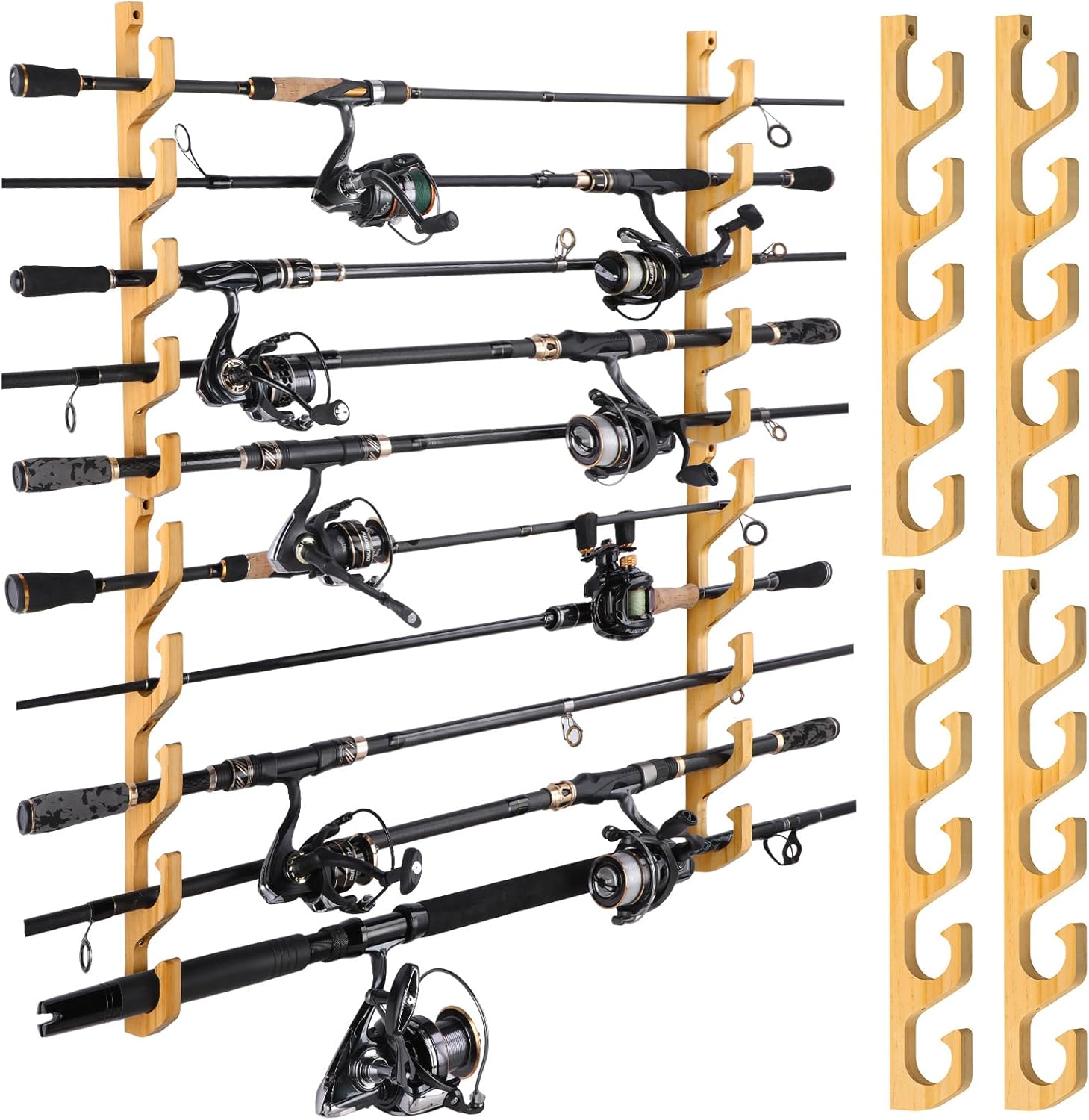
Same smart H5 layout, but in solid wood, and it's the best-looking rack on this list by a mile. This is the one that goes in a finished basement, a den, or a garage you actually care about the look of. It carries a 4.8-star rating, the highest here, and it scales from 5 to 10 to 20 rods depending on how many you string together.
Wood buys you the same gentle contact as the Ghosthorn with the cleaner inclined-opening design of the H5. Reviewers consistently call out the finish quality and how solid it feels once mounted. If your rods live somewhere people see them, this is worth the extra ten bucks over the aluminum. If they live behind the lawnmower, save the money and get the aluminum or the Ghosthorn.
Who it's for
Anglers who want their rod wall to look like furniture, and anyone building out a serious display of a growing collection.
You might also enjoy: Best Side-Mount and Flush-Mount Rod Holders for Boats (2026)
Pros & cons
- Pro: Best appearance here, wood grain over metal or plastic
- Pro: Scales cleanly to 20 rods
- Pro: Gentle wood contact, highest rating in this roundup
- Con: Costs more than the aluminum version of the same design
- Con: Wood in a truly wet garage needs the coating kept intact
Usually $28 to $30. Check current price on Amazon.
SOYEEZE 3-Tier Rolling Cart

Not everyone can put holes in the wall. Renters, apartment garages, anyone who moves a lot. This is your answer, and honestly it's my pick for a lot of people even if they own the wall. The SOYEEZE holds up to 12 rods, rolls on four silent casters (two with brakes), and stacks a 3-tier storage system with a pegboard and six hooks on top for tackle boxes, reels, pliers, and the rest of the clutter.
What you're really buying is a whole fishing station on wheels. Rods, tackle, and tools in one place, rolled wherever you need it, then parked out of the way. The frame is iron with wooden shelves, so it's stable and it doesn't look like a hospital cart. At around $70 it's the priciest pick here, but it replaces a rack plus a shelf plus a pegboard, and you can wheel the whole rig to the truck on the way out.
Who it's for
Renters who can't drill, and anglers who want rods and tackle staged together and mobile.
Pros & cons
- Pro: No wall holes, moves anywhere
- Pro: Holds rods, tackle, and tools in one station
- Pro: Locking casters keep it put
- Con: Takes floor space instead of freeing it up
- Con: Most expensive option here
Around $65 to $70. Check current price on Amazon.
How to pick the right rack for your garage
Four things decide this, in order.
- Mounting reality. Own your walls? Vertical or ceiling mounts win on space and safety. Renting or moving? Go with the rolling cart and skip the drill entirely. PLUSINNO's installation guide covers stud mounting and upkeep if you've never hung a rack.
- Capacity, honestly counted. Manufacturer rod counts assume bare rods or skinny reels. Bulky baitcasters eat space, so if you fish a lot of casting gear, plan for maybe 20 percent fewer rods than the label claims and leave gaps between fat reels.
- Grip vs your blanks. Nice graphite and ultralights want wood or wide soft cradles. Heavy saltwater and catfish rods don't care.
- Where it lives. Damp or coastal garage? Aluminum or coated hardwood beats bare steel that rusts. And keep the whole thing out of a heat-trap attic.
Does storing rods in a hot garage actually damage them?
Yes, if the garage gets hot enough for long enough. Sustained high heat weakens the epoxy resins that hold a blank together and can loosen guide wraps over time, which is why storage guides tell you to avoid attics and uninsulated sheds and keep rods in a spot that stays roughly 50 to 80 degrees. A normal attached garage that swings with the seasons is fine. The real killers are a rod left in a hot car or a metal shed cooking in direct summer sun. Store rods off the floor, off their tips, and out of the worst heat, and a blank will outlast several reels.
The one that fits most garages
If you're buying one rack today and you own your walls, get the Ghosthorn hardwood rack. It's cheap enough to buy in pairs, the wood cradle is kind to nice blanks, and it mounts vertical or on the ceiling so you can build the hybrid setup that actually works. Mounting on a ceiling or storing long rods flat? The PLUSINNO H5 aluminum is the rust-proof pick. And if you can't drill a single hole, the SOYEEZE rolling cart gives you a full fishing station on wheels.
Once your rods are organized, it's worth knowing which ones you actually reach for. If you track your catches with Bushwhack, you'll spot pretty fast that three or four rods do most of your fishing while the rest hang there looking pretty. Handy thing to know before you buy a rack sized for a collection you don't really fish.
Get fishing tips in your inbox
New guides, seasonal tactics, and gear picks — about once a month, no spam.