Best Lens Tint for Low Light Fishing (2026): Amber vs Copper vs Yellow Under $30
 Hudson Reed
Written by Hudson Reed
Copper. If you're buying one pair of polarized glasses to cover October through March, buy copper and close the lens-color chart. That's the short answer on the best lens tint for low light fishing, and it's the one thing the brand-owned lens guides never actually commit to.
Fall light goes flat in a hurry. By mid-October across the northern half of the country you're fishing under a lid of gray that never burns off, and the smoke-gray lens that was perfect in August turns the river into a sheet of pewter. You lose the seam. You lose the color change where gravel drops into the trough. You lose the pale flash of a fish turning six feet down, which is the entire reason you bought polarized glasses.
Four picks below, all under $30, all verified in stock, each one named by the tint that's actually on the frame.
| Product | Lens tint | Best for | Price | Our score |
|---|---|---|---|---|
| KastKing Hiwassee, Matte Blackout | Copper, no mirror | Flat gray skies, Oct-March | $22.49 | 4.5 |
| Fishoholic, Matte Black | Amber, no mirror | All-day freshwater default | $24.99 | 4.5 |
| KastKing Skidaway, Gloss Black | Amber base, scarlet mirror | Bright overcast, snow, open water | $25.49 | 4.0 |
| Fishoholic, Ice frame | Yellow base, silver mirror | First light, last light, heavy snow | $24.99 | 4.0 |
Amber, Copper, and Yellow: What Each One Does to Flat Gray Light
All three are warm tints, so all three cut blue and push the red-orange end. That's why they separate tan gravel from green algae, and why a fish's shadow pops off a sand bottom. What separates them is how much light they pass and how hard they shove the contrast.
Amber sits in the middle and it's what most freshwater anglers should default to. It lifts contrast without going cartoonish, and it's light enough to wear from a 7 a.m. launch through a gray afternoon.
Copper is amber with more density and more bite. Copper runs denser than a straight amber, which sounds backwards for low light until you wear it on an overcast day. Flat light isn't dim light. An October sky at noon still throws plenty of energy at you, it just throws it evenly from every direction with no shadows left to give you depth. Copper pulls that even wash apart into layers again. That's the whole trick.
Yellow is the tint everyone recommends and almost nobody should buy as their only pair. It passes enough light to brighten a dark morning in a way amber can't touch, and it also blows out fast. Step from under a canyon wall into a sucker hole of sun and a yellow lens goes from helpful to uncomfortable in about four seconds. As a one-pair answer for the whole gray season, it's the wrong buy.
Mirrors complicate all of it. A mirror coating bounces light away before it reaches your eye, so a mirrored amber behaves like a darker lens than the same amber without one. Useful when gray sky sits over white snow. Wrong call for a dim December afternoon on a tree-lined river.
Put together, that gives you a short answer by condition:
- Tree-lined river, dim December afternoon: uncoated amber. You need every photon, and a mirror steals them.
- Flat gray sky, open water, midday: copper. This is the condition copper exists for.
- Gray sky over snow or ice: amber or copper with a mirror. The snow doubles the light coming at you.
- Pre-sunrise and the last forty minutes: yellow, as a second pair you swap out of once the sun clears the trees.
KastKing Hiwassee in Copper: Best Overall for Gray Light

This is the pair I'd name if someone asked one question and then hung up. The Hiwassee is a medium wrap on a Grilamid frame with 1.0mm polarized TAC lenses, and the variant that matters is Matte Blackout with the plain Copper lens. No mirror over it. It's the only copper in this lineup, and it does the most work between Halloween and ice-out.
KastKing's own Hiwassee page lists these at $29.99 with Matte Blackout / Copper as a current color, so the Amazon price is under the brand's own MSRP. Amazon shoppers have left 6,367 ratings across the Hiwassee family, averaging 4.4 out of 5.
Who it's for
Wade and bank anglers who fish the same handful of rivers all winter and want to read structure through moving water. The medium wrap suits narrower faces better than the huge sport shields most budget brands push.
Pros and cons
- Copper base with no mirror, which is the combination that reads flat light best
- Grilamid frame flexes instead of snapping when it gets sat on
- Hard case and pouch included at a price where most brands include neither
- Medium wrap leaves more side light in than a full shield does
- Copper shifts color enough that photos taken with them on look wrong to your eye afterward
Price: $22.49. Check the current price on Amazon.
You might also enjoy: Best First Ice Lures for Walleye and Perch: Buy or Skip on 4 Cheap Classics
Fishoholic Amber: Best True Amber Under $30

If copper feels like too much lens, buy this instead. The Matte Black frame with the straight Amber lens is the least fussy option here: a warm, uncoated tint that brightens a gray afternoon without stripping color out of everything. Fishoholic builds these with tall sides to block temple light, which matters more in winter because the sun sits low enough to sneak under the frame all day.
The listing carries 5,998 Amazon ratings at 4.5 out of 5, the highest average in this roundup, shared with the yellow colorway of the same frame.
Who it's for
Anglers who want one pair in the truck that works in October and still works in June. Amber is the most forgiving tint across seasons, and this is the cheapest honest version of it I could verify.
Pros and cons
- Uncoated amber, so what you see is the tint and nothing else
- Tall side coverage cuts low-angle winter light
- Amazon average of 4.5 stars across nearly 6,000 ratings
- Frame runs large, so small faces should look elsewhere
- Amber gives up ground to copper once the sky goes properly slate
Price: $24.99. Check the current price on Amazon.
KastKing Skidaway, Amber Base with Scarlet Mirror: Best for Snow Glare

Gray sky over fresh snow is a different problem than gray sky over brown timber. The light is still diffuse, but the ground throws it straight back up under your hat brim, and an unmirrored amber will have you squinting by hour two. The Skidaway in Amber with a Scarlet Mirror is the pick for that day: warm base tint doing the contrast work, mirror cutting the total load.
The Skidaway family carries 9,856 Amazon ratings at 4.4 out of 5, and KastKing still lists the frame as current on its Skidaway page. Buy this one second, not first.
Who it's for
Ice anglers walking a lot of open lake, boat anglers on big flat water, and anyone whose winter fishing happens above the treeline rather than down in a river bottom.
Pros and cons
- Mirror knocks down snow and open-water glare that flat amber lets through
- Larger wrap seals better against wind than the Hiwassee
- Too dark for a dim river corridor, which is exactly where most fall anglers are
- Mirror coatings scratch more visibly than a bare lens
Price: $25.49. Check the current price on Amazon.
Fishoholic Yellow with Silver Mirror: Best Dawn and Dusk Pick
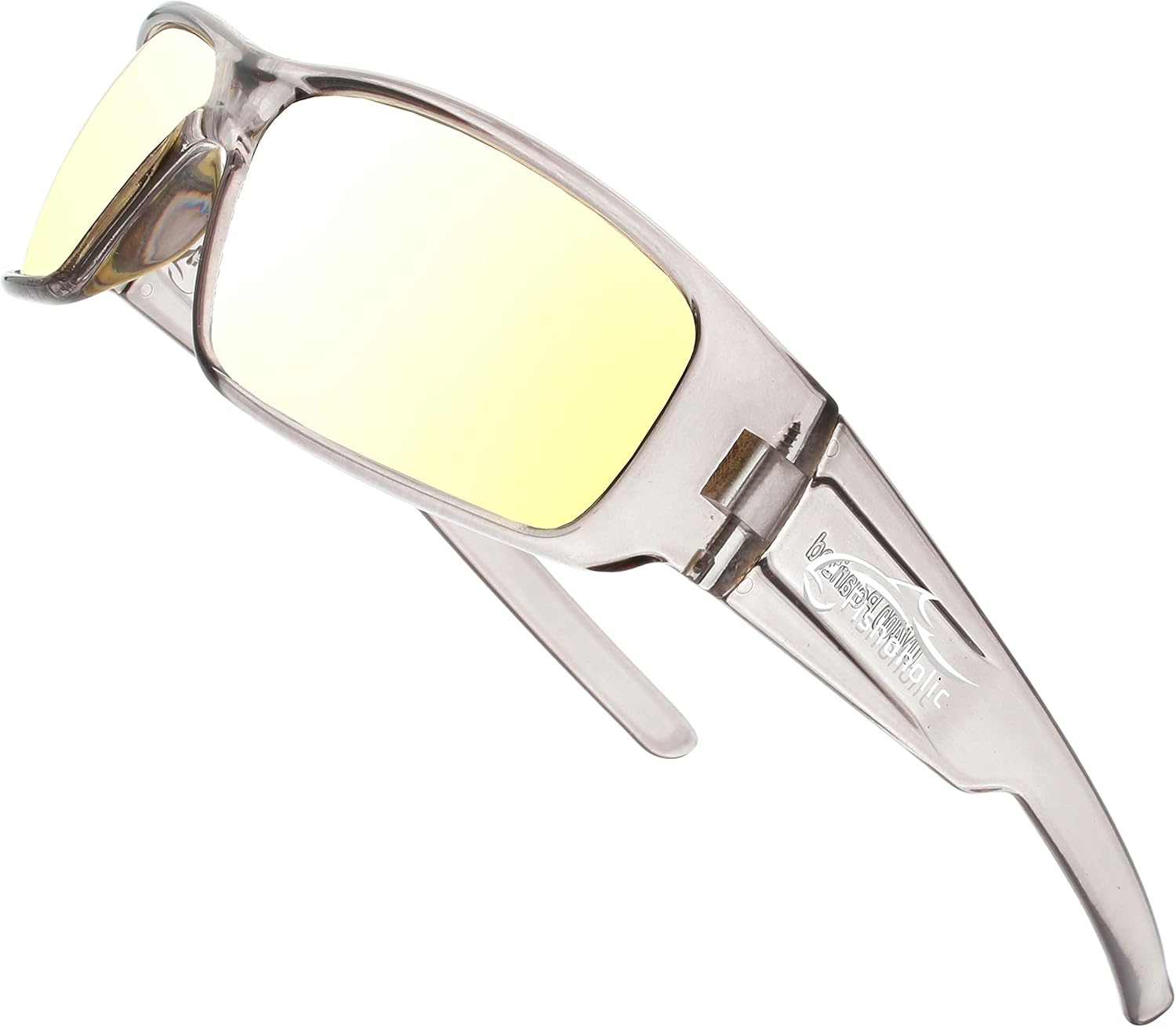
Polarized yellow under $60 barely exists, and that's worth saying out loud. Working through the yellow-lens listings for this piece, most sat below four stars or carried fewer than forty ratings. This Ice-framed Fishoholic, a yellow base lens under a silver mirror, cleared the bar, and the mirror is doing real work rather than just looking good. Bare yellow is unusable the second the sun finds a gap. The silver coating takes enough edge off to keep them on through a brightening morning.
The same 5,998 Amazon ratings at 4.5 out of 5 as the amber pair, because it's the same frame in another colorway. Second pair, not a first.
You might also enjoy: Little Buddy vs Portable Buddy vs Big Buddy: The Right Propane Heater for Ice Fishing Shelters
Who it's for
Anglers whose best hours are the first and last forty minutes of daylight, plus sight work in heavy snow where the extra brightness helps more than it hurts.
Pros and cons
- Genuinely brightens a dark morning in a way amber cannot
- Silver mirror makes yellow survivable when the sun breaks through
- Same verified frame and hardware as the amber pick
- Color rendering is strange enough that some people never adapt to it
- Stock on this colorway runs thin, so check availability before you plan around it
Price: $24.99. Check the current price on Amazon.
What to Check Before You Click Buy
Four things decide whether a cheap pair is worth owning. Lens color is only one.
The tint has to be named. Biggest trap in budget eyewear. Listings sell the same frame as "brown," "bronze," "sunset," and "high contrast," none of which tell you where the lens sits between amber and dark brown. If the seller won't name it, assume generic brown and price it accordingly.
Mirror or no mirror is a decision, not a style choice. River bottom, timber, dock light: no mirror. Open ice, big flats, snow: mirror.
Coverage beats optics at this price. Every lens here is polarized TAC or polycarbonate of similar quality. What separates a good $25 pair from a bad one in winter is whether light sneaks in around the frame when the sun sits low all afternoon. Tall sides and a real wrap matter more than lens-material marketing.
Buy cheap and expect to lose them. I'd rather own two $25 pairs in different tints than one $150 pair I'm afraid to set on a tailgate. That's the real argument for this price bracket, and it's why the tint decision matters more than the brand decision.
Is Yellow or Amber Better on an Overcast Day?
Amber, for most anglers on most overcast days. Yellow brightens the scene, which feels better for the first ten minutes, but overcast midday light is abundant rather than scarce. The problem you're solving is missing contrast, not missing brightness, and amber and copper attack contrast harder. Save yellow for genuinely dark conditions: before sunrise, after sunset, under heavy timber, or falling snow.
Do You Still Need Polarized Lenses When It's Cloudy?
Yes, arguably more than on a bluebird day. Glare off water is a reflection of the sky, and a gray sky is a large, even source that reflects across the whole surface instead of one hot spot. The American Academy of Ophthalmology's rundown on polarized lenses describes the filter as blocking light bouncing sideways off surfaces like water, and notes the image looks a little darker while details get easier to see. One winter caveat from that same page: polarized lenses can make icy patches harder to spot, which is worth remembering on a slick boat ramp or walking out on first ice.
So What Is the Best Lens Tint for Low Light Fishing?
Copper, and the KastKing Hiwassee in Matte Blackout / Copper at $22.49 is the pair to buy if you buy one. It pulls the most layers out of a flat gray river, it's the cheapest pick here, and it's a current model on KastKing's own site rather than old stock moving through a marketplace.
If you want something you'll also wear in July, take the Fishoholic in amber and accept a slightly softer read on the worst days. Add yellow later if your fishing really does happen in the dark.
One thing worth doing once they show up: note the sky condition and which pair you wore next to your catches for a few weeks. Tint preference is more personal than any buying guide admits. Log conditions alongside your catches in Bushwhack and you'll know in one season whether copper actually moves your numbers or you just like how it looks.
Get fishing tips in your inbox
New guides, seasonal tactics, and gear picks — about once a month, no spam.