Ice Fishing Line That Doesn't Freeze: 4 Picks by Rod Job (2026)
 Hudson Reed
Written by Hudson Reed
Ask an ice house full of anglers for an ice fishing line that doesn't freeze and you'll get four brand names and one argument. Somebody swears by braid. Somebody else says braid welds itself into the top guide by nine in the morning. They're both right, and the line isn't actually the variable. The rod's job is.
Braid on a jig rod you're holding and shaking every ten seconds behaves nothing like the same braid on a dead-stick parked in a holder with slush creeping up the blank. So these four picks are sorted by job instead of stacked into one winner: the rod in your hand, the rod you leave alone, the tip-up, and what you tie between them. All four are current, in-stock Amazon listings as of September 2026.
| Line | Best for | Price | Amazon rating |
|---|---|---|---|
| Sufix 832 Advanced Ice Braid | The jig rod you hold all day | About $11.60 (50 yd) | 4.6 / 5 |
| Berkley Trilene Micro Ice | Dead-sticks and fishing outside | About $5.99 (110 yd) | 4.6 / 5 |
| Sufix Ice Braid, 10 lb | Tip-ups and deep-water jigging | About $10.59 (75 yd) | 4.7 / 5 |
| Berkley Trilene 100% Fluorocarbon Ice | Leaders under braid | About $7.99 | 4.5 / 5 |
Sufix 832 Advanced Ice Braid: Best Overall for a Jig Rod

This is the line I'd put on a rod I plan to hold. Sufix builds it from seven HMPE fibers plus one GORE performance fiber at 32 weaves per inch, and the company's 832 Advanced Ice spec page publishes diameters test by test: 0.004 inches at 4 lb, 0.006 at 6, 0.007 at 8, 0.008 at 10. That 4 lb number is the reason it works on a noodle rod. You can run a braid strong enough to horse a slab out of a cabbage edge at a diameter that doesn't wreck the fall of a 1/32 oz tungsten.
Sufix claims the HMPE fibers give it hydrophobic, water-repellent protection that resists freezing. Treat that as directional, not absolute. It sheds better than an uncoated bass braid, and if you're jigging actively in a shelter it stays workable most of the day. Leave it sitting still in open wind at 10 degrees and it'll still crust up like everything else.
Who it's for
Anglers who fish inside a hub or a flip-over and want to feel a crappie inhale a plastic 22 feet down. Also anyone running a flasher who wants line that telegraphs the exact moment a walleye commits.
Pros and cons
- Pro: Sufix publishes a diameter for every test, down to 0.004 inches at 4 lb
- Pro: near-zero stretch, which is the whole point of braid on a jig rod
- Pro: the GORE performance fiber is in there specifically for fray and abrasion resistance against a ragged hole edge
- Con: 50 yard spool, so you're paying more per yard than a bulk braid
- Con: it will still ice your guides if you stop moving it
Price: about $11.60 for the 50 yard neon lime spool. Check current price on Amazon.
Berkley Trilene Micro Ice: The One to Leave Sitting Outside
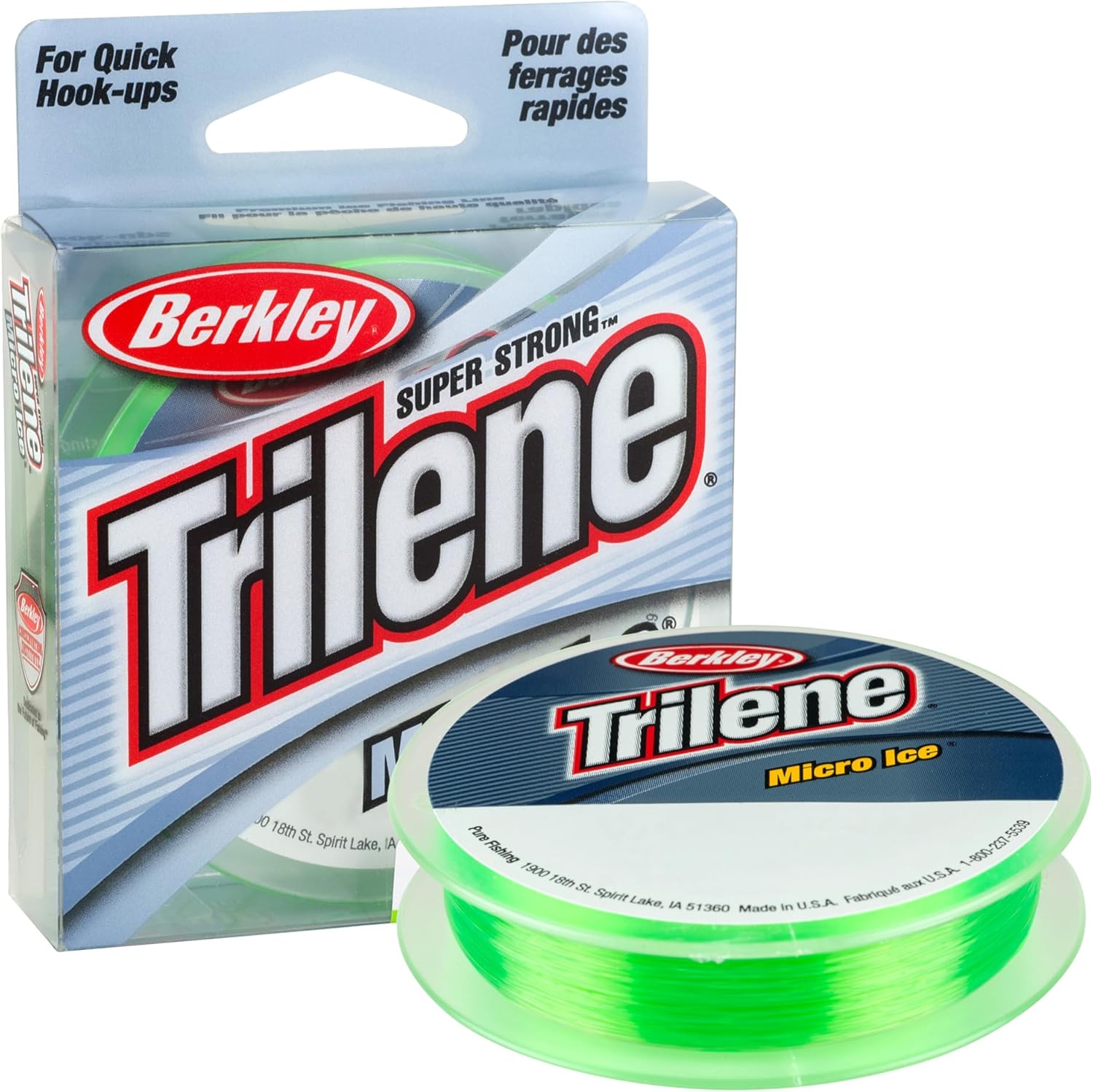
Mono gets talked about like a compromise. On a dead-stick it's the correct answer, full stop.
Berkley's Trilene Micro Ice page calls it the thinnest, strongest monofilament you can fish through the ice and says it stays pliable in cold weather while holding tensile strength. The marketing superlative is theirs, not mine. What I'd actually credit it for is the thing mono does structurally: a single extruded strand has no interior weave for water to sit in, so there's less to freeze when the rod sits untouched for forty minutes. The little stretch you get is a bonus on a rod in a holder, because a walleye that loads up against a dead-stick with braid on it usually feels the resistance and drops the minnow.
At roughly six bucks for 110 yards, it's the cheapest spool on this list. More Amazon buyers have weighed in on it than on the other three lines here combined, at 1,448 ratings and a 4.6 average.
Who it's for
Anybody running a second rod on a tip-down or rattle reel, and anyone who fishes in the open with no shelter. Also the right call for a kid's rod, because mono forgives the hookset a seven-year-old actually delivers.
Pros and cons
- Pro: one extruded strand, no weave to hold water inside the line, so it locks up guides slower than the braids here
- Pro: cheap enough to re-spool every season without thinking about it
- Pro: 110 yard spools fill an ice reel twice
- Con: memory. Cold mono comes off the spool in coils until you stretch it
- Con: the stretch that helps a dead-stick hurts you on a 30 foot hookset
Price: about $5.99. Check current price on Amazon.
You might also enjoy: Best First Ice Lures for Walleye and Perch: Buy or Skip on 4 Cheap Classics
Sufix Ice Braid, 10 lb: Tip-Ups and Deep Water

Different animal from the 832. Sufix sells this one in 75 yard spools, glacier blue, and describes it as treated with an anti-ice slick coating that deters the water absorption behind ice build-up. The 10 lb is the sweet spot for a heavier jigging rod chasing walleye in 25 to 40 feet, and it's a sane tip-up line for pike if you don't want to deal with waxed Dacron.
Yards per dollar is where it earns the pick over the 832. Seventy-five yards at about ten bucks against fifty at almost twelve, and on a tip-up spool or a deep walleye rod you want the extra line more than you want the last thousandth of an inch of diameter. Near-zero stretch either way, so you're not giving up hooksets at 35 feet.
Who it's for
Tip-up anglers, deep-water walleye jiggers, and anyone who wants one braid spool that covers both without buying two.
Pros and cons
- Pro: 75 yards for about ten dollars, more line per dollar than the 832 spool
- Pro: Sufix treats it with an anti-ice slick coating aimed at the water absorption that causes ice build-up
- Pro: glacier blue is easy to see against snow without being obnoxious under the ice
- Con: Sufix doesn't publish a per-test diameter chart for it the way it does for the 832
- Con: braid on a tip-up cuts bare hands. Wear a liner glove
Price: about $10.59 for the 10 lb, 75 yard spool. Check current price on Amazon.
Berkley Trilene 100% Fluorocarbon Ice: Buy It as Leader, Not Mainline

Here's where I'll annoy some people: fluorocarbon is a bad ice mainline and a very good ice leader, and most of the guides-freezing complaints I see about fluoro come from anglers using it as the former.
Fluoro is dense and stiff. It sinks, it holds coil memory hard in the cold, and a full spool on a tiny ice reel behaves like a slinky. As three feet of leader between braid and jig, all of that stops mattering and the thing it's genuinely good at starts to: it disappears in clear water. On a pressured lake in February, under black ice with no snow cover, panfish look up at a jig against a lit ceiling and they see everything.
Who it's for
Anyone running braid. In clear water the leader isn't optional, and one spool lasts several seasons because you're only using three feet at a time.
Pros and cons
- Pro: low visibility where it counts, in clear water under thin snow
- Pro: takes abrasion against a ragged hole edge better than mono of the same test
- Con: memory in the cold is genuinely bad, so keep leaders short
- Con: knot strength to braid needs a real connection, not an overhand loop
Price: about $7.99. Check current price on Amazon. Berkley's own Trilene 100% Fluorocarbon Ice page lists the available tests.
Is there really an ice fishing line that doesn't freeze?
No. There's line that ices up slower, and there's a rig that ices up slower, and the second one matters more than the first.
What actually happens: line comes out of a 33 degree hole carrying a film of water, passes through guides sitting at air temperature, and that film flash-freezes on the ceramic. Braid makes it worse because the weave holds water inside the line itself, not just on the surface. Fused and extruded lines have no interior voids, which is why mono and fused superlines take longer to seize. Coatings help at the margins. Nothing repeals the physics.
You might also enjoy: Little Buddy vs Portable Buddy vs Big Buddy: The Right Propane Heater for Ice Fishing Shelters
Three things move the needle more than brand choice. Keep the line moving, because a rod worked every few seconds rarely locks up. Keep your rod tip out of the slush ring around the hole, which is where most of the water on your line comes from in the first place. And skim the hole. A clean hole ices your guides far less than one with two inches of chowder floating in it.
Do you actually need a leader on ice?
If you're fishing braid in clear water, yes. If you're fishing braid in stained water or in a dark house at night, you can get away without one.
Keep it to three or four feet of fluorocarbon for panfish and walleye. Long leaders defeat the purpose because you end up reeling the knot through the guides on every drop, and a knot passing through a half-frozen guide is how you find out your connection was sloppy. For pike on tip-ups, go to a heavier fluoro bite section in the 40 to 60 lb range rather than wire if the water's clear. Tie braid to fluoro with a double uni or an FG. Do it at home, at room temperature, before your hands stop working.
Pound test by what's actually under the hole
Panfish get 2 to 4 lb. Anything heavier kills the fall rate on a tungsten jig, and fall rate is most of the presentation when you're dropping on marks.
Walleye get 6 to 10 lb braid with a fluoro leader, or 6 lb mono straight through on the dead-stick. Lake trout in deep water want 10 to 20 lb braid, because you're fighting a long line and a fish that runs. Pike on tip-ups: 20 to 30 lb braid or 30 lb Dacron, plus a bite leader. Starting points, not rules. Keep a log of what you caught on what and you'll narrow them to your water inside a season.
Two spools beat one perfect spool
The whole "which line is best" argument assumes you're picking one. Don't. Two spools of line cost about eighteen dollars together, which is less than a tank of gas to the lake and a fraction of what you spent on the auger.
Put braid on the rod you jig with and mono on the rod you leave alone. That single change fixes more guide-freeze complaints than any coating claim on any package.
One safety note while you're planning first ice. The Minnesota DNR's ice thickness guidelines put the minimum effective thickness for a person standing on a stationary load at 6 inches, and there's no thickness that's ever guaranteed safe. Early ice is when the panfish bite best and when people go through. Drill as you go.
Our pick
If you buy one spool, make it Berkley Trilene Micro Ice at about six dollars. It's the least frustrating line in the cold, it covers a dead-stick and a jig rod adequately, and 110 yards fills a reel twice.
If you buy two, add Sufix 832 Advanced Ice Braid for the rod in your hand and a spool of Trilene 100% Fluorocarbon Ice for leaders. That's the setup I'd hand somebody re-spooling in late November, and it runs under thirty dollars total. Running tip-ups too? Sufix Ice Braid in 10 lb covers those and doubles as your deep-water walleye line.
Track which rod had which line on the mornings your guides locked up. Two seasons of that in Bushwhack and you'll stop asking the internet.
Get fishing tips in your inbox
New guides, seasonal tactics, and gear picks — about once a month, no spam.