Best Portable Bait Bucket Aerators for Keeping Live Bait Alive (2026)
 Hudson Reed
Written by Hudson Reed
Open a styrofoam minnow bucket at 2 p.m. on a 90-degree July day and you already know the smell before you see it. Half the shiners belly-up, the water gone warm and cloudy, the survivors gasping at the surface. That dead bait cost you money and the back half of your fishing day. The fix is the cheapest insurance in your tackle bag: one of the best portable bait bucket aerators pumping oxygen into that water while you fish. The hot-weather minnow problem is almost never the heat by itself. It's the oxygen the heat steals.
Here's the part most gear roundups skip. Warm water physically can't hold as much dissolved oxygen as cool water, and at the same time your minnows are breathing harder because their metabolism is cranked up. Two forces pulling the same direction. According to environmental water-quality data compiled by Fondriest Environmental, most fish want dissolved oxygen above 5 mg/L to stay healthy, and warm water gives up that oxygen fast. An aerator doesn't cool the water. It just keeps replacing what the heat and the fish are burning through.
I've sorted the picks below by what actually matters on the water: how much water you're keeping alive. A dozen crappie minnows in a two-gallon bucket is a different job than 50 shiners in a cooler for a catfish overnighter.
Quick picks: best portable bait bucket aerators at a glance
| Aerator | Best For | Price | Rating |
|---|---|---|---|
| Pawfly 25 GPH Rechargeable | Small buckets, panfish minnows | ~$19 | 4.5 / 5 |
| Pawfly 50 GPH Rechargeable | Most anglers, the do-everything pick | ~$23 | 4.5 / 5 |
| Pawfly 64 GPH Big-Bucket | Big bait loads, coolers, overnight trips | ~$29 | 4 / 5 |
All three are USB rechargeable, which is the direction the whole category has moved over the last two years. More on the rechargeable-versus-D-cell debate down in the buying guide, because it's not as one-sided as the listings make it sound.
Pawfly 25 GPH Rechargeable: best for small buckets and panfish minnows

If you fish a standard two- to five-gallon minnow bucket for crappie, bluegill, or perch, this is all the pump you need and probably less than you'd guess. Pawfly rates it at 25 gallons per hour of airflow off a 2,000 mAh battery, good for 28 hours running flat-out or 40 hours on the intermittent setting that cycles 10 seconds on, 10 seconds off. That intermittent mode is the unsung hero here. Cool, well-oxygenated water doesn't need a constant blast, and toggling it stretches a single charge across a long weekend.
It recharges off any USB source. Phone brick, power bank, the truck's cigarette port. So you're never stranded hunting for D-cells at 5 a.m.
Who it's for
- Crappie and panfish anglers running smaller buckets
- Bank and dock fishermen who want something dead simple
- Anyone who hates buying disposable batteries
Pros and cons
- Pro: Genuinely quiet, rated under 35 dB, about the level of a whisper
- Pro: Cheap enough to keep a backup in the boat
- Pro: 40-hour intermittent runtime covers a full weekend
- Con: 25 GPH gets overwhelmed past about 8 gallons or a heavy bait load
- Con: Single airstone, so you can't split it between two buckets
It runs around $19 on Amazon and carries a 4.4-star average across 125 reviews. Check current price on Amazon. For most weekend crappie fishermen, honestly, this is the one I'd buy first and only size up if you find yourself hauling more bait.
Pawfly 50 GPH Rechargeable: the do-everything pick
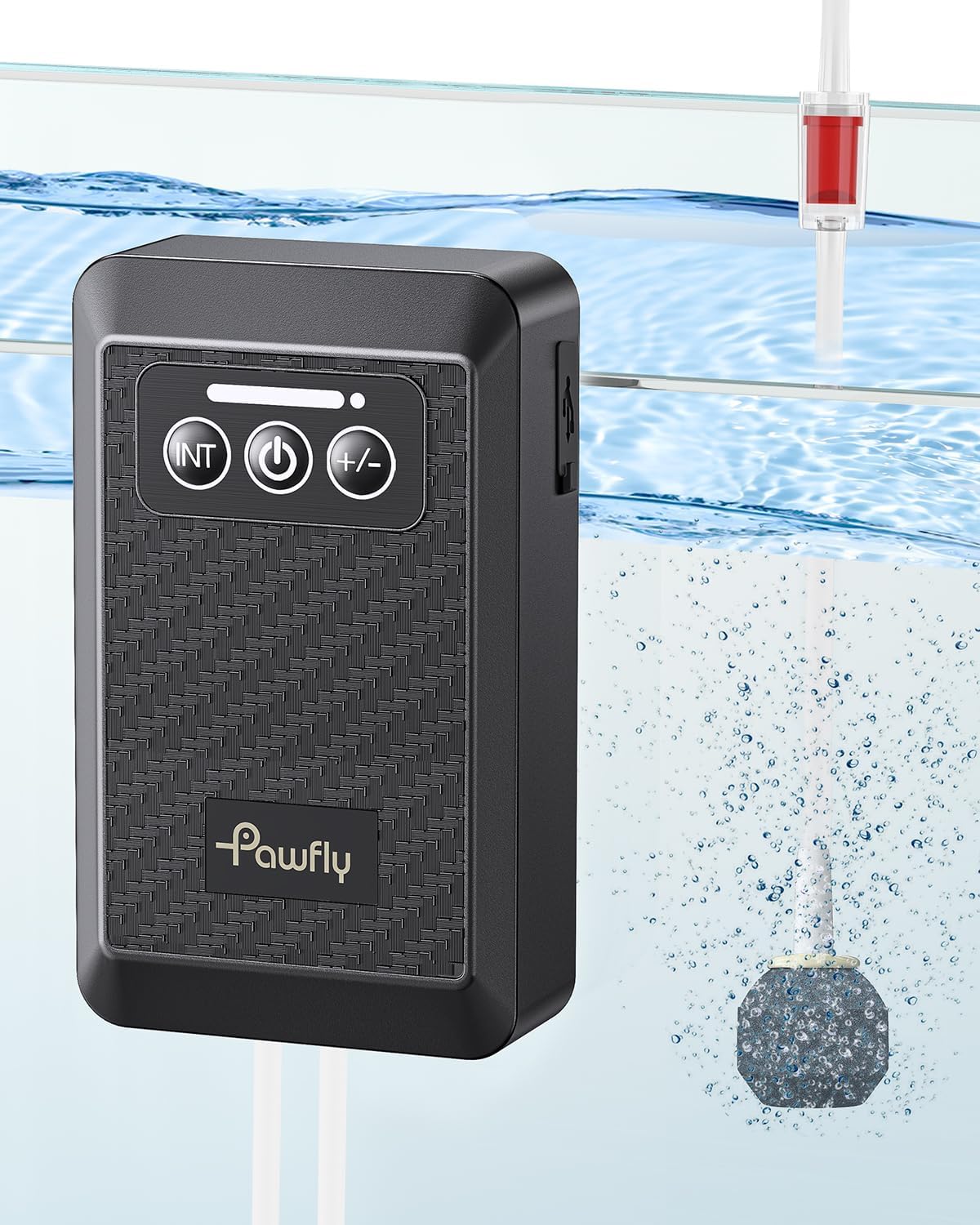
This is the one I'd point most people to if they're buying a single aerator for the next few years. The step up from 25 to 50 GPH airflow, plus a bigger 3,350 mAh battery, covers nearly every freshwater bait situation. Pawfly lists 30 to 36 hours continuous and 36 to 42 intermittent, handling buckets from about 10 up to 60 gallons.
The feature that earns its keep is the four adjustable flow levels. Tap the plus and minus buttons to dial output up for a packed bucket of shiners on a scorcher, or back down to sip battery when the water's cool and the bait's calm. It's the most reviewed of the three by a mile, sitting on a 4.4-star average across more than 1,500 ratings, which tells you it's been in a lot of boats and held up.
Who it's for
- The angler who fishes for a mix of species and bait sizes
- Walleye and catfish guys running medium bait loads
- Boat owners who want one pump that handles a small livewell too
Pros and cons
- Pro: Four flow levels let you match output to the day instead of running wide-open
- Pro: Huge review base, consistent 4-plus-star track record
- Pro: Doubles as a backup oxygen source for an aquarium during a power outage
- Con: Slightly louder than the 25 GPH at full output
- Con: Overkill if you only ever fish a tiny crappie bucket
Around $23, which is the price-to-capability sweet spot of the whole category. See it on Amazon. If you're torn between the three, buy this one.
You might also enjoy: Where Do Crappie Go After the Spawn? A Summer Brush Pile Depth Guide
Pawfly 64 GPH big-bucket aerator: best for heavy bait loads and overnighters

Now we're into serious-volume territory. This pump pushes 64 GPH off a 4,400 mAh battery, and the runtime numbers are wild: Pawfly rates it at 60 hours continuous and a claimed 120 hours on intermittent. That's bait kept alive across a multi-day trip without ever touching a charger.
Where it shines is the big stuff. A cooler full of shiners for a catfish overnight, a loaded bait tank for a long river session, anything up to roughly 65 gallons. The extra airflow buys you a real margin on a brutal day. The tradeoff: it's the newest of the three with the smallest review base, sitting at a 4.0-star average rather than 4.4, so it hasn't logged the same years on the water yet.
Who it's for
- Catfish anglers keeping big bait loads alive overnight
- Anyone aerating a larger holding tank or cooler
- Multi-day trips where recharging isn't convenient
Pros and cons
- Pro: Monster runtime, up to 120 hours intermittent on one charge
- Pro: Enough output for genuinely large containers
- Pro: Anti-vibration pad and rubber feet keep it from buzzing around the boat
- Con: Newer listing, smaller review history than the other two
- Con: More pump than a small-bucket angler will ever use
It runs about $29. Check it on Amazon. Buy this only if you actually move big volumes of bait, otherwise you're paying for capacity you'll never tap.
How do I keep minnows alive on a hot day?
An aerator is half the answer. Temperature is the other half, and the two work together.
Get the water cool and keep it cool. Multiple bait shops and live-bait care guides point to the same threshold: once water climbs past about 75 degrees F, baitfish start dying noticeably faster. The trick anglers swear by is freezing a couple of water bottles solid and dropping them in the bucket, which chills the water without the shock or chlorine of dumped ice cubes. Tap-water ice can do more harm than good, since the chlorine stresses already-stressed bait.
Then keep the bucket out of the sun. Under a boat seat, inside a cooler, in the shade. A dark bucket baking on a metal deck is a slow cooker.
Don't overcrowd. This is the mistake that kills more bait than anything. Live-bait care references generally recommend roughly a dozen small minnows per gallon in warm weather, and to back off to 6 to 8 per gallon for bigger shiners or suckers. Cram in twice that and oxygen demand plus waste buildup will crash the whole bucket in an afternoon, aerator or not. When in doubt, run a second bucket.
And swap the water when you can. Replacing 25 to 30 percent every couple of hours with fresh lake water resets the oxygen and flushes the ammonia from fish waste.
How long will an aerator keep bait alive?
With a working aerator, reasonable stocking density, and water under 75 degrees F, you can hold most baitfish healthy for days, not hours. The bottleneck is almost never the pump. It's heat and crowding. People blame the aerator when their minnows die, but nine times out of ten the real culprit is a bucket that hit 80-plus degrees or had three times too many fish in it. All three pumps above clear a full day easily, and intermittent mode roughly doubles that.
You might also enjoy: Chatterbait vs Swim Jig for Summer Grass: Which One to Tie On and When
What to look for when buying a bait aerator
Four things actually matter. Everything else is marketing.
Airflow versus your bucket size. Output is measured in gallons per hour (GPH). Match it to the water you're keeping alive: 25 GPH for small buckets, 50 GPH as a do-it-all, 60-plus for big coolers and tanks. Buying more airflow than you need just means a bigger, pricier pump you carry for nothing.
Runtime and power source. This is the real fork in the road. Rechargeable lithium pumps (everything on this list) charge off a USB brick or power bank and skip the cost of disposable batteries. The classic D-cell workhorses, like the long-running Marine Metal Bubble Box, run 40-plus hours on a couple of alkaline D-cells and never need charging, which is genuinely handy on a week-long trip far from an outlet. Here's my contrarian take: for the average weekend angler, the old D-cell pumps are the smarter buy precisely because there's nothing to forget to charge. A rechargeable you left dead in the garage is worse than a D-cell pump with fresh batteries in the glovebox. Pick the failure mode you're least likely to trip over.
Noise. A loud pump on a quiet morning can put fish down in shallow clear water. The better rechargeables run under 35 dB with anti-vibration padding; older pumps buzz more. If you fish skinny water, this matters more than the spec sheet suggests.
Water resistance. It's going to get splashed, rained on, and eventually dropped in the lake. None of these are submarines, but the housing should shrug off spray and rain.
One thing you'll see in nearly every forum thread on keeping bait alive: a capful of hydrogen peroxide in the bucket. It releases extra oxygen and acts as a mild antibacterial. Works in a pinch, but treat it as a roadside fix, not a replacement for an aerator and cool water. If you want to track which baits and conditions actually put fish in the boat, you can try Bushwhack to log your catches over a season.
Our pick
For most anglers, the Pawfly 50 GPH rechargeable is the one to buy. It's the price-to-capability sweet spot, the adjustable flow levels let it work for a tiny crappie bucket or a medium livewell, and a 1,500-plus review base at 4.4 stars means it's earned its keep on a lot of water. Around $23, it's almost a no-brainer.
Fish small buckets only? Save a few dollars with the 25 GPH model. Hauling big bait loads or doing overnighters? Step up to the 64 GPH big-bucket pump. Whichever you grab, pair it with frozen bottles and a bucket kept out of the sun. The aerator handles oxygen. You handle the heat. Do both and you'll stop dumping dead bait at the ramp. Want to see how Bushwhack tracks your trips and catches before you sign up? Take a look at Bushwhack's features.
Get fishing tips in your inbox
New guides, seasonal tactics, and gear picks — about once a month, no spam.