Best Fly Fishing Forceps for Trout (Hemostats That Crimp Barbs Fast)
 Cameron Spanos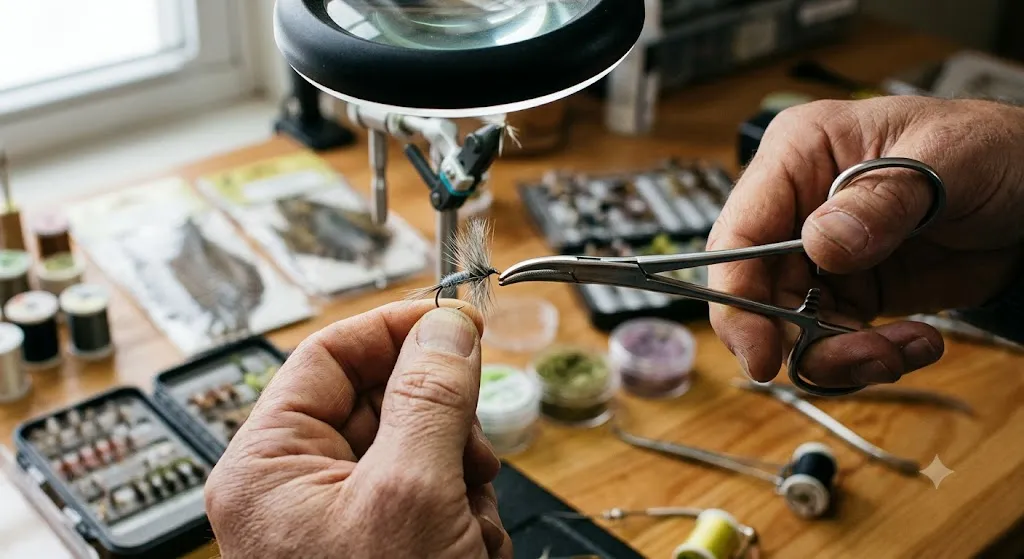
Written by Cameron Spanos
A size 20 pheasant tail buried past the barb in the corner of a wild brown's jaw is not a job for your fingers. I found that out the hard way one October, fumbling a good fish for the better part of a minute while it rolled in the net, because the only tool clipped to my pack was a set of blunt bass pliers. That trout swam off. Plenty of fish handled that badly don't. The right fly fishing forceps for trout turn that same hook-out into a three-second job, and a good pair costs less than a box of flies.
This is a first-pair buyer's guide, not a gear-snob roundup. I'll tell you what actually matters for trout (tip shape, jaw surface, and how fast the thing crimps a barb), name three verified, in-stock picks under $30, and say which one I'd hand a buddy who's never owned a pair.
For trout, buy a curved, locking scissor clamp with a smooth flat spot near the tips. It backs a small nymph out fast, crushes a barb flat in one squeeze, and trims tippet in a pinch. Spend under $15 and skip the oversized saltwater pliers. Speed on the release matters far more than the logo on the handle.
The three I'd actually buy
All three are current 2026 listings, in stock, and sized right for trout water. Prices below are what they showed as of the 2026 season.
| Forceps | Best for | Price | My rating |
|---|---|---|---|
| Kingfisher Scissor Clamp (Curved) | First pair, all-around trout | Around $10 | 4.7 / 5 |
| Kingfisher Fat Finger Clamp (Curved) | Cold hands, gloves, grip | About $25 | 4.4 / 5 |
| Ainiv Curved + Straight Set (2 pc) | Trying both tips cheap | Roughly $7 | 4.3 / 5 |
Kingfisher Scissor Clamp: best first pair for trout

This is the Dr. Slick scissor-clamp formula at a fraction of the price. Curved jaws, a ratcheting lock, and a small scissor blade built into the handles so you can snip tippet without switching tools. For most trout anglers, that combo covers about 90 percent of what you do streamside. It carries a 4.7-star average, per Amazon ratings as of 2026, across a small but consistent batch of reviews.
Who it's for
The angler buying their first real pair. If you fish dries, nymphs, and the occasional small streamer on a 3 to 6 weight, this does everything you need and clips to a zinger without weighing your pack down.
Pros and cons
- Curved tip reaches hooks set in the roof or corner of the mouth
- Built-in scissor handles the tippet-snip job, so it doubles as a second tool
- Locking ratchet holds the fly while you work it free
- Light enough to forget it's on your lanyard
The knock: the scissor edge is fine for mono and fluoro but dulls faster than a dedicated nipper on braid. And the jaws are on the delicate side. This is a trout tool, not something to wrestle a pike with.
As of the 2026 season it runs around $10. Check the current price on Amazon.
Kingfisher Fat Finger Clamp: best for cold hands and gloves

Standard hemostat loops are sized for surgeons' fingers, which is a problem in February when your hands are numb and half-gloved. The Fat Finger clamp widens the finger holes so you can drive it with cold, clumsy hands or wet gloves on. Curved jaws again, same locking action, built for the reach into a trout's mouth. It sits at a 4.4-star average per Amazon ratings as of 2026.
Who it's for
Winter and early-season anglers. Anyone who fishes tailwaters in the cold, or just has bigger hands that fight with tiny surgical loops. If your current forceps make you feel like you're threading a needle with mittens on, this fixes that.
You might also enjoy: How to Release Fish in Summer Heat So They Survive
Pros and cons
- Oversized finger loops work with gloves and numb hands
- Curved locking jaws with a flat crimping surface near the tips
- Heavier, more confident build than a bargain hemostat
The trade-off is bulk and price. At about $25 it's the priciest here, and the wider frame is slightly more to carry. If you fish mostly in shirtsleeve weather, you probably don't need it. If you fish cold, it earns its keep the first frozen morning.
Currently around $25 as of 2026. See it on Amazon.
Ainiv Curved + Straight Set: cheapest way to try both

Here's my mild hot take: for pure trout duty, a pair of plain surgical mosquito hemostats does most of what a $30 name-brand tool does, and this two-pack proves it. You get one curved and one straight, both 5 inches, both self-locking, for roughly the price of a sandwich. They pull the highest review volume of anything here, over 500 ratings at a 4.4-star average per Amazon as of 2026.
Who it's for
The budget angler, and anyone who can't decide between straight and curved. Buy the set, fish both for a season, and keep whichever one lives on your pack. The spare rides in the truck or the boat bag as a backup you won't cry over if it walks off.
Pros and cons
- Two tips, one price, so you settle the straight-versus-curved debate yourself
- Serrated jaws grip a hook shank hard for stubborn removals
- Cheap enough to stage a pair in every bag
What you give up: no scissor, no barb-notch, and fully serrated jaws that aren't ideal for crimping (more on that below). These are medical hemostats sold for fishing, not a purpose-built fly tool. For a first taste of what forceps do, though, they're impossible to beat on value.
About $7 for the pair, current 2026 listing. Grab the set on Amazon.
Straight or curved forceps for trout?
Curved, if you're making me pick one. The angled tip slides along the inside of a trout's mouth and gets behind a hook set in the roof or the corner, which is where flies end up when a fish eats on a tight drift. Straight jaws are a hair better for a clean grip on an exposed hook and for pinching barbs on the vise at home.
Honestly, most experienced anglers stop caring after a while and grab whatever's clipped on. But for the specific job of backing a small nymph out of a trout that ate deep, curved wins often enough that it's the tip I'd start with. That's also why the two-pack above is smart: fish both, form your own opinion.
Why does a barb-crimping notch matter for catch and release?
A barb is the little backward spur that keeps a hook from sliding out. Great for holding fish, terrible for a fast release, because a barbed hook tears more tissue coming out and takes longer to work free. Crimping it flat before you fish is one of the highest-value things you can do for a trout you plan to let go.
You might also enjoy: Trico Spinner Falls in July: The 7 AM Window Every Tailwater Angler Should Plan Around
Here's the detail nobody tells first-time buyers: you want a smooth, flat surface at the tips to crimp a barb, not serrations. Serrated teeth bite into the wire and can weaken or nick the hook. The flat, non-serrated portion near the front of good forceps mashes the barb down clean. Better fly-specific clamps, including the Dr. Slick pattern the Kingfisher scissor clamp copies, keep the tips smooth for exactly this reason and serrate only toward the back for grip. Plain surgical hemostats are serrated the whole way, which works but isn't as tidy.
The mortality math is smaller than the internet claims, for what it's worth. Doug Schill, a research biologist with Idaho Fish and Game, found the difference in trout mortality between barbed and barbless hooks came out to roughly 0.3 percent in his work. So barbless isn't really about the hook wound itself. It's about the seconds. A pinched barb comes out fast, which means less handling and less time out of the water.
How fast do you really need to unhook a trout?
Fast. The clock on a released fish runs on air exposure, and it's shorter than most people think. Keep Fish Wet points to 10 seconds of air exposure as a useful ceiling across species, and a foundational 1992 study by Ferguson and Tufts showed that even 30 to 60 seconds out of the water can do real damage to a rainbow trout after a hard fight.
"The default should be as little as possible. We are unaware of a biological explanation nor a single scientific study showing that air exposure is good for fish."
Sascha Clark Danylchuk, Keep Fish Wet
That's the whole case for good forceps in two sentences. A locking clamp that reaches the hook and pops it out in one motion is the difference between a fish back in the current in five seconds and one you're still fighting to unhook at forty. If you log your catches in Bushwhack, you already know how many fish a good day adds up to. Multiply your handling time by that number and the tool pays for itself on trip one.
Do you need dedicated fly fishing forceps, or will pliers work?
For trout, forceps beat pliers, full stop. Needle-nose pliers are too blunt to reach a size 18 hook and too clumsy for the flat crimp. A locking hemostat holds the fly for you, reaches deep, and crushes a barb without a second tool. Pliers earn their place with toothy fish and big saltwater hooks, not a brown that sipped a midge.
The one upgrade worth considering later is a full clamp-plus-scissor like the Kingfisher first pick, so you're not switching between forceps and nippers mid-release. If you're still building out the rest of your kit, our gear rundowns cover nippers, nets, and the tools that ride alongside your forceps.
My pick for a first pair
Buy the Kingfisher Scissor Clamp. It's the best set of fly fishing forceps for trout if you're buying one pair to do everything: curved reach, a smooth crimping surface, a scissor for tippet, and a lock that holds the fly while you work. At around $10 it's a genuinely easy call.
Fish cold water or wear gloves? Add the Fat Finger clamp. On a tight budget or torn on tip shape? The Ainiv two-pack gets you into the game for the price of a couple of flies and lets you settle the curved-versus-straight question on your own water. Whatever you clip on, the point is the same: get the fish unhooked and back in the river before you've had time to think about the photo.
Get fishing tips in your inbox
New guides, seasonal tactics, and gear picks — about once a month, no spam.