Yellowstone Fly Fishing in June 2026: A Week-by-Week Trip Planning Guide
 Cameron Spanos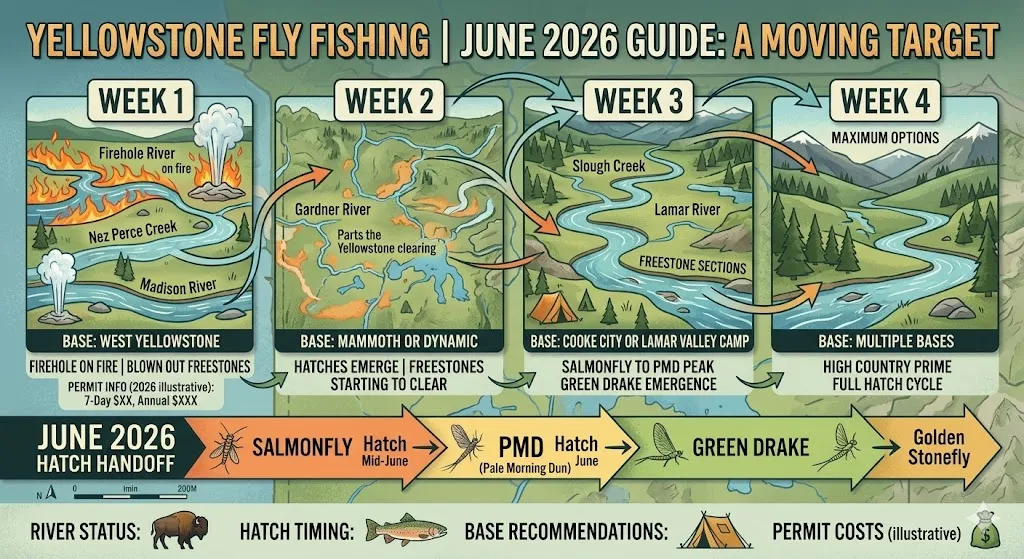
Written by Cameron Spanos
Memorial Day weekend opens Yellowstone's standard fishing season and the park's freestones are the color of chocolate milk. The Lamar looks like a logging road. The Yellowstone is pushing 10,000 cfs through Black Canyon. You drove fifteen hours and your hopper-dropper rig is going to die a slow death in muddy water. This is the moment Yellowstone fly fishing in June rewards the planner and punishes the optimist.
The good news: the Firehole is open, the Madison inside the park clears within days of the lakes opening, and by the third week of the month a rolling hatch sequence walks from thermal water onto freestone runs in a way you cannot find anywhere else in the lower 48. The trick is knowing which river to be on which week.
When does the runoff actually clear in 2026?
Mid-to-late June. That's the answer for most years, and the early-season forecasting out of Bozeman is pointing the same direction for 2026 with snowpack tracking close to average through April. The Yellowstone River's lower Black Canyon historically drops into shape around June 20, with the salmonfly hatch building from June 25 through July 4 in non-drought years, per Big Sky Anglers' season forecasts. Watch the USGS gauge on the Yellowstone River at Corwin Springs for real-time flows as your dates approach.
The Lamar drainage runs later. It usually doesn't fish well until mid-July. If you're planning around the Lamar specifically, push your trip to the second half of July and read a different post. This guide covers the four-week window when the park is open but the freestones are still working out their high-water hangover.
The four-week trip-planning calendar
Here's how the window actually breaks down. Match your travel dates to the river you want to fish, not the other way around.
Week 1 (May 23 to May 31): Firehole and stillwaters only
The park opens the Saturday of Memorial Day weekend. The Firehole is the only river that's reliably fishable, and it's reliably fishable because geyser basins keep it warm enough for hatches when every other watershed is still 38 degrees and brown. Blue-winged olives and midges dominate the first ten days. Bring a 4-weight, 5x tippet, and your patience for crowds at the obvious pullouts.
Lewis Lake opens the same weekend and Yellowstone Lake usually shakes off ice within the first week of June. If you're an early-season visitor and the Firehole is shoulder-to-shoulder, a leech pattern on a slow sinking line off Lewis Lake's outlet is a quiet alternative.
Week 2 (June 1 to June 7): Firehole peaks, Madison wakes up
PMDs hit in earnest. On the Firehole the PMDs are oversized for the species (size 14 is common, where most western waters run 16 to 18) and emergences between 10 a.m. and noon can be ridiculous on warm bluebird days. Cold mornings push the hatch to 2 p.m. or later. The Gibbon starts producing on attractor dries by the end of this week, particularly in the pocket water above and below Gibbon Falls.
Inside the park, the Madison is the next domino. PMDs and caddis start ramping mid-morning to evening, and the first salmonflies and golden stones poke off in the faster water around June 10. The USGS gauge on the Madison near West Yellowstone shows how fast it is clearing.
Week 3 (June 8 to June 14): Madison gets serious, Firehole gets warm
This is the most flexible week of the four. The Madison inside the park is in shape with multiple hatches stacking through the day. The Firehole is still fishing in the morning but afternoon water temps creep into the danger zone by week's end. By mid-month the Firehole's afternoon bite shuts off entirely, and by early July you should leave it alone.
You might also enjoy: Middle Provo River Wade Fishing: Access, Parking, and Hatches Mile by Mile
Henry's Fork (Idaho side, outside the park but a 45-minute drive from West Yellowstone) is the other story this week. Green drakes start showing on the Ranch in mid-to-late June depending on flows, and the Ranch's drake window often runs only 10 to 14 days before the bugs move upstream into Box Canyon water.
Week 4 (June 15 to June 21): freestones drop, salmonflies move
The Yellowstone River starts to come back. Salmonflies sputter near Tower Falls around June 10 to 12 (warm seep zones), then the hatch builds in the Lower Black Canyon around June 20 and walks upstream over the next two weeks, per Big Sky Anglers' season tracking. If you have a guide booked, this is the week to put them on water that's actually clearing.
Where do you actually base?
The four basing options serve different itineraries. There is no single right answer.
West Yellowstone, MT is the default for a reason. You're 20 minutes from the Madison inside the park, 35 minutes from the Firehole, and an hour from Henry's Fork. Every fly shop in town has been doing this since the 1960s. Blue Ribbon Flies and Madison River Outfitters are the institutional knowledge bases. Downside: crowded in June and the rooms book six months out.
Gardiner, MT is the call if you're chasing the Yellowstone River and Lamar drainage as soon as they drop. You're at the north entrance, 15 minutes from Mammoth, and positioned for the late-June salmonfly window on the Yellowstone. Skip this base for early June. The freestones aren't fishing yet and you're a long drive from the Firehole.
Cooke City, MT is the silent-mode choice. Tiny mountain town at the northeast entrance, gateway to Soda Butte and Slough Creek. These tributaries fish later (think July), but if you're piecing together a hybrid trip that pushes into the Beartooth high country in July, sleeping in Cooke City avoids two-hour transit days. For a mid-June trip alone, it's the wrong base.
Island Park, ID is the contrarian pick. You're an hour from West Yellowstone but you sleep on top of Henry's Fork, the Buffalo, and the Henrys Lake outlet. If the green drake hatch on the Ranch is the centerpiece of your trip and the park rivers are a side quest, this is the smarter base.
What do permits cost for 2026?
Yellowstone fishing permits are separate from your park entrance pass. According to the National Park Service's 2026 fishing page, current rates are $40 for a three-day permit, $55 for a seven-day, and $75 for the season. Anglers 15 and under fish free when accompanied by a permitted adult, or via a free youth permit. Permits sell through Recreation.gov and at visitor centers, ranger stations, Yellowstone Park General Stores, and most fly shops in West Yellowstone and Gardiner.
You also need to know the rest of the regs. Barbless hooks are mandatory and the NPS specifies the barb must be pinched flat. Lead-free tackle only. Felt-soled waders are banned to slow invasive species. Native fish (Yellowstone cutthroat, Arctic grayling, mountain whitefish) must be released unharmed. One rod per angler. No bait, ever. The 2026 regulation PDF on the NPS site is short and worth a read in your hotel room the night before you fish.
You might also enjoy: Fly Fishing Utah for Beginners: 5 Forgiving Rivers
Bear spray is not optional
Carry it. On your hip, not in your pack. Practice the safety pull at home before you fly out so you don't fumble it the one time it matters. The NPS recommends groups of three or more for backcountry fishing and warns against solo trips, especially in the Lamar and Hayden Valley drainages where grizzly density is highest.
Bear Management Areas matter for trip planning. Several BMAs along the Yellowstone River corridor, the Pelican Valley, and parts of the Yellowstone Lake shoreline are seasonally closed or require minimum party sizes through mid-July to protect spring foraging. Check the current closure list on the Yellowstone Backcountry Trip Planner before you commit to a hike-in spot. The list shifts year to year.
The permanent closures are also non-obvious. You can't fish within a mile downstream and a quarter-mile upstream of Fishing Bridge. You can't fish 100 yards above or below LeHardys Rapids. The entire Hayden Valley from Alum Creek up to Sulphur Cauldron is permanently closed. The shoreline between West Thumb Geyser Basin and Little Thumb Creek is off-limits. If your plan involved any of these spots, replan.
Yellowstone fly fishing in late June: what flies to bring
A short, opinionated list. Skip the 47-pattern "essentials" box.
- Dries: PMD parachutes and sparkle duns size 14 to 16 (oversized for the Firehole specifically), Elk Hair Caddis size 14 to 16 in tan and olive, Stimulators and Chubby Chernobyls size 6 to 10 for salmonflies and golden stones, Purple Haze size 14 to 18 as a searching pattern
- Nymphs: Pat's Rubber Legs in black or coffee/black size 4 to 8 (this is your salmonfly nymph and your golden stone nymph and your generic big-bug dropper), Hare's Ear size 14 to 18, Pheasant Tail size 16 to 18, Two Bit Hooker for the Firehole
- Streamers: One sparse box. Sculpzilla and Sex Dungeon in olive or black for the Madison and Yellowstone in stained water
Pair stoneflies with a beadhead dropper. Run the dry on 3x to 4x with 18 to 24 inches of 4x or 5x fluorocarbon to the nymph. That rig handles the Madison, the Yellowstone, and the Gibbon without a reset.
The honest contrarian take
If you only have one week in June and you've never fished the park before, target the second-to-last week of the month (June 15 to 21) and base in West Yellowstone. You get the Madison and Firehole at peak, the Gibbon as a backup, the Lamar still won't be ready (so you won't be tempted to waste a day driving up there), and the Yellowstone River starts to drop into shape mid-week for a closing-day attempt at salmonflies in Black Canyon.
The hot take: a lot of trip planning content tells you to come for the Lamar. The Lamar in June is not a thing. Anyone romanticizing the Lamar Valley cutthroat fishery in June is either talking about September or hasn't been there in June. Plan accordingly.
Logging the trip
Yellowstone is the kind of place where the data compounds. Which week you fished, which run produced, what hatch was on, what the water temp was, where the bear closure forced you to detour. You won't remember any of it accurately in fifteen months when you're planning your next trip. Anglers who log their catches in Bushwhack get the historical record back: tagged locations, hatch notes, and water conditions tied to specific dates. That's the difference between guessing about June 2027 and knowing exactly which weekend the Firehole turned the corner two years running.
One last note. Yellowstone weather in June can produce four seasons in a single day. Pack the puffy. Pack the rain jacket. Bring fingerless gloves for cold mornings on the Firehole. The fish are there. The hatches are real. You just have to be on the right water on the right day, and now you know which day.
Get fishing tips in your inbox
New guides, seasonal tactics, and gear picks — about once a month, no spam.