Why Bass Won't Live Below the Thermocline (And How to Find the Layer on Your Lake)
 Hudson Reed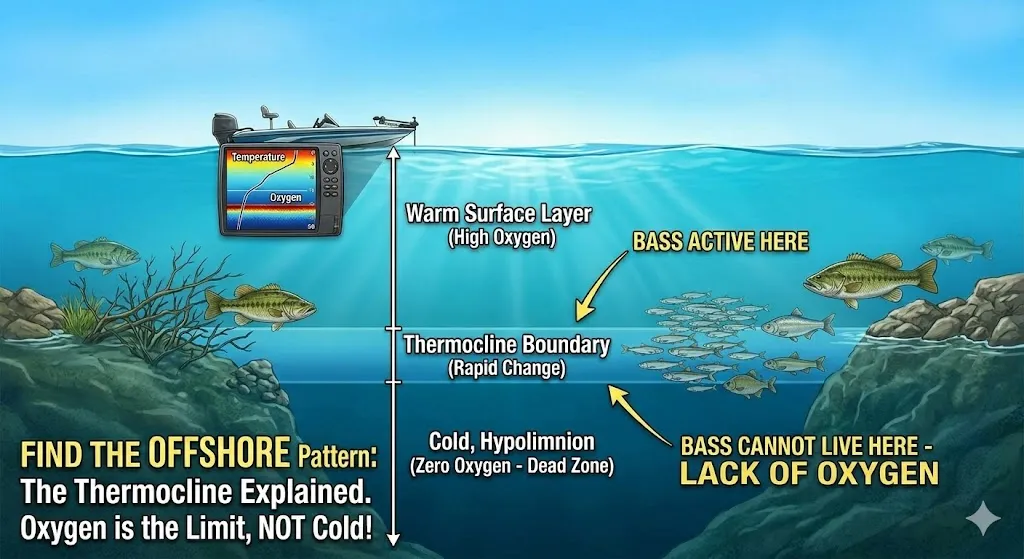
Written by Hudson Reed
Most anglers think deep bass live deep because they like it cold. They don't. They live as deep as oxygen lets them, and that ceiling has a name: the thermocline. Once you understand why bass won't live below the thermocline, every offshore summer pattern you've read about (ledges, humps, channel swings, deep brush) starts making sense as variations on the same theme.
By late July most stratified lakes have turned into a two-story house with the basement sealed off. The top floor (the epilimnion) is warm, sunlit, and full of oxygen. The basement (the hypolimnion) is cold, dark, and so oxygen-starved that a bass can't physically tolerate it for more than a few minutes. The thermocline is the locked door between them, and your job in July and August is to fish right above that door.
This is the mechanism that makes the Bushwhack log data line up the way it does in July: catches stack between roughly 8 and 22 feet on most reservoirs, almost nothing deeper, regardless of how deep the lake actually is. The fish aren't ignoring the 60-foot stuff. They literally can't breathe down there.
What is the thermocline, actually?
A stratified summer lake has three layers. The epilimnion is the warm top layer. The wind mixes it, sunlight reaches it, and photosynthesis pumps oxygen into it all day. The hypolimnion is the cold bottom layer, sealed off from the surface, with no sunlight, no wind mixing, and no oxygen replacement. Between them sits a thin transition zone called the metalimnion, and inside that zone is the steepest temperature drop, which is what most anglers call the thermocline.
The Michigan Inland Lakes Partnership describes the thermocline as a physical barrier: it "prevents dissolved oxygen produced by plant photosynthesis in the warm waters of the well-lit epilimnion from reaching the cold dark hypolimnion waters." Once that barrier locks in (usually by late June in the South, mid-July in the upper Midwest), the hypolimnion is on its own oxygen-wise. And it's losing oxygen the whole time. Bacteria decompose whatever organic matter sinks down, and that decomposition burns through the limited supply that was trapped during spring turnover.
By August, on most fertile lakes, dissolved oxygen below the thermocline is near zero.
The number that matters: 2 to 4 mg/L
Bass don't have a strict temperature minimum. They have a strict oxygen minimum. According to the UMass Water Resources Research Center and most state limnology programs, most freshwater gamefish show stress at 2 to 4 mg/L dissolved oxygen, and mortality kicks in below 2 mg/L. Hypolimnion water in a stratified summer reservoir routinely measures under 1 mg/L by mid-August. A bass that drops into that water is suffocating in real time.
So when your sonar lights up with a deep brush pile in 35 feet on a lake where the thermocline sits at 18, you're looking at structure that has been functionally dead since the Fourth of July. Bass might have lived on it in May. They will live on it again in October after fall turnover dumps oxygen back to the bottom. Right now? Nothing.
Why doesn't the temperature itself stop bass from going deep?
Bass actually like cooler water than the epilimnion provides in midsummer. Dr. Hal Schramm, former head of the USGS Mississippi Cooperative Fish and Wildlife Research Unit, puts the optimum metabolic range for largemouth at 82 to 84°F, but they tolerate a much wider band. Surface temps in July can hit 88 to 92°F on a southern reservoir, well above optimum. The 65°F water 30 feet down would feel great to a bass if oxygen weren't the limit.
That's the whole trick. The reason bass aren't 30 feet down isn't comfort. It's chemistry. Jacob Wheeler, the MLF Bass Pro Tour angler, summarized it in a 2024 Wired2Fish piece: bass want "that happy medium of the coolest water with good dissolved oxygen." That happy medium is the top of the thermocline. Cool enough to slow their metabolism a bit, oxygenated enough to breathe.
"Bass aren't comfort animals in the summer. They're going to live where they can both breathe and ambush. That's almost always the top edge of the thermocline, and almost never below it."
Seth Feider, 2021 B.A.S.S. Angler of the Year, talking about offshore summer position.
How do you find the thermocline on a fish finder?
Every modern unit (Garmin, Lowrance, Humminbird) can show the thermocline as a fuzzy horizontal band across the middle of your 2D screen. The catch is that out of the box, your sensitivity is set low enough to hide it. The thermocline is a density change in the water column, not a hard object, so it returns a weak signal. You have to crank the gain to see it.
You might also enjoy: Best Kids Fishing Rod and Reel Combo for 2026: Dock Demon vs Ugly Stik GX2 vs PLUSINNO
Step 1: Get over deep enough water
You need water deeper than the thermocline itself, or you can't see the band. Idle out to something 30+ feet for most reservoirs. If you're on a lake where the thermocline is shallow (a dingy 12-foot Northern bass lake), 20 feet is enough.
Step 2: Switch to 2D traditional sonar
Down-imaging is too crisp and too literal. It filters out the fuzzy density returns you want. Use plain old 2D ("traditional" on a Garmin, "sonar" on a Lowrance, "2D" on a Humminbird). Set your range to manual at roughly 1.5x your expected thermocline depth so you have screen real estate above and below.
Step 3: Crank sensitivity until the band appears
Open your gain or sensitivity menu and start raising it five or ten percent at a time. Watch the middle of the screen. At normal fishing sensitivity (usually 50 to 70 percent), the column between the surface clutter and the bottom is mostly clean. Push sensitivity up to 85 or 95 percent and a horizontal smudge will start to form somewhere between 12 and 25 feet on most lakes. That smudge is your thermocline.
Step 4: Idle a straight line and confirm it's consistent
The thermocline runs across the whole basin at a similar depth. It follows the warm-water layer, not the bottom contour. If your smudge stays at the same depth as you idle from a creek arm out to the main lake, you've got it. If it drifts up and down with the bottom, you're looking at noise.
Humminbird's own support page confirms the technique: "increase sensitivity until you see the thermocline appear as a band across the screen." Same procedure on all three brands. Note the depth. Write it on your hand if you have to.
What if you don't have electronics?
You can find the thermocline with a deep-diving crankbait and a long arm. Tie on something that runs 18 to 22 feet (a Strike King 6XD, a Norman DD22, a Berkley Dredger 25.5). Make a long cast in the deepest water you can find and crank it back slowly with the rod tip low and the rod loaded into your arm.
Pay attention to the pull. A diving crankbait pulls hard in the warm epilimnion (the rod stays bent, the lure hunts, you feel the bill ticking). When that bill crosses the thermocline, the pull eases up noticeably. The water density is different on the other side, and the lure stops working the same way. Some anglers describe it as the bait "going dead" for a foot or two.
You can also troll a deep crank along a main-lake contour and watch where it stops fouling. Above the thermocline you'll pick up algae, suspended grass, and occasional baitfish hits. Below it, the lure runs clean and cold. The transition is the layer.
It's not as precise as sonar, but on a lake you fish twice a week, three trips of paying attention will dial it in.
How do you use the thermocline depth to find fish?
Once you know the number (let's say it's 19 feet on your lake), that depth becomes the basement of every offshore search you run. Your job stops being "find structure" and starts being "find structure that tops out near 19 feet."
You might also enjoy: Best Braided Fishing Line for Bass and Inshore 2026: Power Pro vs Sufix 832 vs Daiwa J-Braid
The specific structure types this turns into:
- Humps that crown at 12 to 17 feet. A hump topping at 14 with the thermocline at 19 puts the entire bait-holding zone of the hump in the oxygenated layer. The fish stack on the slope between the crown and the thermocline edge.
- Channel ledges where the lip is at thermocline depth. This is what the classic Tennessee River ledge pattern is built on. Bass sit on the lip in oxygenated water and ambush bait that gets sucked off the channel.
- Main-lake points that taper through the layer. The end of the point, where it drops past your thermocline depth, is where fish position. Below that depth there's just nothing.
- Brush piles topping above the thermocline. A brush pile in 24 feet with the top branches at 16 is gold. A brush pile fully under the thermocline is irrelevant in July.
This is also why the June and July deep migration doesn't actually keep going deeper as summer drags on. Once fish hit the thermocline ceiling, they stop. Mid-July through August they're suspended within a few feet of that band, not 5 or 10 feet deeper every week the way some guides describe it.
Are there exceptions?
Two. The first is current. Tailrace areas below dams, current seams in tidal lakes, and the upper ends of riverine reservoirs don't stratify the same way because moving water mixes oxygen down. You'll find deep bass in 35 feet below a generation cycle on a TVA lake in August that would be impossible on a stratified pond. The 2026 generation schedules on lakes like Pickwick and Wheeler are still the single biggest variable for offshore bass on those systems.
The second is shallow, wind-mixed lakes. A 14-foot natural lake in Minnesota or a shallow Florida lake doesn't truly stratify because the wind reaches the bottom. The whole water column stays oxygenated and bass distribute by cover and temperature instead of by the thermocline ceiling.
For the typical Southern reservoir or Midwest impoundment, though, anywhere with 25+ feet of depth and a calm summer, the thermocline rule holds.
What about turnover and the days right before it?
In September and October, surface temps drop, the epilimnion cools to match the metalimnion, and eventually the density barrier collapses. Wind starts mixing the whole column. This is fall turnover. It's miserable to fish for about a week because the suddenly-mixing hypolimnion water dumps dead organic material and low-oxygen pockets through the column. Fishing usually stinks for 5 to 10 days.
After turnover settles, the entire lake is oxygenated top to bottom and bass spread across every depth again. The thermocline disappears as a meaningful concept until next June.
Knowing this changes how you read a late-September trip on your Bushwhack log. A bad week in the third week of September isn't you losing your touch. It's the lake redistributing 20 million gallons of low-oxygen water.
The one mental model to keep: bass won't live below the thermocline
If you take one thing from this post: in a stratified summer lake, the thermocline is a ceiling on bass habitat, not a floor. Anything below it is empty for July and August purposes. Anything above it is in play.
Find that number on your lake. Use it as the floor of your search grid. Stop wasting casts on the 30-foot stuff that hasn't held a bass since the spring.
Get fishing tips in your inbox
New guides, seasonal tactics, and gear picks — about once a month, no spam.