Why the Bass Stopped Biting at 9 AM: Reading the Summer Daily Window
 Hudson Reed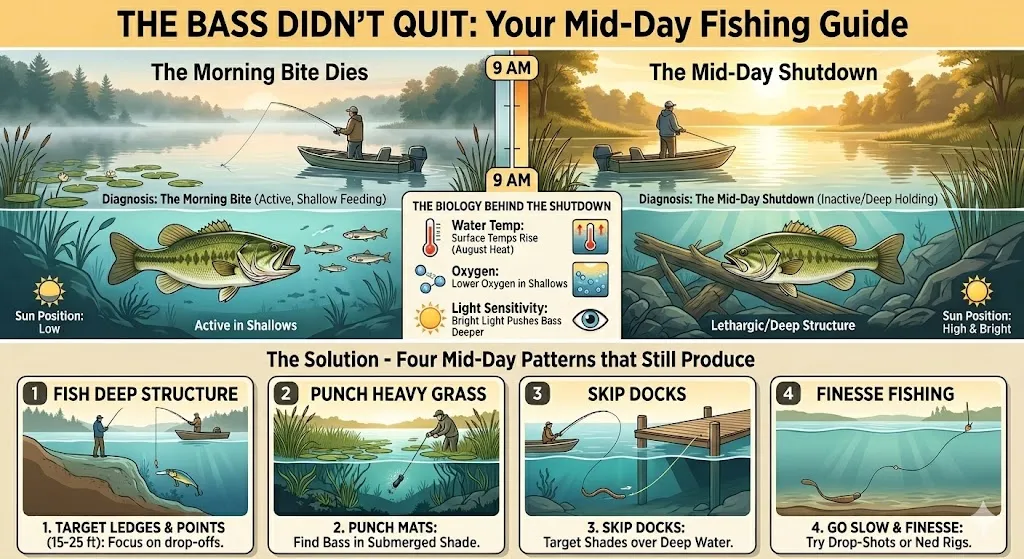
Written by Hudson Reed
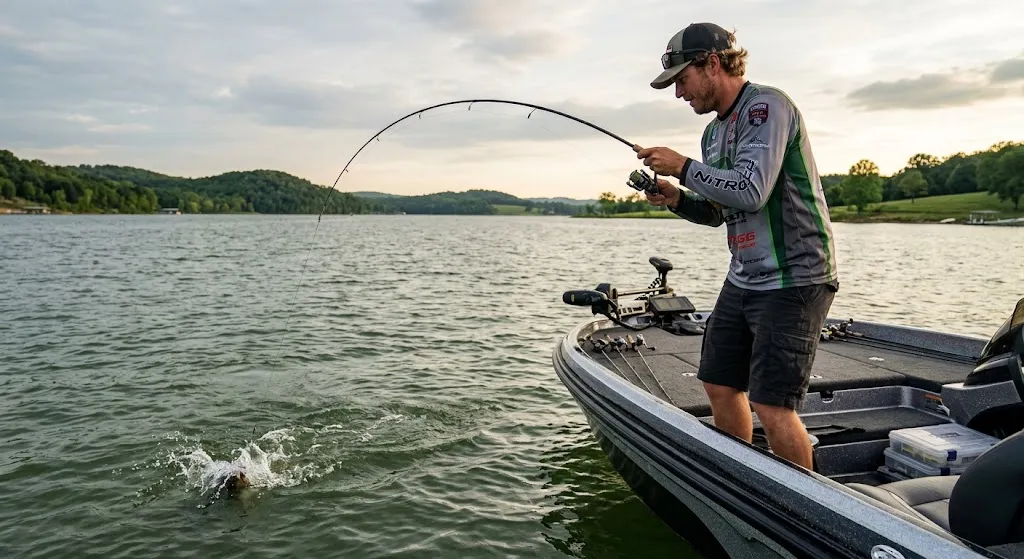
You had eight bass in the boat by 8:45. Three on a frog along the pads, two on a popper down the bluff, the rest on a buzzbait worked across a flat. Then the sun cleared the trees, the surface went glassy, and the next ninety minutes of casting produced exactly nothing. By 10 AM you're looking at the depth finder wondering if the lake died. The bass stopped biting and you can't figure out where they went.
They didn't go far. The bass stopped biting at 9 AM, but they didn't disappear. They moved.
That's the central fact of summer bass fishing, and it's the one most anglers refuse to internalize. The morning bite ending isn't a failure of the lake. It's a pattern shift, and if you can read it, the next eight hours are still fishable. The mistake is throwing the same lures in the same spots and assuming the fish vanished. They didn't. They slid twenty feet deeper, tucked under a dock, or pulled out to a hump you've never put a waypoint on.
Why does the bass bite stop at 9 AM in summer?
Four things change between 8 AM and 10 AM on a clear July day, and all four push bass off the morning pattern.
Sun angle and light penetration. Bass are sight feeders with eyes built for low light. Their retinas hold a high ratio of rod cells, which gives them an enormous advantage in the dawn period when shad and bluegill can't see them coming. Once the sun gets above roughly 30 degrees on the horizon, that advantage flips. Now the baitfish can see them. The ambush window closes. Shallow bass either eat fast and slide out, or stop eating entirely and reposition.
Surface water heating. The top three feet of a lake warm faster than any other zone. On a calm July morning the surface can climb from 78 to 85 in two hours. Bass have a preferred metabolic window roughly 82 to 84 degrees, according to fisheries biologist Dr. Hal Schramm writing for In-Fisherman. Push past 86 and feeding efficiency drops sharply. The fish that crushed your frog at 7 AM aren't comfortable at that depth anymore.
Dissolved oxygen redistribution. Photosynthesis hasn't kicked in yet at dawn, so shallow water can actually be marginal on oxygen at first light. By mid-morning, sun-driven photosynthesis spikes oxygen in vegetation and weed edges, which sounds good, but the same heating that drives that spike also drives surface temps past comfort. Meanwhile the deeper bass below the thermocline are still locked out. The sweet spot, oxygenated and 80-degree water, narrows to a band, and the fish stack into it.
Boat pressure. Every other bass boat on the lake hit the obvious laydowns and points at first light too. By 9 AM those spots have been worked over. Fish that survived the first wave aren't going to eat the second wave's bait.
Stack those four forces and the morning bite doesn't end gradually. It collapses.
The biology in one sentence
Bass are cold-blooded predators whose metabolic rate doubles for every 18-degree rise in water temperature, and whose vision evolved for an ambush advantage that lasts ninety minutes a day.
That's the whole game. The morning topwater window we wrote about in our 90-minute first-light topwater post is the period when the sight advantage is theirs and the water is cool enough to feed aggressively at shallow depth. When either of those conditions breaks, the pattern breaks with it.
What about the thermocline?
By mid-July most lakes north of the Gulf Coast have stratified. There's an epilimnion (warm, oxygenated upper layer), a thermocline (the transition band), and a hypolimnion (cold and often oxygen-dead below). Bass cannot live in the hypolimnion for any meaningful length of time. Studies cited in the journal Ecology of Freshwater Fish found that when dissolved oxygen drops below 3 mg/L, juvenile largemouth show drastic decreases in prey consumption and handling efficiency. Below 2 mg/L they actively avoid the zone.
So when you mark fish at 35 feet on a 60-foot lake in August, check your thermocline first. If the layer is at 22 feet, those 35-foot "bass" are probably suspended crappie or shad. The bass are somewhere between the surface and that 22-foot ceiling, and that's where you should be casting. We went deeper on this in our bass-and-thermocline post, which is worth reading if you don't already own a lake-specific picture of where your thermocline sits.
The four mid-day patterns that still produce
Once you accept that the bass moved rather than stopped feeding, the question becomes: moved where? There are really only four answers, and on any given lake one or two of them will be dominant on any given day.
You might also enjoy: Best Kids Fishing Rod and Reel Combo for 2026: Dock Demon vs Ugly Stik GX2 vs PLUSINNO
1. Deep shade
Docks. Bluff walls. Overhanging laydowns. Marina pilings. Standing timber. Anywhere the sun can't reach the water directly is a candidate.
Shade does two useful things. It keeps surface temperatures a few degrees cooler underneath, and more importantly, it restores some of the bass's vision advantage. A bass sitting in dock shade looking out into bright water sees baitfish silhouetted against the surface. The baitfish looking back into the shadow sees nothing. That's the same ambush dynamic the bass had at dawn, only this version persists all day.
The single most-underrated source of mid-day shade is bluff walls once the sun gets high enough to throw shadow streaks down the rock face. Kevin VanDam talks about this constantly in his Major League Fishing column. The shadows aren't on the whole wall, just specific seams and crevices. A skipped jig dropped into those seams is one of the highest-percentage casts you can make between noon and 3 PM in August.
Lure choices: a 1/2 oz football jig with a craw trailer for bluff walls, a flipping jig or wacky-rigged stick worm for dock pilings, a Texas-rigged creature bait for laydowns. Slow it down. The fish are conserving energy. Your bait should look like it is too.
2. Current breaks and windblown structure
Any moving water in a lake is a magnet in summer. Current oxygenates. Current disorients baitfish. Current gives bass a way to feed without chasing.
The obvious sources: dam tailraces when generation is happening, river mouths, narrow creek channels where the lake squeezes through. The less obvious sources: a windblown main-lake point on a sustained 12-mph southwest wind, the upcurrent corner of a bridge piling, the back of a long flat where wind has pushed shad against a bank.
Wind creates current. That's the whole insight. A flat that was dead in the calm morning can light up at 1 PM when a thunderstorm front pushes wind across it. The wind activates the entire water column, oxygen mixes, baitfish disorient, bass move up. Don't pack up because it got windy. Move to the windblown side of the lake.
Lure choices: a 3/4 oz Carolina rig dragged across windblown points, a deep-diving crankbait or swimbait worked through current seams, a chatterbait if there's enough wind to dirty the water.
3. Deeper offshore structure
This is where the ledge fishermen earn their living from June through August. The fish that crushed your topwater at dawn from the bank-side weedline didn't actually go far. Many of them slid 50 to 200 yards offshore to a hump, a creek-channel bend, a submerged road bed, or a ledge dropping from 12 to 22 feet.
The Tennessee River impoundments built the entire modern ledge-fishing industry around this pattern, but it works anywhere with deep summer water and offshore relief. The same fish that was feeding in 4 feet at sunrise often spends the bulk of its day in 14 to 18 feet of water on a piece of bottom structure within sight of where it ate breakfast.
If you're new to fishing offshore, our ledge-fishing guide walks through finding and fishing them. The shorter version: look for school activity on side-imaging, mark waypoints, and rotate through a deep crankbait, a 1-oz football jig, and a heavy Carolina rig until something connects.
4. Suspended fish over channels
The frustrating one. Not every bass goes to bottom structure. A meaningful percentage of mid-day summer bass suspend, often 12 to 18 feet down over a 30-to-50-foot channel, sitting on bait balls and not relating to any bottom feature you can see on traditional sonar.
Before forward-facing sonar this was the hardest pattern in bass fishing because you couldn't reliably find suspending fish. Now you can. A glide bait, a swimbait on a heavy jighead, a tail-spinner, or a flutter spoon dropped into the bait ball can trigger reaction strikes from fish that are otherwise impossible to target.
You might also enjoy: Pike Fishing for Beginners: The Freshwater Predator Most Anglers Overlook
The honest take: if you don't run forward-facing sonar, this pattern is so hard that you're better off ignoring it and committing harder to the other three. Trying to blind-cast suspended fish in 40 feet of water is a fast way to fish all afternoon without a bite.
The daily window by month
The shape of the summer day shifts as the season grinds on. Here's the rough decision tree we work from on a southern reservoir, adjust the temps north a few degrees for the upper Midwest and Great Lakes region.
June (surface 72 to 80). The morning topwater window is longest, often extending to 9:30 or 10 AM on cloudy days. Bass are still finishing up post-spawn recovery and a meaningful number are within a long cast of the bank all day. Mid-day pattern: shade and laydowns hold up well. Offshore is just starting to load up.
July (surface 80 to 86). The window tightens. Topwater dies at 8:30 on clear calm days. The offshore school pattern peaks. Bluff walls and dock shadows become the primary mid-day shallow pattern. This is the month where committing to one pattern and running it hard beats hopping between approaches.
August (surface 84 to 90+). The hardest month. Topwater window can be brief, sometimes 45 minutes. Shallow fish are predominantly tucked into the deepest shade you can find or shut down entirely. Offshore schools start to break up into smaller groups as ledges get pressured. Wind-and-current patterns become disproportionately important because the lake desperately needs oxygen mixing. A windy August afternoon is often better than a calm August morning.
What about the afternoon reopener?
Many anglers know that the bite can pick back up around 7 PM. Fewer know that some lakes have a real secondary feeding window around 1 to 2 PM, particularly on hot bright days.
Counterintuitive? Yes. The theory is that bait positions hit a thermal ceiling, bass sense reduced escape options, and a short feeding flurry happens when the upper water column is least mixed. We have no rigorous study to cite for this. What we have is a decade of logged catches in Bushwhack that show a small but real secondary bite spike in the 1 PM hour on a lot of southern reservoirs in July. If you've been blanking from 10 to noon, don't pack up at 12:30. Stay through 2 PM and see what happens.
What anglers get wrong when the bass stopped biting
The single biggest mistake is changing locations without changing presentations. People rotate from one shallow bank to another shallow bank, throwing the same buzzbait that worked at sunrise, and conclude after three hours that the lake is dead.
The second mistake is undersizing the move. The fish often shift 20 to 200 yards, not 5 miles. If you crushed them on a particular point at 6 AM, your first mid-day move should be to the deep end of that same point in 14 feet of water, not the next major creek arm.
The third mistake, and this one is heretical: more anglers should fish less between 11 AM and 2 PM in July and August. If you're a weekend angler getting four hours of sleep to be on the water at 5 AM, you'd probably catch more bass per hour by sleeping until noon and fishing 4 PM to 9 PM hard. The morning is sexier. The evening is more productive in many summer conditions. Track your own data with a fishing log for a season and see what your numbers say.
The hand-off mindset
The way to think about a summer day is as a relay. You're handing the bass off from one pattern to the next as the day moves. Topwater at first light. Shade and current through mid-day. Offshore structure through the deep heat. Topwater again at dusk.
The bass haven't shut down. They've punched a different clock card. Your job is to follow them through that schedule rather than fighting it.
Track your catches by hour for one summer and the daily window stops being a mystery. You'll see your own pattern, on your own water, and you'll know whether 9 AM ends your day or just opens the next chapter of it.
Get fishing tips in your inbox
New guides, seasonal tactics, and gear picks — about once a month, no spam.