Where Do Trout Hold Under the Ice? Why You Mark Them but Can't Catch Them
 Cameron Spanos
Written by Cameron Spanos
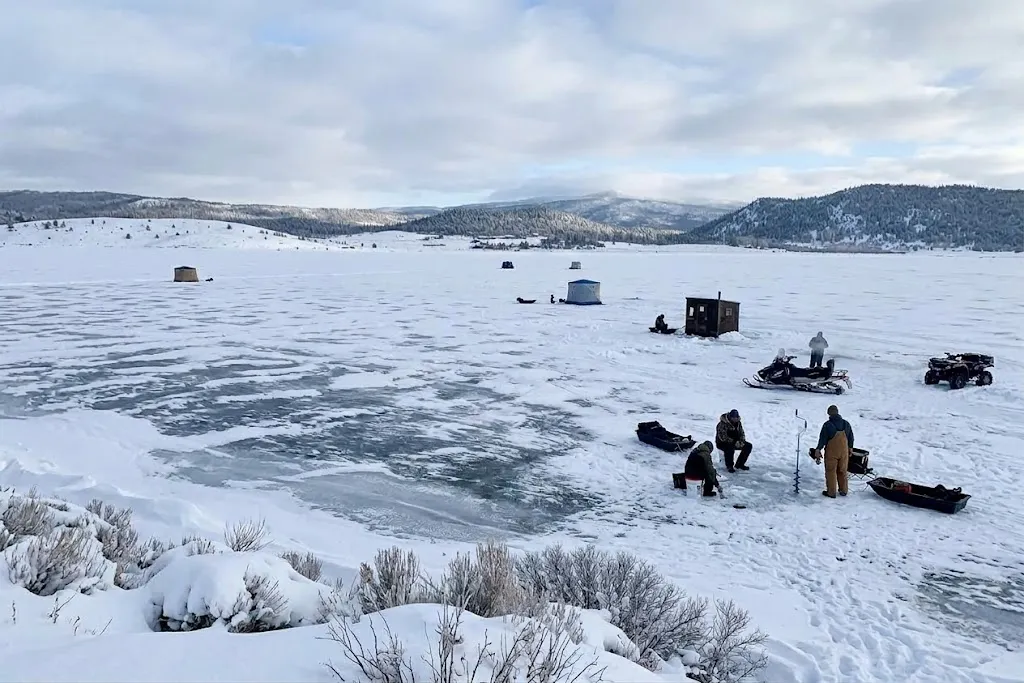
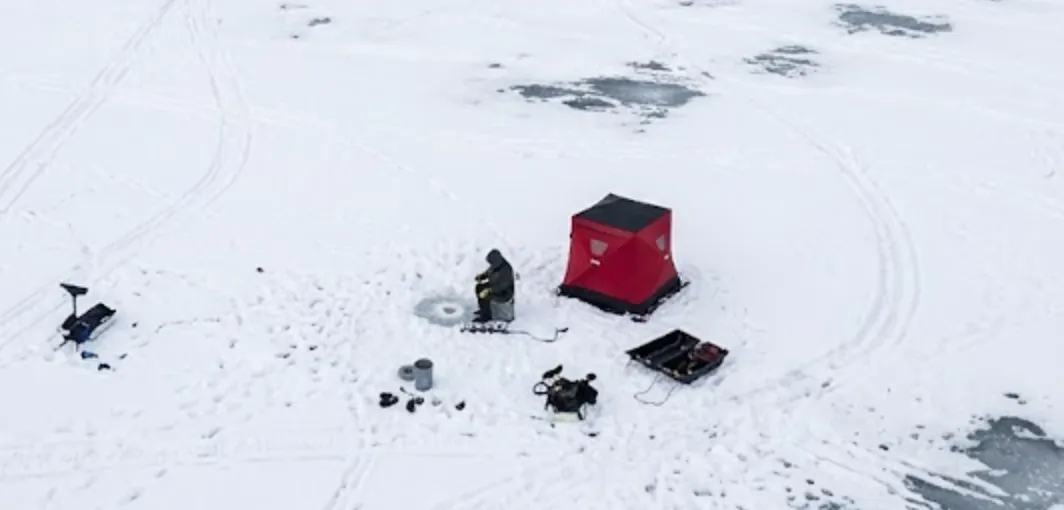
The flasher shows a fat red band not far under the ice. Your spoon is parked a couple feet off the bottom, right where you'd set up for perch, and nothing happens for an hour. That's the most common way to get skunked on a stocked-trout reservoir, and the fix usually isn't a new lure. It's reeling up. Where trout hold under the ice is high, often far higher than people expect, and once you start fishing the top third of the water column instead of the bottom, most of the "marking but not catching" problem goes away.
This is built around stocked rainbows, but the same logic mostly holds for cutthroat, tigers and brookies in lakes. Lake trout break a few rules and get their own section at the end.
Where do trout hold under the ice?
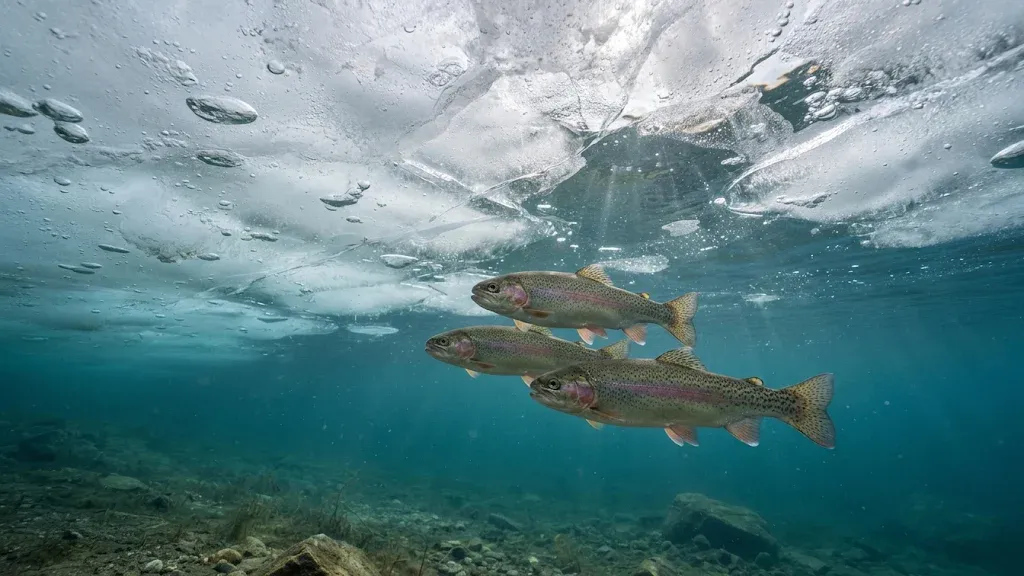
Mostly in the first 15 feet below the ice, and very often in the first five. Utah's Division of Wildlife Resources has told ice anglers for years that trout and salmon can be found anywhere from right under the ice to about 15 feet below it, and that the smart move is to start shallow and lower your bait a few feet at a time until you find them. Idaho Fish and Game's ice fishing tips page says much the same thing in plainer words: trout are cruisers, they can be anywhere in the water column, and they're often caught within a few feet of the ice.
Notice what that doesn't say. It doesn't say "on the bottom." It doesn't say "over the deepest hole in the lake," either.
Water depth and fish depth are two different numbers, and mixing them up is the root of most trout frustration through the ice. A rainbow cruising in 40 feet of water might be swimming at eight feet. A December 2025 DWR report for Hyrum Reservoir put it about as plainly as a fishing report can: fish 5 to 10 feet below the ice, anywhere from 10 to 45 feet of water. The advice keys on distance from the ice, not on the bottom.
Where to drill, then? Points, cove mouths, and flats that drop into a basin. Pick 10 to 30 feet of water near an edge, then forget about the bottom for a while.
Why rainbows ride high instead of hugging bottom
Nobody has run the perfect study that pins down exactly why stocked rainbows suspend shallow under the ice, so be skeptical of anyone who tells you it's settled science. But a few things line up, and they all point the same direction.
Start with oxygen. Under the ice, a lake is sealed off from the air for months, and the oxygen it started the winter with gets used up by decomposition, respiration, and everything living in it. Fisheries managers take this seriously: Idaho Fish and Game biologists sample oxygen through the whole water column at Henrys Lake every week of the ice season, and their 2019-2020 estimate showed levels drifting toward concerning only around mid-February. In ice-covered lakes generally, the lowest-oxygen water tends to sit in the deepest layer, near the sediment, where decay uses it up. Put those together and you have a reasonable explanation for fish avoiding the bottom of a productive reservoir, especially later in the winter. A reasonable explanation, not a proven one. Plenty of trout get caught near bottom in clear, cold, oxygen-rich lakes.
Then there's food and light. Trout are sight feeders, and the brightest water under the ice is the water right under it. Zooplankton, insects, and the small baitfish that eat them use that zone, and predators follow. Minnesota DNR's guide to ice fishing for lake trout notes that lakers chase prey and pin it against the bottom of the lake or, in winter, up against the top of the ice. That's a deep-water fish using the ice ceiling as a wall. Rainbows, which live shallower to begin with, do it constantly.
And trout don't shut down. A 17-month telemetry study of lake-dwelling brook trout in Newfoundland (Cote and colleagues, Environmental Biology of Fishes, 2019) found the fish kept elevated daytime activity all year, through seasonal temperature swings, shifts in depth, and the long ice-induced darkness. That's one species in one small lake, so don't stretch it into a law. But it fits what every trout guide on the ice already knows: these fish stay active all winter, which is exactly why they're "cruisers" and not sitters.
You might also enjoy: Pflueger President vs Shimano Sedona: Which Ultralight Reel to Buy for Trout and Panfish (2026)
Why am I marking trout but not catching them?
Usually one of four reasons, and they're not equally likely. In rough order of how often they cost people fish:
Your bait is below them
A trout will come up a few feet to eat. It's much less eager to swim down ten feet to look at something sitting near the mud. If the marks are at 8 to 12 feet and your spoon is at 25, you're showing the fish nothing. Reel up until your lure sits level with the marks or a foot above them. Above is better than below with trout; they're built to look up.
You're seeing a sliver of the water near the ice
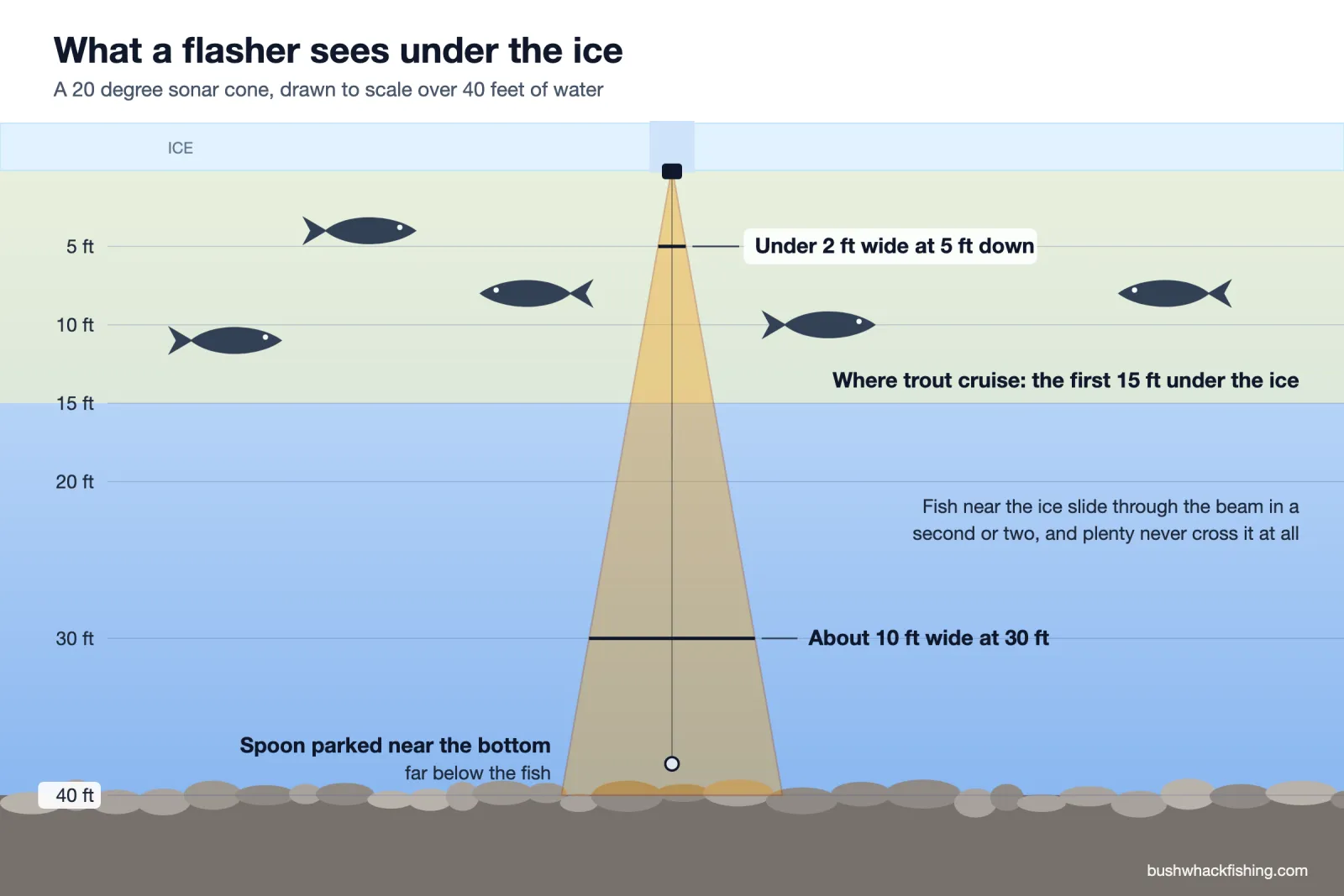
This one surprises people. Sonar spreads in a cone from the transducer, so the circle it covers is tiny near the top. With a typical 20-degree cone, the beam is under two feet wide at five feet down and around ten feet wide at 30 feet. Fish cruising right under the ice slide in and out of that narrow slice in a second or two, and plenty never show up at all. A quiet flasher doesn't mean the top of the water is empty. It might just mean you can't see it.
They're followers, not biters
A mark that rises to your lure, hangs there, and drifts off is a fish that looked and said no. Stocked rainbows do this all day, especially once a hole has been pounded. The spoon-and-dropper section below is mostly about this exact problem.
The fish just passed through
Trout roam. A pod can cruise under you, eat nothing, and be gone in minutes. If fish never stay long enough to work, move holes rather than changing colors for the fifth time.
Fish the top three feet first
When a lake's new to you, start shallow and work down, which is the opposite of how most people start. Drop your lure to about three feet under the ice, jig it there for a few minutes, then lower it a few feet and repeat. Once you get bit, note the depth and stay there. Fish often hold a depth for long stretches of the winter, so the depth you find on a good day is worth writing down.
Fishing that shallow changes a few things. A fish five feet below you hears every boot stomp and auger start. On clear, snow-free ice it can see you too, so kick snow back around the hole and keep your shadow off the opening. Sit still.
For rainbows, a flasher matters less than a notebook. The flasher is great for showing you a fish reacting to your lure. It's lousy at finding fish that sit in the narrow top of its cone. The angler who records "rainbows at 6 to 8 feet, cove mouth, late morning" and drills straight there next weekend will usually beat the angler punching 30 holes and staring at a screen. That's what a fishing log is for, whether it's a notebook or something like Bushwhack, where depth and conditions sit next to every catch.
The spoon-and-dropper trick that turns followers into biters
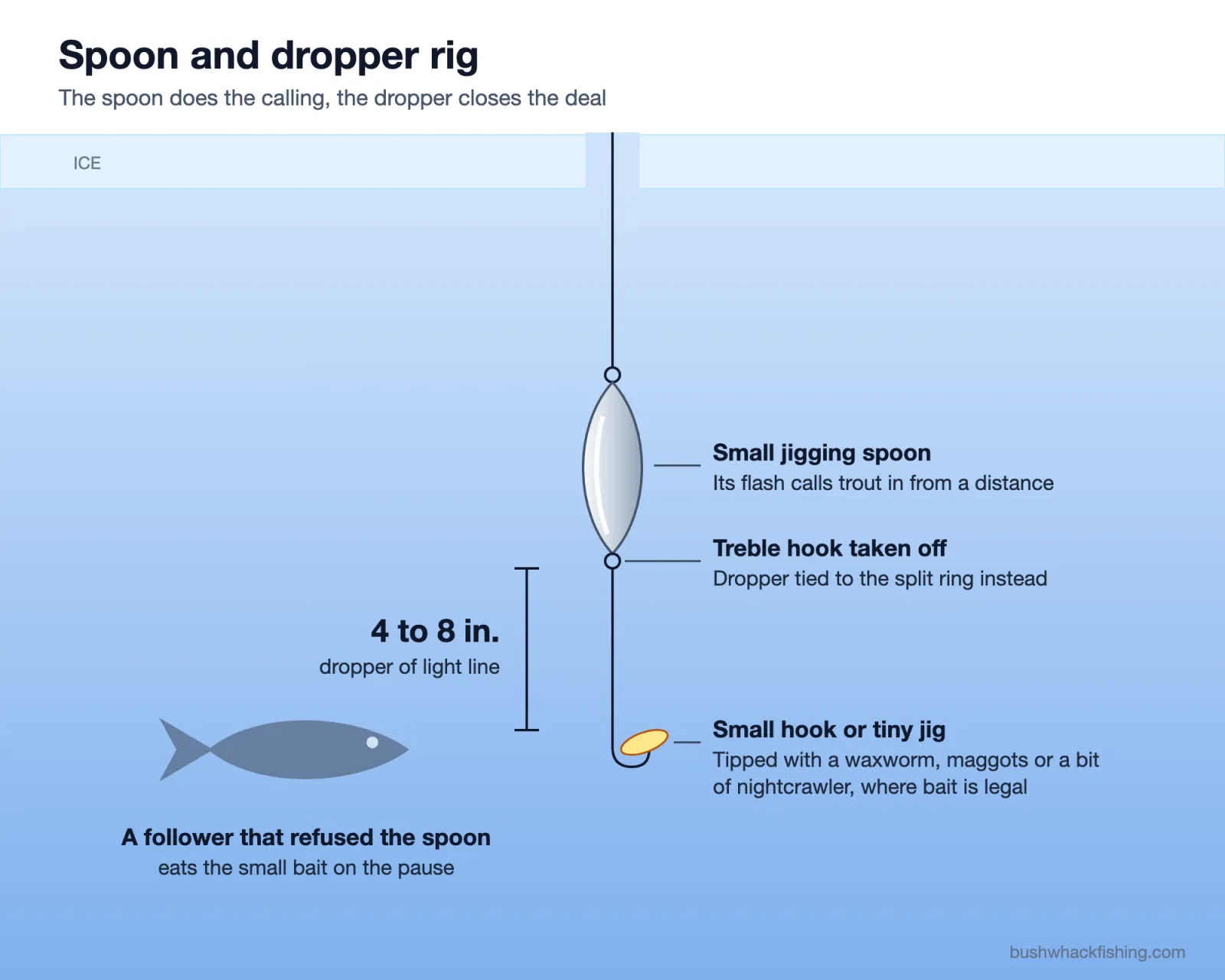
A flashy spoon is the best tool there is for pulling a trout in from a distance. It's often a lousy thing to actually eat. Rainbows will rise to a fluttering spoon, nose it, and leave, because a two-inch slab of metal with a treble hook is a lot of lure for a fish that's been eating zooplankton and bugs. The fix is to let the spoon do the calling and hang something small below it to close the deal.
You might also enjoy: Flaming Gorge Lake Trout Ice Fishing: Jigging Pups on the Channel Edges (and Why Managers Want You to Keep Them)
- Pull the treble hook off a small jigging spoon (a Buck-Shot Rattle Spoon, a Swedish Pimple, or whatever flashy spoon you trust) so the spoon becomes an attractor instead of the business end.
- Tie or clip a dropper of light line, roughly four to eight inches long, to the spoon's split ring. Northland sells a ready-made Bait-Chain Dropper Hook for exactly this, and a Hali-style spoon with a chain dropper does the same job out of the package.
- Put a small hook or tiny jig on the end of the dropper and tip it with a waxworm, a couple of maggots, a bit of nightcrawler, or a scented plastic, whatever's legal where you're fishing. Bait rules for trout water vary by state and sometimes by individual lake, and some waters are artificial-only, so check your regulations before you tip with anything.
- Drop the rig to the depth you've been marking fish, give it a few sharp lifts to flash the spoon, then let it sit still for a long count. Most bites come on the pause, when the dropper is settling or hanging dead.
- When a fish rises and hangs, don't rip it away right away. Hold still, then try a tiny shake that moves the dropper without moving the spoon much. If it still won't eat, lift the whole rig slowly a foot or two. A fish that chases a bait that's leaving often commits.
Minnesota DNR describes laker anglers doing a harder version of this, playing "cat and mouse" by taking the bait away from a stalking fish. Rainbows rarely need it that aggressive. A slow lift is plenty.
Where you're allowed a second line, set a small jig with bait dead still a few feet away at the same depth. The spoon pulls fish in, and some of them eat the deadstick. Line limits differ widely by state, so confirm yours first.
A bigger spoon doesn't help with stocked rainbows nearly as often as people think. If fish are coming in and refusing, going up in size just makes the refusals more dramatic. Go smaller on the dropper and lighter on the line before you go bigger on the spoon.
Slowing down at midwinter
First ice is when trout are easiest. Water's still got its oxygen, the fish haven't seen a hundred spoons, and an aggressive jigging cadence works. By midwinter, after deeper snow has piled up on the ice and darkened the water below, most anglers notice the bite getting pickier. Fewer fish chase. More of them follow and turn away.
That doesn't mean the fish quit eating; the Newfoundland brook trout kept moving through months of darkness. It means your presentation should get quieter. Idaho Fish and Game's basic jigging advice is a good midwinter default anyway: lift the rig about a foot, let it settle, and repeat, rather than ripping it up and down. Lengthen the pauses. Shrink the bait. Lean on the deadstick line more. If you were jigging a spoon hard in December, try a small spoon with a dropper and long still periods in February.
Shallow, weedy, very productive reservoirs under heavy snow are the waters most prone to low oxygen late in the season. If the deep water there is going bad, trout have one more reason to ride high.
What about lake trout and the other trout species?
Lake trout are the exception to a lot of the above. Minnesota DNR says laker anglers usually start in 30 to 40 feet of water and work out as deep as 90 to 100 feet or more. They're fish of the deep basin and the structure next to it. But the same DNR page notes they'll pin baitfish up against the ice, so if you're marking lakers suspended high, don't be shy about reeling a tube or spoon right up toward the ceiling. Bigger, faster lures and a hard hookset fit lakers in a way they don't fit stocked rainbows.
Brook trout in lakes often cruise shallow: the same telemetry study found heavy winter use of the near-shore zone. Splake tend to be fished similarly, closer to shore than rainbows. Cutthroat and tiger trout in Western reservoirs often behave a lot like rainbows: high in the water column, roaming, and suckers for a bit of meat on a small jig, where bait's legal. If you're unsure which you're on, the routine doesn't change much. Start shallow, find the depth, then fine-tune the size and speed.
Fish the depth the trout are at, not the depth the lake is. Everything else is refinement. Trout under the ice aren't mysterious. They're just usually higher than you're fishing.
Going fishing? Write it down.
Bushwhack is a free fishing log that fills in the weather, moon and pressure for you, then shows which spots, flies and conditions actually produce. Blank days included.
Get fishing tips in your inbox
New guides, seasonal tactics, and gear picks, about once a month, no spam.