How to Fly Fish From a Drift Boat: A First-Timer's Guide to Your First Guided Float
 Cameron Spanos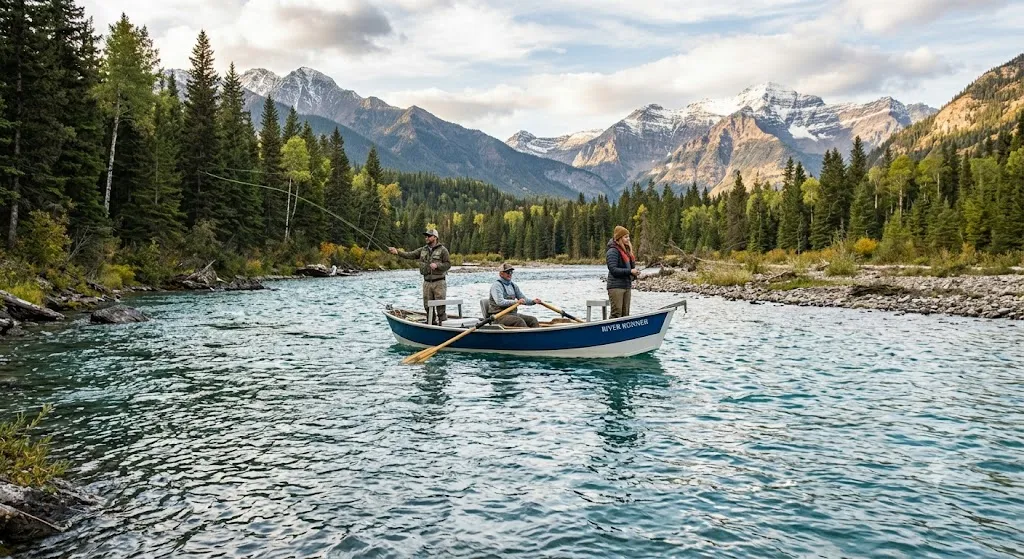
Written by Cameron Spanos
You booked your first guided float for the 2026 season. Probably the Madison out of Ennis, maybe the Yellowstone below Gardiner, or the tailwater Green below Flaming Gorge. You paid $650 to $850 for the day, and now there's a quiet panic in the back of your head: how to fly fish from a drift boat without looking like you've never done it. Good. That panic is the right instinct. The biggest mistake first-timers make is treating a drift boat like a casting platform that happens to move. It isn't. It's a moving platform that happens to allow casting, and the difference matters every minute you're on the water.
Most of the work on a guided float is positional, not technical. Get in the right seat, face downstream, cast at 45 degrees to the bank, mend once, set the hook straight up, and tip your guide 20% in cash at the takeout. Do those five things and you'll outfish most first-timers without improving your casting stroke.
This is the briefing I wish I'd gotten the first time, written for the angler who already knows how to roll cast and tie a clinch knot but has never fished from a McKenzie-style boat with a guide on the oars trying to slow your drift through a soft seam.
How to fly fish from a drift boat: the three-station layout
A drift boat is a flat-bottomed, shallow-draft river boat with raised bow and stern casting positions and knee braces that lock you in while you stand. The guide sits in the middle on the oars and controls speed, angle, and line to the bank. There are three stations: forward (the bow), rear (the stern), and the guide on the oars. The water in front of an imaginary line drawn straight out from the oars belongs to the front angler. The water behind that line belongs to the back angler. You don't cross that line. Ever. You will hook your partner if you do.
Before you go, confirm the water is open under the current Montana fishing regulations, since float fishing is restricted on some stretches, and review the state boating safety rules so a life jacket is aboard for everyone.
Most guided floats on the Madison, Yellowstone, or Green run eight hours, push off around 8:00 AM, and cover six to fourteen river miles depending on flow. Madison River Outfitters and most Ennis shops include lunch, beverages, flies, and shuttle. You bring a license, polarized sunglasses, sunscreen, layers, and cash for the tip.
Which seat should you take, the front or the back?
Most first-timers assume the front seat is the prize. It is, sort of. The front angler gets first look at every piece of water, gets first shot at every rising fish, and gets to fish out ahead of the boat without anyone else's line in the way. On most days the front angler outfishes the back two to one.
But the back angler has the harder job. You see your partner's casts, the boat, the oars, and you have to time your shot to avoid all of it while the boat keeps moving. A back-seat angler who lands fish has actually fished. A front-seat angler who lands fish just had the lane.
The unspoken etiquette: you switch at lunch or a wade stop, never while the boat is moving. If you launched in the front, finish the morning there and trade for the afternoon. If your guide doesn't suggest a swap by 1 PM, ask. The angler who clings to the bow all day looks greedy, and your guide remembers it.
How should you cast from a drift boat?
Forget everything you learned about casting upstream from the bank. In a drift boat, you cast downstream and out toward the bank at roughly a 45-degree angle. You should be facing downstream the whole day. As one Orvis pro tip puts it, if you're in the front of the boat, your guide should not see your face until lunch.
The boat is moving downstream at roughly the speed of the current. Cast perpendicular or upstream and your line gets dragged toward the boat faster than your fly can drift naturally. You get two seconds before the fly skitters across the seam. Cast that same fly at a 45-degree angle downstream and you'll get fifteen to twenty seconds of clean drift before you pick up.
The other reason: short casts work. You don't need to bomb 60 feet of line. A 25-to-35-foot cast to a soft pocket along the bank, landing softly with a slight reach in the air, is the bread and butter of float fishing. Long casts are harder to mend and harder to set the hook on. Keep it tight, keep it accurate, and let the boat do the work of covering water.
Keep the rod tip high and your casting plane straight up over your head. Sidearm casts on a drift boat are how you put a streamer in your guide's ear. Don't be that person.
What's the right mend from a moving boat?
Mending from a drift boat is different from wade mending because both you and the fly are moving. The single most useful technique is the reach cast: you make your forward cast, and as the line is unrolling in the air, you reach the rod tip upstream so the line lands already mended. You get an extra five seconds of clean drift before you have to do anything.
You might also enjoy: Middle Provo River Wade Fishing: Access, Parking, and Hatches Mile by Mile
If you didn't reach cast, you'll need to mend on the water. The rule: if the current between the boat and your fly is faster than the current where the fly is drifting, mend upstream. If your fly is in faster water than the line, mend downstream. Most of the time on a Western tailwater, you'll be mending upstream because the boat is in the main current and your fly is closer to a slower bank seam.
One mend per drift. Two if you have to. Anything more than that, you're moving the fly and putting fish down. As Living Water Guides notes, the most efficient mend is the one you make in the air before the line ever touches water.
How do you set the hook in a drift boat?
This is where most first-timers physically hurt their guides. From the bank, you set the hook by sweeping the rod sideways and downstream. In a drift boat, that motion will either smack the guide, snag the oar, or drive the hook straight into the back angler's hat. Don't do it.
The drift boat hook set is straight up. Rod tip goes from horizontal to vertical in one clean motion, like you're saluting the sky. That gets the hook out of the fish's mouth at a good angle and keeps the line and rod tip clear of everyone in the boat.
A note on hook sets in the boat versus from the bank. On the bank, you have all the time in the world to fight a fish across multiple seams. In a boat, you're moving downstream the entire time the fish is on. The fish stays in the same lie, the boat passes it, and now you're playing it behind the boat with a deep belly of line. Your guide will pull over to a soft eddy if the fish is big enough. Trust that.
Also: do not let the fish run under the boat. If a hooked fish dives, lower your rod tip to the water and walk it around the bow or stern. A fish under the hull will saw your tippet on the chines in about three seconds.
What should you wear and bring?
Layers matter more than gear. Western rivers swing 40 degrees in a day. Sunrise on the Madison in early September can be 38 degrees and 2 PM is 78. Pack for both.
The short list:
- A long-sleeve sun hoodie or UPF shirt. Sun on the water cooks you twice (once direct, once reflected) and you cannot reapply sunscreen as often as you think you will.
- Polarized sunglasses. Not optional. You won't see fish without them, and they're also the only thing between your eyeball and a misfired backcast.
- A wide-brim hat or ball cap with a buff. Heat management and a hook deflector in one.
- Layers you can pile on at 7 AM and strip by 11. A puffy, a rain shell, and a fleece will cover any river day from May through October.
- Sunscreen, lip balm, and a water bottle. Most outfitters provide bottled water in the cooler, but bring your own backup.
- Cash for the tip. ATMs at trailheads are rare and often empty. Hit the bank before you leave town.
Skip the chest pack and the sling. The guide has more flies than you need, organized by what's actually working that week. Empty your pockets, take what fits in a Ziploc, and let the guide handle the rigging.
How much should you tip your fly fishing guide?
This is the question every first-timer is too embarrassed to ask, so here's the direct answer for the 2026 season.
Standard range is 15% to 25% of the trip cost, with 20% as the honest baseline for good service. For a $750 full-day float on the Madison, that's $150. For a $850 trip on the Yellowstone with a wade stop and a hot lunch, $170 to $200. If your guide rowed hard through wind, untangled three nest knots without sighing, and put you on fish you wouldn't have caught alone, push it to 25%.
You might also enjoy: Fly Fishing Utah for Beginners: 5 Forgiving Rivers
Cash. Always cash. Guides cannot easily cash a check, and most outfitters don't pass credit card tips through cleanly (and when they do, the processing fees and tax timing get weird). Hit an ATM the night before. Hand it directly to the guide at the takeout when they're putting your rod away, not at the shop in front of the front-desk staff.
"The tip isn't about how many fish came to the net. It's about whether the guide hustled. Did they row into the wind on a tough afternoon? Did they re-rig your nymph without complaint when you broke it off in a tree? That's what you're tipping for."
(Wil Flack, full-time fly fishing guide, Yellow Dog Flyfishing)
One more piece: tip even on a slow day. A blank float on the Madison in late August isn't your guide's fault. It's the river. The work they put in is the same whether the fish ate or not, and stiffing a guide on a tough day is the fastest way to be remembered as that client.
What's the one thing nobody tells you about your first float?
The pace is faster than you think. You have four to six seconds of usable drift per cast before the boat is past the target. That's it. Pick a spot two seconds ahead, cast, mend once, watch the fly, set if it eats, pick up, find the next spot.
If you spend the first hour fishing like you fish from the bank, you'll have nothing to show for it. By hour two you'll start seeing the rhythm. Hour three you'll hook fish. By hour five you'll wonder why anyone wades anymore.
That's the actual learning curve of a guided float. Not the casting. Not the knots. The tempo.
The hot take nobody wants to admit
The Madison and the lower Yellowstone are not the best first-float rivers in the West, despite the marketing photos. They're crowded, they get harder year over year as guide pressure stacks up, and the Yellowstone above Big Timber has been a grind in late summer for the past several seasons. The Green River below Flaming Gorge, especially Section A, is a better first-timer float. The trout are dumber, the water is clearer (you can see what you're doing wrong), and the canyon float is short enough that you'll get multiple wade stops.
If you've already booked the Madison, fish it. Don't cancel. But if you're still picking a river for your first guided float in 2026, the Green is the river. Track your trip in Bushwhack so you can pull up your conditions, fly choices, and what worked when you go back next year and try the Madison.
Final pre-launch checklist
Run through this in the parking lot at the shop before you walk over to the boat.
- License in your pocket, not the car.
- Polarized glasses on your face, backup pair in the boat bag.
- Layers piled on. You'll strip them off by 10.
- Tip cash folded and ready, in a pocket you won't dig through all day.
- Phone in a dry bag, not your jeans.
- Empty bladder. The boat does not have a bathroom.
- One question for your guide: what are we targeting today, dries or nymphs? Listen to the answer and let them drive.
That's the trip. You'll fish hard for eight hours, catch fewer fish than expected and bigger ones than you remembered, and book the same guide for 2027 before you leave the parking lot. Bushwhack lets you log every fish, fly, and spot from your phone in the boat so you can rebuild the day from your dashboard later. That's how you turn one float into a usable map of the river for next time, when you come back with a rod on your own two feet.
Get fishing tips in your inbox
New guides, seasonal tactics, and gear picks — about once a month, no spam.