Summer Muskie in the Cabbage: A Beginner's Guide to June and July
 Hudson Reed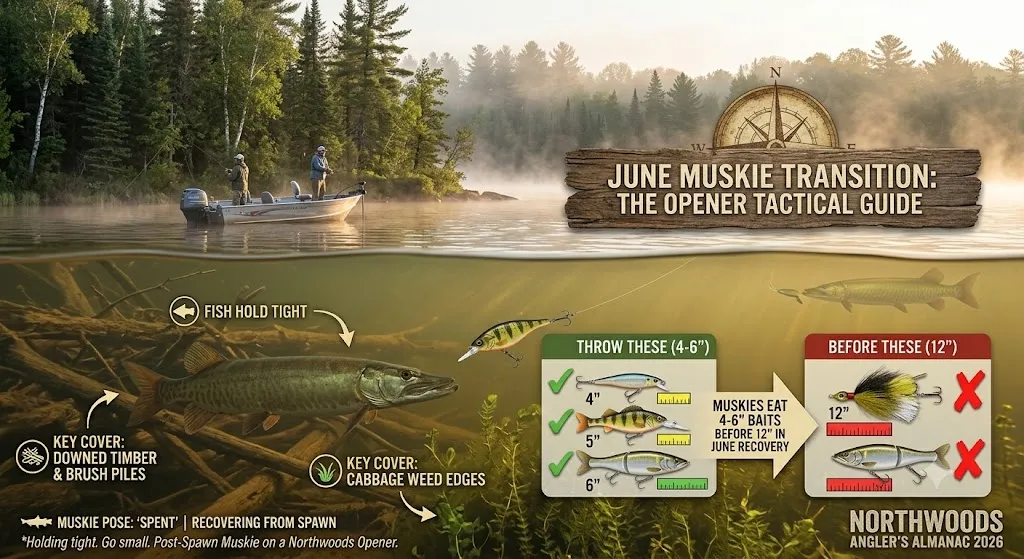
Written by Hudson Reed
Three follows in twenty minutes, all from the same submerged cabbage stalk on the north side of the bar. Not one of them ate. That's what your first real day chasing summer muskie in the cabbage looks like, and if you weren't ready for it, you'd quit and go throw at smallmouth. This guide is so you don't quit.
Muskie are nicknamed the Fish of 10,000 Casts for a reason. Real number's debatable, but the point stands: you're going to throw a lot of water for one strike. June and July, when shallow cabbage weedbeds turn into green walls across the upper Midwest, is the best window a beginner has to compress that count. Fish are predictable. They're shallow. They're in the salad. You just have to fish it right.
Why summer muskie in the cabbage works
Cabbage is the angler nickname for broad-leaf pondweed, native aquatic plants in the Potamogeton family. Per the Minnesota DNR, these grow from rooted stalks in 4 to 15 feet of water with wide, ribbed leaves that stop short of the surface. That structure shades, oxygenates, and concentrates baitfish all at once.
The Wisconsin DNR lists pondweed beds explicitly as preferred muskie habitat, noting that muskellunge are solitary fish that lurk in weed beds or other protective cover. Solitary is the operative word. You're not looking for a school. You're looking for one fish per piece of structure, and the cabbage stalk is the structure.
The best cabbage isn't a flat blanket of weed. It's cabbage adjacent to something else. A green pondweed bed next to a rock hump. A cabbage edge along a saddle between two islands. A finger of weed pointing off a sand point into deeper water. Edge plus edge equals fish.
How to read a cabbage bed
Idle the outside edge with your graph on side-imaging or your eyes on the water. Healthy summer cabbage is bright green, growing in distinct clumps with daylight between leaves. Brown or matted-down cabbage that lies flat is dying and won't hold fish the same way. The cleanest beds are usually on hard bottom: sand, gravel, or rock under the weeds, not mud.
Look for points, fingers, holes, and inside turns within the bed. A muskie sitting in a pocket inside a weed wall is doing what an ambush predator does: hiding, with a view of open water. That pocket is your target. Not the middle of the bed.
Muskie vs pike: don't confuse them
This matters because they live in the same cabbage and a lot of beginners think they're catching one and they're catching the other. Three checks that take five seconds:
- Tail fork. Muskie tails are sharply pointed at the fork tips. Pike tails are rounded.
- Pattern. Muskie show dark vertical bars or spots (or no markings) on a lighter body. Pike show light, bean-shaped spots on a darker green body. Per the Iowa DNR: "muskies have dark spots on a lighter background, while pike have light spots on a darker background."
- Jaw pores. Flip the fish, count the sensory pores on the underside of the lower jaw. Muskie: 6 or more per side. Pike: 5 or fewer.
Why it matters beyond bragging rights: regulations differ. Muskie size limits in Wisconsin and Minnesota are typically 40 inches or larger; pike are often a panfish-tier free-for-all on the same lake. Mis-ID a 38-inch pike as a sub-legal muskie and you've made a problem out of nothing. Mis-ID a 38-inch muskie as a pike and you've kept a fish that was illegal to take. We have a full pike fishing beginners guide if pike is what's actually swimming next to your boat.
The gear list (non-negotiable parts in bold)
Muskie gear is heavier than what most freshwater anglers own. The reason is the fish's mouth: a tarpon-grade row of teeth on a head designed to crush 12-inch baitfish. You can't bring a bass rod into this fight. The minimum starter kit:
- Rod: 8'6" to 9' heavy or extra-heavy casting rod rated for 2- to 8-ounce lures. The length is the figure-8 tool, not just a casting tool. Anything under 8 feet limits your boatside arc.
- Reel: Round-frame baitcaster with a high-capacity spool and a strong drag. Abu Garcia Toro, Shimano Tranx 300/400, or equivalent.
- Line: 80- to 100-pound braid. Not a typo. Muskie leaders abrade braid and abrupt boatside hooksets snap anything thinner.
- Leader: 12-inch fluorocarbon (130-pound) or single-strand wire. Fluoro for clear-water finesse, wire for topwaters and shallow weed work. Never fish muskie without a leader. A 50-inch fish bites through 100-pound braid like sewing thread.
- Net: Beckman or Frabill muskie net, coated bag, 80-plus-inch hoop. A bass net will hurt the fish and tangle the lure.
- Release tools: 10-inch long-nose pliers, jaw spreader, and hook cutters that can sever 7/0 trebles. If you don't own hook cutters, do not go muskie fishing. A bad hookset that pins a treble through a gill plate is the moment you either cut the hook or kill the fish.
That's roughly $700 to $1,200 to get on the water competently. Buying down on this stuff means a dead fish or a snapped rod, and either ending costs more than the upgrade would have.
You might also enjoy: Middle Provo River Wade Fishing: Access, Parking, and Hatches Mile by Mile
Lures: keep it simple your first season
Walk into any northwoods bait shop and you'll see a wall of muskie lures floor to ceiling. Ignore 90 percent of it your first year. You need three categories.
Bucktails. The summer cabbage workhorse. A Mepps Musky Killer, a Musky Mayhem Double Cowgirl, or a Bucher Buchertail in #8 or #10 covers most situations. Burn them just over the top of the cabbage with the rod tip high. Speed is your friend in July. The lure has to outrun the fish's brain.
Topwaters. Low light, warm water, calm surface. A Top Raider, a Pacemaker, or any large prop bait fished in a steady walk-the-dog cadence. The strike is the loudest thing you've ever seen in fresh water. Wait a half-second after the explosion before setting; a muskie often hits to stun before eating, and a premature hookset pulls the bait out of the fish's mouth.
Glide baits and jerkbaits. For when the fish are following but not committing. A Phantom Softail, a Hellhound, or a Suick on a hard rip-pause cadence. Slower than a bucktail. Heavier hits.
That's three lures. Buy one of each in a perch pattern, a black/orange pattern, and a white pattern. Done. Most of the wall is replication, not innovation.
Which lure when?
Bucktails when the wind blows and the water has chop. Topwaters at sunrise, sunset, and on dead-calm overcast afternoons. Glides when you've seen fish follow but won't commit, usually mid-day with bright sun. If a bed is producing follows but no eats, switch lures every few passes. Pressured cabbage fish quit on a single profile fast.
The figure-8: not optional, ever
Here's the contrarian take a lot of bass crossover guys won't accept: the figure-8 is the most important muskie technique that exists. More important than lure choice. More important than spot selection. A meaningful percentage of summer muskie eat at the boat, not on the cast, because they shadow a lure all the way in before committing. If you stop your retrieve at the rod tip and reel up, you just dropped a feeding fish.
Joe Bucher, the guy who arguably invented the modern technique, writes on Musky360: "Use every bit of the rod length to create a LARGE figure 8 with wide ROUND turns." Wide and round, not small and twitchy.
How do you do a figure-8 as a beginner?
- Reel until your leader is at or just inside the rod tip. Not the bait. The leader.
- Plunge the rod tip about 18 inches into the water in one smooth motion. Do not pause.
- Trace a wide figure-eight pattern at least three feet across each lobe. Use the whole rod. Both arms straight, walking the bait around the boat corner.
- Speed up into the turns and pull deeper. Slow slightly down the straightaways and lift shallower so a following fish can see the bait change attitude.
- Do at least two full eights on every single cast. Every cast. The one you skip is the one a 50-incher was tracking.
When a fish does eat in the eight, it'll be inside two feet of the boat. Do not pull the rod up. Set hard sideways, in the direction opposite the fish's head, and keep the rod tip in the water. Pulling up jerks the bait out of the strike zone and tells the fish where the boat is.
What's the best time of day for summer muskie?
Wisconsin DNR puts it plainly: "Anglers usually have the best luck fishing during the daytime." That cuts against the night-bite mythology you'll read on forums. Daytime works in June and July for one reason: the cabbage is the structure, and a muskie in the cabbage is hunting visually.
That said, the bookend hours (the hour after sunrise and the hour before sunset) are the topwater windows. A calm July evening at 8:45 p.m. with a Top Raider walking over the cabbage edge is the closest a muskie angler comes to a sure thing. The middle of the day is when you grind bucktails and glides on the deeper edges. Don't skip the middle of the day. A bright sun pins muskie tight to weed cover where you actually want them.
You might also enjoy: Fly Fishing Utah for Beginners: 5 Forgiving Rivers
Release: this is the part most beginners get wrong
A summer muskie out of warm water is fragile. Water temps in the upper 70s and 80s, which is normal for July on a Wisconsin lake, push muskie metabolism into a stress zone where a long fight and a long photo session kills the fish, even when she swims off looking strong. Delayed mortality is real.
The rules I'd give a first-timer:
- Fight the fish as fast as your gear allows. You're not playing it out. You're stopping the head and moving it.
- Fish stays in the net, in the water, while you get pliers and a camera ready. Net first, photo later.
- Unhook with the fish in the net hanging in the water boatside. Big inline single hooks make this easier than trebles, and a lot of summer anglers are quietly swapping trebles to singles for this reason.
- If you photograph, support the fish horizontally with two hands, one under the chin (not in the gills), one under the belly. Hold it parallel to the water. Twenty seconds out of water max. Count out loud.
- Release boatside, head into the current or wind, and let her kick out of your hand. Do not toss.
If the water at the surface is over 80 degrees, a lot of conscientious anglers stop targeting muskie until the next cool front. That's a judgment call you'll make for yourself eventually. The number to remember is 80.
Where to go: Midwest beginner waters
You don't need to fly to Lac Seul. Plenty of accessible Midwest water holds summer cabbage muskie.
- Minnesota: Mille Lacs, Leech, and the Cass County chain hold trophy-class fish in summer cabbage. Mille Lacs has both pike and muskie, so the ID check above will come up.
- Wisconsin: The Eagle River and Boulder Junction chains, the Chippewa Flowage, and the Hayward-area waters. Wisconsin has more designated muskie water than any other state.
- Michigan: Lake St. Clair is the highest-density muskie fishery in the world. Cabbage is everywhere in the shallows.
- Ontario border: Lake of the Woods, Eagle Lake, and Lac Seul are the trophy factories.
Wherever you launch, log the trip. You're going to fish 30 trips before you have a pattern, and your memory will lie to you about which weedbed produced. Try Bushwhack to track the cabbage bed, the lure, the water temp, and the moon phase on every outing. After a season you'll have a heatmap of your own water that's worth more than any guide's intel.
What about the moon and the solunar stuff?
Muskie anglers obsess about solunar tables. There's something to it, especially around the July full moon when major feeding windows tend to land in the middle of the night. For a beginner, the bigger lever is being on productive cabbage in good daytime light. Worry about the moon once your figure-8 is dialed.
If you're already chasing Midwest summer night water for trout, see the Hex hatch guide. Just don't do both on the same trip. Pick a lane.
The realistic first-season expectation
Honest math: as a beginner doing it right, on decent water, expect one figure-8 follow per outing and one boatside strike every three or four outings. A fish in the net every six to eight trips your first summer is solid. A fish over 45 inches your first season is a stroke of luck. The 10,000-casts number isn't literal, but the spirit is.
The flip side: when a 48-inch summer fish detonates a topwater over a Wisconsin cabbage bed at 9 p.m., nothing in fresh water compares. Not bass. Not walleye. The wait is the point.
Pick a cabbage bed, throw a bucktail across it, and finish the cast right.
Get fishing tips in your inbox
New guides, seasonal tactics, and gear picks — about once a month, no spam.