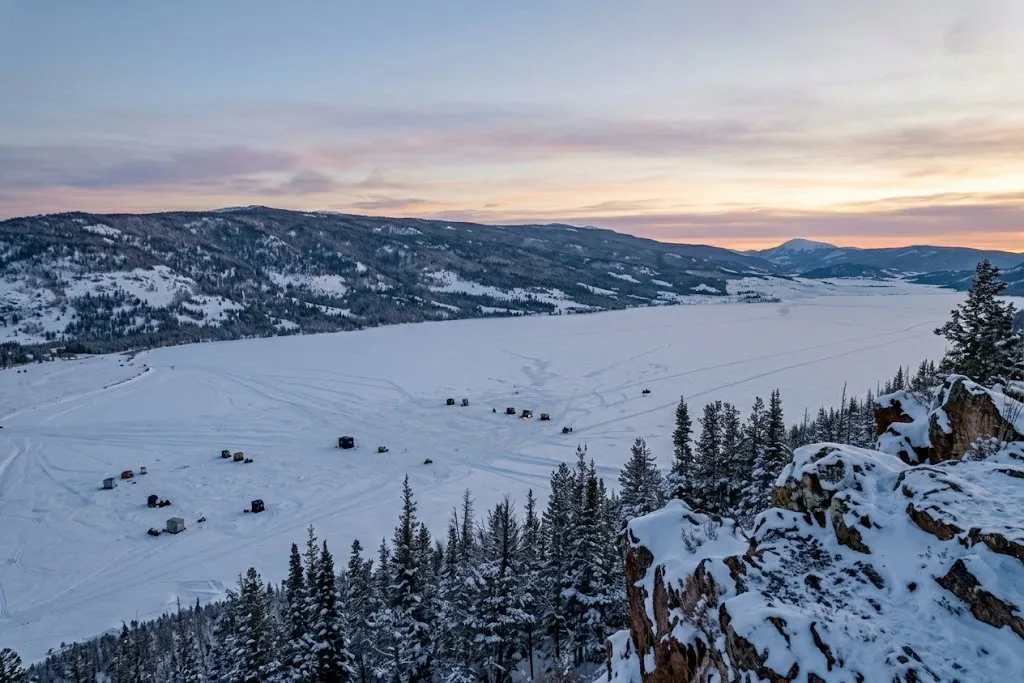
Scofield Reservoir Ice Fishing: Dawn Tigers, Chub Meat, and the Slot That Sends Most Fish Back
 Cameron Spanos
Written by Cameron Spanos
The Utah DWR's spring 2024 gillnet survey at Scofield reported tiger trout in the 17 to 21 inch range. Under Scofield's rules, a tiger that size has to go back down the hole. That one number shapes Scofield Reservoir ice fishing more than any jig color does: the tigers cruising the shoreline before daylight are mostly fish you'll be releasing, and the trick is finding the few that have eaten their way past 22 inches.
This is the hard-water half of our Scofield Reservoir fishing guide, the open-water post that covers the tiger trout program and the chub cycle in detail. Here it's all ice: where the fish sit at dawn and at noon, why a strip of dead chub outfishes everything in the tackle store, and exactly how the four-trout limit plays out when you're sorting fish on a frozen reservoir at 7,600 feet.
Where are the big fish this winter?
Find the chubs and you've found the tigers. The DWR's own March 2026 Scofield report says it plainly: Utah chub are the most abundant prey in the reservoir, so follow them to find the bigger fish.
The science behind that is better than most fishing advice gets. A USGS and Utah State University study of Scofield's food web (Winters and Budy, 2015) found large cutthroat were eating 50 to 100 percent Utah chub and tiger trout 45 to 80 percent. Both species switch over to eating fish at roughly 350 millimeters, call it 14 inches, and both can swallow prey up to half their own length. The same study found the big cutthroat and tigers living closer to shore, while rainbows hung out in open water eating bugs. So the reservoir sorts itself. Shoreline and structure for predators, the middle of the lake for stockers.
Now the cycle part. Cutthroat and tigers have done real damage to young chub over the years, but adult chubs get too big for most trout to eat, they live a long time, and they keep spawning. So the chub population never goes away. It swings. When it's high, the predators that are big enough to exploit it grow fast and get fat, and the fishing turns into a trophy hunt with lots of releasing in between.
My read on this winter, and I'll own it as an opinion rather than a survey result: the cohort of tigers that was 17 to 21 inches in spring 2024 has had two more growing seasons on a chub buffet. Fish switched onto chub grow fast. Some of that year class should be pushing past 22 inches through the ice this season, which is exactly the size you're allowed to keep one of. The cutthroat picture is different. The same 2024 nets averaged 15.5 inches on cutthroat, with fish from 11 to 20 inches, which puts the typical Scofield cutt right at the bottom edge of the protected slot. Expect to release a lot of cutthroat.
Tigers before daylight: fishing the shallow shoreline
The best tiger trout fishing at Scofield happens in the dark and in water that looks too skinny to bother with. The DWR's reports keep saying the same two things: early morning is the best time for tigers, and tigers cruise the shallow shoreline hunting chub.
Translate that to the ice and it means you should be drilled and set up before first light, close to the bank, over rocky points and old weed beds rather than out in the open-water flats where the crowd parks. A Big Fish Tackle forum regular reported a December day of multiple fish in about 9 feet of water. KSL Outdoors' trip with a DWR biologist found fish holding just two to three feet under the ice. Shallow is the pattern, not the exception.
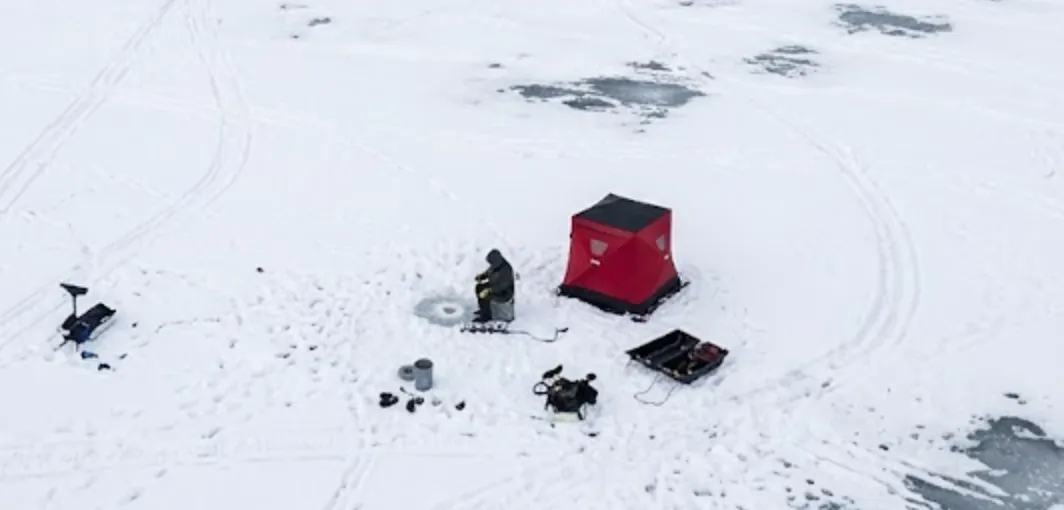
Fish it like a hunter. Set one rod as a dead-stick with a big chunk of chub a foot or two off the bottom, and work the other with a jigging spoon. Utah lets any licensed angler run two poles, so use both. The DWR suggests silver/white or black/white spoons, and that's a solid starting point, though in low light I'd lean on a glow finish and charge it often. Tigers like to follow and then eat on the pause, so when a mark rises on the flasher, slow down instead of speeding up.
Once the sun gets high, the shoreline tiger bite usually tapers. That's your cue to move.
Cutthroat over the chub schools
Midday belongs to the cutthroat, and they tend to stay low. The DWR's advice for Scofield trout through the ice is to keep the jig near the bottom, because that's where most fish hold, and to fish cutthroat with much the same tactics as tigers: tube jigs tipped with chub meat and jigging spoons.
This is where a flasher earns its spot on the sled. Chub schools show up as clouds of marks, and the cutthroat sit under and around them. If you're marking chubs and not getting bit, don't leave. Drop to the bottom edge of the school, tip the tube with fresh meat, and give it time. A flasher also tells you when you've been sitting on empty water for an hour, which is the more common problem.
You might also enjoy: Pflueger President vs Shimano Sedona: Which Ultralight Reel to Buy for Trout and Panfish (2026)
White is the color that keeps coming up. Calvin Black, then the DWR's Southeast Region assistant aquatics manager, put it this way in a KSL Outdoors piece from Scofield:
"Anything in a white color, tube jig, spoons, that seems to be the key and chub meat."
Calvin Black, Southeast Region Assistant Aquatics Manager, Utah DWR (via KSL Outdoors)
That interview is old, from 2014, but the advice has aged fine. The DWR's 2026 reports say essentially the same thing.
Rainbows fill the gaps. The reservoir gets its last rainbow stocking of the year in October, according to the DWR, so early-ice rainbow fishing is usually good. If you've got kids along, rainbows off the bank on worms, PowerBait, or salmon eggs are the easy fish. They're also the only trout here you can keep at any length, which makes them the fish that fills a cooler.
Why dead minnows work (and live ones are illegal)
Dead chub works because it's what these fish already eat. When 45 to 80 percent of a tiger's diet is one species, a strip of that species smells like dinner in a way no wax worm can. The DWR's recipe is specific: cut a strip about one inch by one inch and thread it on a 1/8 or 1/4 ounce jig head. That's a meaningful chunk of bait, bigger than most people put on an ice jig, and that's the point.
The legal side matters because Utah is strict here. The 2026 Utah Fishing Guidebook makes it unlawful to use or possess live baitfish while fishing, anywhere in the state. Dead is a different story. Under Utah Admin. Rule R657-13-12 and the guidebook's bait section, dead mountain sucker, white sucker, Utah sucker, redside shiner, speckled dace, mottled sculpin, fathead minnow (all color variants, including rosy reds), Utah chub, and common carp can all be used anywhere bait is permitted. Scofield's water-specific listing adds no bait restriction, so bait is legal on this reservoir.
A few lines in that same rulebook trip people up at Scofield specifically:
- You can catch a chub, kill it, and cut it up for bait on the spot. You can't carry live fish from Scofield to any other water, and a live chub kept for bait counts as possessing live baitfish, which is illegal statewide. Kill it before it goes in the bucket.
- Chumming is prohibited everywhere in Utah except Lake Powell and Flaming Gorge. Dumping chub bits down the hole to draw fish in is illegal at Scofield, no matter how tempting it is.
- Commercially prepared and chemically treated baitfish are allowed wherever bait is permitted. Plain frozen fish only count if they're a listed species like fatheads or Utah chub, so a bag of frozen smelt doesn't qualify.
My contrarian take: most anglers here bring too much tackle and not enough meat. A tub of wax worms and three colors of tungsten is a rainbow program. If you're after a tiger over 22 inches, catch or buy chub, cut it fresh, and fish the big strip. You'll catch fewer small fish. That's fine.
How does the four-trout limit work at Scofield?
The limit is four trout, combined, with a protected slot on cutthroat and tiger trout. The 2026 Scofield listing from the DWR guidebook, broken into what it means when you're standing over a hole:
- You can keep four trout total per day. Rainbows count toward that four at any size.
- No more than two of the four may be cutthroat or tiger trout under 15 inches.
- No more than one may be a cutthroat or tiger trout over 22 inches.
- Every cutthroat and tiger trout from 15 to 22 inches must be released immediately.
- Trout can't be filleted, and their heads and tails can't be removed in the field or in transit. Bring fish home whole so an officer can measure them.
- Any trout with cutthroat markings counts as a cutthroat. If it has the orange slash, it's a cutt under the rule.
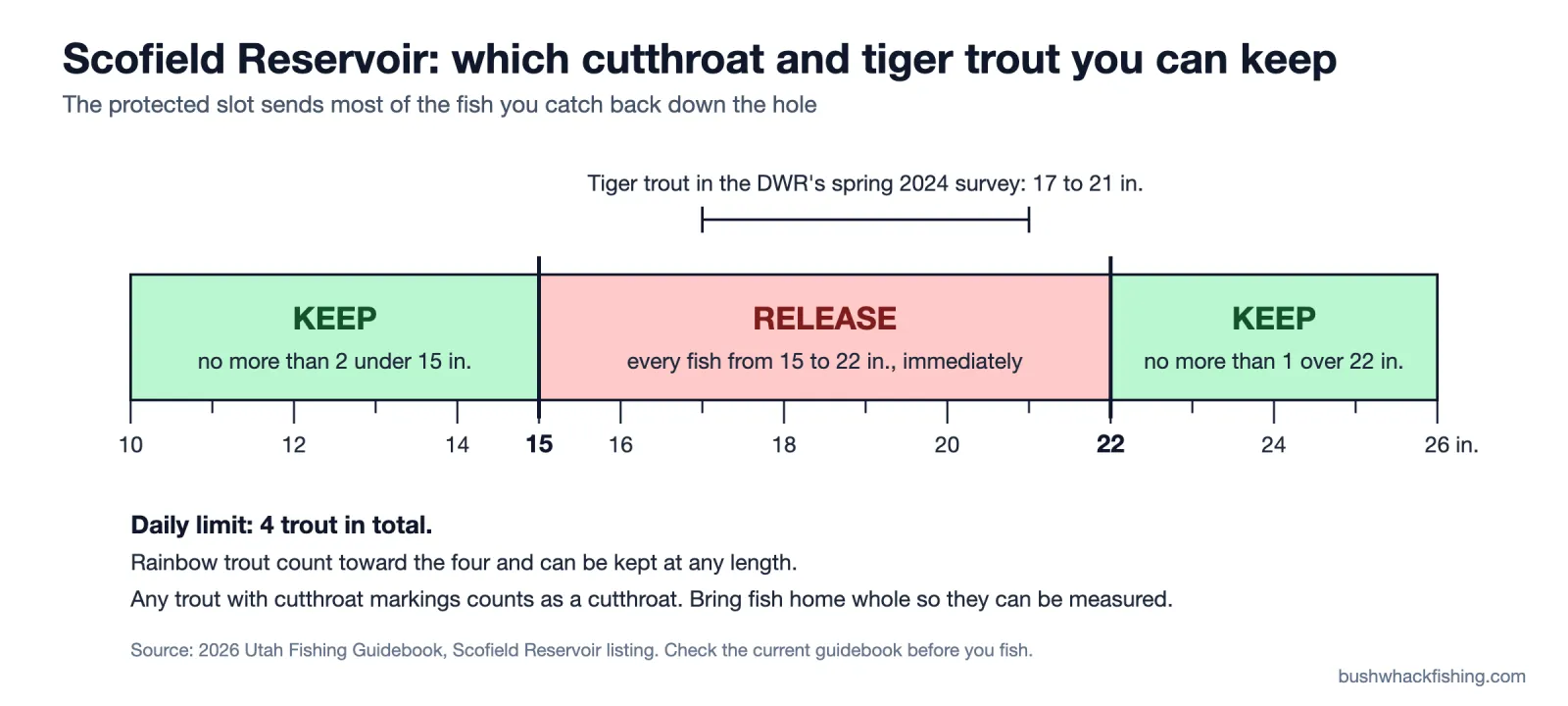
In practice, a full legal bag might be two 13-inch cutthroat plus two rainbows. Or one 24-inch tiger, one small cutthroat, and two rainbows. What you can't do is keep the 18-inch tiger that made your morning, and on a typical Scofield day that's most of the tigers you'll catch.
Two statewide rules ride along. You can fish two poles with a valid Utah license, but you only get one daily limit. And you have to stay within sight of your equipment, no more than 100 feet away, so the dead-stick rod can't sit unattended while you wander off to visit.
You might also enjoy: Flaming Gorge Lake Trout Ice Fishing: Jigging Pups on the Channel Edges (and Why Managers Want You to Keep Them)
The 12-inch hole problem
Utah caps ice holes at 12 inches across on every water except Bear Lake, Flaming Gorge, and Fish Lake. Scofield isn't on that list. Plenty of hand augers are 6 or 8 inches, and a tiger over 22 inches with a chub-fed belly can jam in a small hole. If you're targeting big fish, run a 10-inch auger as a minimum, and have a buddy ready to grab the fish's head while you guide it up. Don't drill a second hole beside the first to make a bigger opening, since that just turns one legal hole into an illegal one.
Releasing slot fish in single-digit air is its own skill. Unhook them in or right at the hole, keep them off the snow, and get them back down fast. Cold air freezes gills and eyes in a hurry.
Ice timing, access, and the spots to avoid
According to the DWR, ice typically forms on Scofield around the end of November and comes off in late March or April. First-ice dates vary by a couple of weeks from year to year, and early ice is uneven on a reservoir this size. Drill test holes as you walk out, and don't trust another group's tracks. In January 2026, Scofield State Park warned that a section of ice near the Mountain View boat dock was unsafe, a good reminder that ice near docks, inlets, and springs stays thin when the rest of the lake is solid.
Most ice anglers access the reservoir from the two state park units, Madsen Bay and Mountain View, or from angler pull-offs along SR-96 on the southwest shore. Check the park's current conditions before you drive up Price Canyon, because a weekend storm can change access overnight.
One rule that catches winter visitors: Scofield's tributaries, including Gooseberry Creek, close on January 1 and stay closed until 6 a.m. on the second Saturday of July to protect spawning cutthroat. The reservoir stays open. The creeks don't, so leave the inlet water alone.
Gear for Scofield Reservoir ice fishing
You don't need much, but the pieces you bring should be chosen for big trout, not perch.
A medium-light ice rod around 28 to 32 inches handles both jigging spoons and a 20-inch tiger. Spool with 4 to 6 pound fluorocarbon or a braid mainline with a fluoro leader; ice-friendly line matters when it's below zero at dawn. A flasher is the single most useful piece of electronics out there, because it shows chub schools and cutthroat under them. Bring a portable shelter with a heater for the pre-dawn session, since you'll be sitting in the dark and the wind on that open reservoir is brutal. And a tape or bump board is required equipment in my book, because the slot means you're going to measure a lot of fish.
If you're still building out a hard-water kit, our first ice timeline for Utah reservoirs covers when Scofield and its neighbors usually lock up, and the Strawberry Reservoir ice fishing guide is the closest comparison, another chub-control water with a slot.
Keep a record of what the tigers do
Scofield rewards the angler who remembers. Which point the tigers cruised at dawn, what depth the cutts held at by noon, which week the ice got good. A season of notes turns a reservoir that feels random into one with a pattern, and the chub cycle means the pattern shifts from winter to winter. If you want a place to keep that, try Bushwhack and log each trip with the depth, bait, and time of the bite. After a couple of winters you'll know the shallow-water window on Scofield better than anyone fishing from memory.
And measure that tiger before you get excited. It's probably 19 inches.
Going fishing? Write it down.
Bushwhack is a free fishing log that fills in the weather, moon and pressure for you, then shows which spots, flies and conditions actually produce. Blank days included.
Get fishing tips in your inbox
New guides, seasonal tactics, and gear picks, about once a month, no spam.