Mahi Mahi for Beginners: Your First June Charter
 Hudson Reed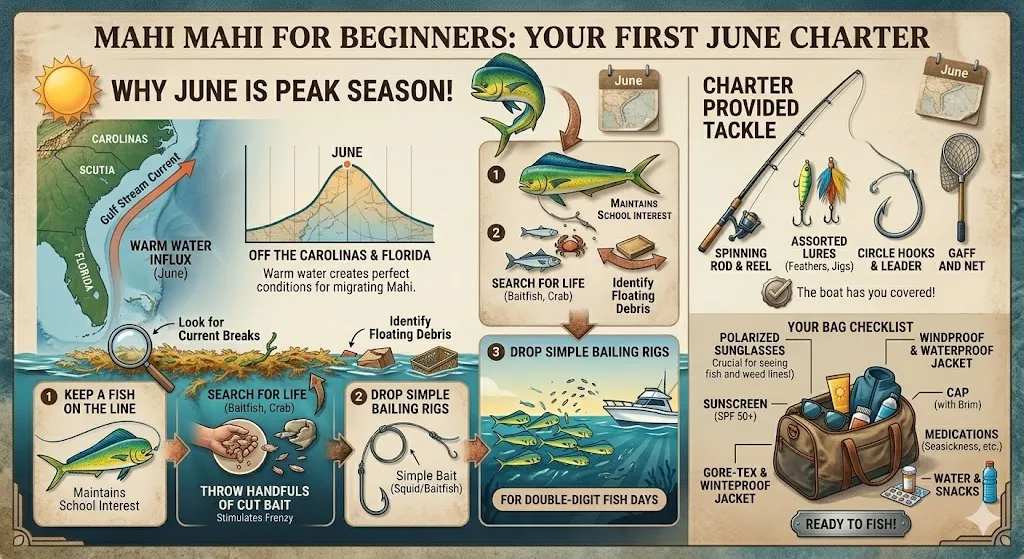
Written by Hudson Reed
The first mahi you see in the water doesn't look like a fish. It looks like a piece of broken neon sign drifting under a sargassum mat. Electric green-blue back, gold flanks, dark spots that flash when it turns. Then it turns again and there are four more behind it. That's the moment you understand why mahi mahi for beginners is the right call for a first offshore trip, and why people book the same June charter every year.
The species cooperates. They eat almost everything. They school. They follow hooked fish to the boat. And in June, off the Carolinas, Florida, and the Gulf, the Gulf Stream pushes warm blue water close enough to shore that you can be back at the dock in time for an early dinner. If your first offshore trip is going to produce, June is the month and mahi is the fish.
Why June is the peak month
Mahi are temperature animals. NOAA-funded tagging research shows they spend roughly 95% of their time in surface water between 77 and 84 degrees, and they actively prefer the 80–82 band when they're migrating north. That migration is driven by the Gulf Stream, which in May and June pushes its warmest, clearest water close enough to the U.S. coast that boats out of Hatteras, Oregon Inlet, Charleston, Jupiter, and the Keys can reach it on a half-day run.
Off the North Carolina coast specifically, the Stream runs 20 to 40 miles offshore depending on the season. By early June it's holding 74–78 degree water with the color break (blue water against the green inshore water) sitting close enough that a 6 a.m. departure puts you in fish by 9. The first schoolie mahi push through in May. By mid-June the bulls follow.
Mature mahi spawn under floating sargassum every two to three days during the season, releasing 33,000 to 66,000 eggs at a time, according to NOAA Fisheries. That biology is the entire reason the weed line strategy works. The fish aren't randomly distributed across the open ocean. They're stacked under shade and structure, eating bait that's also stacked under shade and structure.
What is a weed line and how do you read one?
A weed line is a long ribbon of floating sargassum (that orange-brown algae) that gets pushed into a current seam and concentrates for miles. NOAA designates sargassum as Essential Fish Habitat for mahi specifically, which is the agency's way of saying "this stuff is non-negotiable for the species."
You're looking for three things from the helm:
- A defined edge. Scattered patches hold bait but mahi tend to stage where the weed forms a clean line against open water. That's where the current seam is.
- Color change. The blue side of a weed line will fish better than the green side most days. You want the deep, glassy blue water at 74 degrees and up.
- Anything floating that isn't weed. A pallet. A milk jug. A dead palm frond. A buoy line. Mahi will sit under a coconut for days. Charter captains call these "high-fliers" and they're worth a 20-minute detour.
Birds are the other tell. Frigatebirds working a patch mean there's bait pinned to the surface, which means something below is doing the pinning. If your captain cuts the engines and you hear him say "frigates," stop talking and watch the water.
What about clean blue water with no weed?
Sometimes a current shift wipes the weed lines out and the surface looks like a swimming pool. This is when birds, temperature breaks, and floating debris matter more. The mahi are still there. They're just spread thin and you're hunting individual targets instead of working a continuous edge.
The bailing technique, explained
Bailing is the technique your charter will use the second a school sets up behind the boat. Here's how it actually plays out.
You troll into a weed line. A fish hits a ballyhoo on a flat line. The captain throttles down but doesn't pull the hooked fish aboard yet. Instead, the mate dumps a handful of cut bait (sardines, bonito, ballyhoo plugs) over the side. The hooked fish circles the boat. Other mahi follow it. Then the chunks hit the water and the school sets up.
Now everyone grabs a casting rod. Spin or conventional, doesn't matter. Each rod has a 1/0 to 5/0 circle hook, a 50-pound fluorocarbon leader, and a chunk of cut bait. You toss the chunk into the chum, let it sink with the rest, and a mahi inhales it within ten seconds.
You might also enjoy: Middle Provo River Wade Fishing: Access, Parking, and Hatches Mile by Mile
The trick, the entire reason it works, is to always keep one fish in the water. If every rod gets cleared at once, the school evaporates. So the mate will tell you to slow-play your fish, leave it boatside, and keep dropping chunks every minute or two while the rest of the crew picks off the rest of the school.
Done well, a single bailing session produces 8–15 fish in 20 minutes. Done poorly (too much noise, too few chunks, every fish boated at once), the school is gone in three.
Sight-casting basics
Sometimes you'll spot a fish before the captain trolls past one. A mahi cruising a weed edge looks like a fluorescent shadow under the surface. Sometimes you'll see the fin first.
The cast is simple. Underhand pitch, six to eight feet ahead of the fish, let the bait drop. Don't slap it on the fish's head. Don't try a 60-foot cast across the boat. You want the bait to fall naturally into the fish's path. If the fish ignores it, reel it in slow with a couple of twitches and re-pitch. They almost always eat on the drop.
Mahi mahi for beginners: what tackle to ask about
The charter provides everything. That's the entire point of a charter. But you should know what's being handed to you so you can ask intelligent questions and not look completely lost when the mate says "grab the 7-foot heavy."
For most beginner-friendly mahi setups, expect a 7-foot heavy-action spinning rod matched to a 5000–8000 size reel, loaded with 30–50 pound braid and a 50–80 pound fluorocarbon leader. That setup handles 5-pound schoolies and the occasional 30-pound bull without changing rods.
Hook size depends on what you're throwing. Cut chunks ride best on a 1/0 to 5/0 circle. Live pilchards or pinfish go on a 5/0 to 7/0 J-hook. Trolling rigs use 7/0 to 9/0 ballyhoo rigs the mate will build before you ever leave the dock.
One opinion the charter brochures won't print: if you're shopping for your own setup later, don't buy a dedicated mahi rod. A 7-foot heavy inshore rod for snook, redfish, or striped bass will handle 90% of recreational mahi situations. The rod you'd use for stripers on the Outer Banks is the same rod you'd use bailing mahi 30 miles further offshore. Save the money.
What does the charter provide vs. what do you bring?
This is the question that derails more first-time charters than any other. People show up with seven rods or with nothing. Both are wrong.
The charter provides: all rods, reels, terminal tackle, leaders, hooks, lures, bait, ice, a cooler, a fish-cleaning service back at the dock (most boats), a head/bathroom, and a captain plus mate who will tell you what to do at every step. You do not need to bring fishing gear.
You bring:
You might also enjoy: Fly Fishing Utah for Beginners: 5 Forgiving Rivers
- Polarized sunglasses. Non-negotiable. You cannot read a weed line through reflection.
- A long-sleeve sun shirt and a buff. The June Gulf Stream at 9 a.m. is 80 degrees and 100% humidity. By noon the deck is brutal.
- Reef-safe sunscreen plus a wide-brim hat. Reapply every two hours.
- Closed-toe non-marking shoes. No flip-flops. The deck gets bloody.
- Dramamine or a Scopolamine patch behind the ear, taken the night before. If you're asking yourself "do I need this," you need it.
- Water. Two liters per person, minimum. The boat may have a cooler but don't bet your trip on it.
- Snacks that won't melt. Jerky, pretzels, granola bars. Skip anything chocolate.
- Cash for the mate tip. Standard is 15–20% of the charter price, given to the mate (not the captain), in cash, at the end of the trip.
- A cooler bag if you want to take fillets home and your charter doesn't include a take-home option.
- Your phone in a dry bag.
What you do not bring: alcohol (most charters allow it but save it for after; mixing booze with sun, swell, and circle hooks ends badly), your own rods, your own lures, or any expectation that you'll catch a fish on the first hour. The morning run to the Stream burns 90 minutes before you ever drop a bait.
What if you get seasick?
Two things. First, take the meds before symptoms start. Once you're nauseous on the water, oral meds don't absorb well. The Scopolamine patch goes on 8–12 hours before the trip. Second, if you do get sick, stay on deck and watch the horizon. Going below decks turns mild queasiness into a full surrender. Most captains have ginger candy and crackers stashed; ask.
The fight itself
A mahi hooks differently than any inshore species you've fought. They're surface fish, so the first thing they do is jump (sometimes four or five times) and tail-walk across the surface. The blue-green-gold color flashing in the air is the picture you'll remember.
Don't horse them. The hook is a circle and it'll come loose with too much pressure during head shakes. Rod tip up, steady pressure, gain line when they let you, and let them run on the drag when they want to run. A 10-pound schoolie fights for two minutes. A 30-pound bull might take ten.
And when you bring it to the boat: do not yank it over the gunnel until the mate has a gaff or net ready. A green mahi loose on the deck is the most chaotic thing on a fishing boat. They go everywhere. They bleed everywhere. They bite. Let the mate handle the boatside work.
Logging your first mahi
This is the part most charter guests skip and then regret a year later. The fish are beautiful, the day is long, and you took 200 photos that all blur together. A week from now you won't remember whether the bite was at 9:15 or 11:30, whether the water was 76 or 79, or which weed line produced.
That data matters more than people realize. If you go offshore even twice a year, three trips in you can start to see patterns: water temperatures that produced, depths, lunar phases, distance from shore. Try Bushwhack if you want a fishing log that handles offshore conditions and gives you back the patterns later. Take a minute boatside and log the fish before it goes in the cooler. You'll thank yourself.
The realistic expectation
A good June mahi charter off the Carolinas or Florida produces somewhere between 4 and 20 fish on most trips, with the average closer to 8–12. Most will be schoolies in the 4–10 pound range. Bulls (males with the squared-off forehead) and cows (females with the rounded forehead) over 20 pounds show up on maybe one trip in three.
Some days the Stream sets up wrong and you grind for one fish all day. Some days you fill the cooler in 90 minutes and spend the afternoon trolling for sailfish or wahoo. That variance is the trip. If you book a charter expecting a guaranteed haul, the wrong day will ruin you. If you book expecting an offshore experience with a strong chance of mahi, you'll be back next June.
One last thing. Eat the fish that night. Mahi loses flavor fast in the freezer, the fillets are at their best within 48 hours of the gaff, and a fish you caught at 10 a.m. and put on a grill at 7 p.m. is one of the great meals in American fishing. Lemon, salt, olive oil, hot grill. Don't overthink it.
Get fishing tips in your inbox
New guides, seasonal tactics, and gear picks — about once a month, no spam.