Inshore Saltwater Fishing for Beginners: How to Target Redfish, Speckled Trout, and Flounder
 Hudson Reed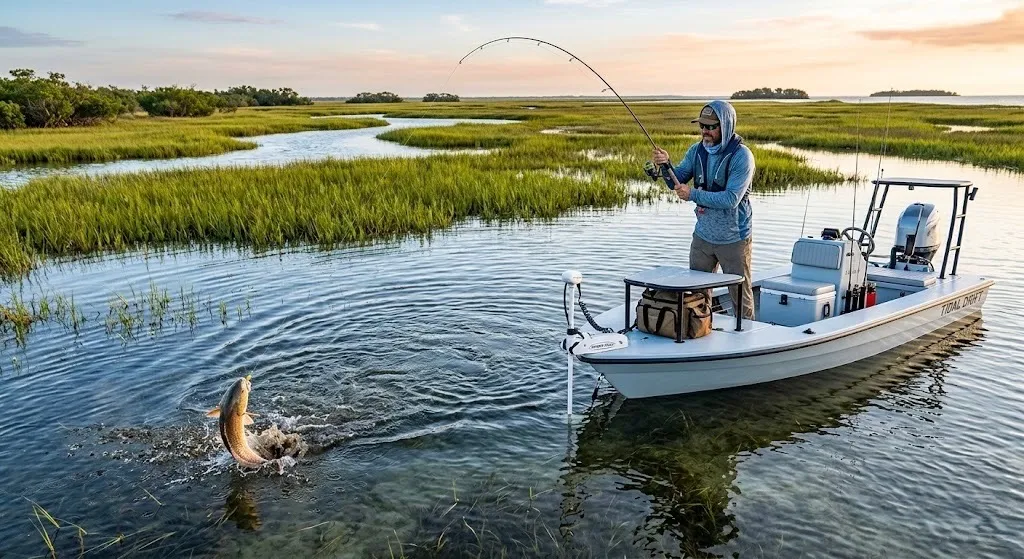
Written by Hudson Reed
If you've spent any time near a tidal estuary, back bay, or salt marsh and watched anglers hauling in chunky redfish or explosive speckled trout, you already know the appeal of inshore saltwater fishing for beginners. The good news: you don't need an offshore boat, a massive tackle budget, or years of experience to get in on the action. What you need is a solid understanding of the three species that define inshore fishing across the Gulf and Atlantic coasts (redfish, speckled trout, and flounder) and the basic skills to put your bait where they live.
I'll tell you honestly: inshore fishing has a lower barrier to entry than almost any other saltwater discipline. You can wade in with a single spinning rod and a small tackle bag and out-fish someone on a $60,000 boat if you know what you're doing. This guide is going to get you there.
What Is Inshore Saltwater Fishing, and Why Should You Start Here?
Inshore fishing means working bays, estuaries, tidal creeks, grass flats, oyster bars, and marsh edges, typically in water from a few inches to about 20 feet deep. You're not running 30 miles offshore. That distinction matters enormously for beginners because inshore environments are accessible from shore, from a kayak, or from a small boat, and the fish are almost always within reach.
Redfish (red drum), speckled trout (spotted seatrout), and flounder are the holy trinity of inshore species across the South. They overlap in habitat, they're catchable on much of the same tackle, and they're all outstanding table fare. According to NOAA, red drum are one of the most recreationally targeted inshore species in the entire Gulf of Mexico, with millions of angler trips logged annually. They're aggressive, forgiving of imperfect presentations, and an ideal beginner target.
The One Rod-and-Reel Setup That Covers All Three Species
Before you start worrying about species-specific tackle, let me give you the one setup I'd hand to every beginner walking onto a flat for the first time: a 7-foot medium-action spinning rod paired with a 2500 to 3500 series reel. Spool it with 10- to 15-pound braided line and add a 20- to 25-pound fluorocarbon leader about 18 to 24 inches long. That's it.
Why braid? Because 10-pound braid has nearly zero stretch, meaning you feel every bump and tick at the end of your line, which is critical for flounder, which are notorious for mouthing baits before fully committing. Braid also casts farther on lighter lures and holds up to the abrasion of oyster bars far better than monofilament.
For lures, start with two categories: a 3- to 4-inch paddle-tail soft plastic on a 1/8- to 1/4-ounce jig head, and a popping cork rig with a 2-foot fluorocarbon leader below it. Those two setups will catch redfish, specks, and flounder in almost any inshore environment. If I had to add a third, I'd toss in a weedless gold spoon, one of the most proven redfish baits ever made.
On rod action: medium is the sweet spot. Medium-heavy will work, but it makes it harder to feel subtle bites. Don't overthink rod brand. A decent $80 to $120 combo will serve you well until you know exactly what style of inshore fishing you love most.
How to Catch Redfish: The Inshore Workhorse
Redfish are the species I'd tell any beginner to target first. They're available nearly year-round across the Gulf and South Atlantic states, they school up (so when you find one, you often find dozens), and they'll absolutely destroy a well-presented lure or live bait. The downside: they can be spooky on shallow flats, and a sloppy presentation will clear a school faster than you can believe.
The key to understanding redfish is knowing they're ambush predators that relate heavily to structure and moving water. Think points at the mouths of creeks, the edges of oyster bars, docks and pilings, and shallow grass flats with current pushing across them. On a rising tide, reds push up onto the grass to root for crabs and shrimp, and this is when you can actually see them tailing, with their coppery bronze backs breaking the surface. Few things in fishing are as exciting as sight-casting to a tailing redfish.
For bait, live or fresh-dead shrimp is probably the easiest starting point. Rig it on a 3/0 to 4/0 circle hook under a popping cork and work it near any visible structure on a moving tide. If you want to go artificial, the aforementioned paddle-tail soft plastic in white, chartreuse, or root beer is consistently productive. A slow, steady retrieve with occasional bottom contact works: think "drag it, hop it, drag it." For sight-casting to tailing reds, accuracy matters more than retrieve speed. Put the lure about 3 feet ahead of the fish and let it sink to the bottom. Then one or two subtle hops is usually all it takes.
You might also enjoy: Spring Striped Bass Migration: A Week-by-Week Location Guide
One important note on redfish regulations: slot limits apply in almost every state. In most Gulf and Atlantic states, the slot runs roughly 18 to 27 inches, though it varies. Check your state's regulations before you go. Undersized fish must be released immediately, and oversized "bull reds" are typically protected because they're spawning fish. Always carry a measuring tape.
Speckled Trout: The Most Forgiving of the Three Species
If redfish teach you patience and stealth, speckled trout teach you the value of noise and presentation variety. Specks are aggressive, they school heavily from spring through fall in shallow water, and they will hit topwater lures in ways that make you want to frame the whole experience on a wall.
The popping cork rig is the single best setup for beginner trout fishing, full stop. Here's the basic setup: clip a popping cork about 18 to 24 inches above a 1/4-ounce jig head rigged with a 3-inch paddle tail or DOA-style artificial shrimp. The cork keeps your lure suspended above the grass, and when you give the rod tip a sharp pop, the cork creates a splash-and-click sound that imitates feeding fish. That noise absolutely triggers speckled trout. Cast it near the edge of a grass flat or over an oyster bed, pop it every 5 to 10 seconds, and hold on.
Early morning and late afternoon, switch to topwater. A walk-the-dog plug like the MirrOlure Top Dog fished over shallow grass at dawn produces some of the most violent strikes in inshore fishing. Cast parallel to the grass edge, work it with a rhythmic rod-tip-down twitch, and resist setting the hook the instant you see the explosion. Wait until you feel the weight of the fish.
Speckled trout are structure-oriented, but differently from redfish. Look for them along grass flat edges, near shell bottom, around channel bends where current pushes baitfish, and on the up-current side of points. Water temperature matters a lot with specks: they love the 60 to 72°F range and go nearly dormant outside of it. In summer, fish early and deep. In spring and fall, work the shallow flats all day.
Flounder: The Ambush Artist That Beginners Overlook
Flounder are the most underrated of the three inshore species. A flounder lies flat on the bottom, camouflaged nearly perfectly, waiting for baitfish to pass overhead. They don't chase prey across a flat. They ambush it at transition zones. Once you understand that, flounder go from mysterious to totally predictable.
The single best flounder spot in any inshore system is the mouth of a tidal creek on an outgoing tide. As water falls, baitfish get swept through these narrow exits. Flounder stack up along the edges, not in the current's center, but on the seam where fast water meets slow water. Other prime spots: the shadow line under docks and bridges, where shell bottom transitions to sand, and depth changes near inlets.
Use the same spinning setup described earlier. A 1/4-ounce jig head with a 4-inch paddle tail dragged slowly along the bottom is extremely effective. The critical skill: when you feel a flounder bite, wait 3 to 5 seconds before setting the hook. Flounder are notorious for mouthing baits before fully committing. More beginners lose flounder by striking too fast than by any other mistake. Live mud minnows rigged on a bottom rig near any dock on an outgoing tide are equally deadly.
Reading Tides: The Single Biggest Factor in Inshore Success
Here's the truth that most beginner guides dance around: the best rod, the best lures, and the best location mean almost nothing if you're fishing at the wrong tidal stage. Tides are the engine of every inshore ecosystem, and learning to fish them correctly will improve your catch rate more than any gear upgrade you could make.
The universal rule: moving water catches fish, still water doesn't. Slack tide, the period when the tide has fully risen or fully fallen and water movement stops, is the worst time to fish, period. Active feeding across all three of our target species drops dramatically when current stops. Plan to be on the water during the two to three hours before and after a tide change, when water is moving fastest.
Species-specific tide preferences vary, and this matters. Redfish are most active during the first two to three hours of a rising tide as water floods onto grass flats and they push up to feed. Speckled trout are less tide-specific but tend to cluster along edges and drop-offs during falling tides as bait concentrates. Flounder, as discussed, favor outgoing tides at creek mouths and inlets where bait is funneled to them.
You might also enjoy: Euro Nymphing vs. Indicator Nymphing: Which to Learn First?
Tide apps like Tides Near Me or the NOAA Tides and Currents website (tidesandcurrents.noaa.gov) give you accurate predictions for any coastal location. Before any trip, pull up your nearest tidal station and plan your fishing windows around moving water. This single habit will put more fish in your net than anything else on this list.
Where Do You Actually Fish? Finding Inshore Access Points
One question beginners consistently struggle with: where, physically, do you go? You don't need a boat to get started in inshore saltwater fishing, which is one of the things that makes it so accessible.
Wade fishing, walking into a grass flat in shallow water, requires almost nothing: old sneakers, a rod, a small tackle bag. Many productive fisheries are accessible from causeways, bridges, and public fishing piers without a boat. If you want to expand your range, a sit-on-top kayak is the move. Entry-level fishing kayaks run around $600 new or $250 used, and they let you quietly pole into shallow flats and navigate tidal creeks that bank anglers can't reach. I've caught some of my best redfish ever from a $400 used kayak.
Before your first trip, pull up Google Earth and identify tidal creeks, grass flats, and marsh edges near public access points. Look for the features in this guide (creek mouths, oyster bars, points, channel edges) and mark them. You'll be surprised how much productive water is already within reach.
Do You Need a Saltwater Fishing License?
Yes, almost certainly. Every coastal state requires a saltwater fishing license for recreational anglers, and many species have additional specific endorsements. In most Gulf states, a basic annual saltwater recreational license runs between $17 and $50 for residents. Non-resident licenses are higher, typically $30 to $80 for an annual license.
Beyond the license, know the slot limits, bag limits, and seasonal closures for each species in your state. Both redfish and speckled trout populations have rebounded significantly in many regions thanks to conservation regulations, and that's a success story worth protecting. Most states have free smartphone apps for licenses and regs: MyFWC in Florida, TPWD in Texas, LDWF in Louisiana. Download yours before you go.
What Should Your First Inshore Trip Actually Look Like?
Let me give you a realistic gameplan for your first time out. Pick a location near a public boat ramp, causeway, or tidal creek access point. Check the tide chart the night before and plan to be on the water starting two hours before low tide or two hours before high tide. Either transition window will have moving water and feeding fish.
Rig up your spinning rod with a popping cork, 18 inches of 20-pound fluorocarbon, and a 1/4-ounce jig head with a white paddle tail. Cast along visible structure: dock pilings, oyster bars, a grass flat edge, a creek mouth. Work the bait slowly, pop the cork every 8 to 10 seconds, and pay attention to what the bottom feels like through your rod tip. You're learning the environment as much as you're fishing it.
Expect to go home empty-handed on your first trip. That's normal. The anglers who consistently catch redfish, trout, and flounder aren't people with magic lures. They're people who've fished the same water enough times to understand it. Start building that knowledge base now.
If you want to track what's working (tides, lure colors, water temperature, time of day), Bushwhack is built for exactly that. Logging your trips doesn't have to be complicated, but the patterns you'll see over a season will genuinely change how you fish.
Get fishing tips in your inbox
New guides, seasonal tactics, and gear picks — about once a month, no spam.