How Barometric Pressure Affects Fishing (And How to Know If It Matters on Your Water)
 Hudson Reed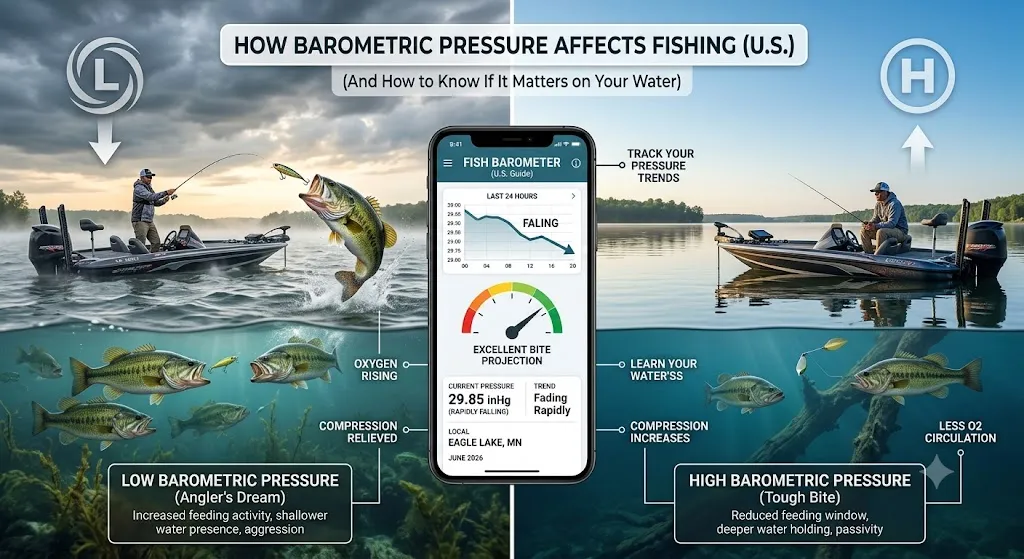
Written by Hudson Reed
The two best afternoons I ever had on a local largemouth lake both came with the sky going green and a storm an hour out. The two worst came the bluebird morning after. Same lake, same lures, same guy. If you fish enough, you stop arguing about whether barometric pressure affects fishing and start arguing about how much, and whether it matters on the specific piece of water under your boat. That second question is the one almost nobody answers honestly.
Here is the honest version. Pressure is real, the biology behind it is real, and the bite window before a front is one of the best you will ever get. But the size of the effect changes by lake, by species, and by how deep the fish are sitting. A chart printed in a magazine can tell you the general shape. It cannot tell you your threshold. The only thing that can is a season of your own catches plotted against the barometer.
What does barometric pressure actually do to a fish?
A fish carries a gas-filled balloon inside it called a swim bladder. That balloon is how it holds depth without burning energy. When the air pressure above the lake changes, the pressure pushing down through the water column changes too, and the gas in that balloon expands or compresses in response.
Drop the pressure and the bladder swells slightly. Raise it and the bladder squeezes down. A fish whose buoyancy just shifted has to re-trim, the way a diver adjusts a BCD. While it is busy re-trimming, it is not chasing your crankbait.
How much that matters comes down to plumbing. Biologists split fish into two camps. Physoclists (closed-bladder fish like bass, walleye, perch, and most ocean reef species) have no pipe to the throat. They can only add or bleed gas slowly through a gland in the bloodstream. Physostomes (open-bladder fish like trout, salmon, pike, and carp) keep a duct connecting the bladder to the gut, so they can gulp air at the surface or burp it out fast.
That single difference explains most of the species split you feel on the water. A closed-bladder bass that gets caught out of position by a fast pressure swing can take 24 to 48 hours to fully equalize. An open-bladder trout sorts itself out in a fraction of that time.
And the numbers are not trivial when fish move vertically. Pressure underwater rises by one full atmosphere every 33 feet of descent, so by Boyle's law a fish needs roughly twice the gas volume at 10 meters as it carries at the surface, and four times as much at 30 meters. The deeper the fish already lives, the smaller a weather-driven surface-pressure change is as a percentage of the total pressure it feels. That is the whole reason deep fish shrug off fronts that flatten the shallow bite.
The science is messier than the tackle-shop version
Here is the part most articles skip. The mechanism above is the popular explanation, and it is plausible, but it is not airtight. David Ross, a scientist at Woods Hole Oceanographic Institution, has pointed out that the pressure change from a passing weather system is tiny next to the pressure changes a fish creates just by swimming up or down a few feet. By that math, a bass that drops three feet experiences a bigger pressure swing than the front does.
So why does the pre-front bite feel so consistent? Probably because the barometer is a proxy. Falling pressure rides in with dropping light, wind, chop, cloud cover, and shifting forage. The fish may be reacting to the whole package, and the barometer is just the easiest piece to read on a phone. Wired2Fish, after surveying a row of touring pros, summed it up bluntly: there is no clean scientific study tying fish behavior to the barometer, and "someone should really study that."
This is not a reason to ignore pressure. It is a reason to stop treating a generic chart as gospel and start treating your own water as the experiment.
You might also enjoy: Chatterbait vs Swim Jig for Summer Grass: Which One to Tie On and When
The falling, rising, and steady playbook
Strip away the debate and a workable pattern survives, one that thousands of anglers report and that the trend data supports. Most guides agree it is the direction and speed of change that matters more than the raw number.
Falling pressure (the magic window). When the barometer starts dropping ahead of a front, the bite often turns on. A rapid fall of more than about 0.18 inHg over three to four hours is the classic trigger. Fish push shallow, roam, and chase. This is the time to cover water fast: reaction baits, spinnerbaits, lipless cranks, topwater if the chop allows. Do not finesse a feeding window away.
Then the front rolls through and the lake goes quiet.
Rising pressure (the dead zone). The 24 to 72 hours after a cold front passes, with a high building and the sky that cruel cloudless blue, is the toughest fishing you will face. Closed-bladder bass and walleye are negatively buoyant and uncomfortable, and they bury in cover or slide deeper. The fix is the opposite of the falling-pressure approach: slow down, downsize, and fish vertical. Drag a Texas rig through the thickest cover you can find, or pull a drop-shot right past their nose. They will eat, but only what is easy.
Steady pressure (the underrated one). A barometer parked between roughly 29.8 and 30.2 inHg for a few days is quietly the most reliable fishing of all. The fish are acclimated, comfortable, and willing. It is not as explosive as the pre-front feed, but it is dependable, and that is worth more to most of us than a one-hour frenzy you have to time perfectly.
For the record, the absolute number lies to you constantly. A steady barometer sitting at 29.80 will usually out-fish one that has jumped from 29.60 to 29.95 overnight, even though the second reading is "higher." Watch the trend line, not the dot.
Why bass, walleye, and trout don't react the same way
If you fish multiple species, you have probably noticed they do not all sulk on the same day. The plumbing explains it.
Largemouth and smallmouth bass are the drama queens. Closed bladder, strong pre-front feed, hard post-front lockjaw. When the bass quit cold after a front, that is the textbook closed-bladder response.
Walleye are closed-bladder too, but they react differently. A lot of walleye anglers do better on rising pressure in low light than on the screaming pre-front bite, partly because walleye lean on the edge-of-darkness feed more than the weather feed. Do not assume your bass playbook transfers.
You might also enjoy: Best Line Counter Trolling Reels for 2026 (Walleye, Salmon & Lake Trout)
Trout are the outlier, and the open bladder is why. They equalize fast, so a front knocks them around less. The flip side of the folklore is that trout also tend not to go berserk at either pressure extreme. Slower to crash, slower to feast.
One contrarian take I will plant a flag on: for fish living below about 30 to 33 feet, pressure obsession is mostly wasted energy. The deeper the fish, the smaller the surface swing matters, and a deep summer thermocline walleye or a wintering bass on a 35-foot hump barely registers the front that ruined the shallow bite. If your best fish live deep, spend your worry budget on something else.
Does barometric pressure actually matter on your lake?
This is the question the charts cannot answer, and it is the only one that improves your fishing.
Every lake is its own animal. A shallow, fertile, weed-choked pond where most fish live in the top eight feet will swing hard with the barometer. A deep, clear highland reservoir where the bass winter at 25 feet will barely flinch. The same front, the same day, two completely different responses. So a pressure rule that works for a tournament angler in Florida can be useless on your home water in Minnesota, and neither of you is wrong.
There is exactly one way to find your real threshold: log it. Write down the date, the bite (good, slow, dead), the species, the depth you caught them, and the barometer reading and its trend. Do that for a season. Patterns surface that no generic chart contains: maybe your lake's bass shut off only when pressure climbs past 30.3, or maybe a slow steady rise actually fires them up while a sharp one kills them. That is the number worth knowing, because it is yours.
Pressure is, after all, just one of five conditions that shift between trips and turn a slay-fest into a skunking. Isolating its effect by hand means recording it every single time you fish, which almost nobody actually keeps up for a full season.
That is the boring reason I track pressure automatically instead of in a notebook. When you log a catch in Bushwhack, it captures the barometric pressure and its trend at that moment, along with water and air temp, time of day, season, and moon phase, so the dataset builds itself while you fish. After a season the dashboard can show you whether your catches actually cluster around a pressure window or whether, on your water, the barometer was never the story to begin with. Either answer is useful. You just have to have the data to read it.
So fish the falling barometer hard, downsize and slow down on the bluebird day after, and quit trusting a chart that has never seen your lake. Then go collect the only proof that counts.
Get fishing tips in your inbox
New guides, seasonal tactics, and gear picks — about once a month, no spam.