Glide Bait Bass Fishing: A Beginner's Guide
 Hudson Reed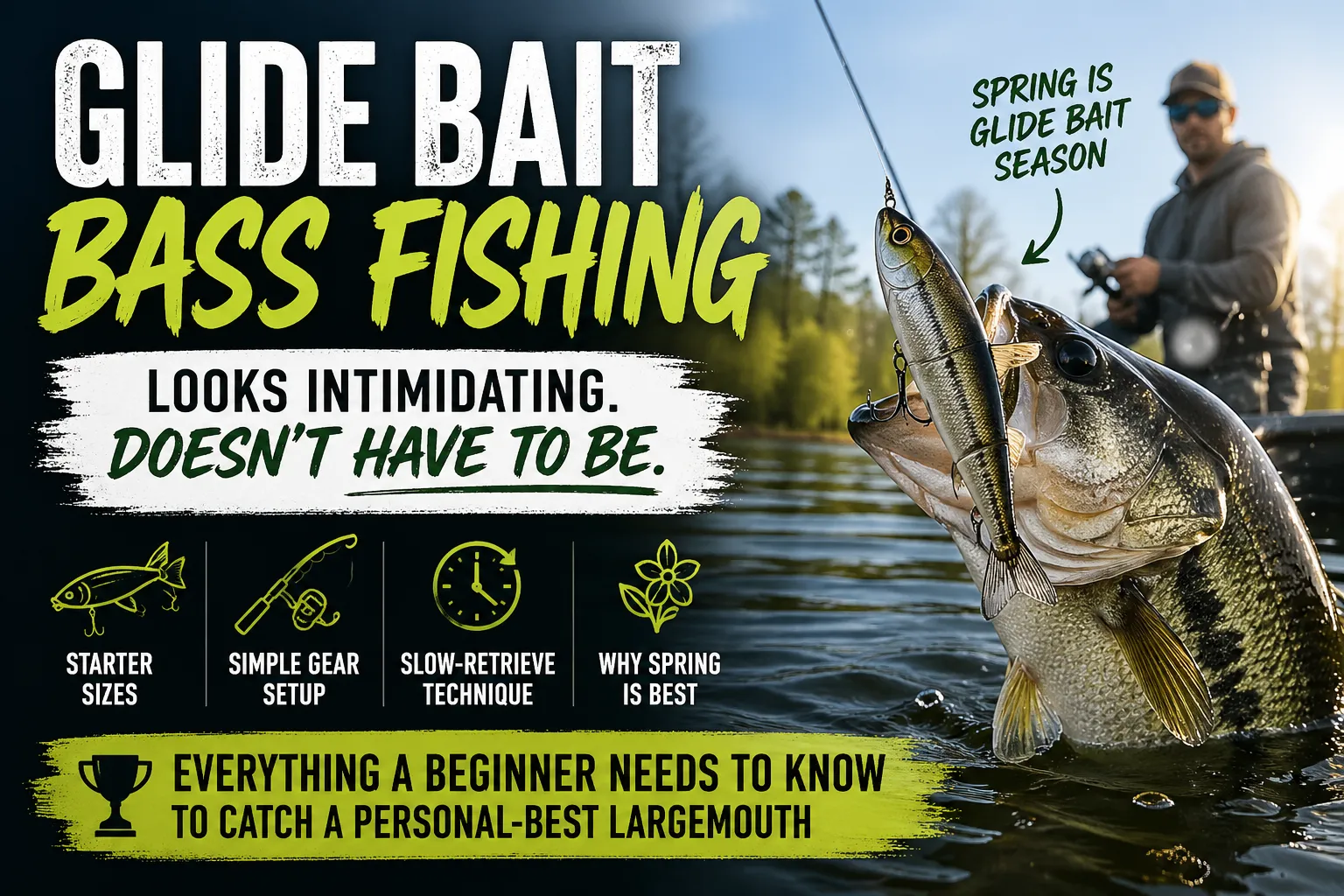
Written by Hudson Reed
Scroll through any bass fishing feed right now and you'll see them: giant, gliding swimbaits drawing violent strikes from enormous largemouth. Glide bait bass fishing has exploded in popularity, and with it, a reputation for being expensive, technical, and reserved for expert anglers. That reputation is mostly wrong. With the right size bait, a basic heavy setup you may already own, and a few fundamental retrieve principles, you can be throwing a glide bait effectively this spring. Here's how to start.
What Is a Glide Bait (and Why Beginners Skip It)?
A glide bait is a hard plastic, two-segment lure with a single pivot point between its body sections. When you work the reel handle in slow, deliberate half-turns, the bait sweeps left and right in a wide, hypnotic S-pattern, mimicking a large, injured baitfish drifting through the water column. That action is different from a multi-jointed swimbait, which undulates with a continuous tail kick and works best on a straight retrieve. The glide bait demands more angler input, which is exactly why beginners shy away from it.
The other barrier is perception: walk into any tackle shop and you'll see glide baits priced from $20 all the way to $150+ for hand-poured customs. That top end can stay on the shelf. Starter-friendly options in the $20-$45 range fish just as well for someone learning the technique, and several of them are proven personal-best producers.
Why Spring Is the Best Season to Throw a Glide Bait
Timing matters more with glide baits than with almost any other lure, and spring is the money window. As water temperatures climb into the mid-to-high 50s°F, pre-spawn largemouth abandon deep winter haunts and push toward shallow, warming backwater coves, bays, and flats. They're actively searching for easy, calorie-dense meals, and spawning baitfish like yellow perch, white perch, and large shad are doing the exact same thing at the exact same time.
A 5-7 inch glide bait moving slowly through that zone looks like a lethargic, spawning baitfish. It doesn't look like a threat. It looks like a meal. That's why spring glide bait fishing is famous for producing the biggest fish of an angler's season, sometimes the biggest fish of their life. If a personal-best largemouth is on your list, this is your season and this is your bait.
Start Small: The 5-7 Inch Sweet Spot for Beginners
This is the most important advice in this entire guide: do not start with a 10-inch or 12-inch swimbait. Magnum glide baits are a separate discipline. They require specialized heavy rods, massive reels, and a level of commitment that can kill enthusiasm fast. Skip them entirely until you've built confidence on smaller sizes.
The 5-7.5 inch range is where beginners belong, and for good reason:
- They cast comfortably on standard heavy bass gear
- The retrieve is easier to feel and control
- They still catch fish well over 5 lbs, and even 8-10 lb largemouth eat these baits
- Budget options exist at every price point
A few reliable starter picks:
- River2Sea S-Waver 168: One of the most recommended beginner glide baits at under $30. Forgiving action, wide availability.
- SPRO KGB Chad Shad (7"): Slightly pricier but widely considered the benchmark for value vs. performance. Slow-sinking design is very beginner-friendly.
- Savage Gear Glide Swimmer: Around $30, easy to work at multiple speeds, great for learning the cadence.
Start with one of these before spending $80+ on premium options. Once you understand how a glide bait should feel on the retrieve, you'll know what you want from a more advanced bait.
You might also enjoy: Spring Crappie Fishing Tips: Ice-Out to Spawn
Glide Bait Rod, Reel, and Line Setup
You don't need to build a brand-new setup from scratch to fish 5-7 inch glide baits. If you already own a heavy baitcasting outfit, you may be closer than you think. If you don't, start with our best baitcasting reels under $200 roundup and match the rod to the reel.
Rod
Look for a rod in the 7'4" to 8'0" range with heavy power and moderate or moderate-fast action. The moderate tip is critical: it loads the bait on the cast, keeps the glide smooth, and helps treble hooks stay pinned during the fight rather than tearing free. Avoid fast-action finesse rods; they're too stiff and will kill the bait's action.
Reel
A 200-size baitcaster with a 7:1 gear ratio or faster is the sweet spot for beginner-sized glide baits. High gear ratio lets you pick up slack line quickly between glides, which is essential for maintaining feel and hook-setting speed. You don't need a 300-size reel until you're throwing baits over 7.5 inches.
Line
Use 15-17 lb fluorocarbon for 5-7 inch glide baits. Fluorocarbon sinks slightly, helping keep your bait in the water column, and its near-invisibility matters in the clear spring water where glide baits shine. It also has minimal stretch, so hook penetration is immediate and solid. Skip monofilament. The stretch works against you. Braid is situational; stick with fluoro while you're learning.
The Slow-Retrieve Fundamentals (Most Beginners Do This Wrong)
Here's where most newcomers go wrong: they overwork the bait. They snap the rod, crank fast, and try to force the action. The result is a bait that darts erratically instead of gliding, and bass refuse it.
The foundational glide bait retrieve is simple:
- Half-turn of the reel handle: one single half-rotation sends the bait sweeping to one side
- Pause 1-2 seconds: let the bait breathe, settle, and hang. This is often when the strike happens.
- Another half-turn the other direction: the bait glides back the other way
- Repeat with a steady, rhythmic cadence
Keep your rod tip low and pointed toward the water throughout the retrieve. This gives you instant hook-setting leverage and reduces slack. Think of it less like fishing and more like conducting: slow, deliberate, methodical. The bait is doing the work. Your job is rhythm and patience.
Once you're comfortable with the basic cadence, experiment with an extra half-second pause, a slight rod dip between glides, or a brief speed-up to trigger following fish. But always return to slow and steady as your default.
You might also enjoy: Spring Striped Bass Migration: A Week-by-Week Location Guide
Reading the Follow: What to Do When Bass Tracks Your Bait
One of the most addictive things about glide baits in clear spring water is watching what happens behind your lure. Bass will often follow a glide bait for 10, 20, even 30 feet before deciding whether to eat. This is where beginners panic and speed up, which almost always kills the bite.
When you see a follower, maintain your cadence. Don't change anything. The fish is evaluating whether your bait is injured or healthy prey. A speed-up signals healthy prey trying to escape, and bass often back off. A steady, almost-slow-motion glide signals wounded and easy.
If the bass follows all the way to the boat without eating, sweep the rod tip in a wide figure-8 motion just below the surface. This boatside figure-8 keeps the bait moving in tight, looping turns that can trigger a reaction strike from a fish that's already locked in. Many of the most memorable catches on glide baits happen right at the rod tip.
Where to Throw a Glide Bait in Spring
Location matters as much as technique. In early-to-mid spring, focus on:
- Shallow, warming backwater coves and bays: these areas heat up faster than the main lake and draw pre-spawn bass early
- Points where fish stage before moving shallow: cast toward deeper water and retrieve the bait uphill; it mimics prey trying to escape and keeps your bait in the strike zone longer
- Areas near spawning baitfish concentrations: find the perch or shad and the big bass won't be far
- Clear to moderately clear water: glide baits need visibility to work; water clarity of 3-15 feet is ideal, and a pair from our best polarized fishing sunglasses under $50 roundup lets you watch followers track the bait
Once water temps hit the low-to-mid 60s and bass move onto beds, the glide bite typically slows. The pre-spawn window of mid-50s to low 60s is your prime time. Fish it hard.
Track Your Sessions, Build Your Playbook
Glide bait fishing rewards anglers who pay attention. Water temperature, retrieve cadence, bait color, time of day, and exact location all influence the bite, and the patterns that emerge from your home water will be different from anyone else's. Start logging your sessions in Bushwhack from day one. Note what worked, what didn't, and what conditions you were fishing. Over a single spring season you'll accumulate a personal database that makes every future glide bait trip more productive.
The technique has a learning curve, but it's not steep. Throw the right size, slow down your retrieve, fish the right water in spring, and you'll understand quickly why glide bait bass fishing has become one of the most exciting ways to target a personal-best largemouth. Get one follow from a fish the size of a football and you'll be hooked.
Get fishing tips in your inbox
New guides, seasonal tactics, and gear picks — about once a month, no spam.