Should You Fish Near Spawning Trout Redds? An Evidence-Based Answer
 Cameron Spanos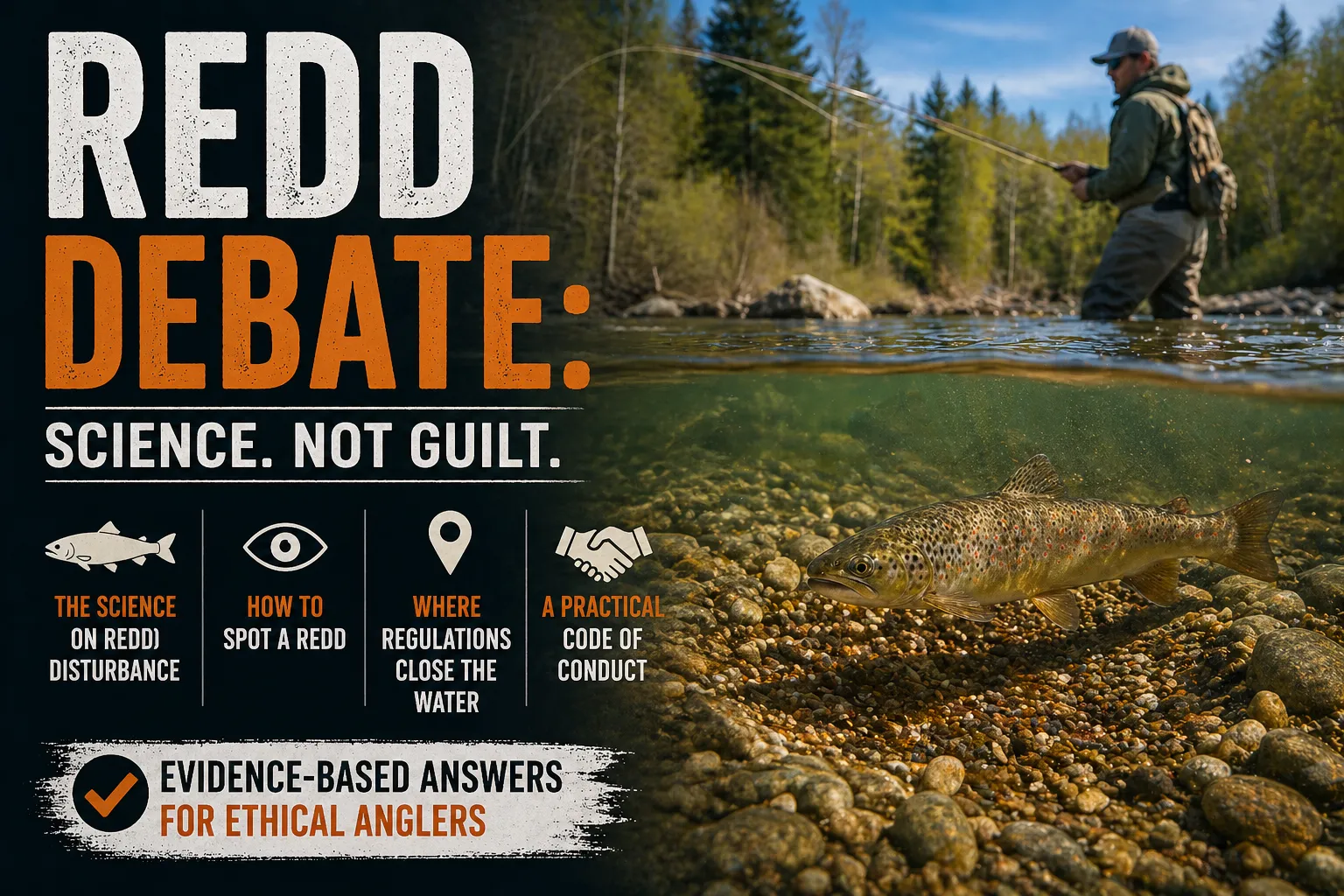
Written by Cameron Spanos
Every April, the same argument flares up on tailwaters and freestones alike: should you be fishing near spawning trout redds? Some anglers call it an ethical violation no different from snagging. Others insist it's legal, the fish are fine, and the hand-wringing is overblown. The truth, as with most things worth arguing about, lives somewhere between those poles, and it's grounded in actual science.
What Is a Redd and Why Does It Matter?
A redd is a spawning nest built by a female trout. Using her tail and body, she fans silt and debris away from a patch of gravel, creating a clean depression where she deposits thousands of eggs. A male follows to fertilize them. Then the female fans gravel back over the eggs to cover and protect them. For the next several weeks, those eggs develop in the spaces between the rocks, relying on cold, well-oxygenated water flowing through the gravel to survive.
Redds are not just interesting biology. They are the literal future of every trout population in that system, wild fish included. Disturb that gravel bed and you can wipe out an entire season's reproduction for the fish that built it.
How to Identify a Trout Redd on the Water
Before you can avoid a redd, you need to know what you're looking at. Here's what to look for:
- Color contrast: Redds appear noticeably lighter than the surrounding riverbed. The female has scrubbed away algae and biofilm, so the gravel looks freshly washed, almost bright, compared to darker, algae-covered rocks nearby.
- Shape and size: They're oval or elongated patches, typically bathtub-sized, in shallow moving water where there's a mix of fine gravel and small cobble.
- Location: Look in water 1-3 feet deep with moderate current, enough to deliver oxygen to the eggs but not so fast that fry can't emerge. Feeder creek mouths, shallow riffles at the head of pools, and gravel bars near current seams are prime spots.
- Fish behavior: If you see a pair of fish hovering low in shallow water with little interest in your fly, you're probably looking at active spawners on a redd. Tail-fanning and side-by-side positioning are dead giveaways.
Timing matters too. Rainbow trout spawn February through April once water temperatures climb above 41°F. Cutthroat wait until temperatures hit 50°F and can spawn into May. Brown trout and brook trout spawn in fall (September to December), so they're less of a concern for spring anglers, though the eggs they laid in October are still incubating underfoot in April when you're wading.
What the Science Says About Redd Disturbance
This is where the debate stops being a matter of opinion. A laboratory study conducted by the U.S. Fish and Wildlife Service in the 1990s produced findings that should give every wading angler pause: a single wading event through a redd can kill up to 43% of the eggs inside it. Wade through that same redd twice in one day, and mortality can reach 96%, depending on the species.
The mechanism is twofold. Physical pressure from a boot or wading staff compresses the gravel, crushing eggs directly. It also collapses the interstitial spaces that allow oxygenated water to flow through the redd, effectively suffocating eggs that survive the initial impact.
You might also enjoy: Mousing at Night for Big Brown Trout in Summer
Sediment compounds the problem. Research on fine sediment in spawning gravel found that when fine sediment (particles smaller than 0.85 mm) makes up more than 13% of the material in a redd, nearly zero steelhead and coho salmon eggs survive to hatch. Churning up fine sediment while wading, even near, not through, a redd, can push that threshold in a single afternoon.
The science is not saying you'll kill every fish in the river if you wade through a redd. Population-level impacts depend on how many redds are disturbed, how often, and how resilient the local population is. But the egg mortality numbers are real, documented, and not trivial.
When the Water Is Actually Closed: Regulations Overview
Many anglers conflate "legal" with "harmless," but the regulatory picture is more nuanced than a simple open/closed binary.
States like Idaho, Washington, and Oregon close many spawning tributaries entirely during steelhead spawning season, and fishing those stretches is illegal, full stop. Wyoming closes sections of the North Platte in April specifically to reduce pressure on spawning fish. Many northeastern states close specific stream sections from late fall through opening day, which can extend into spring when brown trout eggs are still incubating.
But here's the catch: a large portion of quality trout water in the U.S. has no spawning-specific closure. The water is open, the fishing is legal, and the redds are right there. Legal does not mean the eggs won't die if you wade through them. Regulations set a floor, not a ceiling, for responsible behavior. Always check your state's current regulations. Spawning closures change and are often tied to specific GPS-referenced stretches rather than entire rivers.
The Ethical Gray Zone: Legal but Controversial
Here's where reasonable anglers genuinely disagree, and the nuance matters.
Virginia fisheries biologist Steve Reeser has noted that on stocked or heavily managed streams, brook trout populations are primarily controlled by environmental factors like stream flows, not fishing pressure during spawn. Catching a few fish off redds on a put-and-take fishery is unlikely to move the needle on population health.
You might also enjoy: Hopper Season Setup: The Three-Fly Rig That Replaces Your Dry-Dropper in July
Greg Fitz of the Wild Steelhead Coalition takes the opposite view on wild fish: "At some point, my instinct is that we leave them alone." On rivers with native or wild trout populations (native cutthroat, wild steelhead, bull trout), targeting spawning fish is widely considered indefensible. These populations have no hatchery cushion, and each successful redd represents a meaningful contribution to a finite gene pool.
There is also a meaningful distinction between fishing near a redd and targeting fish on a redd. Trout actively feed during spawn season, and egg patterns work precisely because other fish are competing for drifting eggs. Casting to a feeding trout holding in a run below a spawning area is different from dangling a fly in front of a paired female who is literally building a nest. One targets a feeding fish; the other exploits a fish that is physiologically focused on reproduction and not in a position to make a proper feeding decision.
A Practical Code of Conduct for Spring Fishing
You don't need a law to tell you how to behave on the water. Here's what evidence-based, conservation-minded fishing near redds looks like in practice:
- Never wade through a redd. The egg mortality data is unambiguous. If you see that bright oval patch, go around it, even if it means a longer wade or a less ideal casting position.
- Stick to deeper water during peak spawn. The best riffles are exactly where redds are built. During rainbow spawn season (February to April), fish runs, pools, and deeper pocket water instead of the shallow gravel bars.
- Give paired fish a wide berth. If you see two fish hovering low and close together, move on. It's not about sportsmanship. A fish laser-focused on spawning is not eating your fly in any meaningful sense anyway.
- Release spawning fish quickly. If you hook a spawning fish, and it happens, land it fast, keep it in the water, and release it immediately. Spawning fish are already metabolically stressed.
- Know your water. Stocked tailwater vs. wild native cutthroat stream? The ethical calculus is different. Apply more caution where the fish have more to lose.
- Speak up, not down. If you see another angler wading through a redd, a calm word is more effective than a confrontation. Most anglers who disturb redds do it out of ignorance, not malice.
The Bottom Line
The science on fishing near spawning trout redds is clear about one thing: physical disturbance to a redd causes real, measurable egg mortality. A single careless wade-through can destroy nearly half the eggs in a nest. That's not opinion. It's a controlled laboratory finding from the U.S. Fish and Wildlife Service.
Whether fishing in the vicinity of spawning trout is ethical depends on context: the species, the population status, whether you're targeting spawning pairs or feeding fish, and whether you're disturbing the redd itself. On wild and native populations, the ethical case for leaving them alone is strong. On heavily stocked fisheries, the population-level case is weaker, though the redd disturbance risk from wading is unchanged.
The best move you can make is to know your local rivers' spawn windows so you can plan around them. Use your Bushwhack fishing log to track which runs go hot during spawn season and which stretches are worth protecting, so you can make an informed decision rather than stumbling into a redd you didn't know was there. Track enough seasons, and you'll start to see the patterns that make you a better, more conservation-minded angler year after year.
Get fishing tips in your inbox
New guides, seasonal tactics, and gear picks — about once a month, no spam.