Fly Fishing on Your Lunch Break: How to Get a Real Hour on the Water
 Cameron Spanos
Written by Cameron Spanos
An hour is enough. Not enough for a mile of river or a hero shot, but enough to put thirty honest presentations in front of fish that are actually eating, and fly fishing on your lunch break is the most underrated habit in this sport for exactly that reason. I do it regularly, year round, on water that happens to sit a short drive from my office. The short drive is luck. Everything else about pulling it off is logistics, and logistics are learnable.
Almost every piece of fly fishing content assumes a full day. A destination, a shuttle, a hatch chart, a plan. The sub-hour session gets treated as a consolation prize, which is strange, because for anyone with a job and a commute it's the only fishing that exists on a Tuesday.
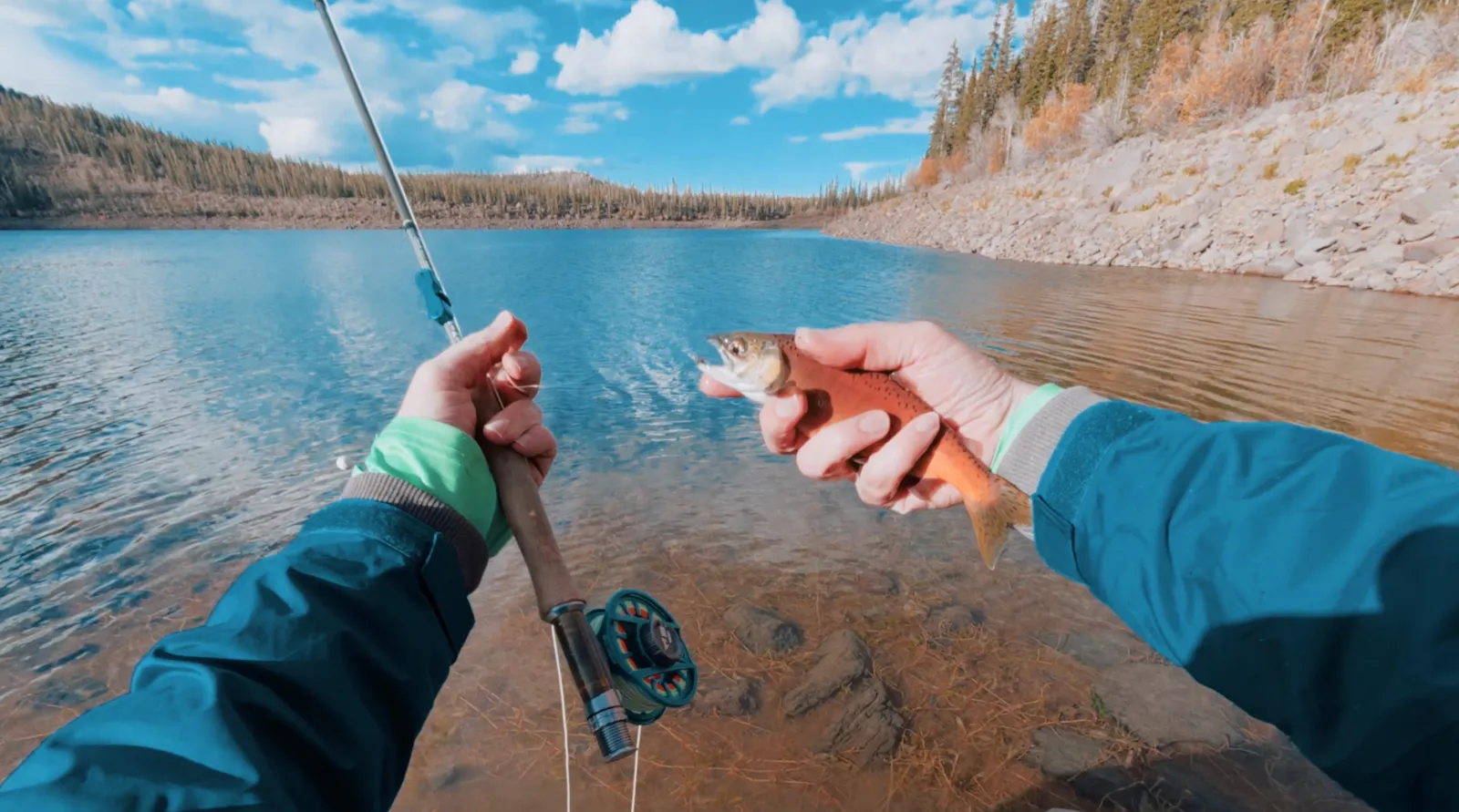
I filmed one of these so you can see what it actually looks like, minus the drone shots and the hero fish.
The math of a lunch hour
One budget governs the whole thing: total break, minus travel, minus rigging, minus making yourself presentable again. Whatever survives that subtraction is your water time.
On a sixty-minute break mine runs about ten minutes of driving each way, five minutes down the bank, thirty in the water, and five to dry off and swap shoes. That only works because the rod is already strung and the bag already lives in the vehicle. Put rigging at the tailgate back into the equation, add re-tying a leader you meant to fix on Sunday, and the same trip collapses into eighteen minutes of fishing and a lot of standing around in a gravel lot.
The honest threshold is about fifteen minutes of driving each way. Past that you're spending more of your break in a vehicle than in the water, and you come back to your desk more wound up than when you left. Thirty minutes of round trip for twenty minutes of fishing isn't a lunch session. It's a commute with a rod in it.
The walk is the half of the budget people underestimate. A better run three hundred yards downstream costs you six minutes each way, which is a fifth of your fishing. At noon, take the water you can be standing in ninety seconds after you shut the door, even when you know something prettier sits below it.
The go bag lives in the truck, not the garage
Rigging at the water is where lunch sessions go to die. Every minute threading guides is a minute you aren't fishing, and the fix is deeply boring: keep one small, complete, permanently packed kit in the vehicle, and never raid it to build a weekend load-out.
Mine is a soft cooler bag and a rod tube. What's in it:
- A rod already strung, leader attached, fly in the hook keeper. Two pieces in a tube if your vehicle can't swallow it assembled.
- One fly box. Not four. The handful of patterns your water actually eats, in a couple of sizes each.
- Nippers, forceps, tippet in two sizes, floatant, a few split shot.
- An old towel and a pair of slides.
- Dry socks in a ziplock bag. This matters more than it sounds like it should.
- Sunglasses and a hat you don't mind carrying back into the building.
Skip the net if you can stand to. Nets grab brush on the walk in, they eat a hand you need, and on a short session with stream-sized fish you're better off wetting a palm and backing a barbless hook out at the surface. Fish stays in the water, you stay on schedule.
Wet wade or waders when you have to sit in a 1:15 meeting?
Wet wade from June into September, waders the rest of the year. That split exists because of the part nobody writing about short sessions bothers to solve: you have to go back to work afterward, sit in a chair, and not smell like a storm drain.
You might also enjoy: Streamers for Pre-Spawn Brown Trout: A Water Temperature Playbook
Quick-dry pants or shorts, wading boots or dedicated wet-wading shoes, neoprene socks if the water's cold enough to ache. Legs air dry on the drive back. Feet get the towel and the dry socks before you pull out, and by the time you're at your desk the only evidence is a slightly damp hem.
Cold months flip the answer, and here's where I'll disagree with the usual advice: waders are the better office option in winter, precisely because you wear your work clothes inside them. You pull them on over your slacks, you fish, you peel them off, and you're already dressed. Bootfoot waders save you the lacing time on both ends, which is worth more on a lunch hour than the marginal wading performance you give up.
The smell is a solved problem, and the solution is that wet boots never spend an afternoon in a hot car. Rinse them and let them air out somewhere with moving air. A closed vehicle at 85 degrees is how you turn a fun habit into the thing your coworkers talk about. Rinsing pays off twice: if your midday water isn't the same water you fish on weekends, laces and felt and gravel traps move invasive species between drainages, and the Stop Aquatic Hitchhikers clean, drain, dry routine takes about ninety seconds when your gear is already out and wet.
Dress code is mostly in your head. Nobody notices damp hair. They notice a wet chair.
Fish one run. Actually fish it.
On a full day you cover a mile of river and fish maybe fifteen percent of it properly. In thirty minutes you fish one run, and if you do it right, you fish it better than you've ever fished anything.
Work it like a grid instead of a march. Start with the seam closest to you so you aren't lining fish you could have caught. Extend a few feet at a time. Once you've covered the width, change depth before you change flies, because most short-session blanks are a depth problem wearing a fly-selection costume.
Then change your angle, since a bucket that ignores a drift from downstream will sometimes eat the same fly presented from across. Most fish in moving water come inside thirty feet anyway, so distance casting buys you nothing here. Cut the false casting, use a pick-up-and-lay-down, and you'll roughly double your presentations in the same window.
Set a phone alarm for your turnaround time. Not a mental note, an actual alarm, because the one day you lose track is the day somebody's looking for you.
Is midday even a good time to fly fish?
For most of the year, yes, and in winter it's the best window of the day. Cold-season trout often don't get going until the sun has put a degree or two into the water, which stacks midge activity and feeding into roughly 11 a.m. to 2 p.m. That is exactly when your break happens.
Spring and fall midday is unremarkable in the good way. Nymphs and streamers carry the load when nothing's coming off the surface, which is most middays, and a weighted pair drifted through one run is a perfectly serious way to spend half an hour.
You might also enjoy: Lower Provo River Fly Fishing in Fall: Access, Flows, and Pre-Spawn Browns
Summer is the exception, and it's a real one. Midday is when water is warmest, trout get stressed as things push past about 68 degrees, and a fish you fight and release at noon in August has worse odds than the same fish at dawn. Carry a stream thermometer in the go bag and make the call on the day rather than on the season. Some weeks the honest answer is to eat lunch at your desk.
Why fly fishing on your lunch break beats a guided day for learning water
A guided day teaches you what your guide knows. That's genuinely valuable, and I'd book one on unfamiliar water in a heartbeat. But it's borrowed knowledge, and most of it evaporates about three weeks after the tip.
Forty lunch hours on the same two hundred yards teach you those two hundred yards. Same place, same time of day, only the variables moving: flow, sky, clarity, season, whatever's hatching. That's about as close to a controlled experiment as fishing gets, and it's why repetition beats intensity. You stop guessing at cause and effect because you've watched one seam behave under twenty different conditions.
The volume is the sneaky part. Two lunch sessions a week is roughly a hundred visits a year to one piece of water. Compare that to fifteen full days scattered across five rivers, which is what a busy adult with a normal job actually gets. One of those produces a pattern. The other produces stories.
That density is also why the habit and a log belong together. A hundred sessions is a dataset, but only if you write it down, and thirty seconds at the truck covers it: flow, weather, clarity, what ate and what refused, and the blanks too, because the blanks are where the pattern lives. Try Bushwhack on a stretch you fish over and over and by the end of a season you'll read a gauge number and a sky and know, before you leave the office, whether it's worth the fifteen minutes.
"I don't have time to fish" is usually a logistics problem
I don't believe most anglers who say they have no time. They have sixty minutes, five days a week. What they don't have is a rigged rod in the vehicle, a towel, and dry socks. That isn't a time shortage. It's an unsolved setup problem, and it's solvable in one Saturday afternoon.
The research is annoyingly supportive here, too. A 2019 study out of the University of Michigan, published in Frontiers in Psychology, measured salivary cortisol before and after short outdoor sessions and found the drop was most efficient when time outside ran between 21 and 30 minutes, and kept dropping past the half hour at a slower rate. A separate 2022 meta-analysis in PLOS ONE, pooling 22 samples and 2,335 participants, tied workday micro-breaks to higher vigor and lower fatigue, though the effects were modest.
Which is a very clinical way of describing something you already know. You come back from thirty minutes in a creek as a different person than the one who left. The 2 p.m. block that used to be a slog is fine. Your inbox looks smaller than it did at 11:45.
So the sixty minutes were never the constraint. The rod in the garage was. Move it to the truck tonight and put a recurring block on your calendar. Call it whatever you want. Nobody reads your calendar anyway.
Get fishing tips in your inbox
New guides, seasonal tactics, and gear picks — about once a month, no spam.