Dog-Days Redfish & Speckled Trout: The Shallow-Early, Deep-Midday Playbook
 Cameron Spanos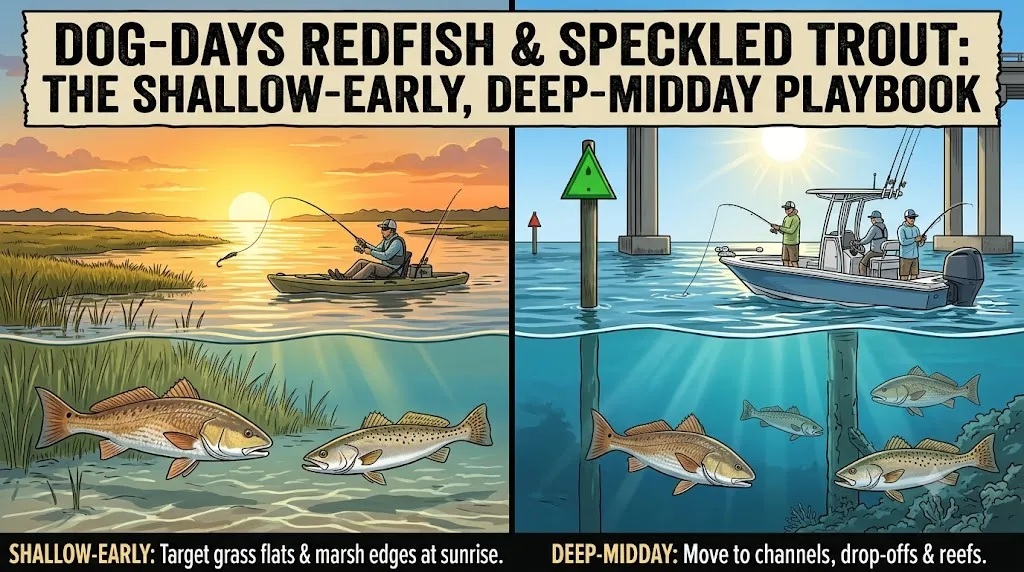
Written by Cameron Spanos
By nine in the morning in late July, the trout bite goes quiet and half the boats on the bay start idling toward the ramp. Big mistake. The dog days redfish and speckled trout pattern isn't one bite that dies at sunrise, it's a moving target that slides from skinny water to deep water and back as the sun cooks the shallows. Learn to follow it and you can stay tight to fish from before first light until well after dark.
The whole game comes down to one variable: water temperature. Everything the fish do in August is a reaction to it.
Why do speckled trout go deep when the water climbs past 85 degrees?
Trout are heat-sensitive in a way reds just aren't. As the water warms, a trout's metabolism spikes. Louisiana Sportsman has reported that at 90 degrees a speckled trout's metabolic rate runs roughly four times what it is in winter, which forces the fish to feed nearly every day or two just to keep up. So they're hungry. The problem is that the shallow grass where they crushed bait at dawn becomes an oven by mid-morning.
Watch a thermometer through a still summer day and you'll see why they leave. Texas guide Jay Watkins has logged water starting at 76 degrees at 5:00 a.m. and climbing into the mid-90s by afternoon, with the shoreline he was wading jumping from 86 to 89 degrees during a single session. Down in Louisiana, bays around Grand Isle have hit 92 degrees at the surface in the thick of the dog days.
Trout don't tough that out. They pull off the flat and settle into the nearest deep, cooler water to rest and wait. It isn't a long migration. A fish can feed shallow at dawn and drop into an eight-foot channel a short cast away by ten. The bait moves with them, and so should you.
First light: grass flats, tidal creeks, and shorelines
This is the golden window, and it's short. From the last of the dark until the sun gets a real angle on the water, trout and reds will both be up shallow eating in water four feet and skinnier.
Grass flats are the classic. So are the mouths of tidal creeks draining into a bay, points where a shoreline bends, and any hard bottom or oyster near deeper water. Topwater earns its keep here. A walking bait or a popper worked over grass in the half-dark draws vicious blowups from both species, and it's the most fun you'll have all day. If they're swiping and missing, drop to a soft plastic on a light jighead and slow down.
Moving water matters more than most people give it credit for. A moving tide is cooler than slack water and it stacks bait against structure. If your morning low or high slack lands right at sunrise, the bite can feel flat even in perfect conditions. Check the tide before you check the alarm clock.
What time should you actually be on the water?
Earlier than you think. For trout, the boat should be off the trailer no later than 5:00 a.m. in the heart of summer. Guides who fish this seriously are at their first spot in the dark and limited out by six or seven. Once the sun is up and the water starts climbing, the shallow trout bite fades fast, usually petering out somewhere between 9 and 11 a.m.
You might also enjoy: Trico Spinner Falls in July: The 7 AM Window Every Tailwater Angler Should Plan Around
Reds give you more room. If speckled trout are strictly an early gig, redfish will keep you busy through the middle of the day. A 7:00 a.m. launch is fine if reds are your target. Here's the part nobody wants to hear: on a hard overcast or lightly stormy day, the shallow bite can run all morning, because clouds keep the sun from ever penetrating and heating the column. A gray, ugly-looking day is often the best trout day of the week.
Midday: channels, potholes, washouts, and shaded docks
When the flat empties out, don't quit. Just go find the cool water the fish went to.
Deep channels next to the grass flats you fished at dawn are the obvious first move. Trout slide off the edge and hold on the drop. Fish vertical or cast up-current and let a heavier jig get down to them. On big flats, look for potholes, swags, and washouts, the slightly deeper depressions scattered across an otherwise uniform bottom. Wade through one on a hot afternoon and you'll feel the water go noticeably cooler around your legs. That temperature break is exactly what the fish are after, and reds in particular will stack in a washout and sit tight.
Then there's shade. Docks, especially older ones with plenty of pilings and floats, throw shadow lines that hold fish through the worst of the heat. Bridges and jetties do the same. Anywhere current squeezes past hard structure and drops into a little deeper water is worth a few casts at noon when everything else feels dead.
Skip the topwater now. Throwing a walking bait across bathwater at high noon is a waste of good daylight. Go subsurface, go deeper, slow everything down.
Getting a bait down where they're holding is the whole battle midday. A 1/16-ounce head that was perfect on the flat at dawn will never reach fish sitting in ten feet of moving water. Step up to a 1/4 or 3/8 ounce jighead, or fish a heavier swimbait, and let it fall on a tight line before you start the retrieve. Plenty of the bites come on the drop. If you're marking fish on the sonar but not connecting, you're probably fishing over their heads.
Redfish play a different game than trout
People lump reds and specks together because you catch them in the same places, but their heat tolerance isn't close. Reds handle warm water better and they'll feed in the middle of the day when trout have long since checked out. That's the contrarian edge in this whole pattern: everyone obsesses over the dawn trout bite and packs it in by nine, right about when the redfish window gets good.
At first light, reds are the shallowest fish out there and usually the last to leave the flat. As the heat builds they slide to washouts, drop-off edges near the flats, marshy points, rock piles, and creek mouths where they can ambush crabs and baitfish holding close to cover. When the water clears up you can sight-cast to them cruising shade lines and edges well into the afternoon.
Bait choice for reds leans a little heavier and a little louder than for finicky trout. A gold spoon, a paddle-tail on a quarter-ounce head, or a cut chunk of crab or mullet fished on the bottom near a washout all produce. Reds hunt as much by scent and vibration as by sight, which is exactly why they keep eating when the sun is high and the water is stained. That's a real advantage on the days trout won't cooperate at all.
You might also enjoy: Hopper Season Setup: The Three-Fly Rig That Replaces Your Dry-Dropper in July
One note on keeping fish: redfish slot limits vary a lot by state, and some have tightened recently. Louisiana, for example, has run a slot roughly in the 16 to 27 inch range, but the rules there have changed in recent seasons, so confirm the current LDWF limits before you keep one. Check your own state's current regulations before you keep anything, because they change more often than the printed brochure at the tackle shop suggests.
The night bite: dock lights after dark
If you only fish one thing all summer, make it dock lights. It's the coolest water of the 24-hour cycle and arguably the most consistent bite. Summer is prime time for it.
The food chain does the work. Lights pull plankton, plankton pulls shrimp and bay anchovies and small minnows, and that buffet pulls trout, reds, flounder, and snook up under the glow. The predators don't sit in the light, though. They hang in the shadow line just outside it, facing in, waiting for something to drift across the bright water.
So cast well past the light and swim your bait from the dark into the bright. That retrieve mimics exactly what they're keyed on. Downsize hard here: 1/32, 1/16, and 1/8 ounce jigheads are the range, tipped with a small white paddle-tail or shrimp imitation, or a Gulp swimming mullet. Tiny baits meant for crappie fishing work great. Work them slow, right through the beam.
Snook are worth a special mention if you fish far enough south. They feed hard at night and the biggest fish of the year often come after dark, so a summer dock-light session is your best realistic shot at a trophy.
Reading your own water beats memorizing anyone's spots
Every bay is different, but the logic is identical everywhere the dog days redfish and speckled trout pattern shows up: fish follow cool water and moving water, and both are easier to find shallow at dawn and deep by noon. Once you understand that, you stop needing a guide's GPS numbers and start reading your own home water.
The fastest way to learn your bay's rhythm is to write it down. Log the tide stage, the water temp, the exact time each fish ate, and where it came from. After a couple of summers you'll see your own version of this pattern emerge, tuned to your creeks and flats instead of somebody else's. You can track your catches and spots with Bushwhack so those patterns are sitting in front of you next July instead of fading out of memory. Bushwhack's features are built around exactly this kind of pattern-finding.
Set the alarm early. Chase the cool water. And don't be one of the boats heading in at nine.
Get fishing tips in your inbox
New guides, seasonal tactics, and gear picks — about once a month, no spam.