Best Time of Day to Fish in Fall (By Species): The Cooling-Water Timing Table
 Hudson Reed
Written by Hudson Reed
The most useful thing anyone can tell you about the best time of day to fish in fall is that the answer flips halfway through the season. In mid-September, dawn still owns the lake. By early November, dawn is often the worst ninety minutes of the day, and the angler who slept in until nine is out-fishing the one who shivered through first light.
What moves that window isn't the calendar. It's surface temperature, and specifically which side of a species' comfort range the water is sitting on. All summer the problem is too much heat, so fish eat when the water is coolest. Once fall drags surface temps down through that comfort band and out the bottom of it, the problem inverts. Now the fish wants the warmest, most metabolically generous hours of the day. Same lake, same fish, opposite clock.
Which makes "dawn and dusk are best" about half a season's worth of advice.
The best time of day to fish in fall, by species and water temperature
Read this table off a thermometer, not off a date. A lake in northern Minnesota can be sitting in the right-hand column by the second week of October, while a reservoir in Georgia might not get there until December. Surface temp is the only input that travels.
| Species | Early fall (65-58°F) | Mid fall (58-50°F) | Late fall (below 50°F) | Flip trigger |
|---|---|---|---|---|
| Largemouth bass | First light to 9 AM, plus the last hour | Split bite: 7-10 AM and 3 PM to dark | 10 AM - 3 PM | ~55°F |
| Smallmouth bass | Dawn and dusk | Mid-morning onward | 11 AM - 4 PM | ~52°F |
| Trout (rainbow, brown, cutthroat) | Early and late, midday if it's overcast | Nearly all day, best 10 AM - 2 PM | 11 AM - 3 PM | ~48-50°F |
| Walleye | Dawn, dusk, after dark | Dawn, dusk, plus windy overcast middays | Last two hours of light into full dark | No flip: light-driven |
| Crappie | Dawn and dusk shallow, midday deeper | 9 AM - 3 PM on structure | Narrow window, roughly noon - 3 PM | ~55°F |
| Channel catfish | Dusk into night | Late afternoon into early dark | 1 PM - 4 PM | ~55°F |
Straight about the sourcing before you trust a single cell of that: exactly one row rests on something I can point you to, and it's the walleye row, where the mechanism is eyeballs rather than degrees. Every temperature trigger in the last column is angler consensus. Those numbers get repeated across guide reports, forum threads, and tackle-shop counters year after year, they line up with what most people see on the water, and as far as I can find nobody has formally studied any of them. Starting points, not findings.
Why does the bite move to midday when water cools?
Because fish are cold-blooded, and digestion runs on water temperature rather than on appetite. The version of this you hear everywhere is that a meal a bass processes in about a day in the low 60s takes several days once the water sits in the mid-40s. I have never found the study those specific numbers come from, so call it an unsourced rule of thumb, same as the triggers in the table. What the rule gets right is the direction: a fish digesting slowly eats less often and picks its moments. The moment it picks is when the water is warmest and its enzymes work fastest, which on a clear late-fall day is the three or four hours after the sun has had time to work on the top few feet.
The people who feed fish for a living have to price that direction in, and their numbers are public. NC State's cooperative extension publishes a trout feeding-rate chart indexed to water temperature, with separate rows for 45, 50, 55, 60, and 65°F plus a note for water above 68, and it tells pond owners to cut back to one to three feedings per week once the water drops below 45°F. That's a pond-management document, not a fishing article, which is why I like it here. Nobody was trying to sell a crankbait when they built that table. It won't tell you what hour to launch the boat, but it does confirm that appetite tracks the thermometer closely enough that professionals schedule around it.
So the sequence for most warmwater and coolwater species goes: heat is the constraint, then nothing is the constraint, then cold is the constraint. That middle stretch, roughly 58 down to 52 degrees, is the best three weeks of the fishing year, and it's the only time of year when you genuinely can show up whenever and catch fish.
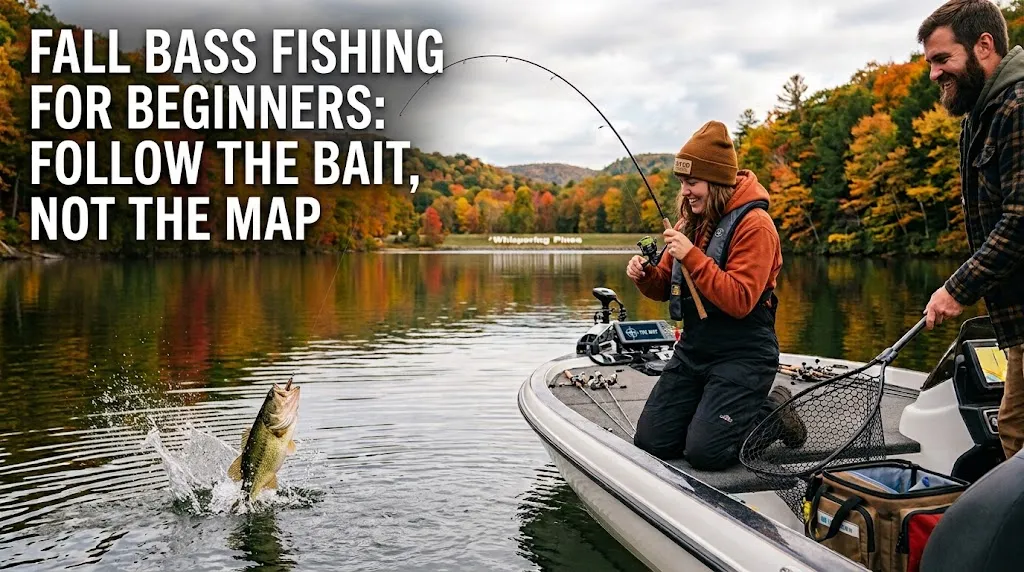
Bass: the flip lands around 55 degrees
Early fall bass still behave like summer bass with more energy. Surface temps in the low 60s, baitfish pushing shallow, and a dawn topwater window that will absolutely still produce. Fish it.
Then somewhere around 55 degrees on the surface, three things happen at once. The dawn bite gets shorter and less reliable. The afternoon bite gets longer and stronger. And the fish start showing a real preference for the north and west sides of a lake. The west bank catches first light, the north bank faces south into the best sun angle of a low autumn day, and either one can hold a degree or two more than the shaded side. That temperature differential is small and it matters enormously. Two degrees is the difference between a bass that follows and a bass that eats.
You might also enjoy: Best Base Layers for Cold Weather Fishing Under $75: Merino vs Synthetic vs Grid Fleece
My contrarian position: the late-fall evening bite for bass is the most overrated window in fishing. Everybody assumes dusk is always good because dusk is always good in July. But once surface temps are under 50, the water is losing heat through the afternoon and by sunset the shallows are colder than they were at 2 PM. You're fishing a falling thermometer in fading light. I'd rather fish 11 AM to 3 PM on a bluebird November day than sunrise and sunset combined, and I don't think it's close.
Smallmouth hold the dawn bite roughly three degrees longer than largemouth do, which is another consensus number rather than a measured one, and then they hold their midday preference deeper into the cold than largemouth ever do. On a 44-degree river in late November, the smallmouth bite is essentially a lunch appointment.
Trout are the last species to give up dawn
Trout are the exception that proves the mechanism, because their comfort range is so much colder than everything else in the table. A 55-degree lake that has already flipped bass to midday is still perfect trout water. Fall trout will eat at first light, at noon, and at dusk, and the thing that actually decides the window is bug activity rather than temperature.
That's why fall dry-fly fishing is a mid-morning-to-mid-afternoon game on most water. Blue-winged olives come off in the worst weather of the day, usually between 11 AM and 3 PM, and October caddis run through the afternoon. Cold nights mean nothing is happening on the surface at 6 AM in late October. If you're a fly angler, sleeping in is not laziness in the fall, it's strategy.
Under about 48 degrees, streams flip too, and the trout window narrows into the warmest part of the afternoon. Spawning browns are a separate matter, and the timing question there is whether to fish near them at all.
Walleye ignore the whole temperature argument
Walleye are the one species in this table that never flip, and the reason is anatomical. The Minnesota DNR describes the walleye's pearlescent eye as the product of a tapetum lucidum, a reflective layer of pigment that helps the fish see and feed at night or in turbid water. That same page notes they typically feed in shallow water at dawn and dusk, retreat to shadows or depth with daylight, and stay active all day when turbidity, chop, or clouds cut the brightness.
Their advantage is a vision advantage, not a temperature advantage. Perch see poorly in low light and walleye see well. Cooling the water down to 45 degrees doesn't take that away, so the low-light bite holds all the way to ice.
What does change is duration and location. The dawn and dusk windows get longer as the season goes and the fish stack tighter on hard structure, so a late-fall walleye evening can produce more in ninety minutes than a whole summer night. And a gray, windy, whitecapping afternoon in November is the best walleye condition there is, because the chop does for the whole day what darkness does at dusk.
Crappie have the shortest window of the bunch
Crappie collapse into the tightest fall schedule of anything on this list. Around 55 to 56 degrees, the consensus among crappie anglers is that feeding is at its most aggressive, and I'd agree with that as far as it goes. That number circulates constantly on crappie forums and guide sites. I've never found a peer-reviewed source behind it, so treat it as accumulated angler experience rather than data.
Below 50, the fish are still catchable but the window shrinks to about three hours in the middle of the day, and they go vertical. Deep timber, bridge pilings, the ends of creek channels. Depth first, clock second.
You might also enjoy: Best Ice Cleats for Fishing Boots Under $40: Coil vs Chain vs Spike
Practical version: in late fall, if your electronics don't show you fish, your clock won't save you. Crappie timing in cold water is a location problem wearing a timing costume.
Catfish keep eating longer than most anglers expect
Most people quit on catfish the week the leaves turn, and they're leaving one of the better bites of the year on the table. Channel cats stay aggressive down through the 50s and into the mid-40s, and there's a real feeding push as they load up before winter.
The timing change is the same story as bass. In September, the dusk-into-dark bite is still the play. By late October, mid-afternoon is better, and by the time the water is in the mid-40s, 1 PM to 4 PM on a sunny day beats midnight by a wide margin. Fish the deepest hole with the warmest afternoon sun exposure you can find. That mid-50s crossover for cats is consensus too, not data. Missouri's Department of Conservation catfish page is worth a look for a different reason: it covers all three catfish species, and the daily limits differ by species more than most people assume.
One caveat worth its own sentence: the very largest flatheads shut down earlier and harder than channels do.
What time of day should you fish in late fall after turnover?
Throw the table out for about ten days. When a lake turns over, the whole water column mixes to a near-uniform temperature and the thermal argument that drives every recommendation above temporarily stops applying. There's no warm layer for fish to seek out in the afternoon, because 12 feet and 40 feet read the same on the graph.
During that window, timing matters less than finding water that hasn't turned yet. Big main-lake basins turn first. Shallow protected coves, creek arms, and tributary mouths can lag by a week or more, and that's where I'd spend the day, at whatever hour is convenient. Once the lake settles and the surface starts cooling again on a clear-day cycle, the midday pattern reasserts itself and the table works again.
Two things to write down every trip
All of the numbers above are starting points, and your water will disagree with some of them. Deep clear reservoirs flip later than shallow stained ones. A lake with a power-plant discharge might never flip at all.
So log two fields on every fall trip: surface temperature and the clock time of every fish. Nothing else. After one autumn you'll have your own version of that table, built from your own lake, and it'll beat mine because it's calibrated to water you actually fish. That's most of the reason Bushwhack exists, and you can see what a few seasons of that data looks like without making an account. A paper notebook works fine too, as long as you actually write the temperature down and not just "cold."
My honest advice for the next six weeks: check the surface temp before you decide what time to set the alarm. Once it reads 54, turn the alarm off.
Get fishing tips in your inbox
New guides, seasonal tactics, and gear picks — about once a month, no spam.