Best Rubber Mesh Fly Fishing Net for Trout: Rubber vs Nylon (2026)
 Cameron Spanos
Written by Cameron Spanos
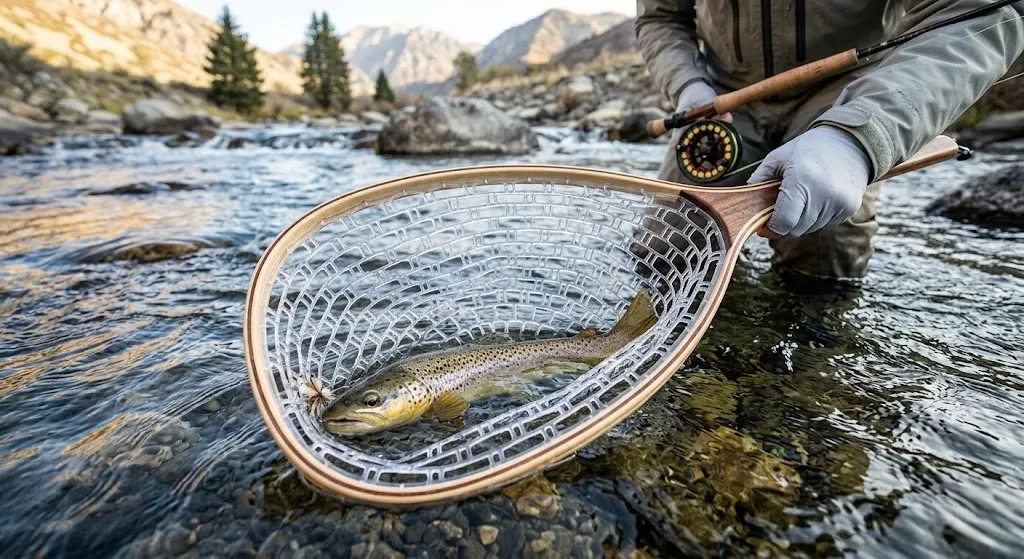
In October 2015, researchers from Carleton University landed 146 brook trout on a Quebec lake using four different nets and their bare wet hands, then checked every fish for frayed fins, missing scales and lost slime. One net came out ahead: the large, knotless rubber mesh. That study is why the best rubber mesh fly fishing net for trout is worth buying before another fly box. For roughly $25 to $50 it improves the part of catch and release you control most.
Two jobs here. First, what knotted nylon and knotless rubber each do to a trout, with the real figures. Then three rubber nets compared from their published specs and current Amazon listing data: an everyday wading net, a cheaper one, and a long-handled net with a bigger hoop.
Quick Picks: Rubber Mesh Trout Nets Compared
| Product | Best For | Price Range | Our Rating |
|---|---|---|---|
| SF Fly Fishing Landing Net | Best overall | $30-35 | 4.6 / 5 |
| SEASPRO 23.6-Inch Rubber Fly Fishing Net | Best budget pick | $25-30 | 4.2 / 5 |
| Aventik Long Handle Landing Net | Boats and bigger trout | $50-55 | 4.4 / 5 |
Our Rating is Bushwhack's editorial score, weighing specs, price, included kit and how many buyers have rated the net. It is not the Amazon star rating, which is given in each section.
Rubber vs Nylon Mesh: What the Brook Trout Study Found
The study is Lizée and colleagues, published in the North American Journal of Fisheries Management in 2018. The fish averaged 310 mm, a hair over 12 inches. The four nets were a large knotless rubber mesh (25 mm openings), a knotless nylon micromesh (2 mm) sold as a "trout net," a large knotted polypropylene mesh (40 mm), and a small rubber-coated nylon mesh (6 mm).
Slime first. Mucus loss showed up on 7% of the trout landed in the rubber net. In the nylon micromesh it was 32%, and the knotted mesh, the rubber-coated nylon and bare wet hands all landed between 23% and 30%.
Fins told a different story. The knotted polypropylene was the only mesh that caused significant fin fraying, raising the odds 5.20 times compared with wet hands. And the soft nylon micromesh, the one marketed for trout, tangled hooks on 68% of landings and produced the longest average handling time of anything tested: 52.6 seconds, against 23.4 seconds for bare hands.
So the non-rubber nets fail two ways, depending on which one you own. Knots and coarse twine frayed fins (that net was knotted polypropylene, the same build as most cheap knotted nylon nets). Fine, soft nylon micromesh grabbed hooks and had the highest rate of slime loss. The authors' own summary: "We concluded that the large, knotless rubber mesh was the least damaging to Brook Trout."
Some caveats, because this study gets exaggerated a lot. Each net was used on only about 30 fish, and the rubber net's slime advantage fell just short of statistical significance on its own. The anglers used treble hooks on inline spinners, not single barbless flies. Every net, rubber included, meant longer handling than bare hands, largely because those trebles caught in the mesh. And no fish died: every trout survived an hour in a holding pen, so anyone quoting a mortality percentage for rubber versus nylon didn't get it from here. The study measured damage.
| What it does to the trout (and you) | Knotted mesh (polypropylene in the study) | Knotless nylon micromesh | Knotless rubber |
|---|---|---|---|
| Slime coat | Mucus loss in the 23-30% range in the study | Worst tested: 32% of fish | Best tested: 7% of fish |
| Fins | 5.20 times the odds of fin fraying vs wet hands | No significant fraying; tiny mesh supports the fins | No significant fraying, though fins can poke through big openings |
| Scales | Lowest scale loss in the study (3% of fish) | Highest scale loss (21% of fish) | Low; the authors say it minimized scale loss |
| Gills and jaw (general guidance, not measured) | Knots and thin twine can catch under a gill plate or around the jaw | Soft, but tangled hooks mean more handling near the head | Smooth, thick strands with nothing to wedge under a gill plate |
| Hook tangling | Treble hooks tangled in every mesh tested | Hooks tangled on 68% of landings; 52.6 second average handling | Reduced tangling, per the authors |
| Weight | Lightest bag when dry, heavier once soaked | Light, also soaks up water | Heaviest bag; more drag in current |
| Drying and smell | Holds water; mildews if stored wet | Holds water and fish slime | Sheds water; wipe it and it's dry |
The agencies land in the same place without the numbers. NOAA Fisheries lists "Wet, soft knotless mesh or a rubber landing net" in its catch and release best practices, noting they "cause less damage to a fish's eyes, fins, scales, and protective mucus coating." Keep Fish Wet explains why slime matters: contact with dry, hard or rough surfaces can remove slime and scales, leaving fish more open to disease, fungal infections especially.
One opinion the study backs up: rubber-coated nylon is not a rubber net. The coated mesh in the test sat with the worst performers on slime and scale loss. If a listing says "rubber coated," keep scrolling until you find a bag that is rubber or silicone all the way through. One limit: the study tested a single rubber net with 25 mm openings, and the authors say mesh size and material could not be pulled apart, so it does not tell you whether small-hole rubber is better or worse than big-hole rubber.
SF Fly Fishing Landing Net: Best Overall

The SF is the net most trout anglers should buy and stop thinking about. Per the listing, the hoop measures 15.1 x 10.8 inches on a handle of about 8.5 inches, the frame is laminated bamboo and hardwood, and the bag is clear rubber with small openings. The listed weight is 0.36 kg, a bit over three-quarters of a pound.
You might also enjoy: When to Stop Fishing for Trout: A Water-Temperature Decision Tree for Summer
What separates it from the pile of lookalike wooden nets is the kit. A magnetic release and a coiled lanyard come in the box, clipped to a copper swivel ring on the handle. SF lists the cord at 13.7 inches relaxed, stretching to 100 inches. It also has by far the deepest pool of buyer feedback of the three: 4.6 stars across 1,276 Amazon ratings when checked in November 2026.
Who it's for
Wading anglers on small to mid-size rivers whose fish mostly run 8 to 18 inches.
Pros & Cons
- Pro: Clear rubber bag, not listed as coated nylon
- Pro: Magnetic release and coiled lanyard included
- Pro: 15.1 x 10.8 inch hoop covers most stream trout
- Con: 8.5 inch handle is short for boat or high-bank use
- Con: The listing gives no bag depth
Price: $32.00 when checked. See the SF Fly Fishing Landing Net on Amazon.
SEASPRO 23.6-Inch Rubber Fly Fishing Net: Best Budget Pick

Cheapest of the three, and it still ships with a magnet. The SEASPRO's listing gives overall dimensions of 23.62 x 11 inches, a wooden frame and handle, clear rubber mesh with 1 x 0.4 inch openings, and a magnetic release with a quick-release clip and coiled lanyard. The description says the wooden frame floats.
The trade-off is information. SEASPRO publishes an overall length and width but not separate hoop, handle or depth figures, and the weight is listed two ways (0.75 lb in the description, 0.45 kg in the spec table). It held 4.4 stars across 157 Amazon ratings when checked in November 2026, a shorter track record than the SF.
Who it's for
Newer anglers, a spare net for the truck, or anyone getting a kid set up for catch and release without spending much.
Pros & Cons
- Pro: Lowest price of the three
- Pro: Magnetic release and coiled lanyard included
- Pro: Rubber mesh with small 1 x 0.4 inch openings
- Con: No separate hoop, handle or depth measurements published
- Con: Fewer ratings and a lower average than the SF
Price: $25.99 when checked. See the SEASPRO rubber fly fishing net on Amazon.
Aventik Long Handle Landing Net: Best for Boats and Bigger Trout

Reach is the whole point. Aventik lists a 20.08 inch handle, a 13.78 x 18.5 inch hoop and a 10.63 inch bag depth, for 38.58 inches overall. That's more than double the SF's handle and a longer hoop, which is what you want from a drift boat, a raft or a tailwater where a 20-inch brown is a real possibility.
Per the listing, the frame is laminated bamboo and hardwood, the mesh is clear rubber with small holes, and the handle carries inch marks for a quick measurement. A magnet is included. The listed weight is 548.85 g, about 1.2 pounds, and that's a lot to hang off a vest all day. Amazon buyers rated it 4.6 stars across 94 ratings when checked in November 2026.
You might also enjoy: Blue-Lining for Wild Brook Trout: The Cool-Water Refuge Play for Summer Heat
Who it's for
Boat and raft anglers, stillwater fly fishers working from a pram or dock, and waders on big rivers who don't mind extra length on their back.
Pros & Cons
- Pro: 20.08 inch handle for reaching from a boat or high bank
- Pro: 13.78 x 18.5 inch hoop with a published 10.63 inch depth
- Pro: Inch marks on the handle
- Pro: Magnetic release included
- Con: About 1.2 pounds, the heaviest here
- Con: 38.58 inches overall snags brush on small streams
- Con: Costs roughly twice the SEASPRO
Price: $51.99 when checked, for the "Long Handle/Small Hole Net" option. See the Aventik long handle landing net on Amazon.
What Size Net Do You Need for Trout?
Match the hoop to the biggest fish you realistically expect, not the fish you dream about. A workable rule: get a hoop about as long as that fish, or a little shorter, since a trout curls into the bag. For small-stream trout under 12 inches, a 12 to 14 inch hoop is plenty. For the 12 to 18 inch fish most rivers produce, 15 to 17 inches. If 20-inch trout are a regular thing where you fish, go 18 inches or longer and accept the bulk.
Depth matters less than people think, and more is not better. The National Park Service's catch and release guidance puts it this way: "Large frames with shallow nets made of rubber or small, soft, knotless mesh are best." A bag that's too deep folds a trout into a U. Somewhere around 8 to 12 inches lets a trout lie in the water with the hoop held at the surface.
Handle length: wading vs boat
Wading, the fish ends up at your knees, so an 8 to 10 inch handle is all you need and anything longer just swings into your legs and catches willows. From a drift boat, raft or tall bank you're reaching down and out, and 20 inches or more saves you from lunging over the gunwale. Buy the handle for where you fish most days.
Do You Need a Magnetic Net Release?
If you wade, yes. A magnetic release is two magnets: one clips to the D-ring at the back of your vest or pack, the other to the net handle. A firm tug frees the net with one hand while the other keeps the rod high.
The magnet alone isn't enough, though. Brush pulls nets off magnets, and a net that falls in fast water is gone, so pair it with a coiled lanyard or a retractor. Coiled lanyards are simple and stretch a long way. Retractors spool a thin cord inside a housing and stay tidier, but the cord is shorter and the spring is one more thing to fail. All three nets above include a magnet, and the SF and SEASPRO listings also name a coiled lanyard.
How to Net and Release a Trout
- Dunk the net before the fish gets close, because NOAA's guidance specifically calls for a wet net and a dry bag is just another dry surface.
- Get the trout's head up and slide it head first over a net you're holding still under the surface, since chasing it from behind with a stabbing scoop is how tippets break.
- Keep the bag in the water with the fish facing into the current, so it's breathing the whole time you're working.
- Take the hook out while the trout is still in the net, using forceps if you need them; with a barbless fly, a little slack often does it for you.
- If you want a photo, lift the fish just above the water with wet hands, keep your fingers away from the gills, and be quick: NOAA says under 60 seconds of air is ideal, and Keep Fish Wet warns that as little as 10 to 20 seconds can harm some species.
- Dip the rim and let the trout swim out on its own once it's upright and you can see its gills working.
Our Pick: The Best Rubber Mesh Fly Fishing Net for Trout
Buy the SF Fly Fishing Landing Net. Its hoop fits the trout most anglers actually catch, the bag is rubber, the magnet and lanyard are in the box, and no other net here comes close to its volume of buyer ratings. Go with the SEASPRO if every dollar counts, and the Aventik if you fish from a boat or your river grows fish that won't fit a 15 inch hoop.
Fishpond's Nomad nets are the usual premium step up, at several times the SF's price. The two Nomad listings checked for this post each had fewer than 40 Amazon ratings, under the bar every net ranked here had to clear, so they aren't ranked. A trout can't tell a carbon frame from a bamboo one. It can tell rubber from knots.
Want to see what your trout days have in common? Try Bushwhack to log each trip and read your own patterns over a season.
Going fishing? Write it down.
Bushwhack is a free fishing log that fills in the weather, moon and pressure for you, then shows which spots, flies and conditions actually produce. Blank days included.
Get fishing tips in your inbox
New guides, seasonal tactics, and gear picks, about once a month, no spam.