Best Hand Ice Auger Under $100 (2026): Only One Name Brand Actually Qualifies
 Hudson Reed
Written by Hudson Reed
The Eskimo hand auger was supposed to be the third leg of this comparison, and every size of it reads "Currently unavailable" on Amazon as I write this in early September. So I went to price the two StrikeMasters instead, and the numbers reframed the whole post. The best hand ice auger under $100 isn't a matchup. It's the StrikeMaster Mora at $58.05, because the Lazer's own Amazon listing reads $122.15 and no size of it clears the cap.
One pick, then, plus one honest over-budget step-up and one $20 part that matters more than either of them. If you worked through our two-budget ice fishing cost breakdown, the auger is the biggest hardware line on the cheap build, bigger than the rod and reel combo and several times what a decent pair of ice cleats runs. The back half of this covers the cordless-drill adapter, which is the move that makes a $58 hand auger worth owning even if you know you'll want power eventually.
| Product | Best For | Price | Rating |
|---|---|---|---|
| StrikeMaster Mora 6-Inch | First auger, panfish and walleye, most anglers | $58.05 | 4.7 / 5 (1,173 ratings) |
| StrikeMaster Lazer 6-Inch | Over-budget step-up for all-season hand drilling | $122.15 (over the cap) | 4.7 / 5 (554 ratings) |
| Mormysh Bearing Drill Adapter | Converting the Mora to cordless-drill power | $19.99 | 4.3 / 5 (98 ratings) |
| Ahuliao Stainless Drill Adapter | Cheapest working conversion for wing-bolt augers | $12.99 | 4.4 / 5 (54 ratings) |
StrikeMaster Mora 6-Inch: Best Overall Under $100

Powder blue, six pounds, $58.05 for the 6 inch. The bigger Moras share one listing that spans $58.05 to $109.99 across the 6, 7 and 8 inch sizes, so check the size selector on the page instead of assuming the 8 inch is a couple of dollars more. It isn't always. The Mora has been the default first auger for so long that StrikeMaster's own product page leads with "time-tested," and 1,173 Amazon ratings averaging 4.7 stars say the same thing in more words.
The blades are high-alloy carbon steel per the spec sheet, and they're the flat, forgiving kind. Flat blades don't grab when you break through the bottom of the hole, they shrug off the grit that lives in a refrozen hole, and a replacement set is a stock Amazon item you swap with a screwdriver. The trade against the Lazer is straightforward: flat blades chip rather than shave, so the Mora is slower per hole, and in exchange it is the one that behaves the same on grit, on refrozen holes, and on the last inch before breakthrough.
Six inches is the right size, whatever the 8 inch happens to cost on the day you look. An 8 inch hole is only a third wider, but you cut area, not width, so it moves nearly 80 percent more ice on every turn. On a first-ice morning where you're punching 20 holes to find the school, that difference is a sore shoulder. A 6 inch hole passes any walleye you'll catch through it.
Who it's for
Anyone buying their first auger, fishing mostly early ice or panfish and walleye, or planning to add a drill adapter later. That's most people reading this.
Pros & Cons
- Pro: $64 cheaper than the Lazer, and actually in stock
- Pro: flat blades resist grit and don't grab on breakthrough
- Pro: replacement blades are cheap and everywhere
- Pro: 6 lbs for the 6 inch, per StrikeMaster
- Pro: handle adjusts from 48 to 57 inches
- Con: noticeably slower cutting than the Lazer in thick ice
- Con: carbon steel blades want a wipe-down before they go back in the truck
Price: $58.05 for the 6 inch. Check price on Amazon
StrikeMaster Lazer 6-Inch: The Over-Budget Step-Up at $122
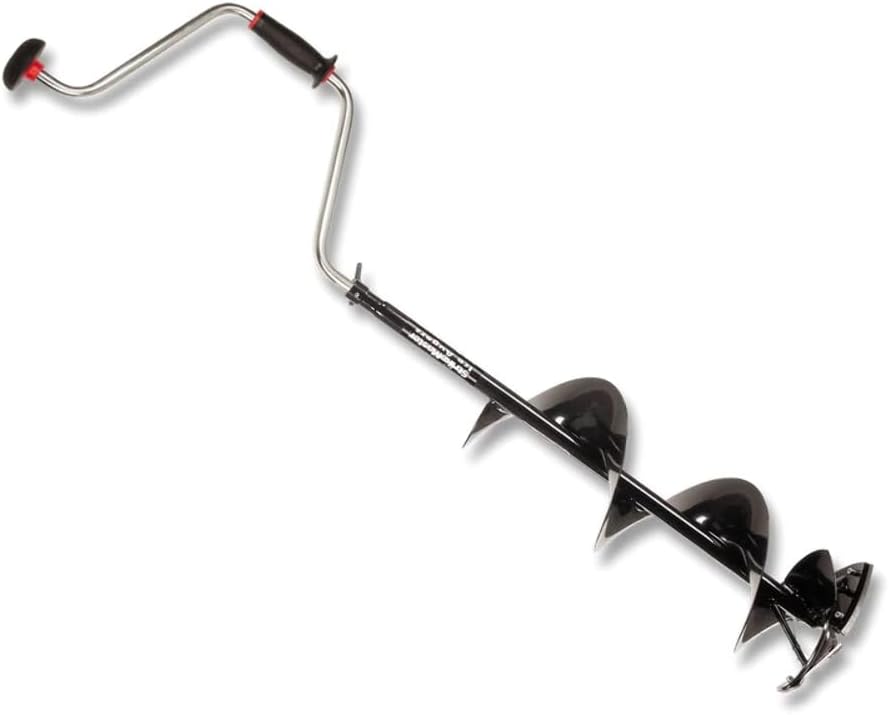
$122.15 for the 6 inch, which is $22 past the line this post is built around and $64 more than the Mora. I'm keeping it in here anyway, because every Mora buyer eventually asks whether the faster blades are worth going over budget for, and the answer deserves a straight number rather than a shrug.
What the money buys is the blade. StrikeMaster lists chrome-alloy stainless steel Lazer blades, and they're curved shaving blades rather than flat chippers. The catalog compares them to throwing stars, which is marketing, but the forum consensus isn't: anglers who've owned both describe the Lazer going through ice "like a knife through butter" while the Mora chews.
So, worth the stretch? Almost never. If you fish first ice and last ice, punch a dozen holes a trip, and quit hand-drilling once the ice gets past a foot, the extra $64 buys speed you'll barely register. It's worth it for exactly one angler: the person who hand-drills 14 inch February ice every weekend and refuses to carry a drill. That's a narrow window, and the $64 buys a bearing adapter plus most of a spare battery for everybody else.
Two knocks, both from owners. The shaving blades hang up on breakthrough more than the Mora's flat blades do, so you learn to ease off on the last inch. And that razor edge is easier to damage: hit sand or a refrozen slushy hole and you'll feel it on the next one. Keep the blade cover on. Weight is 6.5 lbs for the LD-6 per StrikeMaster, a half pound over the Mora, and you won't notice.
Who it's for
The angler hand-drilling thick ice all season, who won't bolt on a drill, and who has the budget to ignore the $100 line entirely.
You might also enjoy: Best Base Layers for Cold Weather Fishing Under $75: Merino vs Synthetic vs Grid Fleece
Pros & Cons
- Pro: markedly faster per hole than the Mora, per owners of both
- Pro: stainless blades, no rust worry
- Pro: 6.5 lbs for the LD-6, per StrikeMaster
- Con: $122.15, so it blows straight through a $100 budget
- Con: shaving blades chip easier than flat blades
- Con: grabs on breakthrough until you learn the feel
Price: $122.15 for the 6 inch. Check price on Amazon
Why isn't the Eskimo hand auger on this list?
Because every Amazon listing for it showed "Currently unavailable" when this was written, and we don't link products you can't buy. On paper it belongs here: Eskimo publishes 6.5 lbs for the 6 inch and 7.5 lbs for the 8 inch, with dual flat stainless blades and a cross-bolt takedown that can't be over-tightened. If a farm store has one for $50 to $60 this fall, it's a legitimate Mora alternative. Just don't pay Lazer money for it.
How thick can a hand auger realistically drill?
Comfortably to about 8 inches, tolerably to 14, and past 16 inches you're doing it because you have to. Those numbers are for a 6 inch auger. Bump to an 8 inch bit and slide every one of them down. One Michigan Sportsman poster put it about as well as anyone: he runs the 8 inch until the ice gets past 8 or 10 inches, then goes back to the 6.
The handle isn't the limit; both StrikeMasters adjust from 48 to 57 inches. Your shoulders and your hole count are. Ten holes through 6 inches of first ice is a warm-up. Ten through 18 inches is the workout that sells cordless augers.
The Minnesota DNR's guidelines for new, clear ice are 4 inches for foot travel, 5 to 7 for a snowmobile or small ATV, and 7 to 8 for a side-by-side. The hand auger's sweet spot sits right where you're walking out anyway, which is also where a set of ice cleats stops being optional. Log the thickness you drilled through alongside the fish in Bushwhack and by year three you'll know which week your lake locks up.
Mormysh Bearing Drill Adapter: Best Drill-Adapter Play

$19.99, and this is the piece that changes the math on everything above. Pull the handle off the Mora, drop this adapter into the shaft, chuck it in a cordless drill, and you have a powered auger for $78 plus a drill you probably already own.
It's the two-bearing style: the hex bit spins inside two bearings, so the drill isn't taking the full side load every time the blades bite unevenly. Per the listing it fits augers with a 0.720 inch (18 mm) inside shaft diameter, which the maker names as Mora and Lazer plus Eskimo, and it wants a 1/2 inch chuck on an 18V drill. Zinc-plated carbon steel, not stainless.
Read that shaft diameter twice. Auger shafts come in roughly 3/4 and 7/8 inch inside diameters (18 and 22 mm), and an adapter for one rattles or won't seat in the other. StrikeMaster's own two-stage adapter lists only the 7 and 8 inch Lazer hand augers as compatible, and it was unavailable on Amazon when I looked. Measure, then order.
Who it's for
Anyone who already owns a real 18V or 20V brushless drill. If that's you, buy the Mora and this adapter and forget the Lazer exists. The drill erases the cutting-speed gap that is the Lazer's entire argument, and the adapter costs about a third of what that gap costs you.
Pros & Cons
- Pro: bearings take side load off the drill chuck
- Pro: turns a $58 hand auger into a powered auger for under $80 total
- Pro: fits the 0.720 inch shaft on both StrikeMasters
- Con: fits 18 mm shafts only, so measure first
- Con: zinc-plated carbon steel, not stainless
Price: $19.99. Check price on Amazon
Ahuliao Stainless Drill Adapter: Budget Adapter

$12.99 and dead simple: a machined 304 stainless slug with a 1/4 inch cross hole, so the wing bolt that normally pins your handle to the shaft pins the adapter instead. Hex end into a 1/2 inch chuck. The listing names StrikeMaster, Mora, and Eskimo augers that use a 1/4-20 wing bolt.
You might also enjoy: How Much Does It Cost to Start Ice Fishing? Two Budgets, Priced Line by Line
There's no bearing. Every bit of wobble goes into your drill's chuck and gearbox, fine for a dozen holes on a Saturday, less fine as a habit. Fifty-four ratings at 4.4 stars is a thin sample, so treat the score as provisional. What it has over the Mormysh is that the wing bolt physically retains it, one less way for the auger to go down the hole if the chuck loosens. Clip a lanyard on regardless.
Who it's for
The angler who wants to try the conversion for the price of a bag of jigs, or who fishes six times a winter with a spare drill.
Pros & Cons
- Pro: cheapest working conversion here
- Pro: 304 stainless, rustproof
- Pro: wing bolt retains it in the shaft
- Con: no bearing, so the drill eats the side load
- Con: only 54 ratings so far
Price: $12.99. Check price on Amazon
What drill do you need to run a hand auger?
An 18V or 20V brushless drill with a 1/2 inch chuck, a side handle, and at least 700 inch-pounds of torque. Those aren't my numbers. Jiffy's cordless conversion kit spec sheet calls for a brushless motor, a side stabilizer arm, a 1/2 inch chuck, an 18V 4Ah battery or better, and a minimum of 725 inch-pounds. In-Depth Outdoors threads settle on the same 700 floor, with regulars suggesting closer to 1,200 if you insist on an 8 inch bit.
Run it in low gear and keep the hammer function off, since hammer mode pounds the blades rather than turning them. Then let the drill breathe. Heat is what kills these conversions, so give it a rest every five to seven holes instead of drilling a dozen back to back.
The unpopular part: if you don't already own that drill, the adapter play is a wash. A qualifying brushless drill and battery is a $200 to $300 purchase, and a $58 auger plus a $20 adapter plus a $250 drill is a $330 electric auger with worse ergonomics than the purpose-built ones. The conversion is a great deal for people with the drill already in the garage. It's a bad excuse to buy one.
Blade type, hole size, and weight: the three specs that actually matter
Blade type is the entire Mora-versus-Lazer question. Flat blades (Mora, Eskimo) chip the ice and tolerate grit; curved shaving blades (Lazer) slice it and don't. Flat for a first auger. Curved for the angler who already knows they hate hand drilling in February and has decided to pay for the fix.
Hole size is 6 inches unless you have a reason. Pike and lake trout anglers have a reason. Everyone else is trading close to 80 percent more ice per hole for room they'll never use.
Weight barely separates these two: StrikeMaster lists 6 lbs for the Mora MD-6 and 6.5 for the Lazer LD-6. The 8 inch versions jump to 8 and 8.5 lbs, another small argument for staying at six.
Our Pick for the Best Hand Ice Auger Under $100
Buy the StrikeMaster Mora 6-Inch at $58.05. It wins partly by default, since it's the only name-brand hand auger I could verify under the cap, and it would still be the recommendation at a tie. Put the $64 you didn't spend on the Lazer toward the Mormysh bearing adapter if there's a brushless drill anywhere in your life. That pairing hand-drills fine on first ice, converts to power in a minute when the ice gets thick, and keeps your total auger spend under $80.
If you'll never run a drill and you fish mid-winter ice every week, the Lazer 6-Inch is the better hand auger. Just go in knowing it's $122.15, not a hair under a hundred. Either way, log which holes actually held fish in Bushwhack so next winter's first trip starts where last winter's best one ended.
Get fishing tips in your inbox
New guides, seasonal tactics, and gear picks — about once a month, no spam.