How Much Does It Cost to Start Ice Fishing? Two Budgets, Priced Line by Line
 Hudson Reed
Written by Hudson Reed
StrikeMaster's own store still lists the Mora hand auger at "From $79.99" and shows every size out of stock as I write this. Amazon has the 6-inch in stock at $58.05 on a 4.7 average across 1,173 ratings, and that one line hasn't moved since August. Nearly everything around it has. Re-pricing this list against what a beginner can actually put in a cart today, instead of what a specialty shop quotes when the season is on, moved the real cost to start ice fishing from $177.59 to $197.51.
Two budgets below. The first comes to $197.51 and gets you drilling holes and catching panfish this winter. The second comes to $458.50 and adds the one item that turns a day you quit at 10 a.m. into a day you fish out. Every price came off the page it links to, checked September 3, 2026. Every total is the arithmetic sum of the lines above it. Nothing got rounded down to look friendlier.
The rule for what gets a link changed on this pass. This post isn't a best-gear roundup, it's a receipt, so I dropped the star-rating and review-count filters and kept one requirement: you have to be able to buy the thing today. Seven of the eight paid lines are on Amazon now instead of two. The eighth sits at Scheels, because there's no in-stock Amazon spud bar worth linking this month, and a retailer with the thing on a shelf beats an Amazon page with no buy box.
Most of the increase is one line. The skimmer accounts for $14.00 of the $19.92, and the spud bar adds $5.00 on top of it after changing retailers, with the last 92 cents spread across the line, the cleats and the combo.
The $197.51 walk-on kit: the real cost to start ice fishing
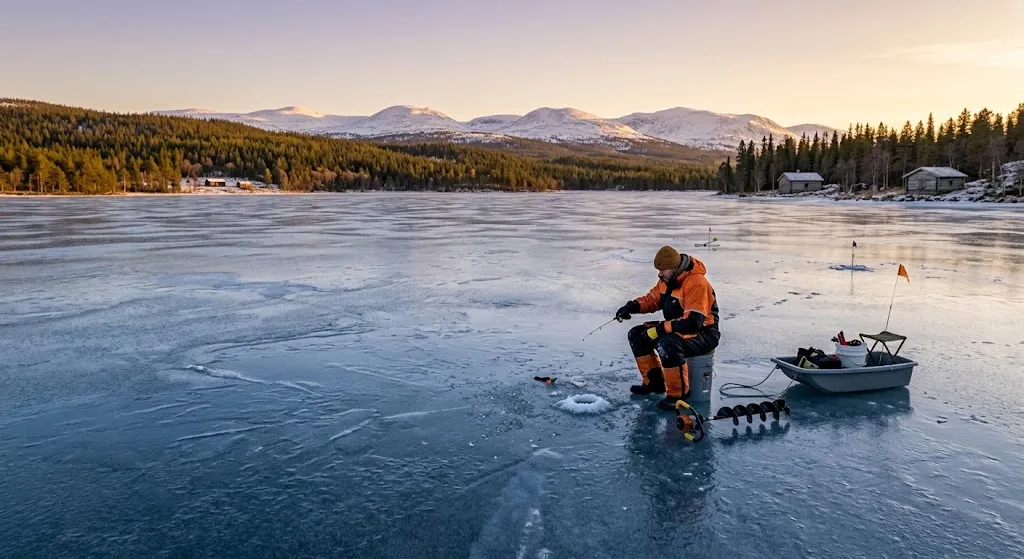
This is the whole list. Eight things to buy, two things to pull out of your garage, and you can walk onto safe ice and catch bluegills and perch with it.
| Item | What I'd buy | Price | Price from |
|---|---|---|---|
| Hand auger | StrikeMaster Mora 6 in. 2-piece hand auger | $58.05 | Amazon |
| Spud bar | Eskimo Redneck Economy Ice Chisel | $49.99 | Scheels |
| Rod and reel combo | 13 Fishing Heatwave Ice Combo, 24 in. ultralight | $27.41 | Amazon |
| Ice skimmer | Frabill Ice Scooper, 30 in. ruler handle | $24.99 | Amazon |
| Jigs and spoons | HT PAJ-16 16-Piece Ice Lure Assortment Kit | $11.49 | Amazon |
| Line | KastKing Premium Monofilament, 8 lb | $8.99 | Amazon |
| Boot traction | Strap-on ice cleats, unbranded | $8.99 | Amazon |
| Ice picks | Frabill retractable ice picks | $7.60 | Amazon |
| Five-gallon bucket | The one holding your driveway salt | $0.00 | your garage |
| Tape measure | The one in your toolbox | $0.00 | your toolbox |
| Total | $197.51 |
Then the license, which almost every startup-cost article skips. Wisconsin's Go Wild resident fee table lists "Fishing, Annual" at $20.00 and "Annual Fishing First-time Buyer (18-64 years old)" at $5.00. So $217.51 for a Wisconsin resident who has bought a license before, or $202.51 if this is your first one in a decade. That table prices the license, not the receipt, since it doesn't say whether an issuing fee lands at checkout. Your state will differ, sometimes by a lot, and it's the one number here you have to look up yourself.
Notice what's in that list and what isn't. The spud bar, the picks and the cleats come to $66.58, which is more than a third of the gear budget spent on not falling through or falling down. That ratio isn't a mistake and it isn't padding. Buy premium versions of those three and you'd have three lines over $50 instead of one, which is exactly the upgrade path I'm telling you to skip. Worth saying plainly that the spud bar clears that line by a single cent at $49.99.
Three lines in that table need a caveat, and none of them is about quality. The lure kit has no rating element on its listing at all, the combo has exactly one review, and the boot traction is an unbranded listing picked on price and on being in stock, where this post used to name HT's Sure Grip treads. One review is a rounding error, so I'm not going to tell you people love these. They're the in-stock option at this price, and in September that's the honest limit of what anybody can say about generic ice gear.
The combo is the line that changed most in character. It's a 24-inch ultralight now, not the 26-inch medium light this post used to name, because the medium light isn't sold on Amazon and the two lengths I'd have preferred are out of stock. An ultralight is a panfish rod, full stop. Better than a medium light for the bluegill, perch and crappie you're actually going to catch, and badly outgunned if a walleye eats your jig. Fair trade at $27.41 for year one. Buy it anyway and add a stiffer stick next winter, once you know which rod you keep reaching for.
The skimmer moved up into the table this pass, which is why that line jumped $14.00. The cheap Eagle Claw skimmer's Amazon listing is a tangled variation page where the size you click isn't reliably the size you get, so the Frabill at $24.99 is the one I can point you at without a warning attached. For the extra fourteen bucks, the tool that clears your hole carries a 30-inch ruler on the handle and measures the ice you're standing on. It was the upgrade pick before. Now it's just the pick.
Why the auger is the only line worth over $50
You cannot fish without a hole, and a hand auger with sharp blades is not a compromise. On the 8 to 14 inches of ice you're typically fishing in December and January, a sharp 6-inch Mora gets through fast enough that drilling is never the reason you quit early. It weighs 6 pounds and the handle adjusts from 48 to 57 inches, both per StrikeMaster's own product page. It never needs a battery charged the night before, and it never leaves you standing on the ice at 6 a.m. holding a dead tool.
You might also enjoy: Best Ice Cleats for Fishing Boots Under $40: Coil vs Chain vs Spike
Size is the part people get wrong, and it isn't a money question. On that one Amazon listing the 6-inch is $58.05 and the 8-inch is $59.99, a spread of $1.94, so you're choosing on cutting effort rather than cost. Six inches passes any panfish, any trout under 22 inches, and most walleyes you'll legally keep, and it turns easier by hand. Get the 6.
Sharp blades matter more than brand. A dull auger of any make is a shoulder workout, and the blade guard that ships in the box exists for exactly that reason.
What does adding a shelter do to the number?
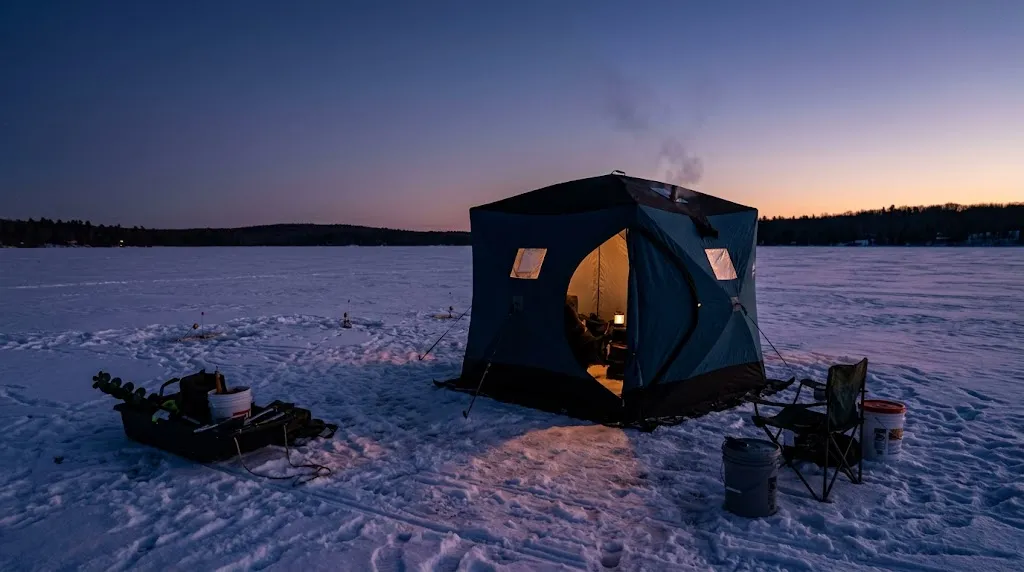
It takes the kit from $197.51 to $458.50, and it's the single best $260.99 in ice fishing. HT lists its Polar Escape Pro 2-person hub shelter at $260.99 on icefish.com, in 300-denier fabric, 59 by 59 inches set up and 67 inches tall at center. Add it to the eight items above and the arithmetic is $197.51 plus $260.99, which is $458.50.
I aimed at $450 for this tier back in August and landed at $469.91, about twenty bucks over. Re-pricing every line lands it at $458.50 instead, $8.50 past the target, and I never had to swap in a no-name pop-up to get there.
What that money buys isn't warmth exactly. It buys the removal of wind, and wind is what ends beginner ice trips. A stiff breeze at 15 degrees is the difference between a pleasant four hours and packing up after 40 minutes with numb hands and one fish. Out of the wind and out of the glare, you also watch your line better, which matters more than people expect when you're jigging a #12 tungsten in 14 feet of water.
The next two purchases after the shelter are a sled and a heater. A shelter bag plus an auger plus a loaded bucket is more than you want to carry a half mile, so you want the sled. The Shappell Jet Sled Jr I'd normally send you to is out of stock everywhere I can verify, and it was $44.99 for the 42-inch model at Blain's Farm & Fleet when it was on the shelf. The in-stock option is the Beavertail Sport Sled at $145.45, which is a lot more sled than a beginner needs. It's a bonus item rather than a requirement, so pay it if you want to solve the hauling problem now, and put the Shappell on your list for when it comes back, because it's the better buy at a third of the money if it returns at that price.
The heater is the easy one. Clam lists the 4,200-BTU CH-4200 at $89.99 on its own site and Amazon has the CLAM Portable Propane Radiant Heater (CH-4200) at $79.99, ten dollars under the maker. That full sequence, kit plus hub plus the $145.45 sled plus the heater, is $683.94, and at that point you own a genuinely comfortable ice fishing operation that most people assume costs three times as much.
Where the money stops buying fish
Somewhere above $500, ice fishing purchases stop increasing your catch and start increasing your comfort, your convenience, and your resale-value problem. Here's what the next tier lists for.
- Clam X-400 hub shelter: $549.99, which is $289.00 more than the HT hub above for the same basic job
- Clam Denali flip-over shelter: $1,299.99
- ICEARMOR by Clam Rise Float Bib: $199.99, the cheapest thing in this tier and the only one on the list that's buying safety rather than comfort
Every one of those is a good product, and none of them will put more fish through your hole than the $197.51 kit will. There's one honest exception, and it isn't a shelter.
Sonar. A flasher or a small sonar unit is the one big-ticket item I think changes your catch rate more than anything else here, because it tells you whether fish are under you at all, and beginners burn entire days jigging over empty water. If you have discretionary money after the walk-on kit, sonar beats a shelter for pure fish count, and a shelter beats sonar for whether you're still doing this in March. Pick according to which one you're worried about.
Four things beginners buy in year one and shouldn't
1. A power auger
The Eskimo E40 Electric Ice Auger, 40v lithium is $499.99 on Amazon, and it solves a problem you don't have yet. You'll drill a handful of holes in a day as a beginner, not forty. Buy the power auger the winter you find yourself annoyed at drilling, which is usually the winter you start running and gunning across a lake for walleyes. It's linked so you can see $499.99 sitting next to a $58.05 hand auger before you click.
You might also enjoy: First Ice Panfish: The Two-Week Window That Outfishes the Rest of Winter
2. A flip-over shelter
The CLAM Fish Trap flip-over shelter runs $599.99, less than half the Denali listed above and the cheapest flip-over worth naming, and it's still the wrong first shelter for a specific reason: a flip-over is a sled you tow, which means it wants a vehicle to get to the lake and reasonable snow conditions to move once you're there. A hub at $260.99 packs into a bag, fits in a trunk, and holds two people. Start there.
3. An underwater camera
The Aqua-Vu Micro Stealth 4.3 lists at $249.99 on aquavu.com, where it's out of stock, and sells for $299.99 on Amazon. Cameras are the fastest way to learn what your jig looks like to a fish. They're also a second screen, a second battery and a second hole to manage, and in stained water they don't show you much at all. It's still a year-three purchase, and paying $50 over the maker's own list price to get one in September is a bad trade.
4. Ice-specific boots
Clam's Sub-Zero X boots are $179.99 on Amazon, $20 under Clam's own $199.99 list, and they're still the wrong first purchase. The warm insulated pack boots already in your closet plus $8.99 of cleats will hold you through a first season. A set of ice cleats will do more for your safety and confidence than $179.99 boots will, because the thing that hurts new ice anglers isn't cold feet, it's a fall onto hard ice with an auger in one hand.
Bibs are the borderline case, and the price moved in your favor. The $199.99 Rise Float Bib is real money, but a float-assist suit is a legitimate safety item and not merely comfort. Paired with those $179.99 boots you're $379.98 into clothing before you own a shelter, which is still most of a hub and a sled. If you already have snowmobile or ski bibs, wear those the first year and put the money toward the hub.
How thick does the ice need to be before you walk out?
The Minnesota DNR's general ice thickness guidelines list "Ice fishing or other activities on foot" at 4 inches, and put anything under 4 inches in the "Stay off" row. Those numbers come with conditions that the DNR states plainly and that I'm not going to paraphrase into something softer:
"The DNR does not measure ice thickness on Minnesota lakes. Your safety is your responsibility."
"Ice is seldom the same thickness over a single body of water; it can be two feet thick in one place and one inch thick a few yards away."
"Ice thickness guidelines for new, clear ice only."
"When a layer of snow melts and refreezes on top of lake ice, it creates white ice, only about half as strong as new, clear ice. Double the above thickness guidelines when traveling on white ice."
The detail almost nobody quotes sits further down that same page. The DNR's table for stationary loads parked longer than two hours lists a person standing at 6 inches of minimum effective thickness. Four inches is the walking number. Sitting over one hole for a morning is a stationary load, and by the DNR's own math that wants six. So the number I fish by is 6, not 4.
That white-ice line is why the spud bar is a $49.99 item in the cheapest budget rather than an upgrade. You chip ahead of yourself as you walk, and you measure what you're standing on with the tape from your toolbox, or with the scooper handle. My own rule, not the DNR's: I want more than the minimum on first ice, and I want to have watched somebody else's holes come up thick before I walk out to new water.
This all matters most in the two weeks after ice-up, which is also the best fishing of the winter. That's the tension of first ice: the best bite of the season lands on the thinnest ice of the season. Wait for the 4 inches. The fish will still be there at 6.
A buying order, if you skim nothing else
- Buy the auger, the spud bar, the picks, the skimmer and the cleats first, because those five items are $149.62 of the $197.51 and they're the difference between a safe day and a story.
- Add the combo, the line and the jigs, which is another $47.89, and pull a five-gallon bucket out of the garage to sit on and haul the rest.
- Buy the license in October rather than the morning of your first trip, and look up your own state's fee table instead of assuming Wisconsin's $20.00 applies where you fish.
- Fish it four or five times before you spend another dollar, and write down where you drilled, what depth you found fish, what the ice looked like and what you caught.
- Only then choose between the $260.99 hub shelter and a sonar unit, because by that point you'll know whether wind or empty water is the thing ending your days early.
Those notes are the part people skip and regret. Ice spots repeat harder than open-water spots do, and December 2027 you will want December 2026's numbers. If you don't already keep a log, you can try Bushwhack with a full demo account and no signup to see what that looks like.
The panfish you find under the ice in December are frequently the same schools you were chasing in November, so if you've already worked out where crappie go in the fall, you have a head start on where they'll be at first ice. That knowledge is free. It's also worth more than the $499.99 power auger.
Get fishing tips in your inbox
New guides, seasonal tactics, and gear picks — about once a month, no spam.