Best Dry Fly Floatant (2026): Gel vs Powder, and the Two Bottles to Carry
 Cameron Spanos
Written by Cameron Spanos
If you carry one bottle of floatant, you're carrying half a system. The best dry fly floatant isn't a single product. It's a gel and a powder, used at different moments, and a lot of anglers who swear "floatant doesn't work" are smearing gel on a fly that's already soaked.
Here's the short answer to the gel vs powder floatant question. Gel goes on a clean, bone-dry fly before its first cast. Powder, and especially a desiccant shake, is how you bring back a fly that's already drowned or slimed by a fish. Standard gels like Gink and Aquel shouldn't touch CDC; brush-on or shake powders are the CDC-safe way to go. If you fish winter midge dries, pick a gel that doesn't turn to paste when the air's below freezing.
That last point is where the classic brands split, and it's the reason I'd pick Aquel over Gink for anyone who fishes past October. All five picks below come in under $13 on Amazon, which also makes them about the most useful stocking stuffer you can hand a dry fly angler.
Quick picks
| Product | Type | Best For | Price | Amazon Rating |
|---|---|---|---|---|
| Loon Outdoors Aquel | Gel | All-season gel, winter midges | $9.95 | 4.7 (256 ratings) |
| Gehrke's Gink (with Kingfisher holder) | Gel | Summer hoppers and hackled dries | $12.95 | 4.7 (93 ratings) |
| Loon Lochsa | Gel | A gel that's sold as CDC-safe | $9.95 | 4.7 (102 ratings) |
| Frog's Fanny | Brush-on powder | CDC and delicate dries | $12.05 | 4.6 (84 ratings) |
| High N Dry Powdered Floatant and Desiccant | Shake desiccant | Reviving a drowned fly | $11.99 | 4.7 (123 ratings) |
Prices and Amazon star ratings as of November 3, 2026.
Loon Aquel: Best Gel for Winter Midge Dries

Aquel is the gel I'd hand anyone who asks for one bottle. Loon says on its Aquel product page that the silicone-based gel "won't melt when it's hot or harden when it's cold," and lists "Will not leave oil slick on water" among its features. It's also the official floatant of Fly Fishing Team USA.
The cold-weather claim is the one that matters in November. Winter midge fishing means tiny Griffith's Gnats and cluster dries, numb fingers, and very little room for error when you're dabbing gel onto a hook you can barely see.
Who it's for
Anyone fishing standard hackled dries, parachutes, and foam bugs year-round, and especially anglers who keep fishing dries through the cold months.
Pros & Cons
- Pro: Loon markets it as temperature stable, hot or cold
- Pro: Loon says it won't leave an oil slick on the water
- Pro: Tied with Lochsa for the lowest Amazon price here
- Con: Not for CDC. Loon's own FAQ, asked whether Aquel works on CDC flies, answers "It does not."
- Con: Murray's Fly Shop's floatant comparison lists needing reapplication during longer sessions as a drawback
Price: $9.95 on Amazon ($7.00 on Loon's own site). Check price on Amazon.
Gehrke's Gink: Best Classic Gel for Summer Bugs

Gink is the bottle a lot of us learned on, and it still floats a hopper fine in July. Murray's Fly Shop calls it "a go-to for anglers for decades" and rates it ideal for most standard dry flies.
Winter is where it falls behind. Murray's lists "thick in cold temps" as a con, and Carter Lyles at Yellow Dog Fly Fishing wrote that it's "nearly solid in cold weather and liquid when it's hot." Already own Gink? Keep it in an inside pocket in winter. Buying new? Buy Aquel.
One buying note. The Gink listing on Amazon with real rating volume is the bottle sold together with a Kingfisher floatant holder, and the 93 ratings are shared across that holder's color options (Brook Trout, Brown Trout, Rainbow Trout, and Fall Run Brown Trout). The bare bottle has a separate listing with only a handful of ratings.
Who it's for
Summer and early fall anglers fishing hoppers, Stimulators, and bushy attractors.
Pros & Cons
- Pro: Decades-long track record on standard dries
- Pro: The bundle includes a holder, so the bottle rides on your pack
- Con: Two fly shops describe it thickening in the cold
- Con: Murray's says it can matte CDC fibers
- Con: You're paying a few dollars extra for the holder
Price: $12.95 on Amazon with the holder. Check price on Amazon.
You might also enjoy: Best Beginner Fly Rod and Reel Combo Under $200 (2026): 5 Picks by Price Tier
Loon Lochsa: Best Gel If You Tie With CDC

Lochsa exists because the "never gel on CDC" rule annoys people. Loon's Lochsa page pitches it as "Gel floatant for ALL flies, including CDC" and says that its temperature-stable formula keeps viscosity consistent whether you're "treating indicators in the snow or the dry flies in the summer." It's also one of the three products Loon itself recommends for CDC in its Aquel FAQ.
My take: smart if your box is half CDC and you hate fiddling with powder, but I'd still brush powder into a small CDC emerger and treat Lochsa as the second gel, not the first.
Who it's for
Anglers whose boxes lean on CDC emergers and other soft-winged patterns, who still want a gel.
Pros & Cons
- Pro: Loon sells it as CDC-safe
- Pro: Loon markets it as temperature stable
- Con: Murray's notes it's slightly pricier than standard gels ($10.00 on Loon's site versus $7.00 for Aquel)
- Con: Amazon showed only 13 left in stock when we checked
Price: $9.95 on Amazon. Check price on Amazon.
Frog's Fanny: Best Brush-On Powder for CDC

Frog's Fanny is the powder with the silly name and the brush built into the cap. Yellow Dog's floatant roundup calls it "best for delicate dries and those with CDC," says it "won't mat hackle or hair," and notes it "also traps air bubbles on nymphs to simulate an emerging insect."
Blot the fly, give it a couple of hard false casts, then brush powder into the wing and body. Slower than a shake bottle. More precise, too, which matters on a tiny CDC emerger.
Who it's for
CDC fans, emerger fishermen, and anyone who wants one powder that does double duty on soft hackles and nymphs.
Pros & Cons
- Pro: Brush in the cap puts powder exactly where you want it
- Pro: Safe on CDC, per Yellow Dog's write-up
- Pro: Doubles as an air-bubble trick on nymphs
- Con: Brush powders are messy in a stiff wind
- Con: Murray's flagged a washed-out look on dark patterns as a con for several of the powders it compared
Price: $12.05 on Amazon, and stock on that listing was thin when we checked. Check price on Amazon.
High N Dry Powdered Floatant and Desiccant: Best for Reviving a Drowned Fly

This is the bottle that saves the fly that just caught a fish. You open the flip-top, drop the fly in still tied to your tippet, close it, and shake. High N Dry's product copy (reproduced on RiverBum's listing) describes 30 grams of desiccant and floatant, a wide opening for big bugs, and indicator crystals that change color when the desiccant has absorbed all the moisture it can.
That indicator is the underrated feature, since spent desiccant does nothing. High N Dry's own copy also suggests refloating the revived fly with its gel or liquid afterward, which is exactly the powder-first, gel-second order I'd use.
Who it's for
Anyone who's ever retied a perfectly good fly because it wouldn't stop sinking.
Pros & Cons
- Pro: Shake-and-dry, no fingers on tiny flies
- Pro: Color-change crystals tell you when it's spent
- Pro: The European retailer La Fine Mouche lists it as "Suitable for all types of flies, even CDC"
- Con: Powder can dull fly colors, a point the European retailer La Fine Mouche makes in its own listing
- Con: Bulkier than a gel bottle
Price: $11.99 on Amazon. Check price on Amazon.
You might also enjoy: Winter Midge Fishing: Larva, Pupa, or Cluster Dry? Read the Rise First
Gel vs powder floatant: which one goes on first?
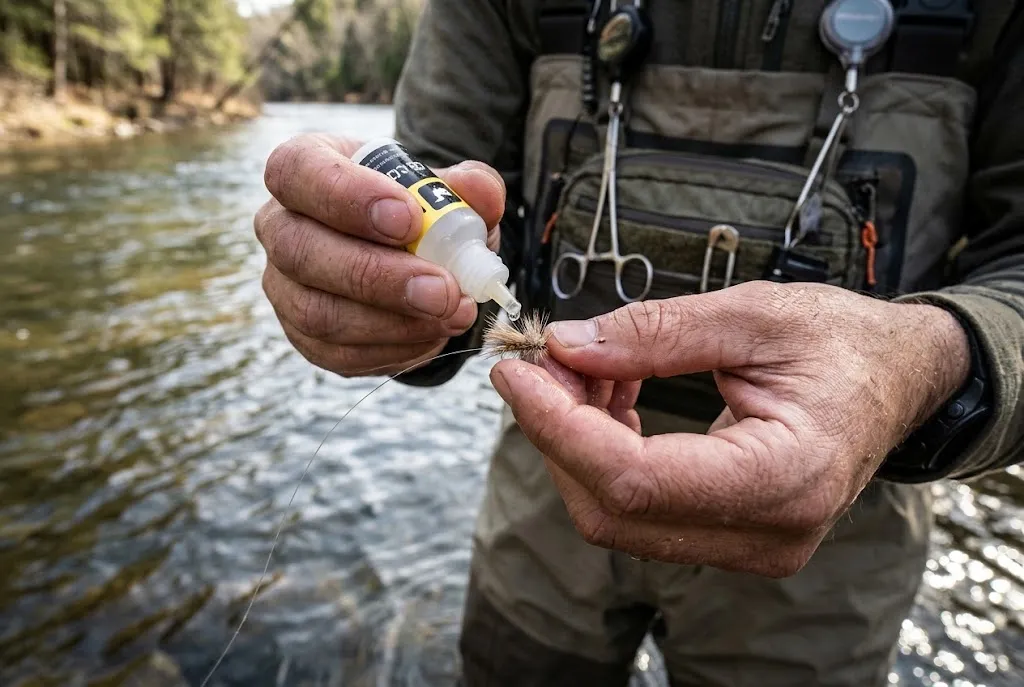
On a new fly, gel only. Put a pea-sized smear (smaller for anything under size 18) on your fingertips, warm it by rubbing, and work it into the hackle and tail before the fly ever touches water. Gel is a pre-treatment for a dry fly, and smearing it on a soaked one is a common reason people decide floatant doesn't work.
On a used fly, powder first, then gel if the pattern can take it. Loon says the same thing about its own desiccant, Easy Dry, which it describes as "best used before applying your preferred floatant." Dry it, then dress it. Never the reverse.
If a fly won't recover after two rounds of shaking, tie on a fresh one.
Can you put gel floatant on CDC?
Not a standard gel. Murray's says Gink can matte CDC fibers, and Loon says flatly that Aquel doesn't work on CDC. The exceptions are gels built for it, like Lochsa. For everything else, use a brush-on powder like Frog's Fanny or Loon Dust, or a shake desiccant.
Loon Dust deserves a mention here. Loon's Loon Dust page calls it "perfect for CDC" and says it gives nymphs an air bubble effect, much like Frog's Fanny. The Amazon listing is thinly reviewed and was nearly out of stock when we looked, so I'd buy it from a fly shop or straight from Loon.
What actually matters when you buy floatant
Temperature behavior
If you fish dries in winter, this is the whole decision. Choose a gel the maker sells as temperature stable (Aquel, Lochsa) over one that two separate fly shops describe as thickening in the cold.
What your flies are made of
Hackle, elk hair, and foam take gel well. CDC and soft hackle want powder.
Whether it can revive a fly
Plain brush-on powders mostly add float; desiccant shakes pull water out. If you buy one powder, get one with desiccant.
If you want to see whether it's the fly or the floatant that's failing, log a few days of it. Jot down the pattern, the conditions, and what stayed up in a fishing log (you can try Bushwhack without an account), and a hunch turns into something you can actually check by spring.
Our pick: the best dry fly floatant is two bottles
Buy these two and stop thinking about it:
- Loon Aquel ($9.95) goes on every fresh, non-CDC dry before the first cast, and Loon says it won't harden when it's cold.
- High N Dry Powdered Floatant and Desiccant ($11.99) revives a drowned fly with a shake, and its crystals tell you when it's done.
That's $21.94 for the pair at today's Amazon prices, which fits in a stocking with room left for tippet. Fish a lot of CDC? Swap the Aquel for Frog's Fanny and leave gel out of the CDC box entirely. And skip buying Gink new unless your dry fly season ends on Labor Day.
Get fishing tips in your inbox
New guides, seasonal tactics, and gear picks — about once a month, no spam.