Bass Fishing July 4 Weekend: Why They Stop Biting (And 4 Spots That Still Produce)
 Hudson Reed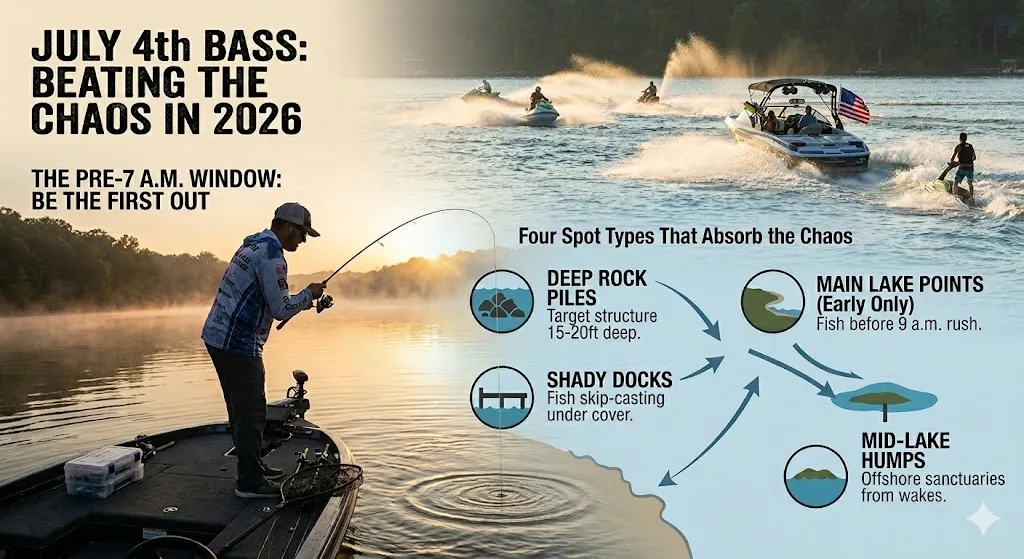
Written by Hudson Reed
July 4, 2026 lands on a Saturday. That detail matters more than most people planning a bass fishing July 4 weekend trip realize. A Saturday holiday means two full weekend days of wake-boat traffic stacked on top of the holiday itself, and the boat ramp at first light is going to look like a Cabela's parking lot in November.
If you've fished a major reservoir on a Saturday-of-July-4 setup before, you already know the script. The bite is on at 5:45. By 7:30 the first pontoon eases out. At 9 you hear the first jet ski. By 10:30 the main lake looks like a washing machine, and by noon your graph is showing nothing but bubbles and confused thermocline. Most anglers blame the heat. The heat is real, but on a holiday weekend the heat is the second-biggest variable. The first one is recreational pressure, and it's a completely different problem than the normal 9 a.m. summer shutdown.
Why bass fishing July 4 weekend is its own problem
The standard summer slow-down is a daily light and temperature pattern. Sun climbs, surface temp creeps up, bass slide down the water column, and the bite tapers. We've covered that elsewhere. Holiday traffic is a different mechanism entirely.
A 2014 study in the Journal of Fish Biology by Jacobsen et al. found that boat noise and recreational disturbance measurably changed lake fish behavior, with fish aggregations becoming "significantly more discrete," meaning tighter, deeper, and less polarized than under ambient conditions. Translation: fish don't just stop feeding when ski boats start running. They physically reorganize. A school of largemouth holding on a 14-foot brush pile at 6 a.m. is at 22 feet by 10 a.m., and not because the sun moved.
Wake-boat ballast and inboard prop wash also push warmer surface water down past where it normally stratifies, which compresses the comfortable zone bass want to sit in. On a glass-calm Tuesday in July your usable column might be 8 to 18 feet. On Saturday of July 4 weekend, after three hours of wake surfers running the main lake at full ballast, that column gets squeezed and shifted, and bass have to relocate to recover.
The other piece, and this is where the average angler gives up, is the cumulative effect. It's not one boat. It's 400 boats over a six-hour window across a reservoir. Bass habituate to single passing engines on heavily pressured fisheries. That's well documented. They do not habituate to sustained 90-decibel chaos that doesn't stop.
What does "the bite is dead" actually mean on July 4?
Two things. Either the fish moved to a structure you weren't fishing, or they're still there and they've shut their mouths. The second one is harder to fix. The first is what this post is about.
Four spot types tend to keep producing while the rest of the lake goes quiet. None of them are secret. What's underrated is why they hold up under holiday-specific pressure, which dictates how you fish them.
Spot 1: Muddied wind-blown banks (the underrated holiday gold mine)
If there's any sustained wind on Saturday morning, find the bank it's blowing into and stop fishing anywhere else. This is the single highest-percentage holiday weekend spot.
Wind-blown banks compound three things that hold bass through chaos. The waves stir sediment and create mudlines, which kills the visibility that recreational traffic relies on to spook fish. The wave action oxygenates the top three feet of water, which becomes critical once the rest of the lake gets churned and thermally scrambled. And the wind itself pushes plankton, then shad, then bass into a predictable feeding zone.
Boat traffic actually amplifies this pattern. The wakes coming off the main channel hit the wind-stacked shoreline and extend the mud line another 10 to 20 yards out from the bank. By 10 a.m. on a busy lake you have a stained-water highway running parallel to the windward side, and bass will set up in it like they own the building.
Throw something with vibration and a clear silhouette. A 1/2-ounce double willow-leaf spinnerbait in chartreuse-and-white is the workhorse. A squarebill in a loud crawfish pattern works just as well. If you're picky about lure choices, this is one of the few summer scenarios where I'd rather fish a chartreuse spinnerbait than a green pumpkin worm, and I'd argue people leave fish on the table on holiday weekends specifically because they refuse to put down finesse gear.
You might also enjoy: Best Kids Fishing Rod and Reel Combo for 2026: Dock Demon vs Ugly Stik GX2 vs PLUSINNO
Spot 2: Deep ledges directly beneath the ski-boat lanes
This sounds wrong. It isn't.
Main-lake ledges in 18 to 28 feet of water (the same ledges you fished in late June with a deep crank) get a strange protective effect on holiday weekends. Wake boats run the channel above them, but the bass holding on the drop are below the depth at which prop wash and ballast pressure meaningfully reach. They feel the noise. They don't get displaced.
The bonus: the shad that were schooling shallower on weekday mornings get pushed off the bank by the traffic and stack on those same ledges. You end up with concentrated bait and concentrated bass in 22 feet of water on a structure most weekend anglers won't fish because it looks too "busy" up top.
Fish heavier than you would on a quiet day. A 3/4-ounce football jig with a craw trailer, a 1/2-ounce drop shot rigged on 12-pound fluoro, or a magnum flutter spoon. The 8- to 11-inch worm rigged with a 1/2-ounce weight that the Karl's Bait & Tackle crew has been preaching for years is the right tool on these ledges specifically because it pulls big-fish reaction bites without spooking smaller suspended ones.
The trick is positioning. Don't anchor in the channel. Pull off to the side, point your boat at the ledge, and live with the fact that ski boats are going to roll wakes through your fishing area every four minutes. The fish are below the wakes. You're fine.
Spot 3: Creek arms with cooler inflows
A creek arm with even a trickle of inflow holds two advantages on a holiday Saturday that no other spot on the lake combines.
The inflow itself is 4 to 8 degrees cooler than the main lake by mid-morning in July, which gives bass a thermal refuge that nothing else on the reservoir provides. And creek arms, particularly the back third, are physically protected from main-lake wake traffic. Wake boats can't run them. Jet skis can but rarely do. By 11 a.m. on July 4 weekend, the back of a creek arm with current is often the most peaceful 200 yards of water on the entire lake, and the bass know it.
The fish that move into creek arms on holiday weekends aren't always the resident creek-arm population. You'll catch transient fish that pushed in from the main lake when the noise got bad. They tend to be aggressive because they just relocated and they're trying to re-establish a feeding pattern fast.
Fish the inflow itself, any laydowns the creek has, and the first major bend going back. A weightless senko, a 1/4-ounce swim jig in shad, and a chatterbait in white-and-chartreuse will cover everything you need.
Spot 4: Shaded bluff walls on the side away from the main channel
Bluff walls are the spot that holiday weekend anglers don't think of because they're vertical and they look featureless. They're the best vertical structure on the lake for a reason.
A north-facing bluff wall on a hot Saturday holds shade from roughly 10 a.m. through 4 p.m., which lines up perfectly with peak boat traffic and peak heat. Bass suspend off the wall at 12 to 20 feet, holding on whatever bait the upwelling pushes against the rock. Wake-boat traffic on the channel side doesn't reach them because the wall absorbs and reflects the noise back into the main lake.
You might also enjoy: Best Braided Fishing Line for Bass and Inshore 2026: Power Pro vs Sufix 832 vs Daiwa J-Braid
The fish here tend to be bigger. Fewer bites, larger average. This is the spot to throw a swimbait or a jerkbait you wouldn't normally throw in summer. A 6-inch hollow-body swimbait rigged on a 3/4-ounce head, fished slow down the wall, gets the eat. So does a deep jerkbait paused on the count of eight.
One contrarian note: skip the bluff wall on the side the wind is blowing toward. You want the calm, shaded face. The opposite face from the wind-blown bank in Spot 1. Bluff walls and wind-blown banks are mirror-image spots on the same day, and a lot of anglers pick wrong and fish the wind-hammered cliff side that has neither shade nor bait against it.
The fish-by-7, off-by-11 game plan
The single most useful change you can make for July 4 weekend doesn't involve gear. It involves a clock.
From roughly 5:30 to 8:30 a.m., bass are in their normal summer dawn feeding window: low light, surface activity, shallow positioning. That window exists every summer day. What's different on the holiday is the back end: instead of slowly fading as the sun climbs, the bite gets shut off by traffic at a specific moment.
On most reservoirs that moment is between 9:00 and 10:30, depending on how close the public launch is and how popular the lake is. By 11 a.m. you are fishing a different lake than the one you launched on. The Karl's Bait & Tackle crew puts the cutoff at roughly 10 a.m. on Saturday mornings in July, which matches my experience on every major Tennessee Valley and Ozark reservoir I've fished.
The plan, in order:
- Be on the water no later than 5:15 a.m., ideally with the boat already in and the rods rigged the night before. The launch line at 5:30 on July 4 Saturday is a 40-minute event, and that's 40 minutes of prime topwater you're losing to a queue.
- Run your dawn pattern until 8:30. Wind-blown bank if there's any wind, otherwise main-lake points and shallow brush. Throw a Whopper Plopper, a buzzbait, or a popper. This window puts your biggest fish of the day in the boat.
- At 8:30, transition. Move to either the deep ledge pattern (Spot 2) or the bluff wall pattern (Spot 4), depending on which way the wind is going. Drop to the football jig, drop shot, or swimbait.
- From 10:00 to 11:00, fish the creek arm. This is when the main lake is loudest and the creek is quietest by the biggest margin of the day.
- By 11:00, be off the water or done targeting bass. Fishing 11 to 5 on Saturday of July 4 is a frustration tax with a poor return.
- Optional evening session: launch again at 7 p.m. and fish until dark. The back end of the day produces, but it produces less reliably than dawn because the water column is still thermally scrambled from six hours of wake-boat traffic. Treat evening as a bonus, not a primary session.
What about night fishing on July 4 itself?
Most of the year I'd push you toward night fishing for summer bass. On the holiday, I'd argue against it on any lake with public fireworks. Booms and post-firework boat dispersal keep bass jittery deep into the night. Bank the effort for the July 5 dawn session instead. It's usually the best bass day of the entire weekend: Saturday's chaos burned the lake clean and Sunday traffic doesn't ramp up until later.
Do bass really habituate to all this noise?
Yes, on some lakes, and that's the wrinkle worth knowing. Heavily pressured fisheries (Guntersville, Texoma, Lake of the Ozarks, the Tennessee River system) produce bass that bite reasonably well even mid-traffic, because the population that survives to fishable size on those lakes is a population that learned to live with engines. Quieter or less-pressured reservoirs produce bass that don't habituate, and on those lakes the holiday shutdown is far more severe.
The practical version: if you fish a 50,000-acre tournament lake, the four-spot plan above plus the dawn window will produce all day with effort. If you fish a 3,000-acre quiet reservoir that just happens to get crushed on July 4, the dawn window is closer to all you've got. Knowing which lake you're on changes how hard you should push the late-morning patterns.
The take I'll defend
Holiday weekend bass fishing isn't a different skill set. It's a tighter clock and a more aggressive spot rotation. Anglers who blame the heat and quit at 9 a.m. are leaving the four highest-percentage holiday patterns on the table. Anglers who refuse to put down their finesse setup are leaving the wind-blown bank pattern on the table too.
And the contrarian opinion most weekend anglers don't want to hear: the dawn window on Sunday morning of a Saturday-July-4 weekend is statistically the best dawn bite of the entire summer on most reservoirs, and almost nobody fishes it. They're hungover or already heading home. If you can be on the water at 5:15 a.m. on Sunday July 5, 2026, you're going to have one of the best mornings of your year. Log it with Bushwhack so the same pressure-driven spots can be cross-referenced for Labor Day and Memorial Day next time three days of recreational chaos pile up on warm water.
Get fishing tips in your inbox
New guides, seasonal tactics, and gear picks — about once a month, no spam.