Topwater Bass Season Timing: The Temperature-Based Guide to Surface Fishing All Year
 Hudson Reed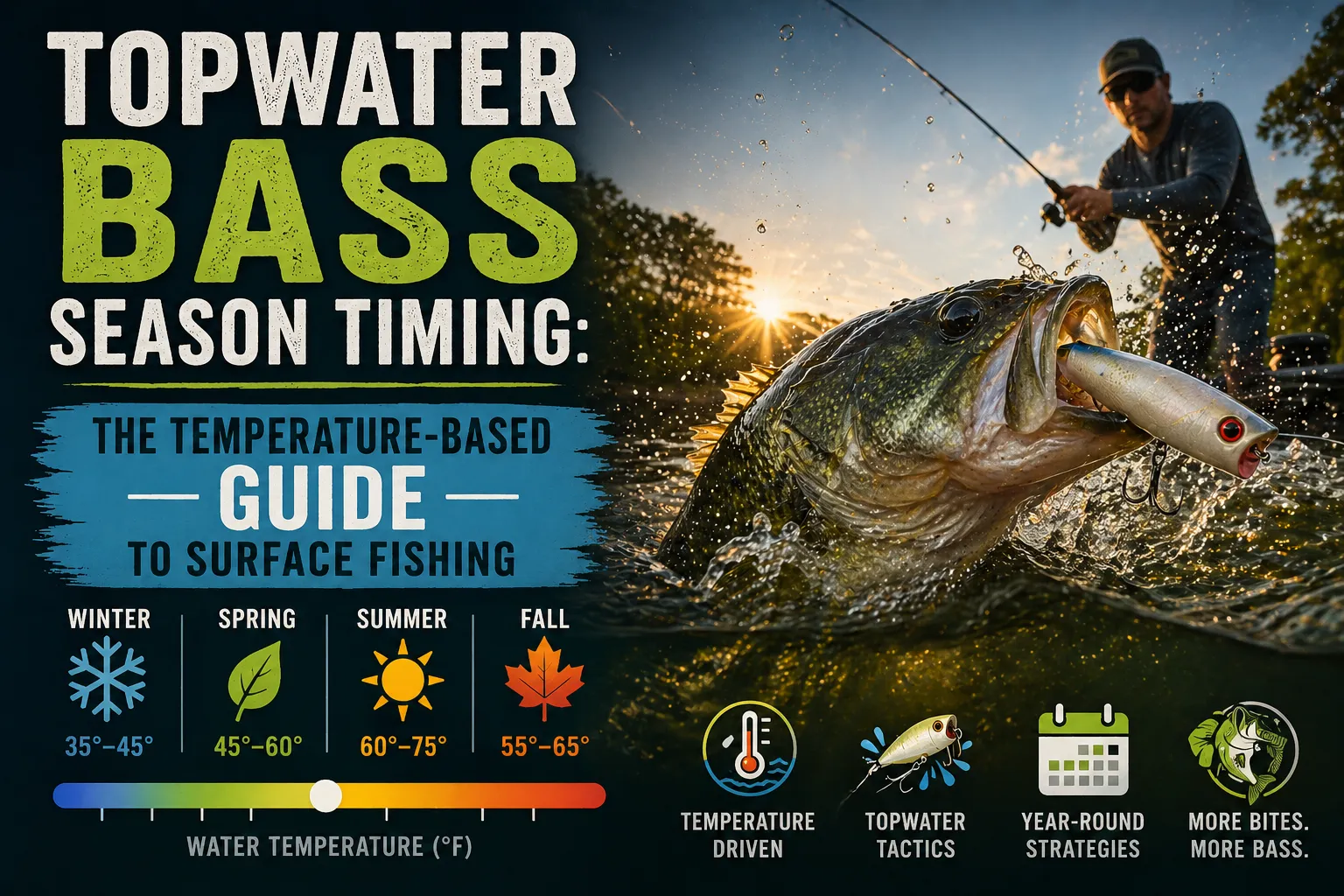
Written by Hudson Reed
There's no strike in freshwater fishing more addictive than a bass blowing up a topwater lure. But topwater bass season timing isn't random. It's tied directly to water temperature, which drives bass location, aggression, and willingness to chase something at the surface. Get the temperature windows right, match your lure to the conditions, and you can have explosive topwater action from late spring all the way through fall.
The Core Rule: Water Temperature Drives Everything
Bass are cold-blooded. Their metabolism, feeding aggression, and how high in the water column they sit are all controlled by water temperature. For topwater fishing specifically, the key thresholds are:
- Below 55°F: Topwater is possible but slow. Bass are lethargic and unlikely to chase a fast-moving surface bait. Focus on subsurface presentations instead.
- 55-62°F: The topwater bite is beginning. Bass are moving shallower and will hit surface baits in the right conditions: low light, shallow cover, calm mornings.
- 62-72°F: Prime early-season topwater. This is the sweet spot for post-spawn bass that are still shallow and aggressive.
- 72-85°F: Full topwater season. Bass are aggressive, shallow early and late, and will chase almost any surface presentation.
- Above 85°F: Topwater still works, especially early morning and late evening, but midday bass push deeper to find cooler water.
A $15 digital water thermometer is one of the highest-ROI tools you can add to your kit. Check it before you rig up. It tells you exactly which window you're fishing in.
Phase 1: Late Spring (May-Early June, 60-68°F)
This is when the topwater bass season timing window opens in most of the country. Post-spawn fish are shallow, territorial, and actively feeding. The water is cool enough that bass are comfortable sitting near the surface during daylight hours.
Best lures for this phase:
- Buzzbait: ideal for searching shallow flats and covering water fast. Retrieve at a steady pace just fast enough to keep the blade running. Dirty or stained water? A buzzbait's sound and surface disturbance is hard to beat.
- Walking bait (Zara Spook, Whopper Plopper) slow, deliberate walk-the-dog action on calm mornings. Start here when water is clear and bass are skittish.
- Popper: great for targeting bass near shallow cover. The compact profile gives bass an easy target in cooler water when they're not yet fully aggressive.
Fish the first two hours of daylight in this phase, that low-light window is when bass are most vulnerable to a surface bait while the water is still cool from overnight.
Phase 2: Early Summer (June-July, 68-78°F)
This is peak topwater season. Bass have recovered from the spawn, baitfish are everywhere, and the fish are feeding hard before summer heat pushes them deeper during midday. You can catch bass on topwater baits all morning in this phase, not just at first light.
You might also enjoy: Spring Crappie Fishing Tips: Ice-Out to Spawn
Best lures for this phase:
- Hollow-body frog: once surface vegetation fills in (lily pads, hydrilla mats, duckweed), a frog becomes the only realistic topwater option. Throw it over the thickest cover, walk it slowly, and get ready for violent blowups.
- Prop bait: the twin propellers add noise and flash that draw fish from a distance in rougher conditions or choppy water.
- Walking bait: still excellent over open water and around dock edges. Faster cadence than spring. Bass will chase in warmer water.
Track your productive early-summer spots in Bushwhack. Bass use the same topwater feeding flats and weed mats year after year once vegetation establishes.
Phase 3: Mid-Summer (July-August, 78-88°F)
Topwater fishing shifts to a dawn-and-dusk game as water temps peak. Midday topwater gets tough as bass move deeper or suspend under shade. But the morning and evening windows can be exceptional, often better than any other time of year if you hit it right.
During this phase, fish the first 90 minutes of daylight on glass-calm mornings. A walking bait worked slowly over an offshore point or submerged flat can produce giant bass. As soon as the sun clears the treeline and wind picks up, switch to subsurface presentations for the rest of the day.
Best lures for mid-summer:
- Frog over mats: peak frog season; bass stack under matted vegetation to ambush prey
- Walking bait (larger profile, 4-5 inch) big bait, big fish mentality on early-morning calm
- Buzzbait at last light: reliable evening producer along weed edges and channel banks
Phase 4: Fall (September-October, 65-75°F Falling)
As water temps drop back into the 60s and 70s, one of the most underrated topwater windows of the year opens up. Bass are aggressively feeding to prepare for winter, and baitfish schools are pushed shallow by cooling water and more aggressive predators. This is schooling bass season, and topwater is perfect for it.
You might also enjoy: How to Catch More Fish After a Bad Trip: Turn Slow Days Into Data
Watch for bass blowing up on baitfish schools near points, channel edges, and open water flats. A walking bait or buzzbait thrown into a school of breaking bass is about as exciting as fishing gets. Cover water quickly, follow the birds, and be ready to cast fast.
Best lures for fall:
- Shad-colored walking bait: match the threadfin or gizzard shad the bass are keying on
- Buzzbait in white or chartreuse: easy to track in choppy water as temperatures drop
- Popper: slower presentation for finicky fish as temps drop below 65°F
Conditions That Affect Topwater Success at Any Temperature
Water temperature sets the window, but conditions within that window determine your success:
- Low light: Dawn, dusk, and overcast days extend the topwater bite beyond early morning at any temperature
- Wind: Light ripple on the surface actually helps topwater. Bass can't see the lure clearly and are less likely to refuse it. Use louder baits (prop baits, buzzbaits) in chop.
- Calm water: Best for walking baits and subtle poppers, but bass can be spooked easily: longer casts, lighter line
- Pre-frontal weather: Falling barometric pressure before a storm triggers aggressive feeding. Some of the best topwater days happen right before a cold front rolls in.
Gear for Topwater Bass Fishing
Most topwater presentations call for a medium-heavy 7' casting rod with a moderate-fast action, enough backbone to drive hooks on a long cast, but enough flex to let the fish fully commit before loading up. Use 40-65 lb braid for hollow-body frogs (you need the power to pull fish through vegetation), and 14-17 lb monofilament or fluorocarbon for hard topwater baits where stretch and shock absorption help prevent pulled hooks. Log your tackle setups in Bushwhack so you know exactly what worked when conditions repeat.
Start Throwing Topwater Now
If the water on your lake is in the low 60s or above, there is absolutely no reason to leave your topwater box at home. The window opens earlier than most anglers think, and it closes later in fall than most realize. Match the phase to the temperature, pick the right lure for the conditions, and get a surface bait in the water. The strike will make it worth it every time.
Get fishing tips in your inbox
New guides, seasonal tactics, and gear picks — about once a month, no spam.