Summer Surf Fishing the East Coast: Stripers and Blues From the Beach in June
 Hudson Reed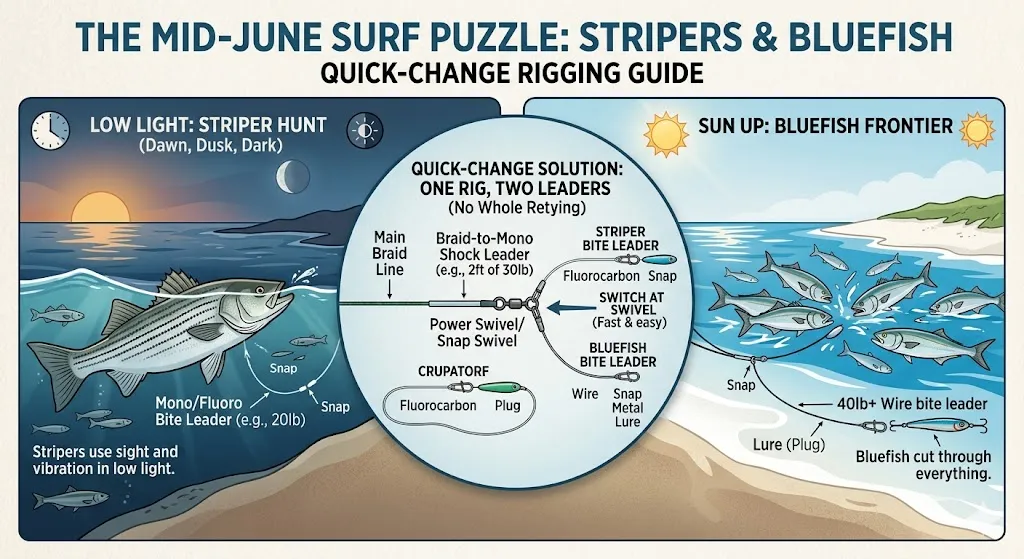
Written by Hudson Reed
By the second week of June, the spring striper blitz that lit up the Jersey coast and the south shore of Long Island in May is mostly done. The big migratory cows have either pushed past you toward Block Island and the Cape, or they have settled into a summer pattern that has almost nothing to do with the way they fed six weeks ago. That is the part most spring guides do not tell you, and it is why summer surf fishing the East Coast trips up so many anglers who crushed it just a few weeks earlier.
The new game is a two-fish puzzle. Stripers go nocturnal and deep. Bluefish move in and feed all day, in broad sun, often within easy casting distance. If you only know how to fish the spring playbook, you will stand on an empty beach at 10 a.m. wondering where everything went.
This is the guide for the next part of the season. Cape Cod down through the Outer Banks, mid-June through August, one rod and a tackle bag that handles both species.
Why the spring bite dies and the summer bite begins
Striped bass have a preferred temperature window of roughly 55 to 68 degrees, and they get visibly lethargic once water climbs past about 70. By mid-June, surf temperatures from New Jersey through Rhode Island are usually sitting in the high 60s to low 70s. The fish do not leave. They change schedules.
According to surf fishing guides at On The Water and the Farmers' Almanac, after about June 15 in most Northeast waters, larger stripers feed primarily in low light and at night, and tuck into deeper, cooler structure during the day. Smaller schoolies will still chase plugs in the wash at midday, especially on overcast days, but the 30-pound class fish you are dreaming about is sleeping somewhere outside your reach until the sun goes down.
Bluefish run the opposite schedule, and they're the fish that finds the weak link in a bargain outfit, which is where a purpose-built setup from our best surf fishing rod and reel combos roundup earns its keep. The Atlantic bluefish migration peaks along the mid-Atlantic and Northeast beaches between late May and early July, with fish staying through October in most years. They are warm-water aggressive. They feed in bright sun, where a pair from our best polarized fishing sunglasses under $50 roundup makes spotting the blitz a lot easier. They blitz peanut bunker and silversides in the trough behind the first bar at noon while the stripers are napping.
Frame the day around that and you stop trying to force one species to behave like the other.
The dawn and dusk striper window
Your striper hours in June are roughly the last hour before sunrise through the first hour after, and the last hour before sunset through full dark. If you can fish overnight, do it. The 1 a.m. to 4 a.m. window on a moving tide is when the biggest fish of the year get caught from shore.
Tide matters more than time of day if you have to pick. The pattern most Northeast surfcasters live by:
- Two hours before high tide through slack high, on an incoming current, fishing a sandbar cut or jetty corner where bait gets pinned
- The first two hours of the outgoing, when bait gets flushed off a flat and stripers stack at the drop-off to ambush
If dawn or dusk lines up with either of those tide windows, that is your shot. If it does not, fish the tide and skip the clock.
For lures, the summer night surf belongs to dark colors. Black, purple, and bone-colored swimming plugs in the 5 to 7 inch range. Soft plastic shads on a half-ounce jig head. Live or rigged eels if you have access to them, which is still the single most productive nighttime bait for big stripers from Montauk to the Cape. Skip the bright chartreuse and pink stuff that worked in May. At night, the fish are silhouetting your lure against whatever ambient light comes off the sky, and a dark profile reads cleaner.
You might also enjoy: Best Kids Fishing Rod and Reel Combo for 2026: Dock Demon vs Ugly Stik GX2 vs PLUSINNO
Slow your retrieve down. Like, slower than you think. A swimming plug worked at a crawl, where you can just feel the lip wobble, will outfish the same plug ripped through the wash four to one after dark.
What about daytime? That is the bluefish shift
Once the sun is up and the striper bite shuts off, do not pack up. Restring.
Bluefish in the 3 to 8 pound class (the size most surf guys call "choppers") feed hard on bright summer days, especially when there is a steady onshore wind pushing bait into the beach. Watch for diving terns. Watch for the slick on the water that says something is being chopped up below. When you see it, you have maybe fifteen minutes before the school moves, so you want a rig that is already tied and ready in your bag.
The basic bluefish wire-leader rig
Bluefish teeth will shear 30-pound mono in one head-shake, which is why every surf bag from Sandy Hook to Nags Head has a few pre-tied wire leaders in it. Keep it simple:
- Cut a 6 to 10 inch length of nylon-coated stainless steel wire in roughly 40 to 50 pound test. Anything longer than a foot becomes a pain to cast and tangles.
- Crimp a small barrel swivel to one end and a 5/0 to 8/0 inline circle hook (for bait) or a coastlock snap (for lures) to the other. Crimp sleeves are faster and stronger than knots in coated wire.
- Tie your main line (30 to 50 pound braid with about a rod-length of 40 pound mono shock leader) to the swivel side.
That is the whole rig. For bait, a chunk of fresh bunker on the circle hook with a 3 to 5 ounce pyramid sinker on a fish-finder slide above the swivel will catch blues all day. For lures, clip a metal (Hopkins, Kastmaster, Deadly Dick) to the snap and rip it back fast. Blues love speed. The faster you can crank, the more bites you get.
Why finger mullet beats a whole bunker for blues
Here is a take you will not see in most beginner articles: stop using huge baits for bluefish. A whole bunker is striper bait. Blues do not eat, they chop, and they will scissor a 10-inch bunker in half and miss your hook every time. A 4-inch finger mullet or a fist-sized chunk of fresh bunker fits in their mouth and hooks them.
If you can find live finger mullet at a bait shop in late June or July, get them. Float-rigged finger mullet behind a bobber on a wire leader is hands-down the most fun way to catch summer blues from the beach.
One rod that handles the whole summer surf fishing day
You can absolutely run a two-rod spread (one in a sand spike with bait, one in your hand throwing lures), and most serious surfcasters do. But if you are starting out, one well-chosen rod handles the whole summer.
The setup that covers both species without compromise:
- Rod: 9 to 10 foot medium-heavy spinning rod, rated for 2 to 5 ounces of lure weight. Long enough to keep your line above the first wave; not so long you cannot whip it around when a blue blitz erupts to your left.
- Reel: 5000 to 6000 size saltwater spinning reel with a sealed drag. Penn Battle, Shimano Saragosa, Daiwa BG. Anything in that class.
- Line: 30 pound braid as your main line. 40 pound mono or fluoro shock leader, about a rod-length, connected with an FG knot.
- Terminal: Pyramid sinkers from 3 to 6 ounces. Pre-tied wire leaders for blues. Plain 40 pound mono leaders for stripers. No wire for the bass; they see it and will not eat.
That setup will throw a 2 ounce swimming plug at 4 a.m. for a 30-pound striper and an hour later launch a chunk bait for a 7-pound bluefish. It is not specialized. It is versatile, which in the summer surf is more useful.
You might also enjoy: Best Braided Fishing Line for Bass and Inshore 2026: Power Pro vs Sufix 832 vs Daiwa J-Braid
How do you tell which fish is on before you see it?
Bluefish hit like they are mad at the lure. Sharp, slashing strike, often two or three hits in a row before they get the hook. The fight is a series of fast runs and head-shakes near the surface.
Stripers thump. One solid pull that loads the rod, then a heavy, head-down run that feels like you snagged a tire. They rarely jump. They rarely shake.
If you are not sure which one you have on, look at your leader before you land it. Frayed and chewed up means blue. Clean means striper. After about three trips, you will know from the first hit.
What tides should I fish for stripers and bluefish in June?
Stripers: incoming tide, last two hours into slack high, especially overlapping dawn or dusk. The new moon and full moon weeks pull the strongest currents and produce the best night bites of the month.
Bluefish: less picky. They will feed through any moving water but tend to crash bait hardest on the start of an outgoing tide on sunny mid-morning to early afternoon, when bait gets flushed off the flats. If you only have one tide cycle, fish a midday outgoing on a sunny day with onshore wind and you will find blues.
The Atlantic States Marine Fisheries Commission notes that striped bass spawning runs in the Chesapeake and Hudson wrap up by early June, after which most of those fish disperse north to feed. That is the official version of what you will see on your local beach: by mid-June, the bigger fish are spread out and moody, and the bluefish are everywhere.
One more thing: regulations are moving targets right now
Striped bass regulations have been tightened across the entire coast every year since 2023, with a 28 to 31 inch slot in most states and a one-fish-per-day limit. Check your specific state. Massachusetts, Rhode Island, New York, New Jersey, Delaware, Maryland, Virginia, and North Carolina all post current rules on their state fish and wildlife sites, and they change. The fish you could keep last summer might be a release this summer.
Bluefish currently sit at a three-fish limit in most Atlantic states with no minimum size, though that has also been adjusted recently. Knowing your numbers before you fish saves you a citation and a bad day.
If you log your trips (water temp, tide stage, time of day, what worked), patterns show up faster than you would think. Two summers of decent notes will tell you more about your local beach than ten years of guesswork. Try Bushwhack if you want a clean way to track that across a season.
Now go fish a tide that overlaps dark.
Get fishing tips in your inbox
New guides, seasonal tactics, and gear picks — about once a month, no spam.