Summer Bass Fishing: How to Follow the Fish as They Go Deep in June and July
 Hudson Reed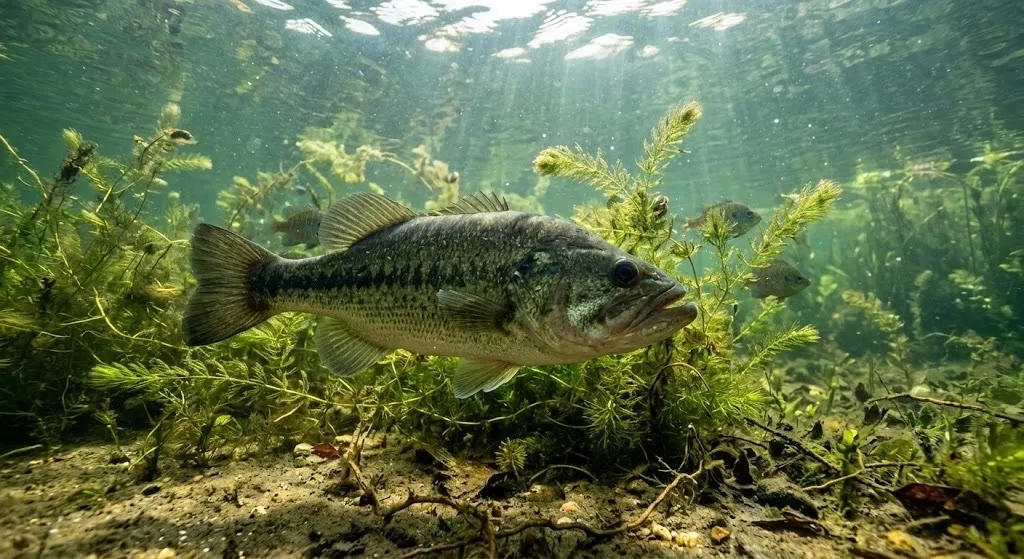
Written by Hudson Reed
Every summer, the same thing happens. The bite that was red-hot in May suddenly goes cold. Topwater explosions on the bank produce nothing. Shallows that held bass through the spawn are empty. Anglers pack up early and blame the heat. But here is what is actually happening: summer bass fishing has not died. The fish have just moved. In June and July, bass follow the oxygen and the baitfish, and both of those things go deep.
If you want to keep catching fish through the hottest months of the year, you need to understand why bass go deep, where they go, and how to put a bait in front of them once they are there. I have fished these patterns for years, and once it clicks, summer becomes one of the most consistent seasons on the water.
Why Do Bass Go Deep in Summer?
Bass go deep in summer because warm water holds less dissolved oxygen, and bass cannot stay where they cannot breathe comfortably. As surface temperatures push into the upper 70s and low 80s, the shallow water that held fish all spring becomes hostile territory. Bass are not hiding from you. They are doing what every living thing does in extreme heat: seeking relief.
The science behind this is called thermal stratification. By late June in most lakes, the water column has divided into three distinct layers. The epilimnion (the warm surface layer) heats up and loses oxygen. The hypolimnion (the deep cold layer) has near-dead, oxygen-poor water. Sandwiched between them is the thermocline: a narrow band of rapidly dropping temperature that concentrates both dissolved oxygen and baitfish. That is where your bass are.
Bass metabolism actually increases in warmer water, so they need to eat more to sustain themselves. But they need oxygen to process that food. The thermocline gives them both: cool enough water to stay oxygenated, warm enough to keep their metabolism firing. It is the sweet spot, and once you find it, you find the fish.
How Deep Is the Thermocline, and How Do You Find It?
In murky or stained lakes, the thermocline can set up as shallow as 6 to 10 feet. In clear highland reservoirs, it may settle at 25 to 30 feet by mid-July. The depth varies by water clarity, lake size, and how much direct sunlight the surface receives. On most midwestern and southern impoundments, expect the thermocline to sit somewhere between 12 and 22 feet through June and July.
The fastest way to find it is on your fish finder. Turn up the sensitivity and look for a faint, fuzzy horizontal band on your screen. That is the thermocline showing up as a density change in the water. Baitfish marks just above that band are the confirmation you want. If you see shad suspended at 18 feet over 40 feet of water, the thermocline is right there at 18 feet, and bass will not be far behind.
No fish finder? You can run a water temperature check with a simple thermometer on a weighted line. Drop it 2 feet at a time and note where the temperature drops sharply. That is your thermocline. It is slower, but it works. Better yet, track your thermocline depth readings over multiple trips so you start to learn how your home lake behaves as summer progresses.
You might also enjoy: Spring Crappie Fishing Tips: Ice-Out to Spawn
Where Exactly Are Summer Bass Sitting?
Bass do not just suspend randomly at thermocline depth. They still relate to structure. The thermocline tells you the depth band; structure tells you the spot within that band. In early summer (June), I look for main lake points with access to deep water: long tapering points that run from the bank and drop into the 15 to 25 foot range. These are transition highways. Bass use them to slide between the shallows at night and deeper water during the day.
By mid-July, I am spending more time on what tournament anglers call offshore structure, spots that have no connection to the bank at all:
- Underwater humps: Rises in the lake floor that top out 5 to 10 feet below the surface. In clear lakes, these are magnets for bass schools.
- Creek channel ledges: The old creek bed before the reservoir was flooded. Bass stack on the edge of the channel drop where hard bottom meets soft.
- Submerged road beds and bridge abutments: Old construction creates sharp bottom transitions that hold fish year after year.
- Rock piles and chunk rock transitions: Any change in substrate, especially gravel to rock, creates ambush zones for bass chasing crawfish.
Finding these spots on a reservoir you have not mapped takes homework. Study your lake map before you go. Contour lines packed close together mean a steep drop. That is a ledge. An isolated circle of contour lines in open water is an underwater hump. Mark your waypoints, then log your catch data to figure out which spots hold fish consistently versus which ones are one-time flukes.
Thermocline vs. Shallow Cover: Which Should You Fish?
| Condition | Fish Deep Structure | Fish Shallow/Cover |
|---|---|---|
| Surface temp above 80 degrees F by 9 a.m. | Yes, fish locked deep by mid-morning | Only at first light |
| Stained or murky water | Yes, thermocline shallower (8 to 12 ft) | Better option than clear water |
| Clear water reservoir | Strong yes, fish suspend 20 to 30 ft | Only post-sunset |
| Wind blowing into a point | Yes, check the point itself at depth | Secondary option |
| Overcast all day | Good option | Worth checking; fish may roam shallower |
| Dense aquatic vegetation (hydrilla, milfoil) | Secondary | Yes, healthy grass generates oxygen, holds fish |
Thick aquatic vegetation like hydrilla creates its own micro-oxygen environment through photosynthesis. Bass can stay surprisingly shallow on lakes with healthy grass beds even in July. But on most open-water reservoirs without significant vegetation, deep structure is where you need to be by 10 a.m.
Which Rigs Work Best for Deep Summer Bass?
The three workhorses of deep summer bass fishing are the football jig, the Carolina rig, and the drop shot. Each has its moment, and I rotate through all three depending on bottom composition and how active the fish seem to be.
Football Jig: First Choice on Hard Bottom
A 3/4-ounce football head jig with a crawfish trailer is the single most effective bait I have thrown on rocky ledges and chunk rock points in summer. The wide football head rocks as you drag it, mimicking a crawfish. Cast past your target, let it fall on a semi-slack line, and drag it back slowly with 3 to 4 foot pulls followed by a pause. Most bites happen on that pause. Use a 7-foot 4-inch heavy rod, a 7.1:1 reel, and 15 lb fluorocarbon. The fast reel helps pick up slack quickly when a fish moves toward the boat.
Carolina Rig: Best for Covering New Structure
When I am on unfamiliar water and need to cover ground efficiently, I throw a Carolina rig. A 3/4 to 1-ounce weight on 17 lb fluorocarbon main line, a barrel swivel, and 18 to 24 inches of 12 lb leader to a soft plastic, usually a 6-inch lizard, creature bait, or floating worm. Cast long, let it settle, and drag slowly back. The C-rig covers water efficiently and the floating bait rides above the bottom, staying visible to fish. It is a great search tool before you commit to a vertical presentation.
Drop Shot: When Fish Are Finicky
On heavily pressured lakes or when bass are clearly showing on your screen but will not commit, the drop shot closes deals. Keep the weight on the bottom, hold your line nearly vertical, and give the worm subtle 1 to 2 inch twitches in place. You are parking a bait right in front of a fish at exactly the right depth with no commitment required. Use a 4 to 6 inch finesse worm in green pumpkin or watermelon red on 6 to 10 lb fluorocarbon with a medium-weight spinning rod.
You might also enjoy: Euro Nymphing vs. Indicator Nymphing: Which to Learn First?
Deep-Diving Crankbait: Best for Active Schools
When I mark a school actively feeding on a ledge, I reach for a deep diver that hits 15 to 20 feet. Make the longest cast you can (60 feet or more) with a 7-foot 6-inch rod to maximize dive depth, reel it down hard to get it into the zone fast, then slow your retrieve once it is ticking bottom. When it deflects off a rock, that deflection is the trigger. This is the fastest way to pick apart a school of feeding fish before they settle back down.
What Time of Day Should You Fish for Deep Summer Bass?
Summer rewards the early and the patient. The best window is 5:30 to 8:30 a.m., when overnight-cooled shallows still hold some fish and bass that went shallow to feed at night are sliding back out to deeper structure. You can intercept them on those main lake points on the way out to open water.
From 10 a.m. to 5 p.m. in July, bass are largely locked on offshore structure. This is not a bad time to fish. It is a focused time. You are working specific spots, not covering water. Slow down, commit to each piece of structure, and give it time. I will spend 20 to 30 minutes on a hump that shows promise on my graph even if I have not had a bite in the first 10 minutes.
Late evening from 6 p.m. until dark, bass push shallower again. Work main lake points with a swimbait or large soft plastic as fish transition back toward the shallows for their evening feed. Log your catches by time of day over a few trips and you will start to see patterns specific to your lake that are more reliable than any general guide.
How Do You Know When It Is Time to Go Deep?
The triggering range on most lakes is a consistent surface temperature of 75 to 78 degrees Fahrenheit. Not just a hot afternoon reading. When you are checking your surface temp at 7 a.m. and it is already at 76 degrees, the transition is on. Once morning surface temps hit 82 to 85 degrees through June and July, the shallow bite is essentially over for most of the day.
The other tell is simpler: if you are throwing proven spring baits in proven spring spots and getting nothing, do not keep doing the same thing. Check your surface temp, pull up your lake map, and start looking 10 to 15 feet deeper than where you have been fishing. The fish are there. They are just not where you left them.
Summer bass fishing is not harder than spring fishing. It is just more specific. You are fishing a smaller slice of the water column in a smaller number of spots. But when you are on those spots at the right time with the right presentation, summer can produce some of the most consistent fishing of the year. Track your patterns, learn your lake, and trust that the fish are catchable. You just have to be willing to follow them where they go.
Get fishing tips in your inbox
New guides, seasonal tactics, and gear picks — about once a month, no spam.